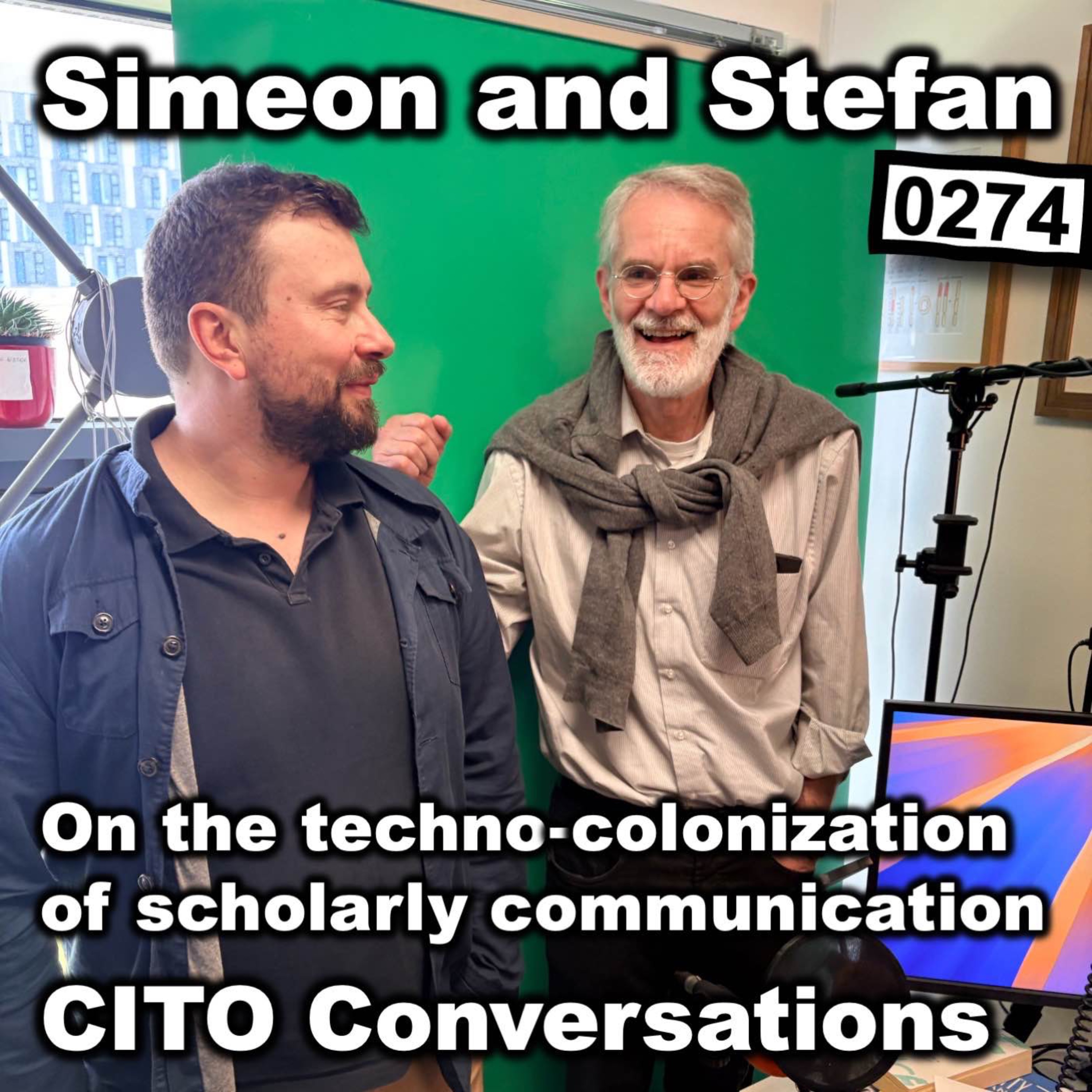
0274 - Techno-colonization with Simeon Vidolov and Stefan Klein episode artwork

EPISODE · May 14, 2026 · 1H 28M

0274 - Techno-colonization with Simeon Vidolov and Stefan Klein

from Design Talk (dot IE)

Professor Stefan Klein and Dr. Simeon Vidolov present their paper, "Techno-colonization of scholarly communication: A call to reclaim control". This paper contributes to wider research into how extractive publishing systems have colonized scholarly communication to gain not only infrastructural control but increasingly epistemic control as well. For far too long, big publishing companies have trapped academics in a vicious circle of parasitic business models employing monopolistic pricing and arbitrary gate-keeping where researchers provide the labour, only for corporate giants to end up owning the published element of scientific intellectual property (often publicly funded) and consequently, control the visibility of research outputs. These companies have moved beyond publishing; they are now providers of critical, AI and data-analytics enabled research infrastructures. They are reshaping scientific knowledge production, academic values and increasingly claim epistemic authority.That such a system can be used to publish research so critical of its inherent structure is both ironic and potentially positive. The authors call for each of us to reject the role of passive participant in our own exploitation. They conclude by calling for us to devise ways to dismantle these corporate infrastructures and reclaim the autonomy of the scientific community. Whether you are a student, a researcher, or a faculty member, join us to discuss how we can build a future for academia that prioritises collective knowledge over commercial surveillance.The underlying paper(s) are both Open Access, links below:·       Vidolov, S., & Klein, S. (2026). Techno-colonization of scholarly communication: A call to reclaim control. Organization, Article 13505084261416192. https://doi.org/10.1177/13505084261416192·       Ngwenyama, O., Klein, S., & Rowe, F. (2026). Platform Capture of Scientific Knowledge Production: Publishers’ Dominance, Generative AI and Subsumption of Academic Labor. European Journal of Information Systems (EJIS). https://doi.org/10.1080/0960085X.2026.2642660 BiographiesSimeon Vidolov is a Faculty Member in the J.E. Cairnes School of Business at the University of Galway. His research examines how digital technologies transform ways of working and organizing, with a focus on embodied and affective experiences. His work challenges dominant narratives of technological progress and interrogates the harmful and often normalized consequences of contemporary digital infrastructures for individuals, organizations, and society.Stefan Klein is Professor emeritus for Interorganizational Systems at the School of Business and Economics, University of Münster, Germany. His main research areas are information infrastructures, the transformation of work, risks of digitalization, and digital capitalism. He studies practices of technology use and organizational transformation from an individual to an industry level.The event was held on 6 May 2026 in University College Dublin, Ireland.AcknowledgementsMusic Title: StoryArtist: MeydänSource: https://bit.ly/2P5CSCv​License: CC BYCover Art Title: Smurfit-ZartisArtist: Photo credit: Allen Higgins. Used with permission.Source: SimeonStefan-seminar.pptxLicense: CC BY-NC-SA 4.0Podcast LicenseDesign Talk (dot IE) CC BY-NC-SA 4.0 The license can be viewed at https://creativecommons.org/licenses/by-nc-sa/4.0By taking part, you give permission for your voice to be recorded, for the recording to be edited, and for it to be posted and published as a podcast. Hosted on Acast. See acast.com/privacy for more information.

Professor Stefan Klein and Dr. Simeon Vidolov present their paper, "Techno-colonization of scholarly communication: A call to reclaim control". This paper contributes to wider research into how extractive publishing systems have colonized scholarly communication to gain not only infrastructural control but increasingly epistemic control as well. For far too long, big publishing companies have trapped academics in a vicious circle of parasitic business models employing monopolistic pricing and arbitrary gate-keeping where researchers provide the labour, only for corporate giants to end up owning the published element of scientific intellectual property (often publicly funded) and consequently, control the visibility of research outputs. These companies have moved beyond publishing; they are now providers of critical, AI and data-analytics enabled research infrastructures. They are reshaping scientific knowledge production, academic values and increasingly claim epistemic authority.That such a system can be used to publish research so critical of its inherent structure is both ironic and potentially positive. The authors call for each of us to reject the role of passive participant in our own exploitation. They conclude by calling for us to devise ways to dismantle these corporate infrastructures and reclaim the autonomy of the scientific community. Whether you are a student, a researcher, or a faculty member, join us to discuss how we can build a future for academia that prioritises collective knowledge over commercial surveillance.The underlying paper(s) are both Open Access, links below:·       Vidolov, S., & Klein, S. (2026). Techno-colonization of scholarly communication: A call to reclaim control. Organization, Article 13505084261416192. https://doi.org/10.1177/13505084261416192·       Ngwenyama, O., Klein, S., & Rowe, F. (2026). Platform Capture of Scientific Knowledge Production: Publishers’ Dominance, Generative AI and Subsumption of Academic Labor. European Journal of Information Systems (EJIS). https://doi.org/10.1080/0960085X.2026.2642660 BiographiesSimeon Vidolov is a Faculty Member in the J.E. Cairnes School of Business at the University of Galway. His research examines how digital technologies transform ways of working and organizing, with a focus on embodied and affective experiences. His work challenges dominant narratives of technological progress and interrogates the harmful and often normalized consequences of contemporary digital infrastructures for individuals, organizations, and society.Stefan Klein is Professor emeritus for Interorganizational Systems at the School of Business and Economics, University of Münster, Germany. His main research areas are information infrastructures, the transformation of work, risks of digitalization, and digital capitalism. He studies practices of technology use and organizational transformation from an individual to an industry level.The event was held on 6 May 2026 in University College Dublin, Ireland.AcknowledgementsMusic Title: StoryArtist: MeydänSource: https://bit.ly/2P5CSCv​License: CC BYCover Art Title: Smurfit-ZartisArtist: Photo credit: Allen Higgins. Used with permission.Source: SimeonStefan-seminar.pptxLicense: CC BY-NC-SA 4.0Podcast LicenseDesign Talk (dot IE) CC BY-NC-SA 4.0 The license can be viewed at https://creativecommons.org/licenses/by-nc-sa/4.0By taking part, you give permission for your voice to be recorded, for the recording to be edited, and for it to be posted and published as a podcast. Hosted on Acast. See acast.com/privacy for more information.

NOW PLAYING

0274 - Techno-colonization with Simeon Vidolov and Stefan Klein

0:00 1:28:35

No transcript for this episode yet

We transcribe on demand. Request one and we'll notify you when it's ready — usually under 10 minutes.

Humanizing Change Tremendousness Join us each episode as we talk with innovators in their respective fields about their unique journeys and how they humanize change in their own work, right here, on Humanizing Change. AI Erik's Podcast Audio Erik Conn The AI News Podcast where we talk AI. NEWMORROW SESSIONS - A PodCast Series on the Future of Hospitality Mario C. Bauer, Florian Schneider, Axel Weber & Dr. Tillman Bardt The Newmorrow PodCast is more than a podcast — it's a platform for open dialog on the future of our business, a platform for those building what doesn’t exist yet. Here, we share and embrace our passion for the hospitality industry, but we won’t romanticize the journey. We ask the tough questions, confront uncomfortable truths, and prepare for a future that resists easy answers. We believe that the tougher and wilder times become, the more openly, honestly and humanely people need to talk to each other and act together. We believe, openness, togetherness, and truthfulness should also be cornerstones of a professional community to develop our utopian idea of „open source“. This is a space where visionaries don’t just imagine the future — they wrestle with the paradoxes that shape it: success vs. happiness, data vs. instinct, stability vs. reinvention. Join leaders, entrepreneurs, and thinkers as they share not what made them — but what’s actively shaping them, now and next. So tune in Canine Fitness Fanatics Podcast Hannah Johnson Do you think your dog might benefit from a little extra fitness? Maybe you want to tighten those left turns in agility or tighten their box turn in flyball? Or maybe they are a bit clumsy and just need a little more body awareness? Welcome to the Canine Fitness Fanatics podcast! With your host Hannah Johnson join us as we talk dog fitness and other areas of canine health too! Our mission is to help condition dogs to reduce the risk of injury and increase longevity, whether that’s in sporting dogs, working dogs or pet dogs. All dogs can benefit from a little extra fitness!

Frequently Asked Questions

How long is this episode of Design Talk (dot IE)?

This episode is 1 hour and 28 minutes long.

When was this Design Talk (dot IE) episode published?

This episode was published on May 14, 2026.

What is this episode about?

Professor Stefan Klein and Dr. Simeon Vidolov present their paper, "Techno-colonization of scholarly communication: A call to reclaim control". This paper contributes to wider research into how extractive publishing systems have colonized scholarly...

Can I download this Design Talk (dot IE) episode?

Yes, you can download this episode by clicking the download button on the episode player, or subscribe to the podcast in your preferred podcast app for automatic downloads.
URL copied to clipboard!