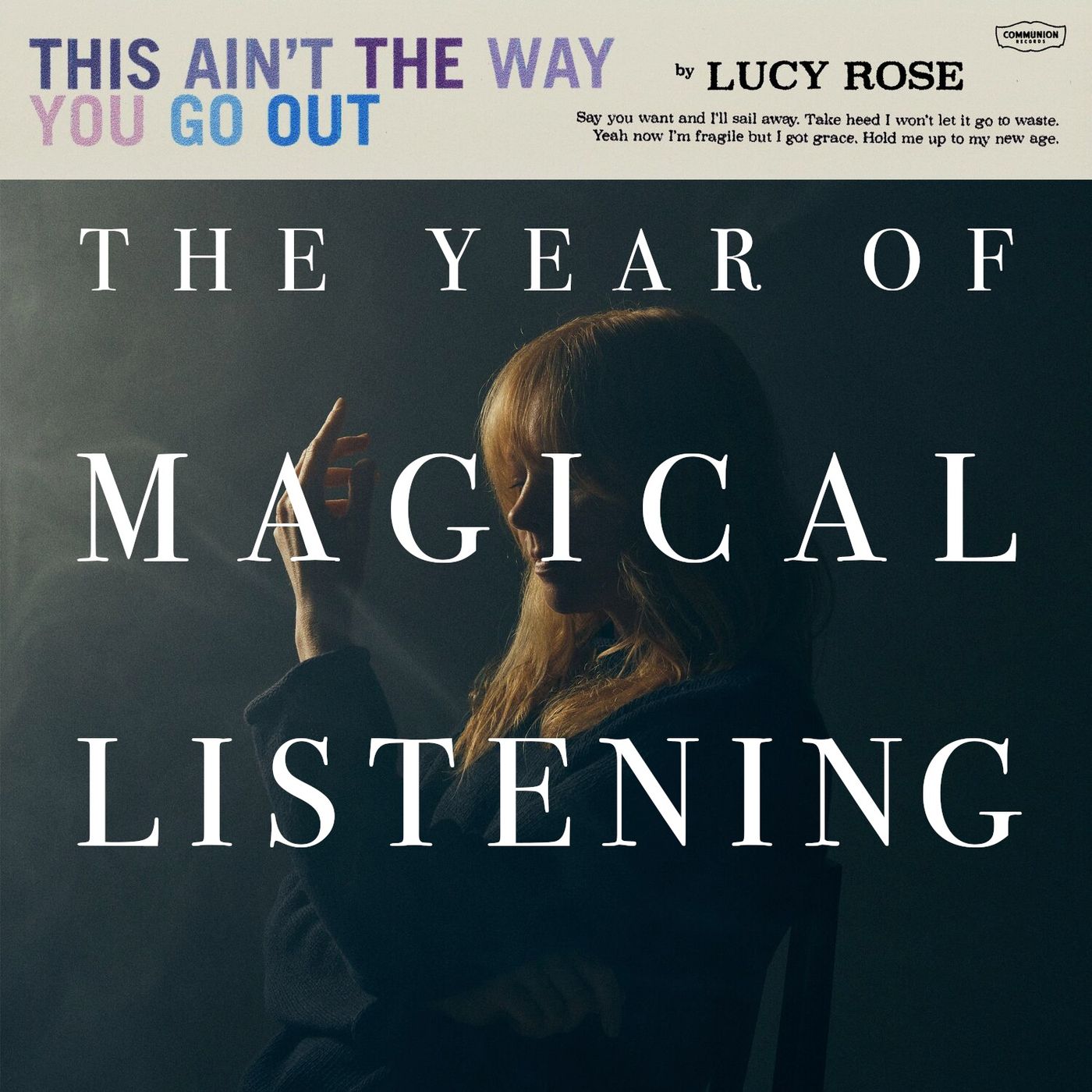
032 ::  RACKET episode artwork

EPISODE · May 31, 2024 · 10 MIN

032 :: RACKET

from The Year of Magical Listening · host Willie Costello

FEATURING This Ain't The Way You Go Out by Lucy Rose, released by Communion Records in 2024. Listen / Buy direct  "Light As Grass""Could You Help Me""The Racket"TRANSCRIPT I thought I had heard everything the piano could do. And then I heard this. What a way to announce yourself. It's a deceptively simple accompaniment, keeping time like a metronome and moving between just a few chords. But underneath it's playing wildly with rhythm, shifting between measures of 5, then 4, then 4 again, then 3 – quietly destabilizing us, but all the while still sounding like a pop song. And then the whole song opens up into billowy synth pads and ascending arpeggios and a new, dilated half-time feel, as if everything we'd heard before has evaporated and we're now floating on top of it. And then, just as quickly, we snap back down to earth, and fall back into the stumbling staccato of the verse. And in fact, this back and forth is what the song's about: the experience of shifting between two different modes of moving through life – on the one hand, the struggle of mundane existence, with all its discomfort, doubt, and pain; and on the other, this ethereal vision of a different way of being, without worry or care – though not necessarily a better way of being, for it only achieves its lightness by, as the singer says, "quietly hiding from reality".  But as the singer continues, "There's a greatness in our view." Neither vision tells the whole story or offers a full perspective on life. Rather, the truth lies in holding these two different visions together, side by side, as only our minds, or this song itself, can do. But let's not stop there. Let's jump into another song, another feeling, and yet another inventive riff – this jaunty, popcorning, syncopated duet between the keys and the drums. It's not revolutionary, but man, does it ever groove. And then, yet another left turn into the chorus, which reverberates with new sounds of open chords and spectral harmonies. And then, the song starts to tear itself apart, disintegrating into a heap of distortion and halting rhythms.  It's all so perfect for a song that's about the incommunicability of one's own pain. It's like the music itself is reaching out for a new language, to express something that mere words cannot. And maybe music can't really express it either; maybe nothing is sufficient to "ever really feel it for you". But music like this is at least enough to make anyone take notice and listen up. So let's do one more. The piano part is now an inversion of the previous two songs, rhythmically simple but harmonically dense, counting out the downbeats with a jazzy chromatic figure. The rhythm section fills things out with a punchy backbeat on the drums and a funky melodic counterpoint on the bass. And as things go on, the sounds get fuzzier, more raucous and resonant, a euphonious cacophony of instruments and effects blending into one. And that brings us to the song's central metaphor: "Cause I'm still picking up the racket / And I hit the ball". Except the song's central metaphor is not actually a metaphor. The singer is quite literally describing their own process of physical therapy after a debilitating illness, which turned the simple act of tennis into a momentous achievement. But of course, nothing in a song can not be a metaphor. And so the racket becomes a symbol of the singer's resilience, a sign of hope in trying times. And at the same time, the "racket" also conjures up the din and clatter of life, the chaos and unpredictability that we must stand resilient against. And that casts the song's own rackety quality in a new light, and gives deeper meaning to the anarchy of its arrangement, with all its glitchiness and overdrive and rhythmical hiccups. The artist is making a racket, if only to express the turmoil that they've been through, and to show us that they can pick up this racket, too, make it their own, and hit that ball.

FEATURING This Ain't The Way You Go Out by Lucy Rose, released by Communion Records in 2024. Listen / Buy direct  "Light As Grass""Could You Help Me""The Racket"TRANSCRIPT I thought I had heard everything the piano could do. And then I heard this. What a way to announce yourself. It's a deceptively simple accompaniment, keeping time like a metronome and moving between just a few chords. But underneath it's playing wildly with rhythm, shifting between measures of 5, then 4, then 4 again, then 3 – quietly destabilizing us, but all the while still sounding like a pop song. And then the whole song opens up into billowy synth pads and ascending arpeggios and a new, dilated half-time feel, as if everything we'd heard before has evaporated and we're now floating on top of it. And then, just as quickly, we snap back down to earth, and fall back into the stumbling staccato of the verse. And in fact, this back and forth is what the song's about: the experience of shifting between two different modes of moving through life – on the one hand, the struggle of mundane existence, with all its discomfort, doubt, and pain; and on the other, this ethereal vision of a different way of being, without worry or care – though not necessarily a better way of being, for it only achieves its lightness by, as the singer says, "quietly hiding from reality".  But as the singer continues, "There's a greatness in our view." Neither vision tells the whole story or offers a full perspective on life. Rather, the truth lies in holding these two different visions together, side by side, as only our minds, or this song itself, can do. But let's not stop there. Let's jump into another song, another feeling, and yet another inventive riff – this jaunty, popcorning, syncopated duet between the keys and the drums. It's not revolutionary, but man, does it ever groove. And then, yet another left turn into the chorus, which reverberates with new sounds of open chords and spectral harmonies. And then, the song starts to tear itself apart, disintegrating into a heap of distortion and halting rhythms.  It's all so perfect for a song that's about the incommunicability of one's own pain. It's like the music itself is reaching out for a new language, to express something that mere words cannot. And maybe music can't really express it either; maybe nothing is sufficient to "ever really feel it for you". But music like this is at least enough to make anyone take notice and listen up. So let's do one more. The piano part is now an inversion of the previous two songs, rhythmically simple but harmonically dense, counting out the downbeats with a jazzy chromatic figure. The rhythm section fills things out with a punchy backbeat on the drums and a funky melodic counterpoint on the bass. And as things go on, the sounds get fuzzier, more raucous and resonant, a euphonious cacophony of instruments and effects blending into one. And that brings us to the song's central metaphor: "Cause I'm still picking up the racket / And I hit the ball". Except the song's central metaphor is not actually a metaphor. The singer is quite literally describing their own process of physical therapy after a debilitating illness, which turned the simple act of tennis into a momentous...

NOW PLAYING

032 :: RACKET

0:00 10:26

No transcript for this episode yet

We transcribe on demand. Request one and we'll notify you when it's ready — usually under 10 minutes.

Big Old Life: Heather Blackbird interviews people on planet earth. Heather Blackbird loves asking questions. This podcast is a learning experience. Join me, Heather Blackbird, as I talk to people about their lives. Frequency of new episodes is a little all over the place and I'm learning as I go. Big Old Life is a small way of talking about the vastness of life, one person at a time. If you are reading this or found this podcast it's probably because someone you know gave you a link to it. :) Explicit Tales Of A Superstar DJ The Insomniac Spun seemingly out of nowhere from her complacent life in the corporate world, turned seemingly overnight from 16-Hour shift work and into the life of a literally starving artist and working musician, The Protagonist navigates her supposed rise to fame and superstardom on a journey through spiritual awakening, coming-of-age, and intimate self-realization--guided by an omnipresent force and equipped with the power of love, magic, and music. {Enter The Multiverse.} [The Festival Project] The Festival Project, Inc.™ is a multidimensional multimedia platform which encompasses exploratory and artistic social personifications and expressions on cosmic theory, spirituality, growth, health & wellness, philosophy and theoretic dynamics in entertainment such as music, design, film, television, radio, dance and festival culture, art, fashion, literature, and science. The Festival Project™ and its subsidiary Non-Profit, The Collective Complex © aims to challenge modern artistic and philosop Explicit Bitcoin Is Dead Trey Carson Welcome to Bitcoin is Dead, the ultimate Bitcoin variety show where host Trey takes you on a journey through the ever-evolving world of Bitcoin. Each episode brings new personalities, fascinating locations, and insightful conversations with politicians, educators, and innovators shaping the future of Bitcoin. Whether you're a seasoned Bitcoiner or just starting your journey, tune in for thought-provoking discussions, unique perspectives, and a deep dive into the ideas and people driving the Bitcoin revolution. Explicit The Sacred +Profane Podcast nephtaragrace The Sacred + Profane Podcast is a provocative conversation dedicated to cementing a better future for all. We specialize in unpacking the nuances of what is considered sacred and profane, particularly focusing on sex, death, and all that pertains to the circle of life. Our aim in focusing on such ”taboo” subject matter is to demystify what is unconscious, bring to light what has been known for centuries as ”the occult,” and empower the rapid transformation that is occurring on the Planet. Explicit

Frequently Asked Questions

How long is this episode of The Year of Magical Listening?

This episode is 10 minutes long.

When was this The Year of Magical Listening episode published?

This episode was published on May 31, 2024.

What is this episode about?

FEATURING This Ain't The Way You Go Out by Lucy Rose, released by Communion Records in 2024. Listen / Buy direct  "Light As Grass""Could You Help Me""The Racket"TRANSCRIPT I thought I had heard everything the piano could do. And then I heard...

Can I download this The Year of Magical Listening episode?

Yes, you can download this episode by clicking the download button on the episode player, or subscribe to the podcast in your preferred podcast app for automatic downloads.
URL copied to clipboard!