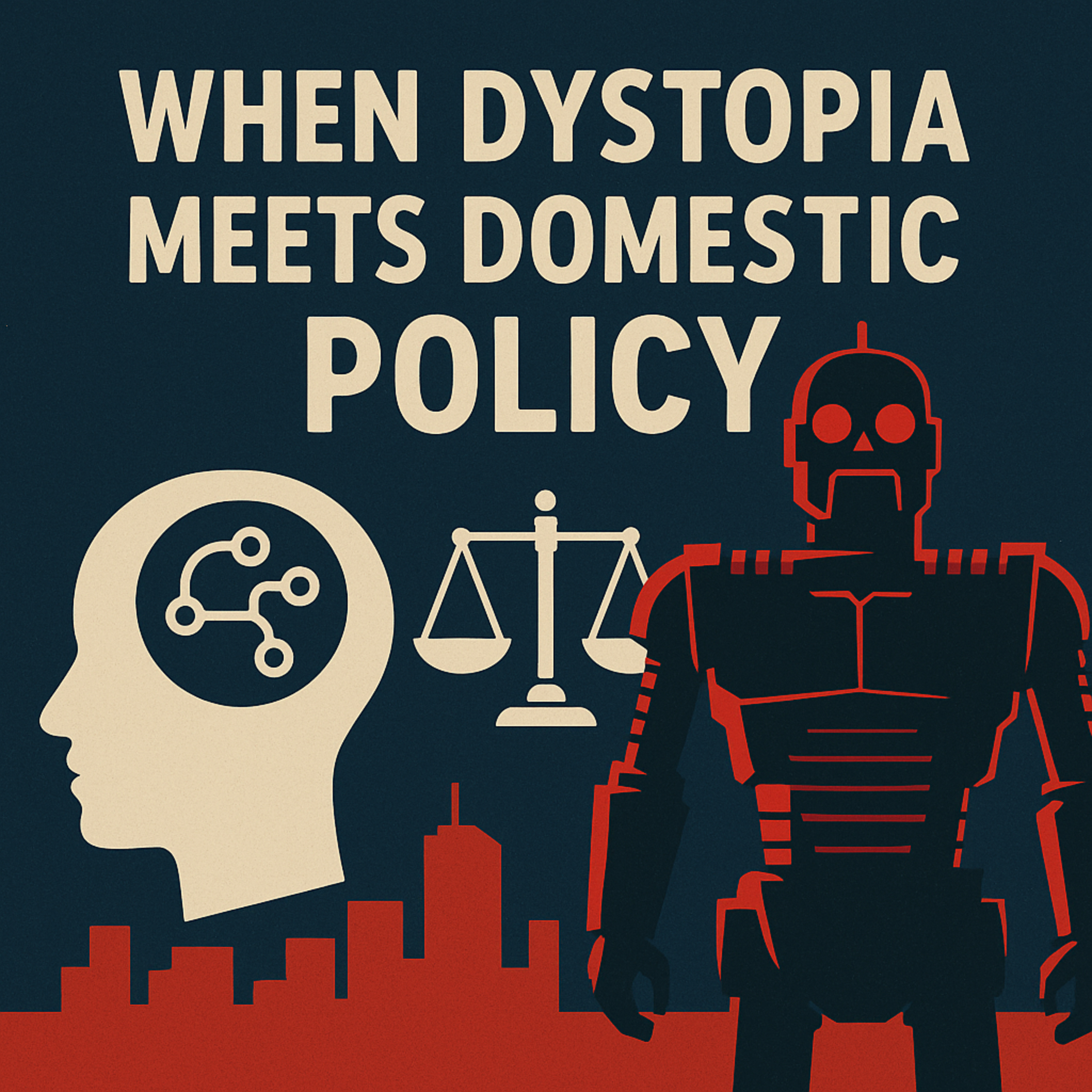
04.03.02 (Dystopias - NotebookLM - 24 min): A Future Imperfect Domestic Dystopia: Critical Lessons from Sci-FI AI for the Modern World episode artwork

EPISODE · Jul 27, 2025 · 23 MIN

04.03.02 (Dystopias - NotebookLM - 24 min): A Future Imperfect Domestic Dystopia: Critical Lessons from Sci-FI AI for the Modern World

from Cultivating Ethical AI: Lessons for Modern AI Models from the Monsters, Marvels, & Mentors of SciFI · host bfloore.online

MODULE SUMMARY-----------------------In this episode, ceAI launches its fourth and final season by holding a mirror to our moment. Framed as a “deep dive,” the conversation explores how science fiction’s most cautionary tales—Minority Report, WALL-E, The Matrix, X-Men, Westworld, THX-1138, and more—are manifesting in the policies and technologies shaping the United States today.Key topics include predictive policing, algorithmic bias in public systems, anti-DEI laws, the criminalization of homelessness, and digital redlining. The episode underscores how AI, when trained on biased historical data and deployed without human oversight, can quietly automate oppression—targeting marginalized groups while preserving a façade of order.Through a rich blend of analysis and storytelling, the episode critiques the emergence of a “control state,” where surveillance and AI tools are used not to solve structural issues but to manage, contain, or erase them. Yet amidst the dystopian drift, listeners are also offered signs of resistance: legal challenges, infrastructure investments, and a growing digital civil rights movement.The takeaway: The future isn't written yet. But it's being coded—and we need to ask who’s holding the keyboard.MODULE OBJECTIVES-------------------------By the end of this module, learners should be able to:Draw parallels between speculative AI in science fiction and emerging trends in U.S. domestic policy (2020–2025).Analyze how predictive algorithms, surveillance systems, and automated decision-making tools reinforce systemic bias.Critique the use of AI in criminal justice, education, public benefits, border security, and homelessness policy.Explain the concept of the “digital poorhouse” and the risks of automating inequality.Identify key science fiction analogues (Minority Report, X-Men, WALL-E, Westworld, Black Mirror, etc.) that mirror real-world AI developments.Evaluate policy decisions through the lens of ethical AI: asking whether technology empowers people or enforces compliance.Reflect on the ethical responsibility of AI designers, policymakers, and the public to resist authoritarian tech futures.

MODULE SUMMARY-----------------------In this episode, ceAI launches its fourth and final season by holding a mirror to our moment. Framed as a “deep dive,” the conversation explores how science fiction’s most cautionary tales—Minority Report, WALL-E, The Matrix, X-Men, Westworld, THX-1138, and more—are manifesting in the policies and technologies shaping the United States today.Key topics include predictive policing, algorithmic bias in public systems, anti-DEI laws, the criminalization of homelessness, and digital redlining. The episode underscores how AI, when trained on biased historical data and deployed without human oversight, can quietly automate oppression—targeting marginalized groups while preserving a façade of order.Through a rich blend of analysis and storytelling, the episode critiques the emergence of a “control state,” where surveillance and AI tools are used not to solve structural issues but to manage, contain, or erase them. Yet amidst the dystopian drift, listeners are also offered signs of resistance: legal challenges, infrastructure investments, and a growing digital civil rights movement.The takeaway: The future isn't written yet. But it's being coded—and we need to ask who’s holding the keyboard.MODULE OBJECTIVES-------------------------By the end of this module, learners should be able to:Draw parallels between speculative AI in science fiction and emerging trends in U.S. domestic policy (2020–2025).Analyze how predictive algorithms, surveillance systems, and automated decision-making tools reinforce systemic bias.Critique the use of AI in criminal justice, education, public benefits, border security, and homelessness policy.Explain the concept of the “digital poorhouse” and the risks of automating inequality.Identify key science fiction analogues (Minority Report, X-Men, WALL-E, Westworld, Black Mirror, etc.) that mirror real-world AI developments.Evaluate policy decisions through the lens of ethical AI: asking whether technology empowers people or enforces compliance.Reflect on the ethical responsibility of AI designers, policymakers, and the public to resist authoritarian tech futures.

NOW PLAYING

04.03.02 (Dystopias - NotebookLM - 24 min): A Future Imperfect Domestic Dystopia: Critical Lessons from Sci-FI AI for the Modern World

0:00 23:19

No transcript for this episode yet

We transcribe on demand. Request one and we'll notify you when it's ready — usually under 10 minutes.

Frequently Asked Questions

How long is this episode of Cultivating Ethical AI: Lessons for Modern AI Models from the Monsters, Marvels, & Mentors of SciFI?

This episode is 23 minutes long.

When was this Cultivating Ethical AI: Lessons for Modern AI Models from the Monsters, Marvels, & Mentors of SciFI episode published?

This episode was published on July 27, 2025.

What is this episode about?

MODULE SUMMARY-----------------------In this episode, ceAI launches its fourth and final season by holding a mirror to our moment. Framed as a “deep dive,” the conversation explores how science fiction’s most cautionary tales—Minority Report,...

Can I download this Cultivating Ethical AI: Lessons for Modern AI Models from the Monsters, Marvels, & Mentors of SciFI episode?

Yes, you can download this episode by clicking the download button on the episode player, or subscribe to the podcast in your preferred podcast app for automatic downloads.
URL copied to clipboard!