
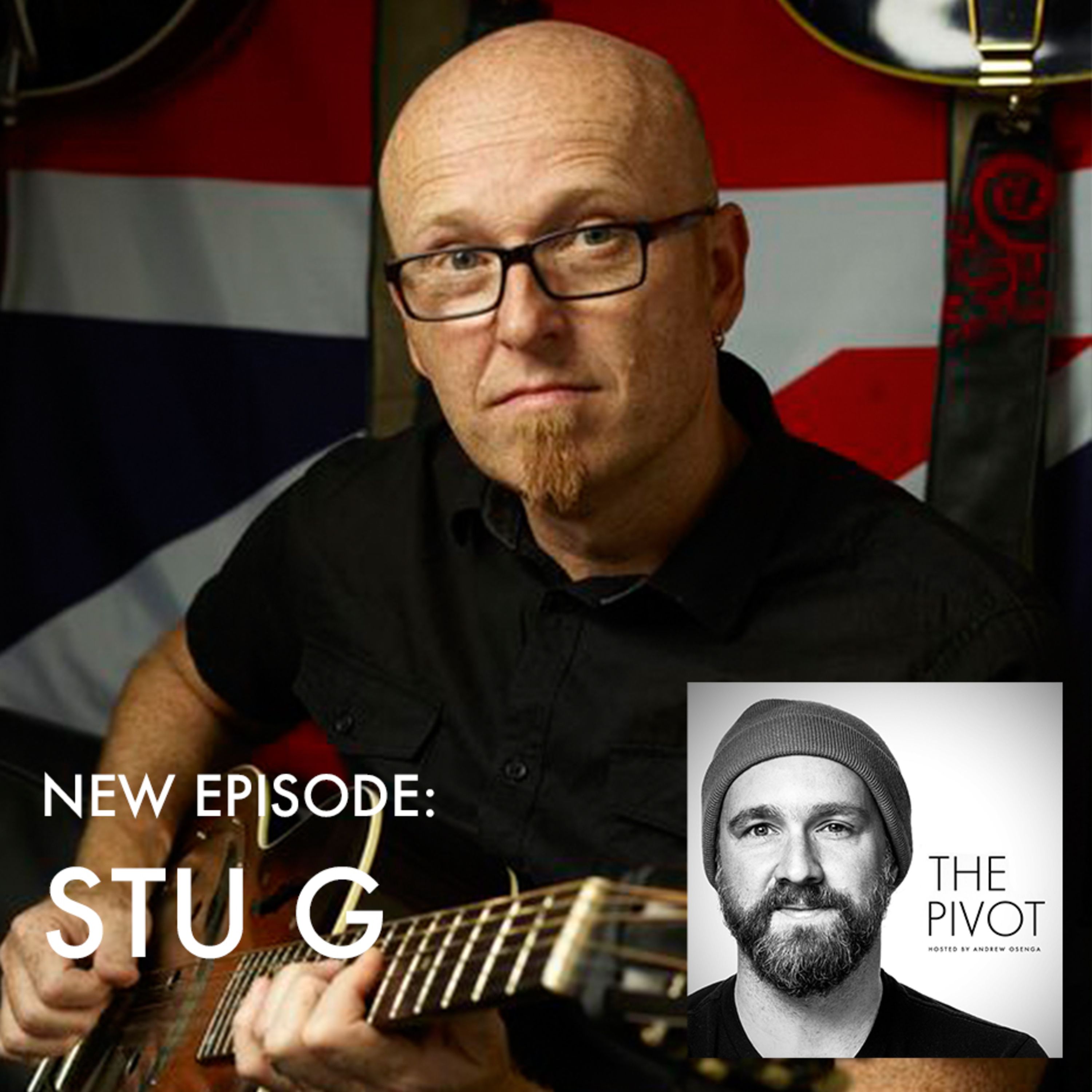
From Nashville, Tennessee, this is The Pivot, stories of people who've made a change. Welcome to The Pivot. My name is Andrew Osenga, and my guest today is Stu G., the legend. Like many of us, I first learned about Stu through his epic guitar playing in the bandolierus, and basically introduced the world to modern worship music.
Over the years, I have heard people talk about Stu in hushed whispers, deep reverence. People don't just like him as a guitar player. This is a guy who carries deep respect, but I've never known him. About a year and a half ago, I all of a sudden started to find myself in the same rooms with him, and got to know him just a little bit, but I understood immediately that this guy was a deep well.
He spent the past few years curating this incredible project. It's a film, book, music, and e-course all around the Beatitudes. That's Jesus' teachings, blessed are the poor, blessed are the weak, from the Sermon on the Mount. It's a life's work kind of thing, and it was a gift to get to sit with Stu and learn more about it.
Plus, I got to talk to him about playing guitar with Michael Louis-Smith, which has honestly been a dream of mine. I've played with Stephen, I've done a little bit with Amy, and I've got to complete the trifecta and play with Smitty. But perhaps it's about time that Stu G. and I started a band called Secret Adventure.
And if you listen to early 90s CCM, you know exactly what I mean. But Stu is awesome, and it was so fun to get to talk to him. But before we talk to Stu, I think we can all agree that 2020 was not an ideal year. A lot of us lost a lot of things.
We lost connection, we lost freedom, a lot of us lost income. Many of us lost loved ones to the coronavirus, or even the political division. It was awful. But as hard as it was, if you're listening to this, then you have access to technology, the internet, and the finances to interact with those things.
There are a lot of people in this world for whom 2020 was even worse. It can be daunting to think, how am I supposed to fix anything like that? It just seems so broken. But there are some simple things that you can do to bring healing somewhere to someone who suffers much.
It is radiant in their ingrained image of God. And one tangible way is, and I kid you not, it's by sending them chickens. Chickens? Chickens.
As silly as that may sound, chickens lay a lot of eggs, which are an easy source of protein, something many, many children in poverty rarely get. They also quickly provide more chickens, so you've got chicks or eggs that can be sold in the market. It's a little crazy, but for many families, the gift of a chicken or two is revolutionary, turning lives around. Food for the Hungry is an amazing organization who's been helping people rise out of poverty all over the world for over 50 years.
And they have this incredible ministry called the Chicken of the Month Club. $28 sends two chickens to a family in need each month. That's less than what it costs to take my family through the Chick-fil-A drive-thru. So guys, go to fh.org slash pivot to sign up.
And when you do, we are going to send you your own Andrew Osenga's Hot Chicken of the Month Club mug just to say thank you. It actually is a very cool mug. If you've already got one, would you post a photo of yourself with it and tag me? I'd love to see it and share it with other pivot listeners.
But guys, we all hope 2021 will be a better year. And one way you can guarantee that it will be for many, many families is simply by sending out $28 a month to the Food for the Hungry Chicken of the Month Club. fh.org slash pivot. Thank you for loving people and serving people.
But that is something awesome. Thanks, friends. And now, here's my conversation with the great Stu G. It just so happened that we were writing another Beatitude song today.
Oh, really? Yeah. So one of the things I want to be doing is, one of the things I'm doing right now is getting a collection of Beatitude songs that are Sunday Settler songs for worship. So, you know, because the Beatitude Project album is a little bit more contemplative, a little bit more artistic.
You listen to it rather than use it. Yeah. There's a couple of songs that are suitable. Yeah.
So I want to do that just to expand the e-course a little bit and also to contribute to the church. Yeah. Oh, man. Yeah, it's really good.
That's exciting. It is exciting. So it was the first one of this next block of songs. So you just started writing.
Literally, yeah. Dude. So that was the first song. And it set a high bar.
Yeah. I believe it. Yeah. There's something about when you have that idea and it's percolating and you finally get a chance to do it for the first time.
Yeah. That first song is always something special. Yeah. Because it's got years of expectation and thought that just, you know.
Yes. Yeah. No, that's right. And with everything that I've kind of pulled together and collaborated on, there's a lot of stuff floating around.
Yeah. There's a lot of knowledge, if you like. So the challenge is, in some ways, the concept is quite deep. Then how do we get that in an easy-to-sing, memorable, simple song?
Because that's what's going to work. Yeah. Yeah. And when you're expanding from Beatitudes, which seems so simple.
Yeah. Oh, it's only, what, eight verses? Yeah. It's everything.
Yeah. That's right. Yeah. Let's get to that.
Okay, yeah. I'll start a place I know you've already talked about a lot, but I never talked to you about it. Yeah. I'm excited to hear.
I grew up in a small town in Illinois, and I remember, I worked at a Christian bookstore in high school, because that was the one place you could get weird, obscure Christian music, which is what I was super into. Yeah. And I remember when somebody said, you've got to check this out. It's church music, but it's, like, awesome.
And at the time, that didn't exist. There was church music, and there was CCM music, and there was secular music. Yeah. And then there was this band that was really, actually, genuinely good.
And as a guitar player, at the time, as a kid who really desperately wanted to be a guitar player, I was like, dude, I've never heard anything like this. Can you tell me, you don't have to go super into it, but how did that thing start? How did you guys, you really did, you created a genre? Like, who gets to do that?
Yeah. And I'm sure you didn't set out to do that. Right, yeah. But how did that happen?
It was a big colliding of worlds and ideas, honestly. So I was a worship leader and musician at a church in the East Midlands of England. Okay. So I was kind of, you know, looking after the, we had three congregations, and I was kind of like, you know, helping pull all that together.
Can I ask you, had you grown up in the church? Yes, I had grown up in the church. I wouldn't say I was a follower until I was about 20, but, you know, I grew up going to Sunday school and Boys Brigade. Yeah, yeah, yeah.
You know, my mum, dad, and my grandparents are very, very faithful, devout Christians, you know, so I grew up in the church. But then I left school and became an electrician. You're an electrician? Yeah, I did a four-year apprenticeship and then worked for them for a few years.
What are you doing after this? Because I could probably use your help in my business. I'm not sure I know all the codes over here, but I did that for a while, and, you know, I was into guitar. I really discovered guitar because of Brian May and Queen.
You know, I was a huge Queen fan, and I wanted to be Brian May, although, as you can tell from the hairstyle, it hasn't quite worked out. I'm not far behind you, so there's a reason you want to take me in a hat. So I was kind of worked as an electrician and doing, you know, learning to play guitar and all that good stuff. At the time, you can't play the guitar like that in church.
That's right. No, that's right. And I wouldn't say that I was kind of, like, hungry to kind of be in the church world, you know, anyway, at the time. You know, late teens.
Met my wife, you know, the lady that was going to be my wife and still is. And she had no church upbringing. So she was quite interested, sort of fascinated that, you know, my mum and dad would always say, you know, we'd like to come to church with us this Sunday, you know. To cut a long story short, we had some relatives in London who had a church.
And they were kind of like the black sheep of the Christian family here with us because they spoke in tongues and raised their hands, right? Yeah, that doesn't feel very British to me. That's right. And so, you know, we connected with them and really enjoyed being around them.
And they invited us to go to London because I was in a guitar and I was really into Phil Caggy. Oh, yeah. And, you know, a friend, my brother actually had given me a, let me a Phil Caggy record and I was really into it. It was town to town.
Okay. Yeah. I'm a Christian blue guy. Okay, yeah.
Yeah. That's a little bit later. Yeah. He was going to do a concert.
Our friend in London invited us to London and we went to this concert and hung around at the church and that's where we became Christians, both me and my wife. Really? And, yeah. So anyway, it's Phil's fault.
We've become great friends, actually. How beautiful is that? I know. It's amazing.
You know, what a player. I mean, he's still probably one of the best in the world and such a great kind of spirited guy to be around, you know, just such a kind, brilliant person. So anyway, I kind of digressed, didn't I? Yeah, so there was all that.
So we ended up moving to London to be a part of this church. That's when I kind of learned about leading worship and, you know, music that worked in those contexts. So, you know, we lived with our pastor and his wife. You did?
Yeah. And so we would travel with them. Wow. That's where I learned, you know, I guess you could say it's where I was discipled, really, you know, and learned about leading worship in small groups and in churches and had my band while I was in London.
And we used to play the rock venues like the Rock Garden and Borderline, Mean Fiddler, you know, places that would be known in the British music scene. And that was a really great time. Really awesome. And then we actually moved to Belgium for a year because we helped our pastors plant a house church.
And so we moved there for a year. Wow. And we did that. Yeah, we kind of did life with them six, seven years like that.
And then something happened and it all kind of fell apart. And Karen and I moved to the East Midlands town called Ketering. It was the same sort of group of churches. You know, I became sort of worship director for those three congregations.
So while I was doing that, they allowed me to, you know, do some things outside of my responsibilities for the church. And so two things really come to mind. One was that I used to play with Noel Richards, who's a worship leader from England. Yeah.
You know, I got to plan these records and play live with him, which was really cool. And then I got to know Kevin Prosh, who was a worship leader from the vineyard. Yeah. At the time in Anaheim.
He kind of came from Kansas originally. Kevin's known for, like, what are some of the songs that he's written? Well, he had a... He's written a song that you just know, and he doesn't know where it came from.
Yeah, that's right. Yeah. I'm trying to think now. He had an album called Even So Calm.
There's a song called Banking Table, I think. Oh, yeah. Even So Calm. He came over to the UK to do some touring and stuff like that.
In fact, our mutual friend, Les Moyer, when I first played with Kevin, Les played bass with him. So actually, we played together, before Delirious, we played with Kevin Prosh at the very first Soul Survivor conference in the UK, yeah. Which became this massive conference. Yeah, it did, yeah.
The extraordinary thing, why I loved being around Kevin was just the prophetic imagination and the prophetic sort of gifting that he had, like, with both music and his songs and his lyrics and what have you. You know, you do a couple of songs, whatever, and then you just kind of hang out with the music for a bit and let the music speak. It was almost like he was given permission. And I know that Les talks about the UK worship scene in, like, a pre-Kevin Prosh and a post-Kevin Prosh sense.
Really? Was that a big deal? Yeah, it was that big of a deal. In terms of, you know, him encouraging...
Like, he would always joke with me about, you know, God loves your tone. Like a t-shirt. Yeah. And it was that kind of encouragement.
Like, you know, you'd have to fit into a box, but to, you know, use your music and your songs as an expression of God's voice and an expression of your prayers, you know, which is interesting because in the UK, it's probably easier to talk like that because, you know, back in the day, certainly, there was a CCM kind of scene, but it wasn't big business and it wasn't, like, really, you know, everywhere that, like, is in America, right? So it's kind of easier to sort of find a path or to just kind of do what you feel like you should do without feeling you're constrained by anything, you know? Yeah, you're carving your own road. Yeah, yeah.
During that time, then, I ended up meeting Martin Smith and Tim Jupp. Martin and Tim and I had a mutual friend called Andy Piercy. He was just helping them sort of form their musical aspirations around this youth event called Cutting Edge in the UK. In combination with Andy and then with getting to meet Martin and Tim, they were like, we do these events.
They literally just started, you know, we'd come down and play. And so I went down and played one Sunday and I went home afterwards and I said to my wife, at that point, we'd been living in Kettering, you know, a new role there for, like, less than probably a year and a half, you know? I said, there's something happening down here. You have to at least come with me next time we go.
I've got a feeling that there's something more for us down there, you know? Wow. And it wasn't like there was an offer of a job or an offer of anything. It was a bit like wanting to be with Kevin.
It's not about the gig. It's about being around it. Yeah. Yeah, the people.
Yeah. We went down there together and, you know, loved everyone, loved the church that it was a part of and, you know, did see a future in making music with these guys, for sure, but that wasn't necessarily the driving force. It was really that, didn't want to be away from that sort of pioneering, prophetic spirit, you know? Yeah.
You know, we ended up moving down there. I actually gave up being full-time in music to move down there. Wow. I was freelance and I thought I would still do sessions as I came up, but, you know, I moved down with, like, five days of work and a little family and Karen was six months pregnant with our youngest daughter.
Holy cow. Did you have another job ever? Well, what I did was I went back to being an electrician, but just self-employed. Yeah.
And made that work. And we did that for, you know, a couple of years and every month we'd do these events and they were growing every month exponentially, you know, pretty much doubling in size all the time. In churches or in clubs? Or were they?
Well, we started as a monthly event, a monthly worship event for youth that was based out of our church and community church on the South Coast. You know, the idea was that we'd give an environment where people could express themselves in the music of the day, you know? Like, so, you know, we were really inspired by U2 and Radiohead and, you know, who was around in the early 90s, you know? I'll never forget, Martin had written, Did you fill the mountains tremble?
That's the only song we did that night, you know? But we just did it for us 45 minutes, you know? And so there was so much of, like, we didn't know what we were doing and we would be doing it with no lyrics and be still playing and getting someone to come up and speak. Wow.
And so, yeah, they were extraordinary times. So at what point did you decide, this group of people who are ministering together and are serving all these kids and they're coming in, when did that change into, let's make recordings and become a band? Yeah. So we were making recordings all the way through, but the recordings were like songs that were coming out of that event and that Martin was writing to lead in those events, right?
And we would do, you know, there'd be five or six songs on each cassette and you'd make 250 and sell them at the back of the thing. Well, you know, what happened was that those cassettes would be getting out there, like, making their trails across the country because people would be hearing about this event. There was an energy around it. The same reason why I wanted to, you know, go and be a part of it.
Once a year, we started to do an outdoor event. Little Hampton has this, it's a seafront town and it has this lovely open sort of field, this grass thing that goes on the beach. And we did this one once and the estimated number of people, there was 10,000. Oh my gosh.
Yeah. It's crazy. It's crazy for a small UK town. Are these church kids?
Are these, like, where are these people coming from? Yeah. They're coming from churches and they're coming from all over the country. Wow.
When does it become, like, your job to be in a band? Yeah. So, as the tapes went out and as the vibe went out and it got more popular, you know, we'd get invites to go and, you know, can you come and lead worship at our seawide event, you know. And so we'd be doing that and it got quite busy doing that.
Martin was a sound engineer and producer. He had a gig recording this Christian event up in Lincolnshire. Decided that they, him and Anna and John, they were there together and they decided they were going to drive home after it finished and it was late. But Martin fell asleep and they had a crash, like, just, you know, 100 yards from, or so, 100 yards from where they were driving to.
That was really the last thing. And so they had a crash and Martin was trapped in the car, broke his leg, you know, was pretty seriously injured. That sort of time in hospital that he had, and, you know, we'd all be going to visit him every day and what have you, but that time in hospital, he read this book called You Two at the End of the World. Yeah.
I think it's Bill Flanagan. I've read that book a couple of times. Yeah. It's a great book.
It is. It's really inspiring. You know, he felt like he'd been given another chance and that he was on the earth for a reason and he sort of encouraged us, like, you know, I want to do this, I want to do this fan thing, like, the rest of my life are you in, you know. Wow.
And so we went for it. So we had four, we had Cutting Edge 1, 2, 3 and 4 as cassette albums, right? I remember they got released over here as almost like a box set. Yeah.
A little bit later on. That's when they got to Illinois. Yeah. That's right.
For the next sort of year or 18 months, from the day we went full time, we did as many, you know, we took as many of us. Yes to everything. We said yes to everything. And so we would be out, like, maybe two, three, sometimes four.
days a week which is a lot in the uk honestly you know there's not so many cities you can play i know you know martin was an engineer and he had a 24 track one inch tape machine and so we bought an alan and heath console and we recorded every one of those shows oh my gosh you set that stuff up yeah yeah and it was in the truck outside that we you know loved our gear in and um uh those recordings and i'm called live in the can and um that's one of the main things that started to get out in america that um you know it's kind of creeped across with people who are visiting whatever and um because i know it was happening that people were really people would release an album and then churches would play songs off that album but that did not that did not happen in my time yeah like that was the first time that you heard a cd and then two weeks later you were singing that song in church right i've never experienced that before that's amazing yeah we worked with someone called alan weed at youth specialties yeah yeah and uh um you know he would send a video out to us to you i guarantee you is how it got to me right i guarantee you because yeah youth group leader gets that box in the mail and it's got like four new cds a vhs and some study guides that's right yeah you're right yeah youth group room exactly there's one little you know throwback story of how we got to america so you need to have an international career because you know you can tell the uk apart from what i said about joining in 12 months whatever you can do it in three weeks if you don't repeat anyone yeah and we had an opportunity to come and play in san luis obispo in california okay um the vineyard uh in san luis obispo we're having a worship conference now they've done it the previous year they'd had like 500 people come to this conference and so they were like oh we've got to have delirious come to the conference you know anyway for whatever reason uh we turned up and there's like 25 people that signed up for this thing and um and we brought all this product with us which was a lot of cutting edge stuff right we had an amazing time with them but they were in the vineyard and so they arranged for us to go down to anaheim yeah uh which is like the mothership yeah the mothership um at the weekend so we went down there we did a concert for their like their youth on saturday night and then we we worship at church on sunday they had this uh big store and they very kindly helped us out by you know we didn't want to take any of the cassettes home with us because you know it's a lot so they took our stuff the fact that anaheim vineyard took our stock of cassettes that we brought with us for this tour and we're selling it there is a big reason why i can guarantee if we said delirious was going to do a show in orange county you know it's out today you know because uh that california and the west coast yeah became a real popular spot for us yeah um so so once that got going then how how long did the band run like actively well the first cutting edge event was 92 and the last delirious show was 2009 november 2009 so we went full-time in 96 so that would have been like you know good 13 years man it was delirious yeah so when so you knew it was the last show when you did the last show yes yeah we knew that it was we were going to finish uh for about a year um before we finished got it what if i can ask what led to that um martin came to us we were in dallas i don't forget it so by this time you guys were playing like massive shows you did shows with like huge bands we did yeah like outside of america we you know we had our own record label we had our own distribution company that jonathan brown yeah ran who was my boss's boss now yeah you know tony ran our record label we had our own staff in the uk and what have you here in america you were seen as a christian band because that's where the records were sold in the christian bookstore yeah in the uk you're just a band yeah yeah i mean people knew us as a christian band there but like business infrastructure support a christian band no that's right yeah yeah our records were in hmv and you know virgin record stores and all that kind of thing and uh and we released singles into the charts uh we we across our career we had five top 20s in the uk which is great we had number two in germany and um yeah like you said we toured with we did a stadium tour in europe with bon jovi and uh we did some shows with brian adams and we played glass of the festival we did the same day as nate kravitz and al green yeah it was amazing they were really amazing days honestly you know and we we didn't do anything different we did you know songs like history maker and my glorious and you know songs we were doing in our worship events we were doing on the road with those guys and i think we had this understanding of it's all one thing like i mean there's people can say a lot better than i can but you know the idea that of sacred and secular we went into that kind of language so much you know like the idea that if god was not there there wouldn't be a there you know and some 139 was always a big thing for us you know um where can i go from your spirit you know like there's nowhere i can go yeah um if i go to the heights of heaven you are there yeah exactly so that's the uh that was the sort of philosophy that we had and um um yeah we loved it when record sales started to dive off because of streaming napster and what have you i mean we were really lucky to have tony and jb you know like uh so we'd have these sort of and very quickly you know it became about the events that we could do and most people don't realize that people buying those cds at shows or stores are funding the staff they're funding all these people that help support the creation of the stuff yeah and their families so you guys are feeling responsible for that absolutely yeah and that's that's a really good point that's absolutely what i mean the only way to really survive as a band which is the same now is that you have to go out and play shows which during which is why a pandemic but it did sort of make us start to have a lot of vision type meetings you know uh what are we doing what do we prioritize because we'd have the luxury of doing whatever we want to do yeah and it just would work and it would work yeah so if we wanted to make a record like uh we made a record audio lesson over which was um really a attempt at being a radio head or muse or whatever yeah and um um and we could do it because this everything else was kind of helping us do that we could do what we wanted well you know if your income goes down you can't do whatever you want you have to do what what makes the you know what what helps you keep going you know and i think that we have got used to doing whatever we want to do you know so for me personally i'm not really sure i want to be on glasterbury i want to play jules holland i want to yeah you know kind of do all the cool stuff yeah um but not being very realistic in fact it's kind of like a uh what's the word i'm looking for entitled all right yeah yeah it's kind of like that's a word i will not suggest to you but yeah you know i felt entitled because of what we experienced you created patterns of this is the way it works and these are the things we get to do and all of a sudden that changes yeah but you know at the same time it wasn't about personal financial gain because we put everything back in yeah it'll work yeah you know uh it was really a idea an ideology you know how much of that was your own personal identity of being oh yeah to do that yeah well i mean that was a big thing you know because um you know my sound or if you like my music was a huge part of our identity yeah and um you're the guitar player in an arena band yeah yeah yeah you know for i'm just gonna sound so pompous to say this but you know like without really talking about it at the time you know like there was bono and edge and then you know you got page and plant you got freddie and brian and you know we felt like we were honest too yeah yeah totally you know i mean my little bands that weren't as successful we were still you still have that dynamic there's the front man and there's the kind of other guy that keeps everything you know the band leader you know yeah uh i don't know if it's making sense but you know that it wasn't like a direct the sort of record sale dip and stuff like that wasn't a direct cause of us finishing but there was conversations on the way about you know what we're doing it made us think about what we're doing why are we doing it did you start to feel the plane landing we were touring all the time because that's what you know made the money and it was i mean we had rules around it and we had them from day one like we would never be away for more than 10 days at a time and that got stretched a couple of weeks you know a few times you know but we never did the 30-day tour thing and you know we turned down um dc talk and we turned down newsboys like in the in the complete heyday and people thought we were crazy yeah your families are in england i know that's right yeah that's right you know we want to do our best to still be married at the end of our years you know and so the family thing really was a big factor in you know bringing it down you know martin came to us and said that um i just need to be at home or is it i've kind of really been talking with our own don't really know how to say this but i think i need to leave the band so what did you do that year where you knew it was going to end yeah what was your how were you looking to the future every time we were in america i would tag on a few days to either come to nashville or uh to california reconnect with people i've met in the industry you know label people or other producers or musicians or whatever during that time in 2009 i ended up meeting jason ingram and he introduced me to holly zabka over at essential essential was just starting yeah uh essential worship that is i mean this is like a year's worth of meetings with all kinds of people but you know i ended up meeting jason and holly yeah and uh and holly offered me a publishing deal and i said yes and then with jason and paul mabry we started something called one sonic society yeah did you see that as a full-time thing one sonic society uh well i think i thought that i hoped it would be yeah but back then you know jason was already very successful songwriter and paul kind of had his thing so i think that paul has produced like all the lord dangle yeah that's right yeah he's yeah he's made some great records yeah absolutely yeah so um and these guys yeah and jason writes every song he's in church i know and uh and they're amazing friends great friends of mine and um so yeah we started to think of one sonic society and um and we ended up moving my wife and i and our children ended up moving here um i've got no other way to say that it was an upside down time for me like um i was in my 40s and i was struggling with is my best work behind me but at the same time i've got to like you know appear like i'm still slugy and um uh and doing all that and you know i struggled with the idea of being a songwriter for a job as well you know so that might sound odd but um you know the rhythm we had with delirious was we would gather ideas all the way through the year but then at the end of the year martin and i would you know spend a little bit of time on our own and then getting together and working on them and then showing the band in january and then recording yeah you're writing at that pace for your own voice rather than writing every day for somebody else i know it's not the same thing it's not the same thing at all not even close no and uh i really struggled with it you know it was uh i felt like you know i was here for a week and then ran out of ideas um yeah my transition i tried to be a staff writer for about two years yeah and like it was a train wreck i just right yeah could not yeah i could not switch no so we have a similar internet so you understand that yeah feeling of like um what am i going to do you know the space of something finishing and then something not quite begun yet that's why i started this podcast because i spent so much of my life in that space right yeah wondering what i'm supposed to do now yeah that thing was cool yeah now what so during that time i wasn't really the greatest person to sort of be a friend with you know and uh but at the same time you know looking back it really kind of birthed a lot of what i understand in the beactive project now you know um so i'm grateful for that i wish that it hadn't been hadn't been like that there was you know there was things i didn't really enjoy about that time but um that's what you were fresh here yeah can i ask this did you feel like you landed here with a with a sense of community or thanks to friends like jason and paul and their wives and um jimmy abeg in particular oh my gosh you know jimmy's i know jimmy's couch you know very well and uh that's awesome yeah like we've got some amazing i felt like we had we had community but it's natural community though so it's not like um it's not the kind of um it's a bit different here it's a bit transitional in terms of um not everyone's available when you need them because everybody's so busy hustling to keep it going yeah that is that's my experience like you're great friends you don't see a lot because it's working 12 hours a day just to survive yeah then they're trying to be parents yeah spouses yeah so one of the things that um i think that both karen and i would feel like was missing was the sense of community and purpose that we had with delirious because i mean i know you know we were with those guys for 17 years and like every minute of every day for 17 years i know that's right so there's really positive things around that and then there's the fact that it becomes a bit of a bubble that you that you out of necessity you kind of have to protect but also that's not necessarily healthy as well you know so um wow um no so we missed that kind of sense of of community you know you felt you felt completely protected you know i think that i think that's a healthy thing for me though like just to sort of feel the rawness of like you know i don't think that every man for himself is the right way to look at life but when you're thrust into a position it's like well okay so right now that actually is kind of healthy for me to kind of you know you know it's just a stretch i really don't believe that that's the correct i don't think that's the jesus way no it's not but it's how it's it's so that's when your belief in jesus operating not in a uh you know western capitalistic mindset yeah and so when you're in that place where you go i gotta make something work how do you approach that in a christ-like way and what have you learned from doing that obediently what do you learn from doing from not like what's been your takeaway and i imagine that led to the project i'm not just the flourishing of myself i'm like the mutual flourishing is what the goal is mutual flourishing that's beautiful so that's not my phrase that comes from a friend of mine who is a peacemaker actually that's a government level you know when jesus says love your neighbor yourself you know another way of looking at that is do i want for my neighbor what i want for myself so when i'm in a space of like it's every man for himself am i cheering on the person who has just achieved something that i feel like i should have had yeah yep that speaks to a deep yeah a deep part of me right there that wrestle yeah yeah and then when you see someone who is perhaps failing you know are you one of the ones to go and cheer them on like to go to help pull them up i mean just i mentioned jimmy abeck jason ingram paul mabry they were there for me at like a low time you know and pushed alongside me and were like you know you're stuji like you know you're loved you know not because you're stuji from the band because you're my friends too yeah it's pretty powerful yeah yeah really powerful how long did that season sort of last that um couple years yeah yeah you know when delirious finished i was a little bit burnt out with and again this is so kind of i don't even like saying this stuff now because i'm not in the same place i was then right but you know i was a little bit kind of fed up with us being the sort of darlings of you know certain charismatic type movements around the world i could have quite easily sort of like walked away from like not wanting to go to church or anything you know um but there are certain times in your life when you get stopped in your tracks you know like one i can definitely say when i first heard queen life killers album in a record store in ipswich that stopped me in my tracks everything changes yeah the next time that happened was when i heard the bends by radiohead oh and then the next time that happened was when i heard a teaching by rob bell and don golden called the new exodus and it was a four-week series that they did at mars hill in 2005 2006 wow that did exactly the same thing as uh as those two records in terms of stopping in my tracks the thing that stopped me in my tracks was that the there's a narrative after the bible and that narrative is that god hears the cry of the oppressed and uh i mean there's a lot more to say about that but that was really really life-changing to me and uh and so in my mind as you do you kind of like think you either daydream or you think to yourself i don't know how this works and i was thinking you know so um i don't care if i don't get to church again but if there was one church that i'd like to get involved with it'd be Mars Hill in Grand Rapids happened to meet Rob at a thing we got chatting and at the end the result of that chat was we'd love you to come out and help us with music at Mars Hill can you come out like once a month for a little while because at that time I don't know if you know Aaron Nequist but he had just moved on from there he came in a guy with Troy Hatfield where the worship is there it was in the heyday of Velvet Elvis and what have you for Rob and so their church would have between 6,000 and 9,000 people or something and so it was a lot for one person to look after in terms of the music side so that's what I did I used to go there I was just struggling with some of the enclosures I guess but that kept me really connected and I'm really grateful for that time as well so that was happening at the same time and also this desire to do something around the Beatitudes so looking back now it's probably a 25 year sort of dream that happened during delirious the Sermon on the Mount was always my kind of essential scripture so if people ask for an autograph and they want you to sign your scripture as I'm sure you've done many times I would just write Matthew 5, 6, 7 well the Beatitudes started becoming a focus because there was these 8 or 9 themes that I thought oh that's cool it'd be good to sing about alongside the poor or those who mourn or making peace or showing mercy or whatever it is always a good time to sing about those things we don't really have a lot of songs that talk about that stuff right and I hadn't thought of it like that it was just like it's just kind of vinyl length album four songs aside and the guys thought it was a great idea but we never got around to that it would have just been songs as well if it was a delirious album and so I was thinking about it through all that upside down so I guess that was God's way of keeping me in and that combined with the Rob thing and the Mars Hill thing and then creating friendships here something's lit your imagination which is it's always hard to walk away from that thing no matter the context but in terms of a mental health sort of conversation that was a definite dip for me that period of time but that was when I started to understand this idea that we have in the Beatitudes Project which is that the blessing is present so it's not a way God isn't giving you a quick fix out of your problem but he gets in there with you so when blessed are the poor in spirit or the extremely poor it's like what are you on about why is blessed there and it's like well when you haven't got everything else you've got me so it's like God climbs down in the hole with you so this idea of incarnation if you like even God coming to us and being human to enter into human suffering so he's kind of a co-suffering saviour that started to inform my thinking around the Beatitudes in a different way if the blessing is present then the invitation is to be present as well present to my own poverty of spirit and present to those others present to show myself mercy and kindness for the times when I've messed up and the ability to show others because as we show mercy we receive it so that then inspired me to kind of okay so people don't want to know my story necessarily so who are the folks who are sort of embodying some of these things and so I started a journey of finding people to talk to and tell me their stories so with poverty of spirit India was always a favourite place of mine to go with delirious and so I managed to get back to India and just spend time with the poorest of the poor in terms of poverty of spirit being a literal extreme poverty experience because that will poverty does crush your self-suppression yes that's true and you know that will crush your spirit but then I discovered a guy who was a multi-millionaire hedge fund manager on Wall Street reached out to him because of an op-ed that he wrote about him leaving it walking away from it for millions of dollars and I asked him what poverty of spirit looks like to a multi-millionaire on Wall Street and so he then talks about addiction and the love of money and how he decided to walk away from it and actually create a non-profit that was helping the poor communities there are places called food deserts where people are so poor that it's easy to buy a McDonald's for five dollars than it is to buy healthy groceries or whatever it is processed non-fresh and so his thing was helping the poor in food deserts to eat nutritiously and a side to that story is that so after we I got his story and we filmed an interview with him for the film and a couple of years later he's on Shark Tank and got a million dollar investment from Shark for his restaurant ideas which is called Every Table and so he's actually got restaurants now in LA and in California for the same prices if it's in a poor area for the same price that you can buy a McDonald's happy meal you can buy a nutritious meal yeah oh my god that's fascinating yeah it's amazing so tell me more about the BMT's project from my experience of my upside down moment and the idea of God being present with me at my bottom of life moment you know the big idea is really this idea of presence that God is on your side when you're at the end of your rope or when you're becoming a peacemaker or you know I went looking for stories of people who are living some of these themes out whether they recognise it or not so I've already mentioned Sam Polk in LA but survivors of prostitution addiction trafficking like what does mercy look like to you a woman that was on death row for 27 years who was guilty of her the crime that put her there but then she had a clemency and actually was out on parole and so and it's like so what does mercy look like to you you know so we tell those those kind of stories in there people who embody those things I went to Israel and Palestine the Holy Land and talked to peacemakers both Israeli and Palestinian like people that have lost children to the conflict but who are working for peace and reconciliation rather than revenge and more violence you know with peacemaking it's like so can we learn from people who are actually in a violent hot spot what the keys are to making peace you know so we can do that here I feel like what we're doing with the Beactis project is giving people an on-ramp towards hope and away from despair you know sometimes all we can think about is what's the next thing I've got to do just to keep going you know what in big language we want to change the world but like what is the next step that I can take just to lift my head you know and so I think the Beactis didn't invite us into that kind of life that's what we did we made an album and a book and a study guide and a film and it's all in an e-course now in one place online you started writing a new record today which is awesome that's amazing yeah you know it's something that it's definitely like a life work it's a labour of love you know it's not paying my mortgage or anything like that which for what it's worth means that I trust it right yeah yes I mean if it was the Beattis and it was making loads of money that would be a paradox wouldn't it yeah it's funny man well that's awesome I'm so excited for people who listen to this to get to dig in and man that's beautiful yeah thank you man thank you so much for coming by today and it's been a treat to get to hear your story and yeah so people want to find the Beattis Project yeah it's thebeattisproject.com that is pretty simple and I'm Stugio S-T-U-G-I-O on Instagram that's awesome and you're still playing guitar all the time too yeah I forgot to talk about Michael so yeah I've done a tour with Michael ever since we moved to America and in 2014 he did an album called Sovereign and from that album onwards I've been a permanent member of his band and he's a great friend and I absolutely love working with him yeah it's been a real you get to play the Secret Ambition solo I get to play Secret Ambition I get to play Place in This World which is kind of holy grail for me I know it's like and I'll tell you what it kicks my butt every day I don't think I can play it it would take me some work I played for Steven Chris Chapman for a number of years and got to play The Great Adventure which I put up there but still there's nothing like that Secret Ambition solo for just you know Guitar Face oh it's awesome I know I'm not sure what I'm still at a place where I'm not sure what face I'm pulling because I'm concentrating so hard I love it well man thank you so much yeah thank you Stoogey I got amazing you can find his Beatitudes project at wait for it thebeatitudesproject.com I'll put the link in the show notes and for the guitar nerds like me you can even get his tones for your Helix or Kemper at tonejunkiestore.com I'll put those in there too I'm actually going to download them because I want to use his AC3 all the time that's it guys thank you so much for listening remember $28 a month sends two chickens to a family in need every month through the Chicken of the Month Club go to fh.org slash pivot to sign up today put some good back into the world 2021 can be a better year and it will be for some people if you sign up for the Chicken of the Month Club fh.org slash pivot we'll be back next week with another awesome episode I'm so excited for it I look forward to you guys getting to hear it thank you for listening stay safe stay warm and now go do something awesome