
EPISODE · Dec 30, 2025 · 8 MIN
1.2 Americas - Zero and the Stars
from A brief history of AI from ancient times to the present day · host Kristy Anamoutou
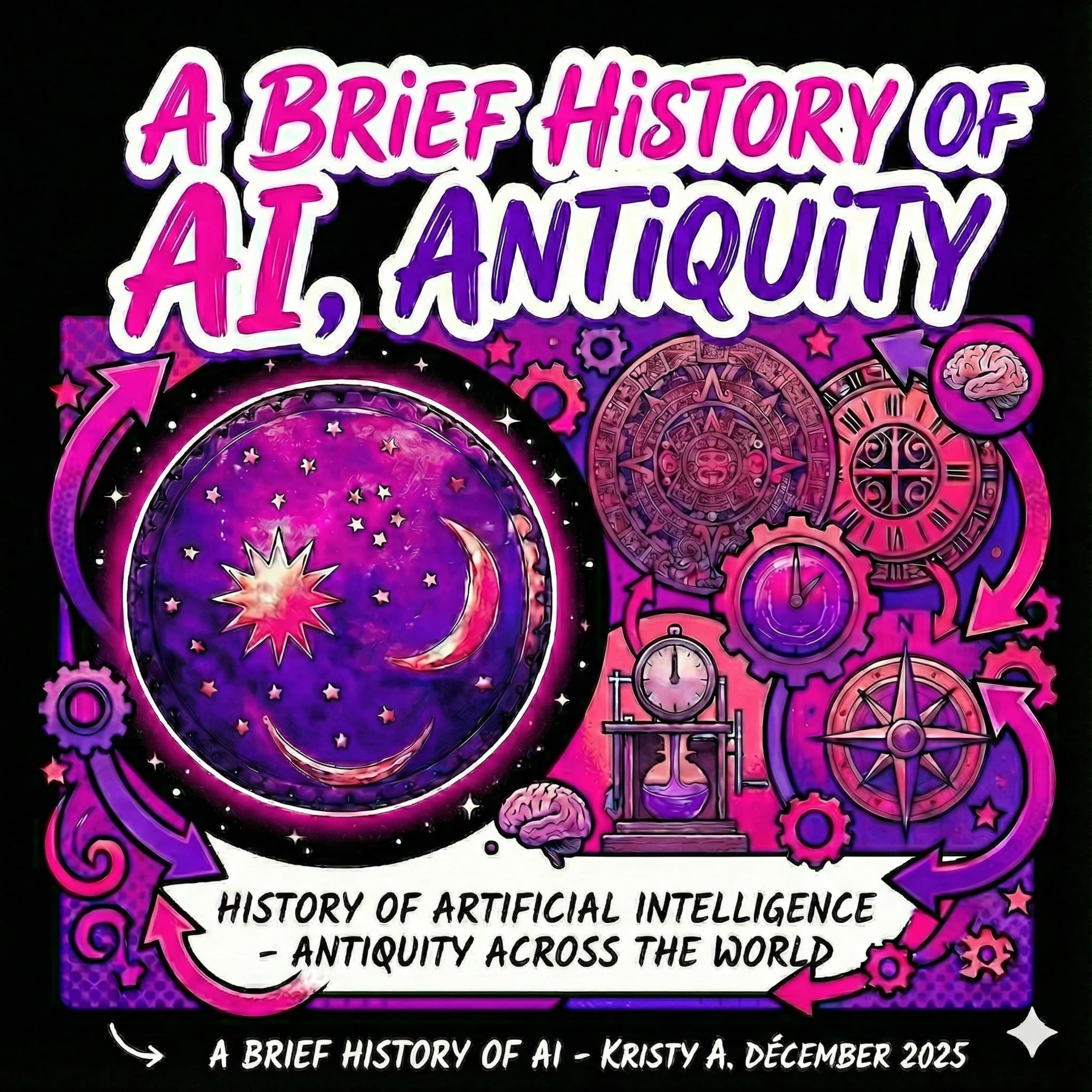
Zero and the Stars: How Ancient Mesoamerica Invented the Language of TimeThere is a concept without which no computer could function. Without which no algorithm could run. Without which modern mathematical thinking would be unthinkable. That concept is zero—the revolutionary idea that an absence can be represented, that a void can have value, that nothing can count.And this concept was invented in the rainforests of Mesoamerica, more than a millennium before it reached Europe.In this episode, we set out to discover a forgotten intellectual revolution.Between 300 and 400 BCE, the Olmecs—the “mother culture” of ancient Mexico—developed a shell-shaped symbol to represent nothingness. The Romans, Greeks, and Egyptians never managed to do this. The Babylonians used an empty space, but without assigning it any value. It was not until the 5th century that zero appeared in India, and several more centuries before it reached Europe.The Olmecs, followed by the Mayans, had solved the problem long before.With only three symbols—a dot for one, a bar for five, and a shell for zero—they could represent any number. Write dates spanning millions of years. Calculate the trajectories of the planets. You will discover the Long Count calendar, capable of dating events four hundred million years in the past or future. The astronomical tables that predicted the position of Venus to within 584 days, a precision that Europe would not achieve for centuries. The intertwining of the Tzolk'in and the Haab', two calendars that overlap in 52-year cycles—a temporal architecture that foreshadows our modern data structures. The priest-astronomers of Copán and Tikal were not performing magic. They were calculating. They had encoded algorithms in their codices that, when applied methodically, produced predictable, reproducible results. These are not metaphors: they are information processing systems, as legitimate as those of our computers — simply carved in stone rather than printed in silicon. This story teaches us something essential. Computing, in its essence, is not linked to electronics. It is the systematic processing of information according to defined rules. And this processing can be done with glyphs as well as transistors, with bars and dots as well as ones and zeros. The zero was not born in the laboratories of Silicon Valley. It was born under the stars of Mesoamerica, invented by astronomers who studied Venus and scribes who counted the days. Glyphs and stars still speak. You just have to know how to listen to them.The companion article is available here.
What this episode covers
Zero and the Stars: How Ancient Mesoamerica Invented the Language of TimeThere is a concept without which no computer could function. Without which no algorithm could run. Without which modern mathematical thinking would be unthinkable. That concept is zero—the revolutionary idea that an absence can be represented, that a void can have value, that nothing can count.And this concept was invented in the rainforests of Mesoamerica, more than a millennium before it reached Europe.In this episode, we set out to discover a forgotten intellectual revolution.Between 300 and 400 BCE, the Olmecs—the “mother culture” of ancient Mexico—developed a shell-shaped symbol to represent nothingness. The Romans, Greeks, and Egyptians never managed to do this. The Babylonians used an empty space, but without assigning it any value. It was not until the 5th century that zero appeared in India, and several more centuries before it reached Europe.The Olmecs, followed by the Mayans, had solved the problem long before.With only three symbols—a dot for one, a bar for five, and a shell for zero—they could represent any number. Write dates spanning millions of years. Calculate the trajectories of the planets. You will discover the Long Count calendar, capable of dating events four hundred million years in the past or future. The astronomical tables that predicted the position of Venus to within 584 days, a precision that Europe would not achieve for centuries. The intertwining of the Tzolk'in and the Haab', two calendars that overlap in 52-year cycles—a temporal architecture that foreshadows our modern data structures. The priest-astronomers of Copán and Tikal were not performing magic. They were calculating. They had encoded algorithms in their codices that, when applied methodically, produced predictable, reproducible results. These are not metaphors: they are information processing systems, as legitimate as those of our computers — simply carved in stone rather than printed in silicon. This story teaches us something essential. Computing, in its essence, is not linked to electronics. It is the systematic processing of information according to defined rules. And this processing can be done with glyphs as well as transistors, with bars and dots as well as ones and zeros. The zero was not born in the laboratories of Silicon Valley. It was born under the stars of Mesoamerica, invented by astronomers who studied Venus and scribes who counted the days. Glyphs and stars still speak. You just have to know how to listen to them.The companion article is available here.
NOW PLAYING
1.2 Americas - Zero and the Stars
No transcript for this episode yet
Similar Episodes
Mar 26, 2026 ·1m
Mar 19, 2026 ·34m
Feb 18, 2026 ·11m
Feb 11, 2026 ·45m