
EPISODE · Dec 30, 2025 · 12 MIN
1.5 Central Europe - Arcs and Stars
from A brief history of AI from ancient times to the present day · host Kristy Anamoutou
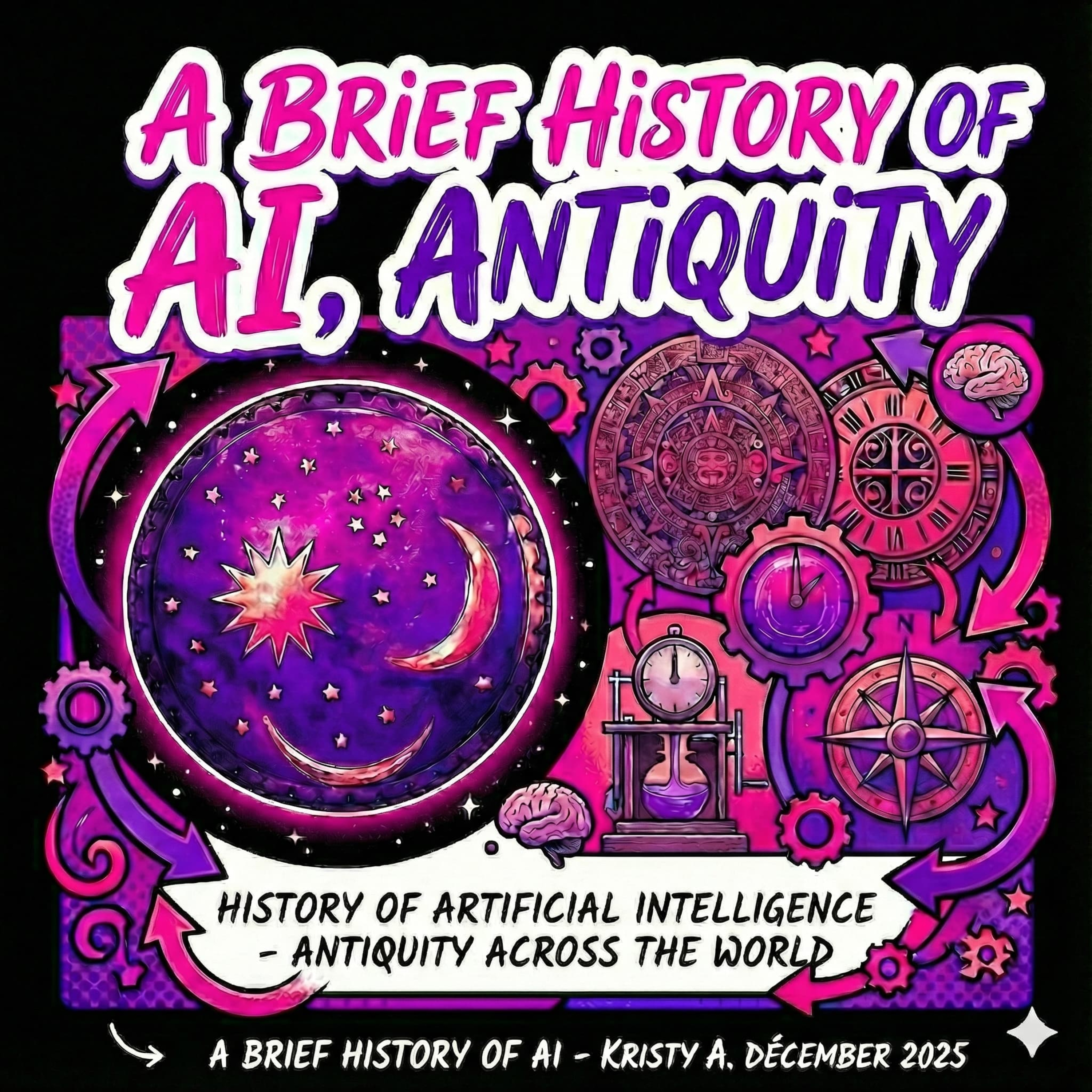
Arcs and Stars: How Central Europe Measured the Sky and the EarthBefore Greek philosophers, before marble temples, there was bronze and silence. In the plains of Central Europe, peoples without writing observed the sky with a patience that we can hardly imagine. They left no texts or legends behind. They left behind objects.In this episode, we set out to discover this Europe of shadows—that of the Celts and Etruscans, the Druids and Roman surveyors.In 1999, near Nebra in Germany, treasure hunters unearthed a bronze disc. Once cleaned, it revealed gold inlays: the sun, the moon, the Pleiades. Two arcs marked the angle between the sunrises at the solstices. The Nebra disc dates from 1600 BCE. It is the oldest concrete astronomical representation ever discovered — inscribed in the UNESCO Memory of the World Register, the result of decades of systematic observation, encoded in metal.You will discover the Trundholm sun chariot, a bronze horse pulling a golden disc, rough on one side and smooth on the other, day and night. The spirals engraved on it? One hundred and seventy-seven, or almost exactly six synodic months. These peoples mastered the metonic cycle more than a millennium before the Greeks gave it a name.You will meet the druids, who passed on their knowledge exclusively by word of mouth, after twenty years of training. The ban on writing was not primitivism—it was a strategy for controlling knowledge. The Coligny calendar, engraved in Gaulish in the 2nd century, predicted the moon's positions to within a day over more than 500 years. An act of resistance against the Julian calendar imposed by Rome.While the north measured the sky, the south measured the earth. The Etruscans invented the arch and the vault, taught the Romans the alphabet and numerals. Roman surveyors, with their groma and 3-4-5 triangle, performed spatial calculation algorithms—the Pont du Gard: fifty kilometers of canal for a fourteen-meter drop. One mistake, and the water would not have flowed.The abacus—the first portable calculator in history. The word “calculate” comes from calculi, the pebbles that were moved on the counting board. Sixty million souls were administered thanks to this instrument.And then there was Caesar's automaton: during the funeral of the assassinated dictator, a wax figure rose and turned to show its twenty-three wounds to the crowd. The riot that followed forced Brutus to flee Rome. The automaton had accomplished what no speech could have done.The history of artificial intelligence does not begin with Turing. It begins with those peoples of the shadows who, without writing, learned to calculate the sky and measure the earth.The arches of the Etruscans still support our bridges. The stars of the Nebra sky disk still shine in our sky.
What this episode covers
Arcs and Stars: How Central Europe Measured the Sky and the EarthBefore Greek philosophers, before marble temples, there was bronze and silence. In the plains of Central Europe, peoples without writing observed the sky with a patience that we can hardly imagine. They left no texts or legends behind. They left behind objects.In this episode, we set out to discover this Europe of shadows—that of the Celts and Etruscans, the Druids and Roman surveyors.In 1999, near Nebra in Germany, treasure hunters unearthed a bronze disc. Once cleaned, it revealed gold inlays: the sun, the moon, the Pleiades. Two arcs marked the angle between the sunrises at the solstices. The Nebra disc dates from 1600 BCE. It is the oldest concrete astronomical representation ever discovered — inscribed in the UNESCO Memory of the World Register, the result of decades of systematic observation, encoded in metal.You will discover the Trundholm sun chariot, a bronze horse pulling a golden disc, rough on one side and smooth on the other, day and night. The spirals engraved on it? One hundred and seventy-seven, or almost exactly six synodic months. These peoples mastered the metonic cycle more than a millennium before the Greeks gave it a name.You will meet the druids, who passed on their knowledge exclusively by word of mouth, after twenty years of training. The ban on writing was not primitivism—it was a strategy for controlling knowledge. The Coligny calendar, engraved in Gaulish in the 2nd century, predicted the moon's positions to within a day over more than 500 years. An act of resistance against the Julian calendar imposed by Rome.While the north measured the sky, the south measured the earth. The Etruscans invented the arch and the vault, taught the Romans the alphabet and numerals. Roman surveyors, with their groma and 3-4-5 triangle, performed spatial calculation algorithms—the Pont du Gard: fifty kilometers of canal for a fourteen-meter drop. One mistake, and the water would not have flowed.The abacus—the first portable calculator in history. The word “calculate” comes from calculi, the pebbles that were moved on the counting board. Sixty million souls were administered thanks to this instrument.And then there was Caesar's automaton: during the funeral of the assassinated dictator, a wax figure rose and turned to show its twenty-three wounds to the crowd. The riot that followed forced Brutus to flee Rome. The automaton had accomplished what no speech could have done.The history of artificial intelligence does not begin with Turing. It begins with those peoples of the shadows who, without writing, learned to calculate the sky and measure the earth.The arches of the Etruscans still support our bridges. The stars of the Nebra sky disk still shine in our sky.
NOW PLAYING
1.5 Central Europe - Arcs and Stars
No transcript for this episode yet
Similar Episodes
Mar 26, 2026 ·1m
Mar 19, 2026 ·34m
Feb 18, 2026 ·11m
Feb 11, 2026 ·45m