
EPISODE · Dec 30, 2025 · 16 MIN
1.8 Antiquity - Conclusion
from A brief history of AI from ancient times to the present day · host Kristy Anamoutou
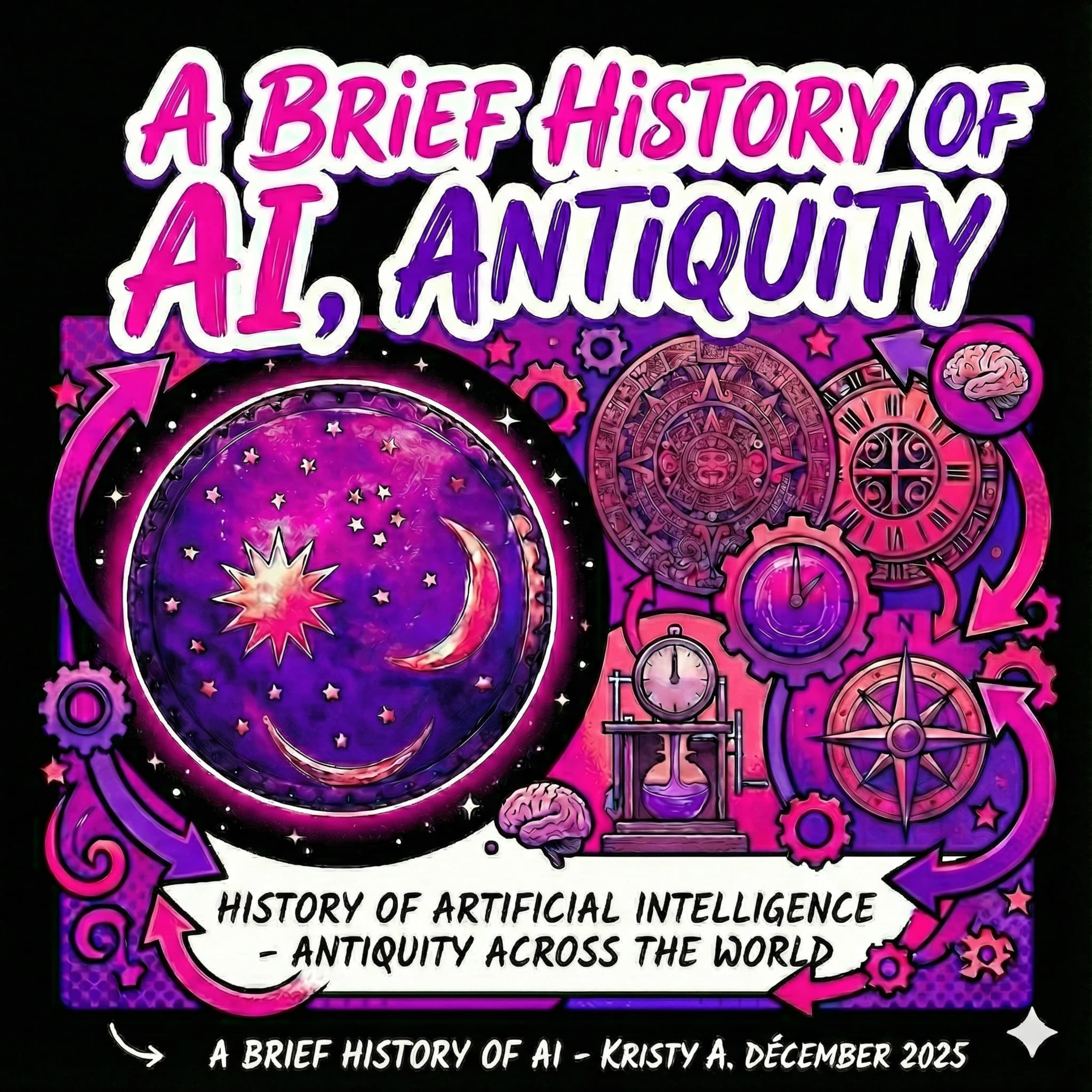
From the Lebombo caves to the tropical forests of Mesoamerica. From the workshops of imperial China to the temples of the Nile. From Yoruba shrines to Pacific atolls. Nine stories. Six continents. Fifty millennia of human history.What does this journey teach us?In this episode, we weave together the threads that connect all the stories we have told. And we discover that humanity, regardless of latitude, has asked the same fundamental questions.The dream of autonomy. From the Yoruba babalawo who calculates rather than guesses, to Su Song's 133 automata, from Talos patrolling the coast of Crete to the Polynesian navigator calculating his position in the middle of the ocean—everywhere, humans have wanted to delegate to matter what seemed reserved for the mind.The formalization of reasoning. The 256 binary configurations of the Ifá system. The Mayan Long Count calendar. Aristotle's syllogism. The algorithms of cuneiform tablets. The same intuition spans continents: thought can be broken down into steps, and these steps can be executed mechanically.The encoding of information. Before alphabetic writing, before paper, before silicon, humanity had already invented a multitude of systems for capturing information: the African binary system, the Inca quipus, the Aboriginal songlines, the Polynesian star compass.But we are also discovering what conventional history has forgotten.It forgets that binary existed in Africa two millennia before Leibniz. That the Maya invented zero a millennium before Europe. That the Babylonians practiced integral calculus fourteen centuries before medieval Europe. That the Polynesians had developed multi-sensor navigation systems millennia before our GPS. That songlines have preserved information for fifty thousand years—a duration that our digital systems have not yet proven they can match.And we open the door to the Middle Ages. Al-Jazari will build the first programmable humanoid robot. The House of Wisdom in Baghdad will preserve forgotten Greek texts. Ramon Llull will invent the first Western logic machine. The thread has never been broken.All civilizations have asked the same questions: can we delegate thought to matter? Where does the mechanical end and the living begin? Each has answered with the resources of its environment and cosmology.What we call artificial intelligence is only the latest incarnation of a thousand-year-old quest: to inscribe thought in matter, so that it survives those who conceived it.The ancients asked the question. We are still searching for the answer.The journey continues.
What this episode covers
From the Lebombo caves to the tropical forests of Mesoamerica. From the workshops of imperial China to the temples of the Nile. From Yoruba shrines to Pacific atolls. Nine stories. Six continents. Fifty millennia of human history.What does this journey teach us?In this episode, we weave together the threads that connect all the stories we have told. And we discover that humanity, regardless of latitude, has asked the same fundamental questions.The dream of autonomy. From the Yoruba babalawo who calculates rather than guesses, to Su Song's 133 automata, from Talos patrolling the coast of Crete to the Polynesian navigator calculating his position in the middle of the ocean—everywhere, humans have wanted to delegate to matter what seemed reserved for the mind.The formalization of reasoning. The 256 binary configurations of the Ifá system. The Mayan Long Count calendar. Aristotle's syllogism. The algorithms of cuneiform tablets. The same intuition spans continents: thought can be broken down into steps, and these steps can be executed mechanically.The encoding of information. Before alphabetic writing, before paper, before silicon, humanity had already invented a multitude of systems for capturing information: the African binary system, the Inca quipus, the Aboriginal songlines, the Polynesian star compass.But we are also discovering what conventional history has forgotten.It forgets that binary existed in Africa two millennia before Leibniz. That the Maya invented zero a millennium before Europe. That the Babylonians practiced integral calculus fourteen centuries before medieval Europe. That the Polynesians had developed multi-sensor navigation systems millennia before our GPS. That songlines have preserved information for fifty thousand years—a duration that our digital systems have not yet proven they can match.And we open the door to the Middle Ages. Al-Jazari will build the first programmable humanoid robot. The House of Wisdom in Baghdad will preserve forgotten Greek texts. Ramon Llull will invent the first Western logic machine. The thread has never been broken.All civilizations have asked the same questions: can we delegate thought to matter? Where does the mechanical end and the living begin? Each has answered with the resources of its environment and cosmology.What we call artificial intelligence is only the latest incarnation of a thousand-year-old quest: to inscribe thought in matter, so that it survives those who conceived it.The ancients asked the question. We are still searching for the answer.The journey continues.
NOW PLAYING
1.8 Antiquity - Conclusion
No transcript for this episode yet
Similar Episodes
Mar 26, 2026 ·1m
Mar 19, 2026 ·34m
Feb 18, 2026 ·11m
Feb 11, 2026 ·45m