
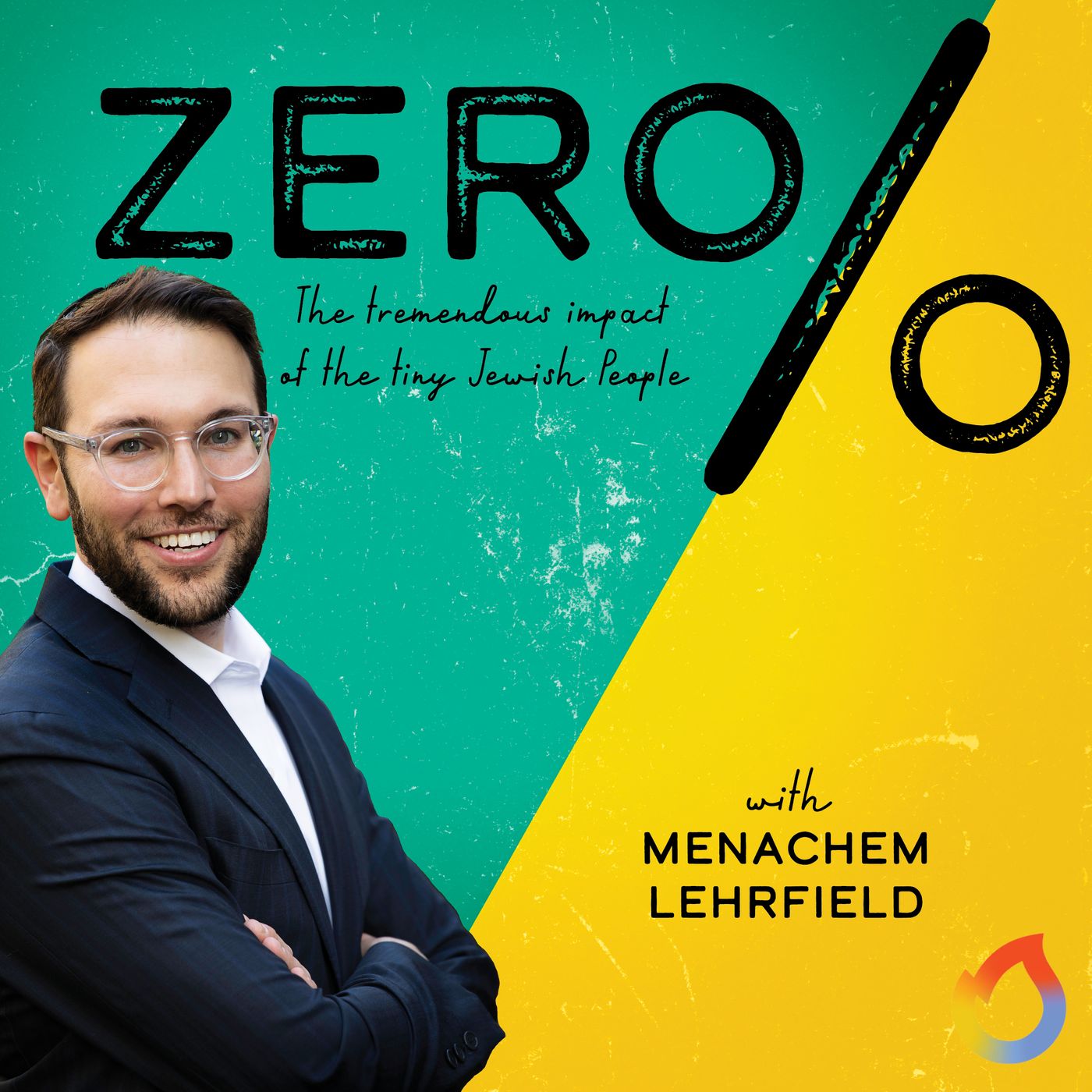
EPISODE · Dec 29, 2021 · 18 MIN
14- The Concepts of Conception
from Zero Percent · host Menachem Lehrfield
In this episode we start our exploration of time and how it allows us to connect to the growth mindset.Transcript-Hey everyone, I'm Menachem Lehrfield. Welcome back to Zero Percent. This season we've been learning all about the growth mindsets, and how we see them in Jewish thought. How the different ideas that we learn ourselves, that we teach our children, over time can help encourage and build a growth mindset, and how profound even the slightest change in the way we educate, and the way we praise and encourage our children, how even that slightest thing can help produce a growth mindset. But even more profound is the way we incorporate all of these growth mindset concepts, into the way we live our lives. That is the type of organic, natural exposure to the growth mindsets, that produces generations of growth mindset people, which in turn produces generations of successful people.Life has lived in the realm of time, and the reality is when you look at religion, the majority of religious life is based on time, whether it's the different ritual or events that happen throughout the year, and Judaism, like all other religions does mark different times of year in specific ways at specific times. But also in the way that we individually, we mark different life cycle events at different times. And in doing so, both in stopping throughout the year, to mark a specific season or a specific time, or, pausing through my life at specific junctures in time, as I am experiencing certain things, allows me to bring religion, to bring significance and meaning into time, and thereby allows me to bring significance into life itself. I'd like to spend the next couple of weeks, exploring how Judaism approaches time, how we approach different lifecycle events, different moments in our individual lives, that allow us to connect organically and naturally, to this growth mindset research.And then we'll begin to explore the different times throughout the year, where we may commemorate or remember a specific thing that happened in our past. But more importantly, we tap into something right here in the present, that is deeply connected to the different concepts we've been learning up until now. So let's begin with the Jewish life cycle. Now, where should we begin? Many would start from the first Jewish event in the life of a child. But the reality is, that the Jewish life cycle begins way before that. It begins all the way a conception. Jewish wisdom teaches, that when a child is in utero, when a child is in its mother's womb, it studies the entire Torah, with its own special angel.So what that means is, as a child is in utero, it learns every single thing the child is ever going to learn. Everything the child ever needs to know for the rest of its life, it learns while it's in its mother's womb. And then right before the baby is born, the angel taps the baby on the top of its lip. And just like that, everything that he learned is now forgotten. What's the point? What's the point of teaching a child, everything he's ever going to need to know, and then causing him to forget it. If he's going to forget it, what's the point of learning it. It must be that it's not truly forgotten, it's just not accessible to the conscious mind. What that means is, every time I learn something new, I am not really learning a new idea, I'm remembering something I once knew. And therefore, when you learn something that is steeped in truth, you learn a true idea. Deep down, you should feel this sense of familiarity.I remember hearing that before, it makes sense, I recognize it as true. Plato believed, that we all inherently have all the knowledge we need, deep down inside. And he tries to prove this concept from an experiment where Socrates is talking with this uneducated slave boy, who didn't have any background in geometry. And he manages to show that the boy actually understands some very basic and important geometric principles, even though he never formally learned them, just because he must have innately understood these things inside. I remember learning this in grad school and our philosophy class, and thinking that it was really stretched. And even though I don't think the experiment proved the idea, the idea is nonetheless, deeply rooted in Jewish theology. We believe that deep down inside, we have the answers to all the questions we'll ever need to know. Deep down inside the wisdom is there.And it acts almost like a litmus test to understand innate truth, if I can remove all the biases, which is not an easy thing to do. But if I can remove all the biases, when I hear an idea that is true, it should deeply resonate as something that I recognize from my past, something that I know is true. But again, if that's the case, why cause us to forget it. There's something beautiful about being able to open up a computer, that you just bought from the store. You come home from the Apple store, you open up your MacBook, you turn it on. And it just works. I don't know if you remember, but I certainly do. Like in the nineties, when we got our first computer, you took it out of the box, and it took hours if not days to set it up. You had to manually install the operating system. You had to type all of these long commands into MS-DOS. And, why go through that whole process if you don't have to. Wouldn't it be great to come as a human being, just like a pre-loaded computer.Already having all of the software that you need. Wouldn't that be amazing. Imagine being born as a human Google. Imagine having all of the wisdom completely and totally accessible, at any time you wanted it. Why forget it? The point is, we want the inspiration to be deep down inside. We need this compass deep down inside that allows us to understand if something is true or not. But if we didn't forget, if we were born with all the information we ever needed, then we'd never work hard for anything. We would miss out on a lifelong pursuit of knowledge. We would miss out on the journey. We'd miss out on the process of working hard for something. And that is the entire point. The point is to work hard. The point is to put in the effort. This is the pattern of every single stage of life. Every single stage, every phase of life begins with that artificial gift of inspiration. Just like when we were in utero, we learned everything that there is to know, but then as quickly as it comes, it's taken, it's gone.And our job is to work hard. Our job is to put in the effort to build ourselves back to that same point. Every single phase of life, every single human experience, is made up of three distinct phases. The first phase, is the flash of beginning. In Jewish mysticism, the analogy that's given for these three phases, is the male contribution, the female contribution, and the product of both, which is the child. So we have the male stage, the female stage, and the child stage. And this is an analogy, for these phases as we see them throughout life and in future episodes, as we talk about different life cycle events, we may come back to this paradigm. But aside from just being an analogy for all of the other phases of human experience, it's also true in terms of the conception of a child. The first phase, the male contribution, is something that is quick, is easy, doesn't take up a lot of physical space, and not saying that conception is easy.There are many people who cannot conceive, and it is one of the most painful and difficult experiences. But when it does work, the male contribution to the conception and creation of a child, is a very easy, quick experience. It's something that's pleasurable, it's a realm that's imbued with a concept of newness. The male body is producing millions of sperm every single day. And at this point, in the male phase, its endless possibility. Any one of those millions of sperm can produce a child. But if it stays in that first phase, if it stays in the concept of maleness, it's nothing. It's potential for potential sake. The story is told of a king who's riding along in his royal chariot. And as he's riding along, he sees this poor man standing on the side of the road.And in a moment of empathy, he pulls over. And he begins talking with this miserable, impoverished gentleman. And he hears this man's plight. And he says, you know what, I'm the king. I own all of the land. I'm going to give you four stakes, four pieces of wood, not the meat. Four pieces of wood, and I want you to drive those stakes into the ground. And any space between those four stakes, that land will belong to you. The royal guards go, they get the stakes, they come back, they hand them to this poor gentleman. And he takes the first, and he sticks it right into the ground, right in that spot. And he takes the second one, and he travels a couple miles down the road, and he puts it in the ground. And as he's putting it in, he thinks, well, if I go a little further, I'll get more land.So he goes a little further, he is about to put it in the ground, and he thinks himself, just a little further. And as this story goes, he never stopped. That is what we call potential for potential sake. That is a very male concept. It's about amassing money, not because I want to buy things with the money, but just to have the money. It's about having all of my options open. Because as soon as I make a decision, as soon as I decide I'm killing off all the other options. I heard once, I don't know if this is true, if anyone has a source for this, please let me know. But apparently, the suffix in english cide, means to kill, like homicide means to kill somebody, suicide means to kill oneself. What does decide mean? When I make a decision, I decide something. To decide apparently, allegedly, is to kill off all other options. And that's exactly what happens.For the full tra
Embed this episode
What this episode covers
In this episode we start our exploration of time and how it allows us to connect to the growth mindset. Transcript- Hey everyone, I'm Menachem Lehrfield. Welcome back to Zero Percent. This season we've been learning all about the growth mindsets, and how we see them in Jewish thought. How the different ideas that we learn ourselves, that we teach our children, over time can help encourage and build a growth mindset, and how profound even the slightest change in the way we educate, and the way we praise and encourage our children, how even that slightest thing can help produce a growth mindset. But even more profound is the way we incorporate all of these growth mindset concepts, into the way we live our lives. That is the type of organic, natural exposure to the growth mindsets, that produces generations of growth mindset people, which in turn produces generations of successful people. Life has lived in the realm of time, and the reality is when you look at religion, the majority of religious life is based on time, whether it's the different ritual or events that happen throughout the year, and Judaism, like all other religions does mark different times of year in specific ways at specific times. But also in the way that we individually, we mark different life cycle events at different times. And in doing so, both in stopping throughout the year, to mark a specific season or a specific time, or, pausing through my life at specific junctures in time, as I am experiencing certain things, allows me to bring religion, to bring significance and meaning into time, and thereby allows me to bring significance into life itself. I'd like to spend the next couple of weeks, exploring how Judaism approaches time, how we approach different lifecycle events, different moments in our individual lives, that allow us to connect organically and naturally, to this growth mindset research. And then we'll begin to explore the different times throughout the year, where we may commemorate or remember a specific thing that happened in our past. But more importantly, we tap into something right here in the present, that is deeply connected to the different concepts we've been learning up until now. So let's begin with the Jewish life cycle. Now, where should we begin? Many would start from the first Jewish event in the life of a child. But the reality is, that the Jewish life cycle begins way before that. It begins all the way a conception. Jewish wisdom teaches, that when a child is in utero, when a child is in its mother's womb, it studies the entire Torah, with its own special angel. So what that means is, as a child is in utero, it learns every single thing the child is ever going to learn. Everything the child ever needs to know for the rest of its life, it learns while it's in its mother's womb. And then right before the baby is born, the angel taps the baby on the top of its lip. And just like that, everything that he learned is now forgotten. What's the point? What's the point of teaching a child, everything he's ever going to need to know, and then causing him to forget it. If he's going to forget it, what's the point of learning it. It must be that it's not truly forgotten, it's just not accessible to the conscious mind. What that means is, every time I learn something new, I am not really learning a new idea, I'm remembering something I once knew. And therefore, when you learn something that is steeped in truth, you learn a true idea. Deep down, you should feel this sense of familiarity. I remember hearing that before, it makes sense, I recognize it as true. Plato believed, that we all inherently have all the knowledge we need, deep down inside. And he tries to prove this concept from an experiment where Socrates is talking with this uneducated slave boy, who didn't have any background in geometry. And he manages to show that the boy actually understands some very basic...
Ready to play
14- The Concepts of Conception
No transcript for this episode yet
Similar Episodes
No similar episodes found.
Similar Podcasts
No similar podcasts found.