
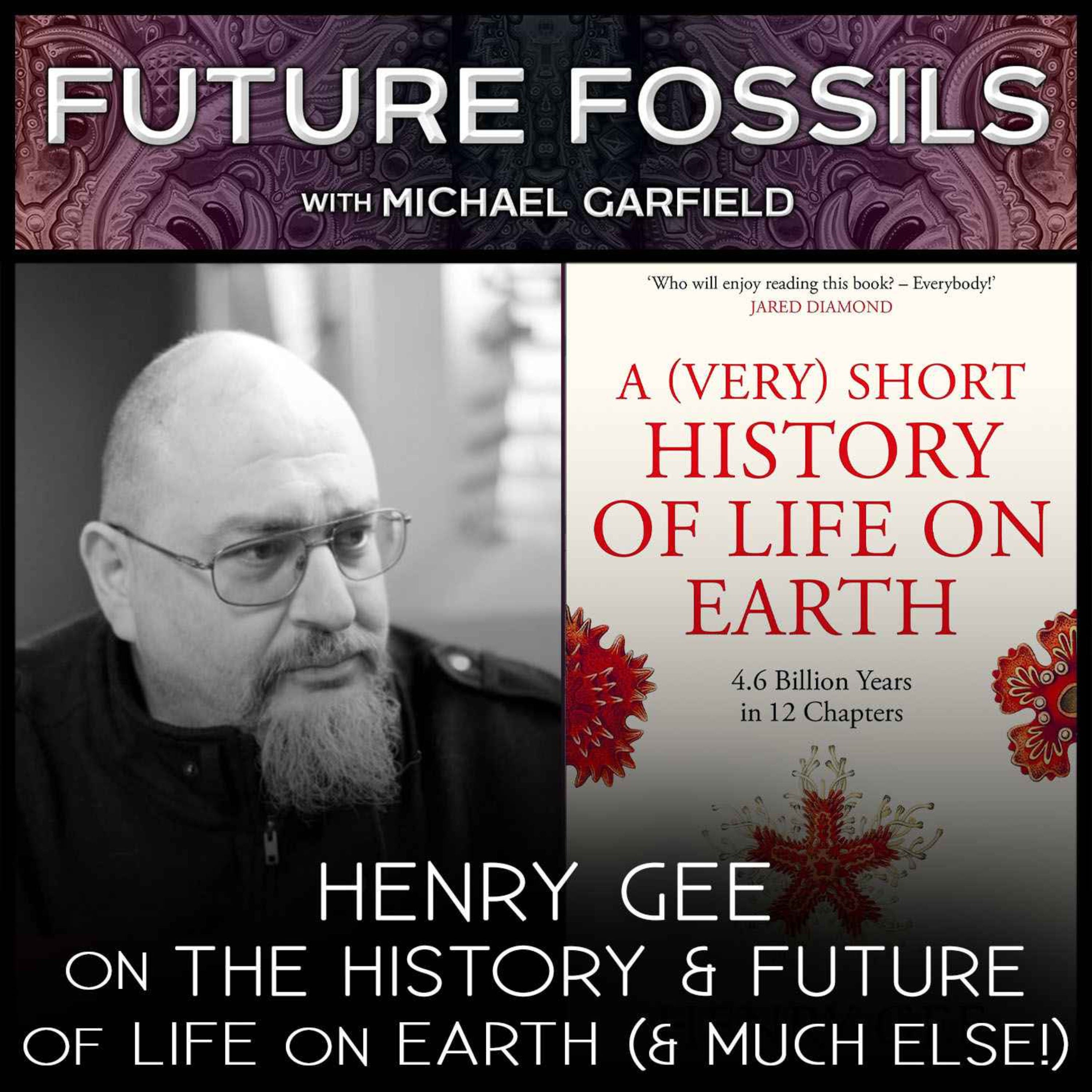
Greetings Future Fossils! I'm making this one short and sweet for episode 184, which is my birthday January 1984, which is super appropriate for this bizarrely congruent confluence of minds that I get to share with you this time. This, I think, is the first episode I'm not gonna bother to edit at all, because it was just so delightful and ripping the entire time that I just can't bring myself to do it. So, I don't know, guess, let me know if you notice the difference if you take issue.
I think I'm probably a whole lot less articulate when I don't pull all the fillers. But at any rate, Henry G is amazing. Paleontologist, evolutionary biologist, senior editor of Nature, musician, parent, humorous person. I deeply enjoyed talking with the author of several books, including the one that we discuss in this episode, a very brief history of life on Earth, which in, as he puts it, 12 pithy chapters, takes us all the way from the formation of the cosmos to the end of life on Earth, actually, into the future.
And what I think is a rather virtuosic demonstration of speculative evolutionary biology in the final chapter. But it's possibly one of the best short, like 200 pages, ways to acquaint yourself in detail with how life has evolved on its planet. I really was deeply impressed as a lifelong fan of this subject, and you gotta read it. That's all I gotta say.
But because he's such an interesting multi-dimensional, well-rounded person, we spend a good deal of this conversation talking about other things as well, including the fact that he was the founding editor for Nature's Futures Series, which was originally a commissioned science fiction series that basically hosted everyone of import alive as a science fiction writer at the time of its inception. And since, I mean, that may be an exaggeration, but you know, it's not that much of an exaggeration. And we talk about music, and we talk about family life, and we talk about a number of other things. I really feel like this is a quintessential Future Fossils episode.
I'm delighted that I get to share it with you. And before we dive in, I just want to thank every single person supporting the show on Patreon, because you guys, I'm up at 1am right now with my son in my lap, because this little guy will not go to sleep, and I had to extract him from the arms of his exhausted mother so that she could get some sleep. And basically, this is the time that I have to work on the show these days. It's nuts.
And without your support, I wouldn't be doing this at all. It would be too insanely difficult, and yet it is precisely because I have this family that I must continue doing Future Fossils. So thank you to everyone. We're only about a quarter of the way towards my goal of a thousand patrons.
If you love this show, for the love of God, please put some money on it. Two, five, ten bucks a month. I don't care what it is. The goal is a thousand patrons.
Special thanks to Jonathan Musser and Michelangelo for the latest sign-ups. Michelangelo, as you probably know, was the guest on three excellent episodes of this podcast that I highly recommend you dig back into the archives and discover for yourself if you haven't already. Oh, also, patrons supporters just got their hands on the lossless downloads of my latest live performance, opening for Divachka at Meow Wolf in Santa Fe, which was easily one of the coolest days of my entire life. That video is now up on YouTube, and Bandcamp and Spotify and everywhere else.
But if you're the kind of person who appreciates 24-bit Dolby-Master audio, rather than 320 kilobytes per second MP3, well that's just one of the many many things that I do to try and shower my love on every single person who helps me keep this show on the roll. All right, thanks everybody. I love you. Enjoy.
So, you know, my computer is very wayward. I bought it second-hand off a friend until we've been going so I have connected to Riverside before I have no idea why I can do it today. Not a problem. The way I kind of saw it as this, you know, like tetrapods emerging onto land and then deciding, no, no, no, no, we're going back in the water.
And then, you know, like someone, I follow this science fiction newsletter that said, that said, Star Trek Enterprises, the only show that got it right because they're the ones that are showing. Sorry, I missed you followed something and then I had to follow something. I said, I said, I subscribed to the science fiction newsletter that said enterprises, the only Star Trek series that got it right because they're the only ones that show the technology not working perfectly. Yeah.
You know, the ones that are like, oh, I don't know if I want to go in the transporter. That's sketchy, you know. So, you know, it's and after all the timing issues we've had on the rescheduling. I mean, you know, it has to come right eventually.
Oh, that's better. I can can I hear you in both ears now? Probably. Yeah.
Yeah. I can hear you better. Probably have my daughter screaming in both of your ears. Yeah.
See, I heard that before. You see all my computer I could see in here. You and I just couldn't get my microphone to engage. It just refused to do it.
Anyway, we're here. No, wonderful. Well, I'm excited. I was actually up all night with your book.
Oh, Oh, oh, Christ. Oh, Christ. It's not that long. It's been a long time since I pulled an all-nighter, but I really felt like I had, you know, I've got a family and there's a lot going on and I had, I don't know, 20 pages left by the time the kids were asleep and people.
Yeah. Yeah. It gets better. It gets better, man.
It gets better. You know what? I, how old are yours? She's turning three this week and he's almost eight months.
Yeah. It gets better after they hit five. Then it kind of calms down. I remember when our first child was born, he's now 24.
The first six months was hell. And then one day he slept through the night. He went to sleep and I remember me and my wife sitting exhausted on the sofa and we just looked at each other and said, what did we used to do before we were parents? And we used to jointly edit this newsletter for local parents and we used to put in funnies that appeared on the internet and one was, so you want to be a parent.
Try these simple tests to see if you're fit to be a parent. One, shopping. Go around the supermarket and do your usual shopping but take with you a live goat. Being prepared to pay for everything the goat eats or destroys.
Preparing your living room, get a cooked fish finger, put it, stuff it down the back of the sofa and leave it there for a year. This was a bit old school. Prepare your video cassette recorder. Put a slice of toast.
But my favorite one was how to dress a one year old. So this exercise, you will need an octopus and a string bag. Now put the octopus in the string bag without any of the tentacles coming through holes. So you can relate to all these.
Indeed, yes. I mean, I don't know. I must be a glutton for punishment because I have a great sense of humor. It feels, I don't know, there was this thing.
I don't know if I talked to you about this in emails leading up to this of which there were many. But I kind of fell out of academia after I read a couple papers in the final semester of my undergraduate degree that kind of knocked me off the rails that I've been on. 21 years consistent monomaniacal obsession with vertebrate paleontology. And then I read this paper by Martin Noah and Josh Plotkin on the evolution of syntactic communication.
And I realized, oh my god, they're talking about more than just syntax of words. They're talking about multicellularity. They're talking about social organisms. Like this is a math that the error catastrophe that they were describing here in the recombinant adaptation to that crisis explains a kind of a teleology in evolution.
And I got really excited. And I started pressuring, you know, I was at the University of Kansas and Ed Wiley was there. And of all people, the co-author of evolution as entropy, you think this guy would have some sympathy for someone with a yen for general evolutionary dynamics. But he was shockingly dismissive of the idea of evolutionary phenomena before DNA.
My boss as a scientific illustrator at the Museum Linda True, she said, look, if you want to put an interdisciplinary fellowship together, you probably could, and you could probably get it funded, but you'd need six people advising you in six different departments, and they all hate each other, and they don't trust each other, and they don't speak each other's language. And I said, I'm the student, I'm not supposed to be teaching these people. And I bailed. And I spent 13 years in festivals.
And the short of this story is that I feel like the insanity of making art and music and giving talks at festivals for 13 years before I fell back into the orb as a science communicator at the Santa Fe Institute had prepared me for children in a way, because it's like you're never getting enough sleep. There's always too much noise. You know, you're just so I'm permanently in a way kind of like peripheral. Well, I've got, you're doing lockdown.
I've got a new passion. So I bought a cheap guitar. And as soon as I've got a keyboard player, so I thought it was a guitar. You know, I've been doing some music with a guitarist friend of mine, but I need to play some guitar to show him what I mean.
You know, I play some not very good guitars. I think I can replace it with proper guitar. But lockdown does these things to you. I mean, I used to be a live player and then lockdown, you know, pandemic, and I discovered I'd much preferred recording at home.
And I'm afraid I bought this first guitar. It's a very cheap Epiphone, I think 90. And, you know, it's a slab. But a friend of mine said, come on, you're soon going to get a whole collection of guitars.
You won't be able to resist it. And, I don't think it'll be a chance. And I said, no, no, I won't do that. But I do have my eyes on an Epiphone.
Let's pull with humbuckers because I'm in it. And I just commissioned a woodwork friend to mine to make me a mandolin. So, so I'm, you know, I've got the bug. Do you have recordings online?
I do. I do. I do. Okay.
The thing you should look for is an album by the recording name is G&T, G&T, and Thomas, so it's G&T. And the album is called Ice and Disliced. And it's on Apple Music. My friend Adrian Thomas, who's an old friend of mine, I was in a band with him like 20, 25 years ago.
And he turned professional. He's a professional guitarist and he teaches and plays. But then he had, he had an unfortunate happening, got psoriasis in his finger ends. So he can play guitar to teach and record a bit.
But he's also a drummer. So he's back, you know, behind the grumps or in about four or five different bands. And he makes a living. So during lockdown, he had plenty of time.
But now he's always out peeking. So I don't know if I've got so much material, I've just sent him a disc and do another whole album. And maybe we will. But I, for this album, I used a Yamaha clavino piano, which I've since sold.
And I've got my crew Marlmojo 61 organ, which does beautiful robes and clavino. But I had banks of synthesizers. I had an Oberheim, OBX, and I had a MOOC Model D. And I had, oh, God, Corganis 20 and a profit five.
But all on iPad, you know, I had an obsolete string synth and I had a melodron all on iPad, all on iPad. So it sounds like Rick Wegman and his knights of the Knights of the Round Table going to the center of the Earth on ice. But it's just me and an iPad. But now I've got a called Nautilus, which is just fantastic.
I mean, it's got so many sounds. That's the one I did for the audio book for the history of life on Earth. Because he's got the most amazing sound. It's got the sounds of flies solving quadratic equations and avvarks and chatting to each other in Chinese.
It's just the best. It's got super foley and incredible sounds. And it's got lovely world music. I didn't know what a duduk was.
Do you know what a duduk is? Yeah, it's the Middle Eastern string instrument with the little... No, no, that's something else. A duduk is a wind instrument.
It's an oboe. Oh, yeah. And it's such a haunting sound. And they've got, you want a duduk they have at least three in the North of us and all sorts of other Bulgarian nose flutes.
And I mean, it's just astonishing. So I did the audio book for the history of life on the North of us. I mean, it cost me, you know, £2,000. But then it's, but as I did the audio book, it's tax deductible, right?
So, you know, that's what most people really hate it. I did all these fantastic sounds. And you read the reviews on Amazon and people say, it's a fantastic book, but I really hate the sound of it. Well, you've spent my heart by doing music beds for your own audio book.
I did. I did. I did. I mean, what happened was, sorry, I'm blithering along.
What happened was, I didn't expect them to ask me to do the audio book. So I was very surprised when the pumps are asking me and I thought, basically they're doing it so they don't have to pay an actor union rate. So I thought, that's why they're doing it. But no, they did pay me.
So then they said, Hey, Henry, come down to London for three days and record it. I said, no, there's a pandemic. I'm not going anywhere. I'm going to do it at my home studio, Slabby Road.
And they said, yeah, I said, look, I've been recording albums. You know, the one I did, G&T was the third one I did in lockdown. I said, I've been recording stuff. I don't let me show you a demo.
So I sent them a demo and with some effects and they liked it. So I did the whole thing. And they didn't require me to do much in post production, except take some of the dinosaur heavy breathing away, too much dinosaur heavy breathing. So some of them, some of the vocals, some of the erasure was a bit hot, so I had to read a few bits.
But that's pretty much as I recorded at home. And a few people thought it was lovely, but most people hate it. Oh my god. I, you know, now, what do you mean doing the festivals for all this time?
What do you do? Well, I mean, I was a painter. I mean, I parlayed my scientific illustration training because what happened was the University of Kansas Natural History Museum said, we really hate to tell you this, but we can't actually pay you what you're worth. We're paying you like a third of what you're worth because of Bush era budget cuts.
And so I mean, I kind of lingered while I was trying to find an appropriate institution. I never actually ended up sending my vertebrate paleo recommendation letters out to the schools that I was trying to apply for because I had met a girl who is this, these kids mother now. We were together for 14 years before we actually had kids, but those 14 years were insane. And so, yeah, there were a couple years there after my undergrad that I just lingered around at the museum and did illustration for the curator of her pathology.
And they said to me after a while, they're like, you know, I'm sorry, but we wish we could pay you what you're worth and we can't. And so I said, well, I'm not finding a grad school and I'm not finding a scientific illustration career. So I'm just going to bail. I'm going to go live in the one place that I know I love, which was Boulder, Colorado.
So I moved from Lawrence to Boulder because I had fallen in love with Boulder at the age of seven. Well, it's easy to fall in love with Boulder. I've seen that once. Yeah, I fell in love with Boulder at the age of seven because that's where I met.
Well, that's where the second place I met Robert Bocker. And I'm at the age of three in Palm Springs at the Museum of the Desert. My dad was in the desert. Yeah, he took with an impression of age.
Yeah, I mean, he loves kids, right? And he took me under his wing. And at the age of seven, we were going through Boulder to visit a childhood friend of my mother's and my mom decided to just look him up in the phone book and give him a call. And he picked up the phone and said, why don't you come out to get tacos with me?
I'm going to the field tomorrow. I just got over the flu. But let's do this. And he spent two hours with me at the Maya and Boulder.
I don't think it exists anymore. The Terrace Maya, but he spent two hours with me just doing this thing, drawing on little notebook papers, answering every question I had, convincing my mother that she should let me have a pet snapping turtle. And then taken me out to his dot send to show me the oldest brontosaurus bones, then known to science in the bed of his truck. And, you know, and so that sealed the deal for me.
And I fell in love with Boulder then for sure. And then I went and I did fieldwork with him starting at age 12 every summer until I guess 19. I was there every summer in Wyoming and Coma Bluff working on Nail Quarry and driving past the original Stegosaurus Quarry on our way out to now, Michael, are we doing this thing now? Are we going to start doing this?
I mean, we're in it. I mean, at some point, we are going to talk about your book, but I'm glad to get to know you. I'm going a bit of an exclusive to you. This, no, I haven't told anybody this, it's just a little secret.
Okay. One of the problems that people have had with my book is there no pictures. And so that's fine with me. I mean, I wrote it as a novel kind of, I wrote it as a story.
Didn't have pictures. Imagine the things for me, but you're an illustrator. So I'm talking to you about this. I'd be appreciating your views.
So I said to the publisher, I had two publishers, one in England and one of the states and I said to both of them, hey, why don't we do a slightly longer history of life on earth with pictures? And they said, well, let's see how this one sells first. So if you want to see one with pictures, get everyone to buy lots of copies. But I am doing a kind of children's version, this is exclusive, which will be illustrated.
And they would have an illustrator, but I put your name forward and other people I know just to see what they think. But it's going to be a children's version, but as it'll be fairly high level because most children know more about dinosaurs than their parents. So I probably shouldn't tell you because there's nothing being sealed, there's nothing being inked, there's no agreement, no contract yet be made. But I've been talking to the editor and we've been talking about what formats will do and so on.
So there will be a version of my book with pictures aimed at, you know, preteens, I suppose. Well, I'll buy off from my kids without question. I'd like to put my name in the hat in spite of the fact that I'm rusty as hell. I recently.
Well, I like your pictures. You sent me an email, you know, how many problems I've tried to get in touch. You said, you know, by the way, here's some pictures. And I thought that was great.
I put you forward with some other people. And I have to say, including both my kids, terrific illustrators, you know, purely nepotistic. And I said to my younger daughter said, hey, you can't do that. And she my younger daughter is my young daughter is very shy.
She's 21. And automatically she suggested a college friend of hers who was now a professional illustrator. And she said, you can't you can't suggest me. You're my dad.
I said, look, you've got to, you know, usually old boy network. That's the only way to get on. And my my all my daughter will go out of a way to go out of a way. My son is outrageously out there.
And he also does amazing pictures as well. He is he used to be a girl. He used to be a very strange girl. And then he transitioned to be a boy in about 18.
And he's now much happier. But all the time he did the most of the make. He does the most R rated cabaret at the LGBT club. You know, one of the best parties I went to was when he was in the cabaret of a of a gay club.
And it was I'm not a party person. I don't like parties. But I like this party and I realized I liked it because everyone was going as themselves, whether they were in street clothes or got up in the most amazing costumes they were going as themselves and not as their daytime persona. So no one felt threatened, you know, and and some chap pinched me on me bum.
The only time I've ever pulled at a disco. I thought, no, he's not my fight. Nice chap. Not my time.
But I thought I wouldn't be there. So, you know, one o'clock in the morning, much to my surprise, I'm still booing in a way on the dance floor because I had pretty old school disco, you know, from my childhood, you know, Donna Summer and all that stuff. And it wasn't, you know, club beats, which is way beyond me. So my son, he was trans, he was then just non-binary.
He said, does anybody see my dad? He was in the green room with all the other performers. Does anybody see my cat? And they said, well, what's he look like?
He says, you know, a bit 50s, fat bearded. Oh, he's still on the dance floor. So I was on the dance floor. It was going quite slowly because it was one in the morning and by that time the floor got rather sticky.
So, you know, then this enormously tall drag queen who must have been six foot full without the heels sort of floated towards me and said, am I, Henry G? And I said, yes. And I said, I don't really do all this, you know, I'm not as young as I look. And he said, or she said, no, we all have that problem, darling.
And now this person called Glitter Hawk is a great pal, you know, I mean, I don't know what he's probably called Kevin and he works in marketing. I've no idea. But you know, he was all anti-gressing into the strange world in Africa. But you've got all this to look forward to, mate.
You know, well, you know, to tie this into the paleontology, then, you know, PRTO, Desharnas, it was always talking about the hyper-collectivization leads to hyper-individualization or hyper-personalization. It's like, you know, the, the niche construction, you know, that happens at, you know, when people like Jeffrey West talk about cities as, you know, three-dimensional complex overlapping transport networks. And so you've got, you know, this, this super exponential bonus to the number of interactions that's happening. And that means to the number of niches that are propagating in that space.
And so, you know, a global, you know, connected, highly heterogeneous society. And this is exactly what you would expect. And that's why William Irwin Thompson, you know, used to talk about how so-called evil is the enunciation of the next level of order. And he would talk about how people were freaking out about rock their kids listening to rock and roll, which has, and how that, you know, it's every, every generation has basically trained on data that no longer encompasses the world in which they live.
And so it, this stuff comes up as noise. No, well, you know, it's just like generals always, the generals are always fighting the war that was fought for one before last, well, they, I mean, it's, but I have to say, I'm still lucky. My kids still love me. And this is because I've given them nothing to react against.
I'm just a little even more outrageous than they are. It's the, it's the, the only way to do it. But this is something that you will find quite soon is the love of dinosaurs that they will never grow out of. But I remember when nature published the first feather dinosaurs, it is that I'm going to tell you the story and I'm going to tell you where the kids come in.
I was at the meeting of the Society of Vertebrate Paytantology in New York in 95 or 96, I can remember which it was. Anyway, one of the mixers was in the hall of the North West Pacific, you know, one of the one with the totem poles and the pot latches and the clinget artifacts. And anyway, there we were. So how to buy totem poles drinking beer and this Chinese fellow called Chen Pei G terms up with this very greasy, much handled photographic print of what became sinosoropterics.
And, you know, he works in the Yixian formation, but he's a, he's a crustacean specialist. So, you know, their crustacean little branchier poles and things in their like teenagers have spots. I mean, it really is, there's loads of them. And he was using them to be to do the stratigraphy, but he kept coming across the bed of dinosaurs and, and of course, some of the places, one of them.
So he brought this photograph along and everyone was wowed. Martin Rell said, I'm on the next flight to Beijing, and I was standing next to John H. Ostrom, who was very old, and he just was completely lost for words. And he just sat down on a bench with his stick and he was just amazed because all his dreams had come true.
But we have people some context there because yeah, Ostrom found DeNonicus. And so that was, while, while, he was a student, his exactly, he was a pro, he was a mentor of back there. And they, the two of them, they revived dinosaurs into these, into active, fast and metabolizing intelligent creatures. They gave them feathers before they had any evidence of feathers.
And so that's the education. But they made them hot blooded. They make, because when I was in my, when I was a little kid, darn, it's always seen as lumbering, stupid things that just died out because they were stupid. That's how it was seen.
Oh, I lost you. There we go. You're, I hear you now. No, somebody phoned me up.
I come up. Chen Page was at this meeting. It's at times like this as a journalist when you realize you've run out of business cards. So I found a bit of cardboard, you know, being very full of initiative.
I found a bit of cardboard just the edge of a beer mat and, and wrote my name and contact details and through the crush of people, I gave it to Chen Page and the rest is history. He sent me to the paper, we published the paper. And many years later, I happened to be in China and I was at the Institute in Nanjing. And I, that was when I actually saw Sino's or Optics for the first time.
The, the director took me up to their strong room to see their treasures. And there was Sino's or Optics and some other mammals and things. And then we came down and was standing outside this, outside the building. I don't know if you've ever been there, but it's very hilly, Nanjing.
And we looked down at the bottom of the hill and we could just see this old man toiling up this hill. And he got to the top and it was Chen Page. He aged a lot in the previous year. I didn't recognize him, but we entered, you know, the introduction to the said and then he got out his pocketbook.
And in his pocketbook was this piece of cardboard with my name and numbers on it that I'd given him. He'd had it in his pocketbook ever since as a kind of totem. That really got to me anyway. To cut back a bit further, because, you know, I'm being an editor of Nature, I get all the papers, but I don't see the fossils.
And I always love to go and see the fossils if I possibly can. So when the kids were four and two and a half, the Natural History Museum in London, and I was living in London at the time, had an exhibition called Feather Dinosaurs from China. So I dropped the young one at the child mind doing me and the four year old, got on the tube to the Natural History Museum. And my wife was a journalist.
She was at the BBC at the time. So it was half the holiday. So off we went. And because it was the half the holiday, the main dinosaur exhibition, which is free, which is absolutely rammed, but the Feather Dinosaurs from China exhibition was in a side room and you had to pay extra to get in.
So there weren't many people in there. And it was just nine fossils in there, all lit mewdally in this exhibition hall. And I think I had published eight of them by that time. One of them was core diptorix.
And that wasn't on the wall. That was on a tabletop slab. I hadn't realized quite a big. It's like a turkey.
It's a great kind of gangly thing. And I completely forgot about the kid who was whizzing around this exhibition like a stray asteroid. And so I was deeply thought looking at core diptorix, looking at the jaws and the feathers and wondering what this was. And this little face appeared on the opposite side of the tabletop and said, Dad, did you punish this in nature?
And I thought, yeah, well, out of the mouths of babes, you know, I remember the paper, yeah, they sent it in and we punished it. That's what we did. So you know, you have this to look forward to. It's going to be fun, especially in Colorado.
I saw the Archaeopteryx once one of the specimens. I'm trying to look it up on photos that must have been 2015 and Tucson at the Gem Show. They had a touring and I had a religious experience with it because this is strange. I mean, I'm going to, I don't know, out myself as a weirdo, I guess with you.
But I had a, I was painting in 2010, I was painting at NASA Ames. I was the only person that was ever allowed to live paint at an event that they were hosting. Amazing place. Yeah, the hangar.
Had its own clouds built. So they, so I was painting at this place and this woman comes up to me and she says she'd like to commission me to do a painting in exchange for second like bodywork. And I said, okay, so I met her at her house in a mission a couple weeks later and she gave me 2CB and lay me down on a table and worked my back for a few hours. And at some point in that experience, I had been thinking about this as, and it's politically, it's in politics to call it this now.
I don't know what to call it. But at the time I was trying to like, I was like, do I have a spirit animal? And I couldn't come up with, you know, an animal with which I identified myself. You know, an animal that felt like my familiar.
And somehow in that bodywork, she must have been working some deep tissue or something. And I felt this extraordinary grief. And then I realized that the reason that I had never been able to find my familiar is because it was extinct and it was the Archaeopteryx. And the Archaeopteryx, I saw in that moment that I saw it, I saw it with these gorgeous iridescent feathers, like a black rackle, black feathers with a blue and green and like white flare.
And then, so that was 2010. And then it was, I think, was it 2012 or 13, that they actually did the Molana poor research on Archaeopteryx and confirmed that they were actually proposed that that was the precise feather coloration of that animal. I'm just still thinking, can you have a spirit animal that's extinct? That's interesting.
But I mean, I think my spirit animal is a slug. It moves very slowly. Like salad. Well, there's a tie in there, I guess, because my friend Bruce Damer, who works in Origins of Life Research.
Yeah, that's right. You told me about him and I his work on diving, reading up. Yeah, he works with Dave Damer at UCSC. But Bruce was working with NASA Ames on some of the early A life and Origins of Life stuff.
Was he working with with Lynn Rothschild? I'm not sure. I'm not sure. Because she said NASA Ames and goes out to Yellowstone and looks at all these extremely far-out.
Not surprisingly, if they know each other. But I mean, the slug husband is called Rocco Mancinelli and he got some extraterrestrial life. He actually put bacterial samples on the long duration exposure facility and had them exposed to space for ages and brought them down. And most of them had died and some were alive, although very sick.
They could, with a bit of love and care, they could just about be revived. So he was trying to wonder if Panspermia could work. I'm like the Tardigrades, the Chinese accidentally crashed on. Was it the Chinese?
Oh, he's really the Stig I think that that's the Marvel and DC comics of Mist trick. They're a stupid Tardigrade man. Somebody who actually didn't swallow Tardigrades in a pet. And then I was trying to imagine, make a little story about this.
I tried to do this as well going to sleep and I was having a nap. So I imagine this girl who's a mild spectacle, Belinda Barker is a nuclear power station technician and a cadmium rod's not going into the pile. And so the thing is going to blow up. So she actually goes into the live radioactive core and fixes it and comes out and underneath the radioactive, she doesn't realise she's suddenly grown this kind of keratinous shell that fades away when she's out of the red up core.
So then she becomes a kind of daredevil who goes into space and into radioactive waste and molten lead and everything. So Tardigrade man is the next superhero. They should do that. I mean, there's so many animals that could be superheroes.
I mean, about sea cucumber man who sails villains by squirting its guts out from its anus. No matter what you are. And that's F.W. is what they call that.
Yeah. Yeah. Well, you should know that there's a brilliant animated series for, I guess, children and adults on Netflix called Keepo and the Age of the Wonderbeasts. That features a post-apocalyptic show in which humans have retreated underground and when they keepo the protagonist comes back above ground, she finds that the surface has been claimed by all of these mutated sentient descendants of the animals that we are familiar to us.
The wolves are especially hilarious because they're all like obsessed with science. They're all Carl Sagan's spoof, the wolves. But each group has its own sort of clan. And then there's this one entity in there that is a hive mind of Tardigrades that manifests in these plumes of water and is able to shape shift and take form and like mind meld with people.
I'll bet like the thing in the abyss. Yeah, it is. But it's made of Tardigrades. It's like a Tardigrade to just hive.
Tardigrades are just the best. They're so under-appreciated. They're just so cute. So this is actually a point of entry into your book.
If you could imagine us finally getting to it. Because one of the things I wanted to talk with you about is how I found threads through the book. And one of those threads is dimensional, for lack of a better term, conquest or niche construction or the adaptation niche construction thing. The way that you tell the story about how in the water and then just the extraordinary hardship.
Everybody thinks about this flappy, long fish or whatever coming out. But that was actually very late in the game compared to all of the other prep work that had to be done before that. The mycelia were there already and the insects and everything else that vertebrates were late to the party. And then you end the book.
Well, I guess then you've got the air. You talk about the birds and we've touched on that. But I think it would be lovely to hear you riff a little bit on the evolution of flight. And then towards the end of the book you talk about, well, let's not discount space.
We're very close, it seems, almost. If we can not destroy ourselves first to learning to adapt in a, I love that you referenced Douglass Dixen's Afterman. And then he's got the man after man, which apparently I guess is largely plagiarized from Wayne Barlow. Well, I don't know, it's a bit strange, man.
But man after man has those space adapted humans that are like radiation shielded and everything. I'd just love to hear you settle into your saddle here as an evolutionary storyteller. And riff on this. Just talk about life as a process of continuing to achieve success in new hardships.
Somebody who will know from Santa Fe is Stu Kaufman. And he has this idea that life is this, he defines life in a kind of thermodynamic way. But life is that system that is constantly expanding its own phase space. It's constantly making new niches for itself, which is not the case for physical chemical systems.
And this is why he thinks that having a definition of life is kind of impossible, because it's always changing the game. And this is what I found when I was writing the book, that if life has a motto, it's whatever doesn't kill you, makes you stronger. So that life originated very, very early. I mean, almost as soon as the earth formed, as soon as the earth was remotely habitable, there was life.
It started very, very quickly. And this suggests to me that very simple life must be ubiquitous in the universe. I mean, I think it's one of the things that planets just get infested with, like small children get colds. And it's just that complex life is another matter.
But once life gets going, it starts responding to environmental challenge by increasing in complexity, so that it can basically run more economically. And the first thing, the first threat was the great observation it meant, two and a half cost your mind back two and a half billion years ago, when all these little organisms which had adapted for life without oxygen, were suddenly confronting with oxygen. And if that weren't enough, an ice age that covered the planet in ice for 300 million years. So what they did, what life did then was perfect something they'd been playing with, which was the kind of bacterial community.
Bacteria are very big areas. Lots of different species tend to live in the same places in biofilms and stromatolites. And because one bacteria is wasted is another bacteria's food. And they're always swapping genes, swapping chemicals.
And they live in this kind of freewheeling goblin market of exchanging stuff. And what they started to do was take this to the next level. So various different bacteria, each of which was specialized in its own thing, would live inside a common membrane. And the bacteria that did their own thing just became good at doing their own thing and leaving all the other tasks to their cellos.
So the little cyanobacteria, which were good at photosynthesis, just did photosynthesis. And they contracted out all their other functions to mitochondria, which used to be regular proteome bacteria, but they were very good at metabolism and oxidative, forest thorylation, releasing energy from food, basically. And then the original protagonist of all this was the archaeon, the tiny little archaeon that had started out by sending little tendrils out to other bacteria that surrounded it. These little tendrils eventually became the endoplasmic reticulum of the eukaryotic cell.
But the archaeon was the place where the chloroplasm, the mitochondria, parked their DNA. And so the archaeon became the nucleus of the cell. And then you have this cell. And the thing about eukaryotic cell, it's just like Adam Smith and the Wellford Nations.
You can have little cottages all during their weaving and marketing and selling from their little cottages. But they can only do so much as one family operations. But if you want to do it more, you get all of them working together in a factory. And each one works on one stage of the process that it does best.
And this means you can produce some more widgets or cloth works or whatever than you could just by the sum of the cottages. So eukaryotes could do more with less and go further. And that was the response to the great observation event. And then roll a few million years, billion years, whether more tectonic, bruhaha and fus and bother and more ice ages, some of the eukaryotes start getting together quite aggressively to produce multi-cellular organisms.
They started doing this fairly early on with very simple fungi and algae. Multi-cellularity has evolved at least 20 times independently. But it was when the animals came along where multi-cellularity really became complex about 600, 700 million years ago. So that was another response to global threat.
And so what happens is life tends to respond by increasing in complexity when disaster looms. And of course, you know, you talked about the tetra-bots coming onto land. Well, whenever there is a vacant niche, life will invade it. No matter how hard it is back in the Cambrian, the pre-Cambrian, the land surface of the earth was volcanic rock.
There was no soil. There was a lot of wind and water and weathering, but not it was a pretty rough place to live. So it took millions of years of lichens and small plants and breaking down the rock and adding their own organic matter to make the first soils. And it was only then that the little bugs came in and lived underneath the leaf litter.
And the tetrapods were, and still are, a strange group of fish adapted for water of negative depth. I mean fish live in all sorts of depths. You have fish that live in the deep sea, and you have fish that live in the open water, and fish that live in the shallow water, and fish that live in water of negative depth, which is the fresh air. So when the earliest tetrapods came from river predators that lived in shallow water, and quite often were above the water.
If they were above the water, their first task was to get back under the water as quickly as possible. But that's how tetrapods came about, and eventually by invading a niche that other fish hadn't invaded. And then you get into the air insects began to fly, and so if insects began to fly, they're going to be other creatures that are going to fly to chase the insects. And so the most successful were the dinosaurs who became the first flying vertebrakes.
I mean properly flying vertebrakes, the things that just fell out and parachuted. So in all of that, there's a thing that you talk about here, where you strike it as a kind of like a folding, like I don't know, like the way that I think like the Baker transformation, you know, where you you take the it's a chaos theory thing, where you take two points on a plane, you fold it over, and then you stretch it to the original distance, and you fold it over again. And every time you do that, your original error measurement is doubled. And so you get these, you know, you get these bizarre nonlinear things coming out of that.
And that is... I'm losing you, Michael. Oh, there you are. Yes, so there's something in that that kind of reminds me of I don't know if you ever read any Della's Pilgrim at Tinker Creek, which is a long time ago.
Oh, God. Yeah, such a masterful work of natural history as mysticism, right? And it's why it won the Nobel Prize. And there's a scene in that where she's talking about imagining the glaciers rolling back and forth like shutters, you know, just like up and down and up and down, taking a step back, you know, zooming out into the deep time, you know, and just seeing these successions that you're talking about flickering.
And as they're as these these glaciation and volcanic periods or flickering across the surface of the earth, then we are being sort of like alchemically processed into ever more refined forms. And I really felt that in your book. And so this... Oh, gosh.
I should go and read that. I haven't read that since I was 23 and in hospital with a back injury. I'd listed a keyboard back in those days. They were big beasts and burst a disc in my back.
And I was in Hottle, my father used to bring me a very strange assortment of books. I don't know how he chose them. He bought some really terrible science fiction, but there were two books he bought, which one was Annie Dillard's Pilgrim at Tinker Creek. And I must dig it up and read it.
I found it quite hard work at the time, but the other book he bought was Jorge Luis Borges, Labyrinth, which is the English translation of his Spanish Fictions with a few other things. And that blew my mind and he's still my most favorite author, this Borges. And so that's what rock and roll does for you. You see, you get in hospital and people bring giving Borges to eat.
It's funny that you mention that because I delighted in seeing you bring up Borges in this book. I haven't read any of his stuff. I'm only familiar with it second hand, but then David Krakow read SFI and Tim Taylor, his office manager, he, the director of his office, they gave me the collected works of Borges just like a couple weeks ago. I'm about to dig into it.
But then you also mentioned Olaf Stapleton. It's right, your brain. Oh, Stapleton. Starmaker.
Starmaker. Like people who listen to this show know that I am Olaf Stapleton lunatic. Are you? Yes.
Wow. Well, I thought of Starmaker because I mean, I've read it several times. And while I was writing the last chapter of the book, I got it out again to read. And the reason I felt I had to include it, there were two reasons.
One is the scale of time. In fact, you know that in the book, which we're talking about, which is my book, A Very Short History of Life on Earth, it's all available in all good bookstores. Students that will do half your assignments for you, so by two. And some of the things you noticed there are no illustrations, but there are time charts.
And it was because of Starmaker that I did the time charts in the way that I did them. Like the very, the very first timeline is Earth in the universe. You know, it goes all the way to Milky Way merges with Andromeda Galaxy at the top. And then I have Cameron explosion.
And then now, and then it's time any bit further on extinction of all life on Earth. So it was there, it was just like the timelines at the back of Starmaker to make you feel giddy with the stale of it. So that was the first reason. And the second reason was when I was talking about the Mayfly ever-nescence of human life on Earth.
But we're going to be here and then we're going to be gone like only did large fickering of graduations. And Stapleton most Starmaker, you know, he was a veteran of the first world. For those who don't know, Stapleton was a most unusual writer of speculative fiction. And he was a pacifist, but he did serve on the Western front in the first world war as an ambulance driver.
So he probably saw more death in carnage than even the soldiers did. So he was like most of these war veterans, these authors that came out of war, they were so traumatized by their experiences, but they could only express it in terms of fantasy. Now Stapleton did his kind of, you know, his modern political philosophical fantasies like Starmaker and Last and First Men. But another veteran of the Western Front was Tolkien.
And he was invalidated out with Pyrexia of unknown origin, which we now call Tren Tiva. And he wrote this story called The Fall of Gondolin, which is about this elvish city that is besieged by far-breathing metal beasts, which then became dragons. This is a guy who was one of the first to see the first tank battles. I mean, imagine how traumatic that might have been.
So Tolkien and then other war, this is, I didn't even think about this until I read Tom shipping, talk about this, Kurt Vonnegut and Slaughterhouse Five, who witnessed the bombing of Dresden. So Mervyn Peek at Gorman Garst, all these were battle-scarred PTSD suffering war veterans. I got one for you. Yeah.
While Disney was an ambulance driver in World War I, he was, he was, I don't know if he was a driver, he was in the ambulance corps, 1916. Fantasia, think about it. Yes. Yeah.
And also Snow White. I think Snow White and the Seven Dwarfs are best movie ever made, released in the same year that the Hobbit was published, 1937, and also the same year that the Star Maker was published. Weird, this kind of stuff. Anyway, so at the end of Star Maker, the protagonist wonders how ordinary human beings can cope with the kind of dreadful horror of war.
And he says, we have two lights for guidance. One is our own little atom of human community, and the other is the cold light of the stars, which seem very, very, very antithetical. But I hope you don't mind. I'm going to do it anyway, if you did mind.
And I'm going to read the last bit of my book about Stapleton. And Stapleton concludes in Star Maker, strange that it seems more not less urgent to place some part in this struggle, this brief effort of animal kills striving to win for their race, some increase of lucidity before the ultimate darkness. So then I'll write at the very end, therefore do not despair the Earth abides, and life is living yet. I enjoyed writing that sentence.
It was lovely. It's funny because I know that Stapleton was an influence on Lovecraft, and I feel like Lovecraft completely missed the point. Do you really play well different times? Lovecraft endorsed him.
Lovecraft celebrated him. I think Lovecraft had issues that made him willing to accept the madness of... Well, Lovecraft's don't say, I mean, Stapleton these days would be seen as fairly left-wing, and we know that Lovecraft was a very very right-wing. So I don't know if it's pseudoscience, but it does kind of beg that question about whether somebody's going to call me on this, but it reminds me of something I had read at some point about, that conservatives have a more active, disgust response.
They're just like, they just don't want it as much. No, that's interesting. No thanks. I'll have to look that up.
Well, I love Lovecraft. Lovecraft is so... He's writing is so bad that it's brilliant, if you know what I mean. And Brian Aldis wrote that Lovecraft succeeds a psychological case history even if it fails as literature.
And one of the things you can do with very bad literature is parody it really easily, and lots of people. I mean, there were quite a few horror writers who started by parody in Lovecraft. Clive Barker was one of them. But his Lovecraft, mythos, Lovecraft's world, Lovecraft's use of language, just incredible.
I mean, the man was a very strange, flawed genius. Lovecraft is immense fun, but when you've read the mountains of madness or the horror over Insmouth or all that stuff, when you've read it and you've stripped away all the terrible writing, it has a psychological trace in your head. It leaves some preternaturally kafonic ecore in your fevered brain, and it kind of sticks with you. Well, do you know, I mean, you must know Charles Strass.
Oh, yeah, I don't know him personally, but I know his work and I know when he his books about the laundry, where it's a kind of mashup of Lovecraft and James Bond. Right. It's hilariously fun. I mean, do you have your look like you could be cousins?
I mean, we do, actually. Yeah. Well, I also got my Neil Stevenson beard. Yes, that helps.
Yeah, you think. But yeah, he's... Strass is very, very good at satirizing Lovecraft as well. So I remember there's one of his books about the laundry where he has it that they protected his girlfriend, plays this violin that's made of a human bone, and it's an genuine Eric Kazan.
And that's a short story of Lovecraft, the music of Eric Kazan, where somebody has this haunted violin and plays this impossible music. I didn't read that one, but I bought it for my wife because she was trained and worked for years as a concert violist. Oh, as a luthier. And so she stopped doing that when she had kids, but she delighted in that book, you know, because it's like she's very into spooky stuff.
I also recently bought her Ellen Moore Rifft on Lovecraft and did a graphic novel called Providence. I kind of missed Adam Moore and I should get into it because I've never got into the Sandman or anything like that because graphic novels pass me by and I've only kind of tangentially heard of them through reading Neil Gaiman and books like Good Omens and American Gods and things like that. Yeah, well, I love Neil Gaiman. It's just great.
I think it's one of the finest graphic novels ever produced. Actually, this isn't to the point of your book, but this does bring me to a question I wanted to ask you about because we've been sitting here stewing in sci-fi references for a while, which is normally I don't read the press materials that publishers send me. I just want to read the book. I don't know.
People send me like, you could ask them questions about this. I'm like, no, screw you. I'm going to ask my own questions. But you know, like two days before our last week's originally scheduled call, I went ahead and I actually looked at that packet and realized that you're the guy that founded Nature Futures.
I was like, oh my god, like this has been the, I've only written ever one actual legitimate work of science fiction. But I was like, oh my god, I need to write another because I need to submit something to Nature Futures. And so I would love to hear you talk about that particular act of transgression of getting speculative fiction into a scientific journal. Because I mean, that was just like a Hail Mary pass and you landed it somehow.
Well, you see, the thing about Nature is certainly in the past, we felt that we could do, there was a certain, it's not quite so much now. Now we're sort of huge and corporate. But when I started, Nature was a very small organization now. We really had the sense of, hey, let's do a show right here.
And we sometimes thought, yeah, we could just do stuff because we felt like it. And that's wonderful creative freedom. So it was 1999. And we were wondering how we were going to celebrate the millennium.
And somebody in the office had the idea of commissioning a series of science fiction stories to celebrate the millennium. And I can't remember who it was. One of my colleagues insisted it was me, but I'm not sure. Anyway, this idea erupted to the surface, like a kind of postural and the manager of the kind of books and art section said, okay, Henry, you know about science fiction, you run it.
Well, I didn't know that much about science fiction. But so what I did was, I wasn't quite sure what to do. But then it turned out that Tor books, science fiction in printing New York, was part of the group of companies that also owned nature. And one of the directors, Stefan Von Holzbrink, he was a lovely, lovely guy.
He really liked to get down and dirty with the kids. And he came to my desk one day and said, he was interested in future. He said, Henry, he said, you should visit Tor, they are van der van der companies. So I thought, so I went to New York and I visited Tor and I got in touch with, oh, I can't remember the name, the anthologyist.
I'll find it, you know, Tom Dovaty, associates. Oh, I can't remember the name of a lovely guy who did a lot of their anthologies who helped me on his dead mouth. And they gave me a whole pile of books and huge lists of contact lists, which I went home. So the first person I asked was Arthur C.
Clarke, because I happened to have his email. The reason I had his email was I had done a film review of the Roland Emmerich film Independence Day, the first one, which I thought was terrible. And so I wrote, I wrote in this, why doesn't, why don't people adapt the amazing canon of unadapted science fiction novels that there are out there? I mean, for example, I wrote, Arthur C.
Clarke's childhoods end starts in much the same way as Independence Day with alien spaceship, told me over the city of the earth. But the, what happens is much more interesting. Well, it turned out that Clarke was our one subscriber in Sri Lanka. And he sent me a, he sent me a fax, you know, remember those?
And the fax was a table of all his books. And when they were optioned by Paramount Pictures, none of them had been made into films, except for 2001, which started as a screenplay anyway. So that was interesting. I got to talk to Clarke and I got to meet Clarke.
I actually met him, he was in London. And he wrote this story long before the, the column came out, he was going to be our first story. And he was, oh, this is a, oh, crucky. This is so, this is so many, so many, so, everything is a tangent, everything else.
There was an exhibition in London that's an article called the National Portrait Gallery, where they were going to have portraits of 100 famous people. And there was going to be an event in which the people themselves would also be present. So an Arthur C. Clarke was one, he was, he was wheeled around by one of his, you know, people in his wheelchair.
And I went up to him and said, hi, I'm Henry G. And his first things he said was in a broad West Country accent, which he never lost. And I'm not going to try and both things. He said, when are you going to publish my piece?
And I said, it'll be out soon. And he offered it for free. And his agent was furious about that and chasing over that. So we started as we went to go and we had Arthur C.
Clarke, and we had, you know, Dan Simmons and Greg Bear. We did have Charlie Stross. Oh, in fact, the first, the first few, first bit we had Joe Halderman, Peter F. Hamilton, Harry Harrison, Nancy Cress, Jeffrey Vantis, Paul McCourley, Von De McEntire, Caulley, Dr.
O, Jack Cully, an old friend of mine, Catherine Kramer, Jeff Crook, Stephen Baxter, Barrington Bailey. We eventually in the end had, my favorite science fiction author is probably Ursula Le Guin. And I wrote to her and I got this lovely handwritten letter back as he said he wasn't going to do it. But eventually, Von De McEntire, who was a great fan of the series, prompted her to do it and they did one together, I also got Frederick Paul to do one who must have been about a thousand years old.
And he wrote it by hand and I had to kind of transcribe it. Luckily, these stories weren't very long. Anyway, I ran that till about 2007. And then I gave it over to a colleague of mine, Colin Southerland, who runs it to this day.
What used to happen is it used to be at the back page of nature. And it was only for short runs. And then we would stop it and do some boring marketing feature. And then people would write in and say, Hey, what happened to futures?
That's the only reason we read nature is for futures. So I did it till 2012. In 2007, it was going to be its third run. The editor filled Campbell at the time and said, Can you, how long would he take you to bring back futures?
I've got nothing to put on the back page. I'll just bring some of my mates, right? And I said, I'll do it on one condition. I said, that it's not a short run.
It's a continuous run. And you know, until, you know, we run out of the energy, all the earth is struck by an asteroid, whichever comes first. And good to his word, futures is still going. Although, and I think it's just online now.
And it's still there. I've made a lot of friends through futures. Eventually, we just, it was originally commissioned. But we opened it to all comers after a while, because people would write to me at the Manhattan Commission.
And they said, Will you accept my story? I said, No, we just commissioned them. He said, Well, why don't you commission me? I said, All right, they'd write me a story.