
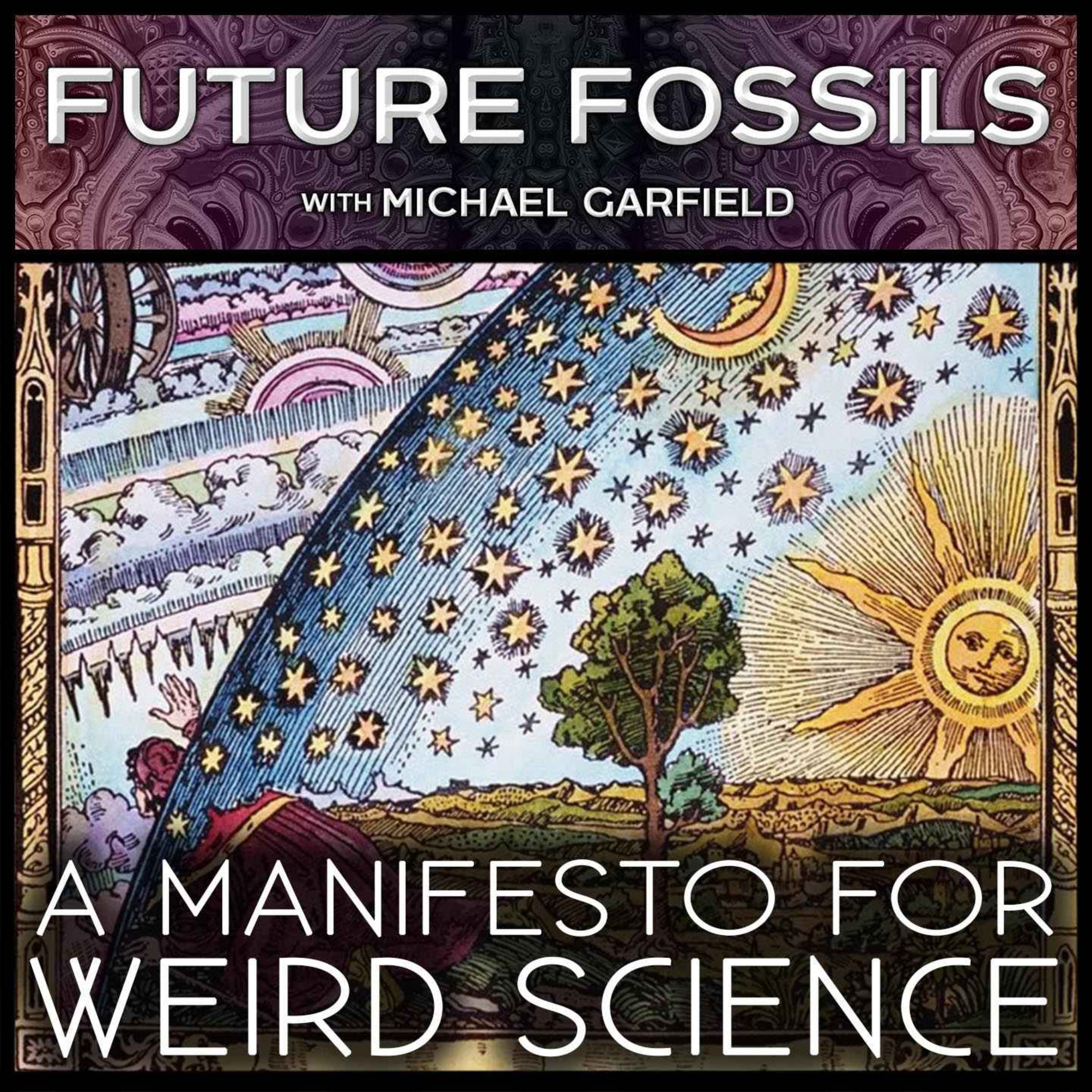
Greetings Future Fossils. This is Michael Garfield welcoming you to episode 186 of the podcast that explores our place and time and for a number of reasons I want to take a different tack in this episode and record a solo piece in part because I just checked both my local and drive storage to discover to my horror that I appear to have never actually downloaded a very important and interesting conversation that I recorded on a previous now just used podcasting platform I recently switched away from in the last few months whoops I hope it's not gone forever but here I am fulfilling the prophecy of the digital archaeologists that inspired and motivated the show in the first place in keeping with the observations of Eric Wargow about the time loops in which science fiction authors so often seem to find themselves it does seem a little strange although perhaps not entirely unexpected in the most mundane possible expression we become what we contemplate even if we're not drawn into some kind of eschatological tractor ahead of us in time or merely constructing the linear flow of time through some braided four-dimensional object that we nearly and adequately interpret in linear sequence then I think even the Squares among us would agree the more of yourself you give over to an idea the more it possesses you the more it seems to incarnate in your life so again it's not a shock exactly that I'm sitting here wondering about the lost artifacts of a previous iteration of myself although I'm really frustrated that I have given myself the pretext to even discuss this in some way and to eventually have to make the concession and the necessary apology to my would-be guest and offer to do over which is one of the most horrible things I've ever experienced as a podcaster but anyway so yeah I want to talk about something else for this week's episode because I was actually kind of inspired to riff on this for the show earlier today after finding myself in at least two or three different conversations in which the topic I want to discuss with you today came up and so I'm getting bolder about raising these ideas in both online and offline conversation but I still feel like with this episode I'm gonna be really sticking my neck out and painting a target on me for anybody unsympathetic to the nuanced strangeness in which this show ordinarily finds itself and the topic I want to discuss with you today is a complex one it's a topic about not the known or the unknown or in any kind of ultimate way the knowable or the unknowable so much as areas of inquiry that are for one reason or another sociological slash financial off limits to the inquiry that people disagree whether or not they are due I mean I can think in terms of my own reading history the lowest hanging example would probably be Our Lady of Fatima which was this apparition of the Virgin Mary who appeared to three shepherd children in Portugal in the early 1900s 1917 delivered a series of prophecies that these children reported to their community and then ultimately manifested in a strange visitation that was witnessed by a very large group of people who reported something akin to the sun falling out of the sky which Richard Dawkins in his book on weaving the rainbow says is not the onus of science to explain what is so obviously a mass hallucination and yet I always found that claim to be offensively dumb because we don't understand the mechanics of mass hallucination which makes it a perfectly interesting and viable topic to be explained or at least explored by the kind of rational skeptics that Richard Dawkins takes himself to be and yet it is so obvious that his distaste for organized religion and its various fantasies makes it that he is unwilling to entertain the validity of researching this thing or the possible benefits to a secular rational scientific society to understand it better which just strikes me as totally absurd and yet Richard Dawkins for whatever reason finds mass hallucination an explanation of adequate depth for his purposes and so you know that's fine on one level I applaud and celebrate the neuro diversity that allows for a kind of even coverage of the attention manifold by the human species I mean it strikes me as as obvious and inevitable an evolutionary strategy of human collectives as the evolution of different sensory and cognitive systems across species is at the level of entire populations and ecosystems meaning that of course it's adaptive for instance for there to be owls and larks people who stay up late and people who get up early because when we were living in tribal situations around a fire surrounded by lepers or bears or whatever yeah of course you want people that are gonna stay up all night and then those people get to sleep during the day and then other people are awake during the day and I've heard the explanation that this is why we have sociopaths because there was always some kind of evolutionarily sustainable minority of these people in society because even though they're not exactly compatible with the core dwelling mutually grooming statistically normal person it is their very difference that actually gives them unique function in society at large now before I say anymore I do need to back up and just say that the history of psychometrics is fraught with people trying to do intelligence and development studies that are preloaded with the assumption that people do in fact fall into normal distributions of IQ or whatever that's largely not the case I mean the bell curve is the kind of story that people like to tell because it seems simple and highly explanatory but it's fraught with not only methodological issues but horrible social consequences so I mean we do have to be careful about and I guess this is where we can kind of wrap this back to the issue I explained I have with Richard Dawkins in this regard the desire to stop explaining at some level to decide that that's sufficient is ultimately a metabolic question it's how much attention can I bring to a subject how long am I comfortable remaining unsure unresolved how much data can I collect before I come to some understanding how often do I need to be able to update the algorithm by which I evaluate these data putting it in a kind of critical socioeconomic articulation there is a strong correlation between at least a person's potential to make important scientific or artistic contributions creative contributions broadly and their freedom to do so financially socially culturally so it was and remains often the case that people like Isaac Newton or Charles Darwin Alexander von Humboldt you know these trust fund kids are the ones that are making or are at least remembered for making these major breakthroughs these major discoveries I mean it's worth here just as an aside stating what I think should be obvious which is that this is an extremely strong case for a rational society to emphasize greater economic equality in spite of the fact that so much of technological innovation seems actually only to deepen that inequality and that's really perhaps a conversation for another time but I do think that if what we really collectively cared about was to facilitate the greatest number of people being able to make the greatest contributions to society then the means to achieving that goal would be to give people more leisure time with which they can pursue more rarefied and culturally productive interests and yet what we have is a surveillance retail dystopia in which the only leisure time we seem to want to give people is to preoccupy themselves with the flooding of our behavioral engineering and as much as I love the golden age of television I really do have to ask myself what else I could have achieved with the thousands of hours I have spent glued to hypnotic glowing box anyway that is not at all what I wanted to talk about today so like back to the point thinking again about Richard Dawkins being satisfied by the explanation if you can even call it that that Our Lady of Fatima is a mass hallucination the point that I want to make here is that I don't find that to be a satisfactory explanation on complexity podcast episode 72 I spoke with Santa Fe Institute external professor and Columbia University professor Simon De De Deo about work that he co-authored in the effort to differentiate different kinds of explanatory heuristics different ways that people come to what they consider to be a satisfying explanation about a phenomenon and as it happens there are multiple different ways that we can seek out the simplest story about something seems you know people talk about the Occam's razor a lot but actually that term is really abused by adherence to scientism and as it happens there are multiple different co-extant meanings of simple that are all kind of conflated in conversations around how an explanation should be as simple as necessary but no simpler so Simon's angle on this which I found interesting can be broken down most coarsely into the understanding that there is parsimony which is the simplest algorithm that you can run to reach those simulated results or the simplest equation that you can draw that illustrates the laws in question a parsimony is drawing would utilize the fewest possible strokes to capture the essence of its subject it's elegant and gestural but there are also people who favor conciliants conciliants stories and these are the people that seek an explanation that can encompass as many different disparate phenomena as possible within one explanatory framework Simon makes the point that revolutionary physicists tend to fall into this category James Clerk Maxwell in proposing his theory of electromagnetism Simon says was effectively penning a conspiracy theory that made visible the clandestine linkage of electricity and magnetism as a single force and of course very similarly conspiracy theorists tend to see patterns that co-implicate a number of different public or private agencies in the same complicate-in-the-hidden agenda the difference between the revolutionary physicist and the conspiracy theorist Simon says is not ultimately in the bias that they demonstrate to seek a simple explanation of a concillant nature but in the social milieu within which they are embedded in the communities in which they find themselves the conversations that they seek out for confirmation or disconformation of their proposed hidden order of course there's another layer to this which Simon points out is that in either case what a person is going to find more or less likely is dependent on their so-called Bayesian priors on their conditioning on the experiences with which they have trained their models our models of the world and so someone who has never seen a platypus before for instance like the Royal Society at the turn of the 19th century then yeah you're gonna think that this is an improbable animal you're going to check to see if it's a hoax and likewise Simon offers the example of Timothy McVay who seemed to many people so unlikely to be both a criminal mastermind capable of single-handedly pulling off the Oklahoma City bombing but also so dumb that he was caught by a traffic cop the next day speeding around with expired tags and handguns sitting openly on the seat next to him that sounds like a patsy a fall guy right i mean if you are not well acquainted with the ways in which someone can be both brilliant and stupid at the same time the way that a criminal can be so nervous and distracted that they make this kind of horrible self-implicating error then you're gonna look for a hand behind the curtain now i need to make it clear that again part of the risk of discussing all of this stuff is that the issue of the conspiracy theory is so polarized and that that's exactly my problem with it that otherwise very reasonable and intelligent people on either side of the argument about any given unifying theory be it political economic psychological or whatever seem to come into these conversations with a kind of positive or deficit of the attention really required in order to have the difficult conversation and make the same what looks to me to be an intellectual error as Richard Dawkins does in his dismissal of our lady of Fatima as sufficient cause for not just himself but any scientist to pursue with rigor and given that there are over seven billion people on this planet i find that kind of sweeping totalist claim a patently ridiculous no no this world is big enough to assign at least one person to even the most absurd questions so long as those people are given the appropriate training in understanding the complexity to which we have assigned them and now that i've said all that i can finally get to the damn point of all of this which is that i often find myself in conversations about fringe strange ontologically challenging phenomena such as for instance the experience of religious revelation or UFOs or nonlinear temporality or ghosts or astrology and to those people who would ask what it is i'm doing slumming in what they may regard as intellectual ghettos i would respond that it's important to understand the history of how some part of town becomes a ghetto in the first place the socioeconomic and cultural forces that create and maintain good and bad parts of town as constructs as emergence in the complex system of human civilization and that often the criticisms that are leveraged at these areas are made as though there were something innately dumb or trivial or unworthy about a given topic of inquiry when in fact it may be precisely the opposite case that it is because these domains are trivialized by worldviews that feel the need to police their boundaries against them for instance by atheists who so desperately need to reinforce the position that god cannot exist that the very practice of neurotheology was complicated for decades by what effectively amounted to otherwise rigorous scholars refusing to peer into the microscope of psychedelics and transcranial magnetic simulation which we now know can reliably produce direct phenomenal encounters with something that challenges mechanistic explanation in numerous interesting ways and beckons us into a deeper embrace of agnosticism even as we accept the plain fact that the imminent first hand or zeroth hand encounter with transcendence is available to pretty much everybody under the right circumstances that's a terence mckenna thing and he was really pushing people for a long time to his credit to in the spirit of the original natural philosophers and early chemists run the script for themselves this is something that again one of my favorite authors Richard Doyle talks about in his book Darwin's Pharmacy Sex Plants and the Evolution of the Noosphere that the trip reports amassed on sites like errowid.org constitute a kind of recipe book a trail left for again digital archaeologists to not only study but to reconstruct to replicate results and yet as any inveterate sai cannot will tell you set and setting are both extremely complex in the formal way deployed by the discipline of complex systems science meaning that things like sensitivity to initial conditions non-linear interactions unpredictability and emergence countless causal factors interacting at multiple scales simultaneously all of these things lead to the imperfect ability to run the simulation and get the same results twice this is one of the big questions or debates in evolutionary biology incidentally I saw Aviv Bergman give a talk at the Santa Fe Institute today on his work in cancer and evolution and the question of robustness or rather the the sensitivity or lack of sensitivity to environmental perturbations at the genetic and anatomical levels of an organism for instance the five fingers of the hand how many genes can you change and still have five fingers how high can you crank the rate of mutation and the organism still have sort of backup systems that maintain the same form in changing environments and his work suggests that metastatic cancer loses robustness and is therefore able to generalize in a way that without reverting to its stem cell like state is nonetheless able to pass through one tissue type into a completely different tissue type and adjust to its environment in a way that allows it to morph into and inhabit new alien contexts it has less of its own distinct identity and forms its individuality in a much more intimate tango in whatever cellular situation it happens to find itself viruses do something similar at the genetic level where very high rates of mutation allow viruses to jump from one host species to another this is incidentally the reason that Andy Dobson at Princeton and others have argued that we really really need to emphasize and fund the fight against deforestation and wild meat trades because zoonotic illnesses are not only common but becoming more common illnesses that jump to human beings like covid-19 seems to have bird flu many others another way of thinking about this is that the faster things change the less sure you should be about your models of the world mass extinctions punish specialists etc this is something I bring up a lot I'm sorry for people who are getting sick of hearing me talk about this and in fact the episode I lost and hopefully can recover was with Roland Harwood on whose show which is called On the Edge and it's super good I discussed the circumstances that favor generalists over specialists both of us identifying as generalists and we had a good time justifying our existence in that conversation and I recommend it and I'll link to it in the show notes but anyway I'm getting on track again returning to the point basically the landscape of human knowledge is not evenly distributed it's not a map of what matters it is a map of what people both think matters and can afford to justify research into with funding taking a very broad definition of funding I want to make it clear that I'm not talking about financial capital again there's the luxury of one's time the support of one's community I mean a real mundane and painfully obvious example here for me right now is the fact that with my wife's help in putting the children to sleep tonight I've managed to make time to put in work on this podcast in the first place and of course then there's also everyone's moral as well as financial support in the patreon community to whom I feel a deep gratitude and a sense of responsibility for the numerous ways in which they slash you continue to keep wind in the sails of this show as it meanders across oceans of mystery and yet I would really like to see as I mentioned a moment ago more fringe inquiries receiving more support and this is finally where I get to the point where I expect some hate mail if somehow what I'm about to say is taken out of context or triggers someone's scientific reflex is that one thing I would like to see studied very rigorously with formal quantitative methods over the span of years by a large international research community is evaluating the claims of practitioners in domains for which modern scientific materialism has no proposed viable mechanism and has therefore dismissed derided and openly mocked in some cases decades and in other cases centuries in spite of the fact that a great many people claim that there is in fact a there there and I just want to give because it is so fresh on my mind the specific example of astrology which in a conversation with some friends on facebook today one of whom put up this admittedly amusing meme about a woman who's like oh my god wow yeah how did you guess that insert generic personality trait here was something that I had because my son was in this particular sign of the zodiac and yeah there's a lot of that going on there are a lot of people that are practicing astrology as either a typing system or a predictive system there's a number of different ways to think about this but a lot of people out there are doing a very very poor job and how would you even begin to evaluate the difference between a poor job and an excellent job the people that deride astrology don't really bother to ask that question they assume they already know the answer and that everyone is doing it badly which is funny because this pattern shows up somewhere else in a very obvious way and that is in the unreliability and dangers inherent in the black market illegal drug trade where people again and similarly have this very circular and self-reinforcing logic that because something has been made illegal therefore there are no quality control mechanisms in place no regulated production of a given substance and it falls upon people that are messing around with dangerous chemicals in their garage and so people then die from accidental overdoses or they have scary horrible experiences and then these substances consequently develop reputation for being dangerous even though it has been very effectively argued that many supposedly dangerous street drugs can induce profoundly positive effects when the various factors that contribute to the reliability again the replicability of those beneficial effects is well understood and that knowledge is shared and distributed and people are empowered to act upon it in responsible ways and I think you know we can all look to the success of the decriminalization programs in place in countries like Portugal as evidence of this and I don't know what's going on in this episode but I feel like I'm developing a conspiracy theory that this is just secretly an episode where I get to talk about Portugal as much as I would like to because I'm totally enamored and there probably is no real connection between the fact that Portugal is where Our Lady of Fatima was observed and where we also have in a much more modern secular sense another miracle in which sane drug policy seems to rule the day I mean after years of working music festivals where other life painters and I were often in these positions where due to the rave act festivals were not allowed to provide any kind of harm reduction assistance at their events or they would have been perceived as aiding and abetting in the sale of drugs and so people were dying or being hospitalized or other horrible man handling by ignorant paid security people that didn't know how to handle these problems and in many cases this person just needed a blanket or a glass of water or a place to sit for a while and cool down and we saved these festivals immeasurable costs in legal fees in recuperative brand management because certain socio-cultural landscapes only allow the tragic escalation of relatively minor problems right anyway I'm getting off on a tangent again I want to bring it back to the backbone of this whole thing which is that astrology and actually many other disciplines I think have not been properly subjected to rigorous statistical methodologies because the history of this field is one in which facts such as Isaac Newton's passionate interest in alchemy and astrology is swept under the rug and best forgotten an awkward glitch and forgivable flaw in one of the pioneering geniuses of modern science never mind that Descartes himself got the Cartesian plane supposedly from angel he saw in a fever dream when he was a young soldier stationed in Bavaria during the 30 years war fighting bohemians or you got people like Kekule who stumble upon the structure of benzene with the nocturnal visionary experience of an ouroboros appearing to him like Seraph or something in the bible or like the wheels of Ezekiel and then you get similar reports from people like Nobel Prize winning chemist Kerry Mullis who invented the polymerase chain reaction by which nearly all lab genetic synthesis is conducted and not only attributes that discovery to his exploratory use of LSD but also admits on sober occasions to have witnessed things that do not fit into our earthly taxonomy meaning stuff like a six foot glowing raccoon with which he had some kind of encounter and this is where credible reports from respected historical figures veer into a kind of aesthetic isomorphism with UFO encounter literature. I don't know how anyone could claim that this stuff is not interesting but this stuff has been satisfactorily explained as the way that a brain for instance communicates its unconscious states to its conscious states and as such therefore deserving of no further inquiry or explanatory effort. It's like no reality check those were straight up angels and they founded the modern world.
Whatever they really are should be one of the most interesting questions we could possibly be asking ourselves in my opinion but you already know that if you've been listening to conversations I've been having with T. Ferry on future fossils for the last few years or with Sean S. Dorn-Hargans or with Phil Ford and J. F.
Martell of Weird Studies podcast whom I know care quite a bit about these issues but I'm actually sure that they recognize and I'm glad to point out that what I'm talking about in this episode is not exactly an encounter with mystery per se but a commitment to the scientific project of discovering what is mystery in the way that they use it where it studies this notion that it's irresoluble it's bottomless fathomless that mysteries are not problems to be solved or questions to be answered and I fully agree with all of that but the point is that there's this thing that comes out of computer science which is a rigorous taxonomy of whether a particular problem is computable or non-computable or whether it's computable but in non-polynomial time meaning effectively it would take forever and therefore it's practically non-computable and as far as I'm concerned it's really the goal of science more broadly to investigate which one of these three categories pertains with respect to any given phenomenon no matter how mundane or seemingly anomalous. The question of whether something like for instance a set of material mechanical causal relationships can ultimately be properly differentiated, tested with physical experiments and then ultimately thus made the objects of our engineering abilities and capacity to construct niches for ourselves by manipulating our environment ultimately for me it's a question of what kind of questions do we need to ask in order to determine whether astrology is ultimately knowledge that can make verifiable quantitative predictions. I mean astrologers are going to disagree with this and I know this for the record but you know I think that a lot of people have kind of given up on that particular aspect of it because what we're really talking about and this is really where I reach the threshold of what I consider the most provocative part of what I'm trying to get to and say in this episode which is that I understand in the mockery of people who think that SunSine newspaper horoscopes are ridiculous that opinion is shared by the vast majority of practicing astrologers that I have ever met in my life and while I don't know the proportion between reasonable and unreasonable people in this or really any given field what I want to say is that every astrologer worth their salt that I have ever met understands that a natal chart or a transit chart are these illustrations of complex networks of multi-scale causal relationships and I mean this is of course I'm kind of conflating two categories here because a lot of astrologers I think especially following in like the Rick and Becca Tarnis archetypal astrology tradition are not necessarily inferring any kind of causal relationship they're simply appreciating the synchrony and the correlation of the macro, meso and microscales through the movements of celestial oscillators you know paired across these scales you know I don't think they're you know they're kind of taking a Jungian turn in emphasizing the A causal principle of synchronicity but I'm with Eric Wargo who's appeared on the show a few times to talk about his his study of time loops and retro causality on this issue yes which is that I think it's not satisfying to accept an A causal mechanism or principle and I mean this is sort of the reciprocal or the yin to the yang of what I was saying earlier about Richard Dawkins which is that it surprises me that some archetypal astrologers believed that this stuff works without a mechanism or that perhaps that just offends some kind of anti-linear sensibility I don't know but I don't think it necessarily has to and here's the meat of it which is that it seems from where I'm sitting looking at this issue that and I should qualify that like all of these ideas I claim as my own not in order to take credit for them but to absolve other people of the responsibility of them these are notions I've developed by myself and no colleague or employer be implicated in this nonsense but that said it seems to me hypothetically that the right way to think about astrology and I think this can be tested is in a way that is as fundamentally uncertain as the algorithm of a trip report and for the same reasons there are so many causal variables again their interactions are non-linear over a long enough time scale and I know this particular statement even on its own is heretical but I think you could consider our solar system and its evolution to be the operation sometimes complex system but complex adaptive system in that the orbits of the planets adjust into what are effectively well tempered harmonic relationships and distances from one another and we see this in exoplanetary systems where there are musical thirds and fifths in the relationships between the planets that are slightly out of tune just as they are in human music which seems to have something to do with phenomena like heart rate variability where the more minor variations within a person's heartbeat the more evenly the strain distributed on that system and it's the people with very low heart rate variability that invariably are at risk of heart attack anyway I'm rambling again the point is that in network theory you have nodes and you have edges and in astrology a person's chart is made of nodes constituted by various celestial bodies of which there are dozens named within our solar system numerous asteroids and comets and so on on top of planets and larger planetoids and that's already quite a lot of detail against a backdrop of fixed and moving stars that may or may not even matter and may have simply been placeholders for some kind of phenomenon operating at a completely different scale such as persistent bands in the psoriation of Earth's magnetosphere and it's worth noting that there is a legitimate science of biogeomechanics there is an intersection between this study of the relationship between our bodies as electromagnetic process objects and fields generated in part from atmospheric activity and in part from the piezoelectric activity of the ground squeezing beneath us and so you have people like Darren Lipnicki in 2007 who wrote a piece correlating geomagnetic records over Perth, Australia where he lived with the dream journal he was keeping and the variable bizarreitude or surreality of his dreams which turned out to have apparently something to do with the amount of cosmic radiation to which he was subjected when the magnetic field over Perth so I mean that's 2000 dreams over seven years that he referenced in that study and it's a sample you know it's n of one but there's plenty of other work that's being done in this area by people like animal conservationist worrying about the impact of electrical transformers and large power line assemblies on natural environments like a wetlands for instance my former graduate advisor I mentioned earlier Shonnys Bernhardens this was something that he talked about when he introduced me in my classmates to the concept of biosimiotics which is the study of how other organisms interpret their environment often a built human environment you know how does the bell tower look to the bats and falcons some animals see the earth's magnetic fields and it seems rather obvious to me that if that were the case for humans we would all be arguing about a very different set of phenomena and this plugs back into a conversation I had last year with W. Brain Arthur, Santa Fe Institute and Stanford economist whose paper economics in Nouns and Verbs made the point that understanding something through algebraic equations is very different from and discloses a completely different world from understanding the same phenomena through computational thinking through algorithms and agent-based models and in Brian's language an economy understood as a collection of nouns is very different from an economy understood as a collection of verbs as a collection of unfolding processes this is obviously something big in the sciences in the gap between object oriented ontology and process philosophy as espoused by people such as Tim Morton in Alfred North Whitehead respectively the point being that worlds are not merely disclosed they are enacted that every truth claim has a subject of urban an object involved in defining the coordinates by which we can evaluate that claim that's a Ken Wilbur thing he called that integral calculus he made the point that the postmodern revelation that all knowledge is contextualized means that scientific papers ought to be identifying the address of the researchers that actually make these claims that the unique personal biographies and other situational details such as perhaps the phase of the moon might matter to the reproducibility of scientific findings I mean that last point was actually a point made by Charles Eisenstein and something we discussed when I had him on the show back in the 80s of future fossils I mean there are botanical experiments that were completely differently under a new moon and under a full moon and that brings me back to the point which is that there definitely are cosmic influences on biological systems there's no question of this and I just cannot believe that the in-culturated distaste for something that was admittedly understood in a rather fuzzy and idiosyncratic way in the era before we even called it science at a time before the standardization of scientific methodologies I mean it's ridiculous to think that nothing is valid from that earlier understanding at the same is true of so-called old wives tales herbal medicine of the technologies of yoga and other contemplative practices these things have all been validated and I need to make it clear that many other people have noted that it's not really science's responsibility to validate these things you know indigenous and ancestral knowledge forms stand in their own right they have their own dignity and intrinsic value they don't require rubber stamping in order to exist alongside settler colonialist thinking that said I also want to make the case that science is not the unique province of settler colonialists that what these people all over the world are practicing are forms of science with overlapping but not perfectly overlapping methodological toolkits that the process of inference is something practiced by infants and yet we can and should test these ideas against contemporary statistical techniques for those of you who don't know the Princeton engineering anomalies research lab which operated for 27 years within the Princeton engineering department did all kinds of statistical and meta statistical research into phenomena for which we have no known mechanism and yet they were able to demonstrate rather compellingly that weird weird things are going on like for instance the apparent influence of willpower or intention on the outcome of otherwise random mechanical events like electronic random number generators or pachinko machine style setups where balls fall through a series of rods and should land in a normal bell curve distribution but they don't people were able to skew the number of balls falling to one side or the other simply by focusing their attention on an outcome for which we have no mechanistic explanation I will link to the parallab paper archive in the show notes and for those of you who can follow the debate there were critics of their approach but the parallab themselves responded to criticisms that their results were due to what is called the file drawer effect which is the occlusion the hiding of negative results making it look like positive results are statistically more significant than they actually are with a meta statistical analysis showing that they would have had to have hidden millions and millions of papers illustrating negative results for their positive results to be irrelevant so I mean this is a rare and beautiful example of how even within a prestigious institution and even while persecuted by other members of that institution honest unflinching rigorous science can be performed on the truly weird and unknown to test and explore claims made by people in the pre-modern world about things like telepathy or telekinesis and let me restate and emphasize that we don't need to start out knowing how this stuff works or even if it works at all that is the point the point is to be bold the point is to sail science into the terrains populated by dragons and tigers on our medieval maps rather than simply assuming with the high conceit of our rational enlightened era that those dragons and tigers don't exist or that they do we don't know and if you're going to tell me that we have no responsibility to find out then why not just crawl back into the dark age from which you claim to have differentiated yourself and now if you've made it this far then you probably agree with me but if you don't or if you do and you can think of ways to further this then I would love to hear back from you if you can't tell by now I'm kind of expecting the worst in this situation people calling me out as being a total lunatic and yet I think just one more point worth making is that in one of the books that inspired this podcast in the first place Doug Rushkoff's present shock he talks about research into the influence of lunar cycles on human hormones and how each phase of the moon results in a spike of one of four different neurotransmitters acetylcholine serotonin dopamine or norepinephrine Doug Rushkoff wrote a piece at edg.org about how this idea this idea of chronobiology is perhaps one of the most important and under appreciated ideas that he could propose so yeah maybe we don't have to call it astrology you know maybe the mythic significance of constellations is something that we can safely put off to one side as something that astrology practices as a hermeneutic discipline whereas there are in fact valid biologically grounded physical effects measurable demonstrable phenomenologically palpable effects that occur for instance when there is a full moon or a solar flare as has been my experience it seems like everybody goes nuts when there is an x-class solar flare and these are things that we should be able to study now with the help of computational techniques big data the same tools that afforded us the possibility of using twitter for instance as a so-called macroscope into human affect and sentiment following the work of people like Peter Dodds and Kristinforth at the university of vermont or Mac Pelert in Vienna we have macroscopes now that we could use to for instance detect changes in affect and sentiment in these large online textual corpora and see if there is in fact any correlation with say the solar eclipses or the transits of Jupiter or whatever and you know honestly in a way i would be relieved to discover finally conclusively formally rigorously that this is not the case to learn what we can disprove to learn what hypotheses we can smash against this kind of approach and it's just the fact that we're not doing it that drives me nuts because ultimately the history of science and technology the advancement of human culture can be told as a series of people saying oh that'll never work famous last words proven wrong the definitive example being people deriding the possibility of human flight mere years before the famous successes of the right brothers who if anyone will step up and be the right brothers of a disciplined astrological research program a disciplined program studying the possibilities of retro causality and yet as eric orgo mentioned in episode 171 there is such a taboo against these things that we could be implementing them practically technologically in quantum computing etc and still refusing to accept this phenomena take place it's bizarre and yet again i do have some sympathy for the historic context in which people found it difficult to accept for instance germ theory because there just weren't that many microscopes going around for most of the history of human civilization so of course the idea that tiny animals living on you are what's making you sick seems preposterous likewise if in fact there are grand cosmic structures in which we are embedded unless you have the macroscopic tools to investigate these phenomena it sounds rather a lot like the assertion of some kind of transcendental Old Testament intelligence and we don't go there right we're modern people so just to reiterate this just to state it one last time i think that that's bad critical thinking that's bad modernism good modernism is in certain ways akin to good zen a tradition that has maintained for centuries great doubt great awakening no doubt no awakening to the degree that science is committed to overturning its earlier understandings allowing our biased projections of probability to determine where we cast our gaze and what kinds of questions we ask is actually and ultimately more religion than it is science insisting that astrology has no basis in truth is religion folks it's not science until demonstrated otherwise and even then the point is everything is up for grabs except of course to the degree that we cannot afford to allow these questions to remain unanswered i accept that we do need some kind of solid ground to stand on that we can't just luxuriate in the infinite mystery of the psychedelic nature of human experience and keep the door open forever to questions that we can actually answer i mean that's absurd too but folks please wonder please be bold enough to admit what it is we don't really know and to formulate precise surgical questions about how it is that we might come to know i don't claim to be an expert in the area of hypothesis formation and experimental design but i would love to talk with other people about this so if you've made it all the way through this episode and you have ideas about how we might more carefully inquire into phenomena that seem weird or impossible to the modern western mind then please drop me a line either on twitter or in the future fossils discord server or facebook group send me a message on patreon whatever works for you for the last few years i've been identifying and talking with disenfranchised members of academia people whose curiosity is too keen to be politically appropriate in that environment who want to ask profound questions that are forbidden by their university departments how can we bring these people together better how can we fund them anonymously or pseudonymously can we use decentralized finance to crowd fund pioneering scientific research into fundamental theoretical topics like this for which there is no immediate apparent potential return on investment it seems like all the conversation i've seen around the decentralized finance of science or d-sai is about stuff like life extension biomedical technologies and so on like the obvious low hanging fruit the stuff investors are already jumping at we can do better i want to do better and i would love to know your thoughts about how we can okay thank you for listening to this rant and i should also mention that in the time it's taken me to record this i have not just let my wife put my kid to sleep but also taking him out on three very long night walks but also i found the rolling hardwood episode thank god i found the recordings so i'm gonna get those out for episode 187 please stay tuned if you like this show do me a solid and join the roster of patreon supporters at patreon.com slash michael garfield help me make it through an immensely challenging phase in the life of my young family and keep the show going and that's it thanks a lot talk to you again soon see you in the online groups maybe be well and stay curious oh and ha ha ha final post-script after editing this episode there was a sun quake this week while i was working on this huh and also i didn't realize it but i recorded this on the east of our lady of fachima right at the 13th may 2022 had no idea except perhaps the idea i was about to have what do you make of it