
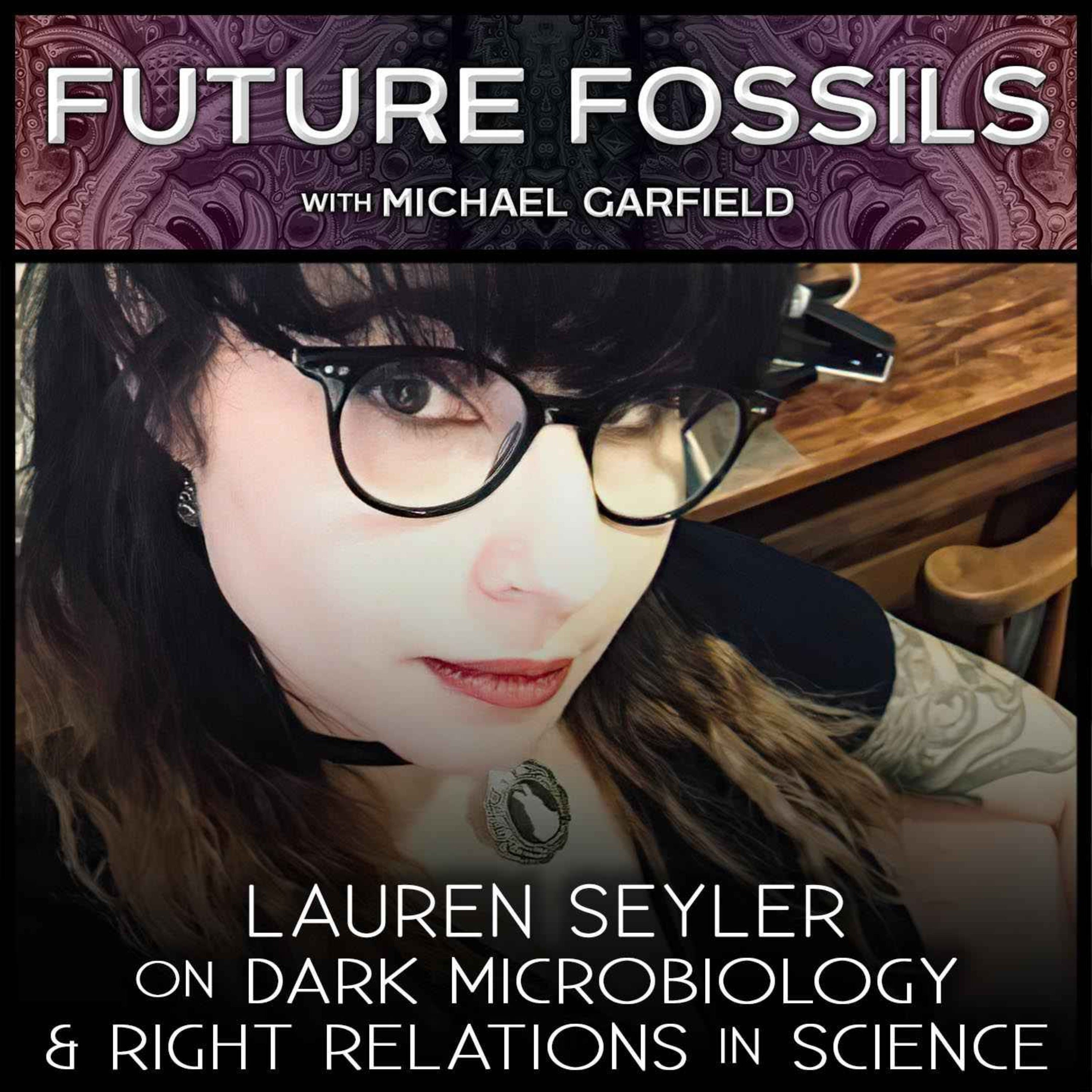
There is a lot of colonialist mindsets in the way that we approach science as a whole, you know, the way that we think about discovery, the way that we think about exploration. We have a way of approaching natural systems with this mindset that I think limits our thinking, right, that limits in some way our ability to interpret what we're looking at, to actually learn from our observations. And I think pulling in these other perspectives only makes us better scientists in addition to being more mindful of the fact that we are on somebody else's land. Thanks, Future Fossils.
Welcome back for episode 190 of the podcast that explores our place in time. I am Michael Garfield, and for me this week, our place in time is, well, Santa Fe and unusually gloriously rainy day. But more broadly, this show is committed to widening the aperture of our thinking and awareness. I want to contextualize all of this in terms of the non-human turn, which is a running theme on this show and our relationships and responsibilities regarding the non-human world, including those parts of ourselves that we would traditionally regard as non-human, including the microscopic organisms that live within us, and the, as above so below, relationship whereby the anaerobic microbes that live in our guts are kind of mirrored by the dark microbiology that inhabits swamps and marshes and deep sea sediments and other areas where, once upon a time, the bloom of oxygen in our atmosphere forced life to tunnel underground and ride out a catastrophe.
There's something really deep and archetypal and profound for me in thinking about how all of the bunker survivalism and escapist space palace fantasy is really just a kind of harmonic on this larger cycle of story in which life begets catastrophe and then bifurcates, and there are therefore ever after surviving populations that learned to adapt to the new crisis and those that escaped and then the reconciliation of those two groups. Anyway, yeah, this week's guest is the most excellent Lauren Siler, assistant professor of microbiology at Stockton University, who studies dark carbon cycling in oceans, mud, and rocks. And we could have had a very different conversation about her esoteric practice, but perhaps we'll have the opportunity to explore that in a future episode. This week we get into questions about the history of life, the life non-life boundary, anaerobic microbes as invisible labor, the wonderful world of omics expanding far beyond genomics into proteomics and other ways of thinking about information as it is instantiated in living systems, the conflict between institutional and individual agency, revolution of consciousness required for effective and collective action at planetary scale, and the issues of power and responsibility.
Namely, best practices for working with the indigenous as a scientist, stepping up to biospheric stewardship and practicing right relations across scales. I need to give a shout out to Siv Watkins, with whom I had a very resonant conversation in episode 182, and I recommend pairing the two of these like a fine wine and cheese, both fermented by our invisible friends. So get ready to lean into a warm and wonderful conversation with an intelligent and interesting person about the substrate of your very life and mind and all of ours. But first I want to thank all of the people supporting the show on Patreon and encourage you to do the same.
Life is not getting any easier and I am immensely grateful to everybody who has been helping me keep this show minimally sustainable, including the latest new supporters and patronage of the world. I'm Mark O. Rhett Dabristine, Travis Nobles, James Moron, William Seral, Peter Serrato, Martha Braun, Tanner Moskarela, Mehai, Samuel Neshu, Cheryl Smith, Shani Stoppnitsky, Shelby Straight, John Wagner, Benjamin Bradley, Sean Nihili, Brenda Holiday, Katherine Chapman, and Virginia Blue Knight. That sounds like a lot of people, but it's actually been three weeks since I published an episode.
So please join our ranks. My dear friend James Boswell recently described the high quality Facebook group that I host for patrons as a quote unquote, extreme a file living in the inhospitable environment of social media. And not only is that perfect for this episode, but it is generally true. I find that there is something really beautiful about meeting together in such a difficult and unfriendly place where so many of us are trapped and sharing something heartful, soulful, intelligent, patient, civil, and compelling with one another, this virtual community we've created for the show.
But if you're either too young or too wise to be stuck on Facebook like the rest of us, then we also have a future fossils discord server for patrons. And I continue to write lots of music and explore artificial intelligence artwork. And I am just constantly reigning. Interesting fun stuff on those of you who are helping me feed my kids.
So patreon.com slash Michael Garfield, go explore, even if you have not a dollar to contribute. And if that's the case, and even if it's not, then please rate and review the show on Apple Podcasts. Help me find some new listeners. I'm finally at the point where I've had to cave and just accept I need help producing this show.
And on that note, please join me in celebrating the contributions of Tammy Poudina, PiperDrive anthology.com, who helped me edit this episode as well as the next episode, which is the very, very overdue conversation with Roland Harwood. Tammy is a hero who helped save my sanity this month. And I also want to thank Alex Feldman, who has started helping me edit some of the transcripts for the show so that I can collect them and do a forthcoming book. That's right, folks.
Anyway, one more time, please drop a five star rating and a glowing, ebuient review of this podcast on Apple Podcasts and help some other weirdos find us and then hop onto patreon.com slash Michael Garfield and throw yourself into the mix for the price of some ridiculous virtual in-game item you just purchased. It's far more satisfying, I promise you. And with that, I've already ran to far, far too long. Here is Dr.
Lauren Siler to talk about Dark MicroBio. Lauren Siler, I am delighted that I managed to rope you in to future fossils. I'm excited. Why don't we?
Okay, because there are a couple of genres of episode, one in which I play Insider Baseball with someone I've known forever and lose the audience with a bunch of references they don't understand. And one in which I am completely neglectful of due diligence and invite a very interesting person under the show whose work I have not really given nearly enough attention to and you are for sure in the latter category. So how would you introduce yourself to the fully naive? Well, I would describe myself as a microbial ecologist and biogeochemist.
So I'm interested in how microscopic life exists at the borderline or the gray area between living matter and non-living matter. They're kind of at the crossroads between biology and geology. So I'm interested in the transformative properties of microscopic life, how it changes things from non-living to living and back again. So let's start, like, since I'm enjoying playing the rigorous fool here, let's start with the question of when you say the border between life and non-life, what do you think you're talking about?
What for you to the best of your understanding is the definition of life? Because for the other podcast I host, I just had Sarah Walker of ASU on the show. I love Sarah. Right.
And Sarah, as a former postdoc of Paul Davies, has what I consider a kind of a minority position on life as being possibly something that, I mean, minority in this sort of modern secular world, certainly not minority in the broader human experience. And I think that's an important distinction we'll get into later in this conversation. But she's got a position that I like that perhaps the entire universe might be best understood as life. And so I'd like to know kind of what you mean, where you inject nuance into that distinction.
Yeah, it's definitely a definition that I like, the idea that you could consider the entire universe to be alive in some respects. Certainly all of the elements that make up living things started off as the dust inside of stars and inside of dying stars. And so if you think of it that way, everything is potentially alive. Right.
To me, like, there's an asset definition which is a chemical system capable of Darwinian evolution or self-saining chemical system capable of Darwinian evolution. And that's the definition that I start off teaching my students. But I think that while that's a good definition to start with, it lacks some nuance for me in particular. When I think of life, I tend to think of it in a very thermodynamic sort of way where you are taking things that are in a stable state and producing a lot of chaos, a lot of entropy as a result.
You're forming complexity from things that have less complexity, but you're also producing a lot of chaos in that process, which is what I think is so fascinating about life. Can you describe it as something that produces structure or something that produces chaos and really it's kind of both at the same time? So just because I'm feeling mischievous today, I want to pose a question to you that I didn't get to pose to Sarah when I spoke to her that was inspired in me by reading the book Quantum Evolution by University of Surrey Professor John John McFadden back in, I think I was still in college when I read this book, but he's trying to apply quantum mechanical thinking to the microbiological realm and to recast life as a fundamentally a quantum phenomenon and was in that book attempting to offer an explanation for the origins of life in that the widely touted improbability of the kind of chemical complexity that we see in biological systems may not be as people often say, like a tornado blowing through a junkyard and assembling a 737, but that basically self-reproducing organic molecules undergoing Darwinian selection may have... It's been implemented instantaneously into the environment of the early Earth as the output of a massive simultaneous quantum computation that occurred in a superposition of all possible outcomes and collapsed as soon as the molecule as one of those versions started replicating.
And so even in that situation, it seems that there is a kind of Darwinian selection operating on not the matter itself, but the possibilities of it. And so this is something that's always bottled my mind when people talk about trying to understand the life and on life boundary because I was a student at the University of Kansas and I wasn't a student of EO Wiley, the famous evolutionary biologist, he was there. And for a guy who co-authored the book Evolution as Entropy, which is what you're talking about, the thermodynamic piece, the creation of local order and global disorder, I was surprised that he was convinced that Darwinian selection before DNA was impossible. So I'm curious your thoughts on that.
And then we'll back up and we'll actually sit some context because we're already deep in the shit. We're already playing in baseball in the 90s episodes. So anyway, yeah. Yeah, I think that's a really interesting point.
And I kind of agree with that idea that you can't really have what we think of as Darwinian selection without that being driven by genetics. I don't see a chemical system being driven by Darwinian selection in the same way that an information system is driven by Darwinian selection. To me, I love the idea of there being this potential face of possibilities and one just kind of runs away with it. I think that fits really well into my worldview.
Yeah. Okay, well then anyway, sorry, let's back up and talk a little bit more about background here for you personally. Zoom back out. We're kind of, hopefully nobody's neck is broken and the powers of 10 zoom we're playing here.
Talk a little bit about how you got into the sciences and how you became interested in muck and the things that live in muck and the relationship between muck and the rest of the world that we take for granted and in which most of us spend a considerable amount of effort trying to ignore muck. Yeah. So I had kind of a weird childhood, I guess, in that I was raised by my dad. My dad and my mom split up when I was still an infant and they were both very young when I was born and my dad took custody of me, which was unheard of in the 80s.
And he was in the middle of a military career at the time. And so my grandparents just care and tell me. And then around the time I was about four years old, he had a devastating car accident while he was on duty and completely destroyed his back and ended up having to get surgery and he got a big settlement from it. But it kind of ended his military career.
He had a long period where he had to be a part of the lesson and kind of building himself back up again. And so he decided to go back to school. He had finished high school through high school, but he never went to college. None of his brothers went to college either.
He was the first person in that generation of the family to go to school. His parents didn't even finish high school. It was a very blue collar family. And my dad decided to go to college.
And my grandparents reaction was kind of like, you're going where? Why? So by this point, I was five years old and he was going to school at Stockton University, our local university, which back then was still Stockton State College and bringing me with him to class kind of a lot, which my grandparents were like, they totally didn't understand why would you bring this little girl with you to college classes. But it was such an informative experience for me because he started out of a chemistry major such a biology.
So I was meeting all of these scientists at this very young age and they were into it. They were like sending me home with experiments to do and giving me homework and giving me assignments and class. And not only that, but I was also meeting like these humanities professors with large professors learning about music and history and all of these different topics. And I just fell in love with the university environment and with science.
And I was going everywhere with my dad, going into the pine barons, going bird watching, going to the shore and collecting seashells and just from a very young age, developed this fascination with life in every form imaginable. But I didn't really get into microbiology, I guess until I was in college. I knew that I was interested in biology. I started out as a chemical engineering major, but that ended pretty quickly.
And approach to science, which is not a field to me, this idea of kind of breaking things down and making them efficient. I just wanted to go out there and study things in like a pure way, in a basic research kind of way. So I switched to biology and it was through genetics, I think, that I really got into microbes, because microbes experience the world in a way that's completely different from macrophana and macrophora, everything that they experience is through chemistry and through genetics. And to understand them, you really have to understand these chemical interactions that they use to experience the world and interact with the world.
And I was just so fascinated by DNA and how elegant it was and how DNA coded for everything that we can see and a whole lot of things that we don't. And that really pulled me into this invisible world that exists all around us. And it's really the foundation of everything that we see. I mean, if we didn't have microscopic life, we couldn't have plants and animals and soil and all of the things that we rely on to have the kind of biosphere that we experienced.
So what is it specifically about salt, marsh and marine sediments that you found particularly captivating? Because just to frame this, explicate this for people, these genomic and various other omic approaches that you're bringing to this domain, I'm used to hearing them in the context of terrestrial ecosystems. People wondering what's growing in their farm. In a way, it's more akin to the chemical engineering disposition where people are trying to understand stuff like crop yields or it's a little bit more obviously self-centered.
And what is invisibly supporting us in our efforts to exploit the surface of the planet and less so about the depths? And you seem somebody who, I mean, someone with a twir handle dark microbiome. What we drew me to you was, I don't think this is weird, but like, it's something that drew me to my wife actually, which was a recognition of the kafonic. Yeah, I love that word.
Yes, the dark and mysterious. Was that just a lifelong thing? I think that really started for me, I guess as a grad student because so I, when I was looking for PhD programs, if I was finishing up with a biology student, I knew that I wanted to really study molecular biology. I was really interested in this intersection between genetics and biochem.
But the programs that I was looking at, a lot of them were very lab focused, like E. coli as a model and cancer and just things that didn't appeal to me at all. Because like I said, I spent so much of my childhood being outside and I wanted to be out in the environment. I wanted to be understanding life in a very natural context and not under fluorescent lighting for hours a day studying these model organisms.
And so I found the oceanography program at Rutgers and at first I thought, I don't really have the background to get into this, but it turned out that I did and I did get into the program. It was through studying the ocean that I really gained in appreciation for the dark, I think, because most of the ocean is in the dark. Most of it is below the reach of sunlight and most of the life in the ocean experiences life in the dark. I mean, there's this like skin on the very top layer of the ocean that the sunlight reaches and there's a lot of activity there.
But below that, it's just total darkness all the time. And from there, I got interested in, well, what happened below that in the rock and at the very bottom of the ocean, what's happening in Deep Rock on land? What's happening in mud? Like these things to me were so much more fascinating than what's happening in the top 100 meters or so or 200 meters or so of ocean where the sunlight is penetrating and it's a world that we can kind of understand because it's closer to what we experience every day.
It's on the shining and there's algae in the water that are kind of like plants on land and these are interactions that we can sort of relate to whereas the kind of stuff that's happening in the dark, it's powered by chemistry, it's so alien to the things that we experience every day. And then I guess that from there is how I got into astrobiology because it's not a big leap to think about life in the dark on our own planet and then to life in the dark on other worlds. So I'm curious then given that what your thoughts are on very, very early because I don't know if you know my buddy Bruce Damer, but he's an astrobiologist at UC Santa Cruz and his work with Dave Damer there, he's been working on a hot springs origin model in which photosynthesis evolves in their version of things almost immediately. It's very, very early and yet other people have alternative models in which life started out as a chemo synthetic thing that did not require sunlight.
It seems like the origins of life debate in some measure really hinges on that question and I'd love to know how you reflect on, I mean obviously we are indebted to the things that live in the dark, but do you think that we come from those things or do you think that they are an instance in which life expanded from easier to more sort of difficult energy sources? That's a good question. I have seen some good arguments too for anoxogenic photosynthesis, a photosynthesis that does not produce oxygen as a byproduct the way that plants do, but produces other byproducts and kids. I think some good arguments for that being much more ancient than you get it credit.
And so it's a tough question to answer because there are so many different possibilities out there for the origin and you go to any origin of life-centric conference. Everybody goes in with certain ideas, biases, prejudices, their pet theories and this is something I was talking about with my husband on the way here that we all in science kind of have this post enlightenment idea that everything that we believe is based in logic and rationality and reason and fact and none of it is driven by our emotions. What a couple of origin of life scientists argue with each other and like how heated it then. How emotional they get about their ideas.
And so I try to keep a very open mind and say yeah, if we produce really good evidence that life started out as powered by light then I have to run with that. But I guess to me there is kind of this internal bias or this feeling that it makes more sense to start from the more difficult mode and start in the dark and then go oh wait, hey, there's this whole other source of energy that we haven't been using before and then you see this explosion into everything that we see now. I think that to me there's something that makes a lot of sense about that and if we think about the places where life might originate elsewhere in the solar system certainly light might not be a viable option for energy. So even if our own origin begins with light that may not necessarily be the case on other world where chemical energy is where it's at.
So I'd like to get into the weeds here a little bit with you about the way that you actually do your work. You know a number of your papers and presentations that people can find on Google Scholar which I'll link to in the show notes. Talk about and I mentioned this a moment ago various omics approaches and again I'm going to act totally naive here and invite you to talk about I mean most people I think at this point I probably heard about genomics thanks to the successes of the human genome project. But this is just one of many and in particular I'm curious about you gave a or you convened a presentation at the AGU Fall Meeting in New Orleans in 2017 on using omics based approaches to link biotic and abiotic processes in subsurface environments.
So this is a poster. These techniques and then what for lack of a better metaphor what light do they shed on these processes that link the living in the non-living realm. Sure. Yeah so that was a session that I convened at AGU and then we gave a really nice poster session on that and had a lot of great research involved in that.
So just to start from what omics are because omics is one of those terms that kind of gets thrown around a lot and now it's sort of applied to almost everything. But omics started with the term genomics and genomics refers to looking at the collection of genes that an organism has available to it. And then that expanded later to metagenomics where you're looking at all of the genes available to a community of organisms. And this is really helpful when you're studying microbes because microbial communities can be extremely complex.
You can have hundreds of thousands of different species interacting with each other and something like 99% of them can't be isolated in the laboratory. So if you want to look at what a microbial community is doing in the natural environment, one of the easiest ways to start teasing that apart is to take a sample of a microbial community say from soil or water or a biofilm around a hot spring or unsampling biofilms now in the pine darins that you can talk about that in a little bit. Take that biomass, extract the DNA from it, sequence all of the DNA and then start looking for functional genes and start trying to tease out what functions does this community perform, how do these functions potentially interact, what kind of processes is this community carrying out. Now that has its limitations because just because something has potential to perform a function doesn't mean that it's actively doing it.
So from genomics we go to transcriptomics where we're looking at RNA. So I think fewer people in the general public have an idea of what RNA does. You kind of all know what DNA does thanks to Jurassic Park and a lot of other things in the public consciousness. RNA is kind of like an information middle person.
So RNA is a way of taking the information that's stored in DNA and turning it into some kind of product, something that will actually perform a function. And so if we start looking at RNA, because RNA is generally only made when it's needed, when a gene is turned on and we want to make the product of that gene and it doesn't hang around for very long, if we take the RNA from a community and sequence that, then we have a better idea of what genes are actively being used by that community at a given time. So I've done both metagenomics and metatranscriptomic work in looking at microbial communities and their functionality. From there you can look at the collection of proteins that are being made from those genes.
Proteins are the things that do all of the work in a cell. They carry out chemical reactions. So you can look at the collections of proteins that are being made. Or you can do metatallomics, which I've also done, and you can see that on my Google Scholar page, where you're looking at the products of those proteins.
So you're looking at all of the small molecules that are being made that serve as intermediates and final products of this network of chemical reactions that have carried out in a living organism or in a community. And that gets really complicated because there are just so many different products of all of these different chemical reactions that are carried out by a living community. And some of them have a function that we know and most of them don't. And we don't know if they actually have a purpose or if they're just sort of made by accident or as a by-product of something else that maybe doesn't really serve any real function.
And so teasing that out. I mean, people have this tendency to think of bacteria as incredibly simple compared to animals or plants. And in some ways, yeah, you can make that argument. But there's so much going on at the chemical level that we just have barely scratched the surface of.
And just teasing out all of those different interactions and the functions that a community carries out as it's taking substances from the environment and transforming them into other things that can be used by plants and what we call higher organisms. I hate that term. It's so practical. I hate it.
But making all of these compounds accessible to plants, I mean microbes take nitrogen from the atmosphere and make it available to plants. We talk about plants that put nitrogen in the soil, for example. Not the plants doing it. It's the bacteria that live around their roots that are carrying out that function.
They're a bacteria that break other things down and make them available for other organisms to use, which is one reason why the salt marsh is so fascinating. You're asking why I'm interested in marshes in particular. There's just so much going on in the mud in terms of decay and cycling, different nutrients and breaking things down and making it available for other things to use. All of these different, incredible transformations happening.
And so using all these different tools, kind of different snapshots at different levels of organization, there's different forms of information based on what the microbe is capable of doing, what genes do they have turned on at that particular moment in time, what products are they making, what are the different molecules that are being passed around in these transformations, and then putting all of that together, you can start to put together some kind of picture of what these different organisms are doing and the different processes that they're carrying out. I'm really glad that you touched on your distaste for the label higher organisms and lower organisms, because one of the more heretical views espoused by some of the folks at the Santa Fe Institute, in particular Jessica Flack, she's proposed that the assumption that greater levels of complexity emerge out of simpler systems is flawed, and that this is an artifact of the level of granularity that we bring to observing systems at different scales. And she says, if you actually go and you look at the dizzying complexity of a single bacterium, it's actually very hard to argue that the functional relationships in that bacterium are less complex than the functional relationships, for instance, between people in a society, and that maybe complexity and simplicity are less objective, ontological things and more about the perspectives that we bring to the study of these phenomena. And so it's funny when you talk about nitrogen fixing microbes, I think about how pissed off I was listening to Joe Rogan interview Elon Musk and him constantly being like, wow, how are you so smart that you did all this stuff, you built all this stuff, and at no point in that entire conversation did Elon Musk defer to the hordes of invisible and uncredited people that are working for him and actually doing these things.
So anyway, yeah, I'd love to hear your riff on that, because that I think that leads us into the other ways that the unseen and invisible start to appear in your work. Oh, Lord, yeah, I don't want to get too communist on Maine, but you've seen my Twitter, so you know I get very communist on Maine. But yeah, the invisible hands that do all of this work and don't get credited for it. And yeah, I absolutely agree with that point on granularity and if something I was just explaining to a friend of mine the other day talking about how difficult it is to perform microbiological research, particularly as an ecologist, because I, with the example, a leader of sea water, right?
Millions of bacteria in that leader of sea water, and I'm condensing it down onto a filter and I'm taking all of the interactions that occur in this space and condensing them down into one unit, whereas the microbes don't experience the world on that scale. They're experiencing things on a scale that is so much smaller than what people of the surveys. I told my students the other day, a gram of dental plaque contains the number of bacteria, a number of bacteria, people to the number of human beings that has ever lived on this planet. I'm dreaming silently right now.
Like, oh, my God, that's on my feet. Far by. But when you think about this just to hear numbers and then you try to think of the way that a bacteria as an individual experiences the world. And we can't even really, I mean, we're just gaining the ability to think of bacteria as individuals instead of a population with things like single cell genomics, and someone just patent it as single cell transgrodomics.
And now we can look at the genome of a single cell rather than taking that cell and hopefully growing it in the lab and making enough of that organism so that we can start to study it. We can look at it in terms of a single cell or we can look at the things that that single cell incorporates as it's growing and dividing. And like, we're just now getting the ability to start looking at microbes as individuals instead of exploring them as these communities that we kind of condense into something that we can understand at our own scale, our own way of experiencing the world. But like you say, like there's just so much complexity there.
There's so many different interactions going on and so much give and take between these populations and these individuals. And it really is on the same level of complexity that say human civilization experiences. Like Jacques Minnault said, what's true for equalized, true for the elephant. So all living things experience reality, I think, on the same level of complexity.
It's just a matter of scale. But we all have the same needs in terms of building biomass and acquiring energy and looking for a place to rest our electrons. So it seems like there's a very low energy transition between that and this other thing that I think about a lot, which I was lucky enough to bring up with Santa Fe Institute fellow Mingxian Liu on his episode where he studies root networks and the history of these things. And we had a really interesting conversation about how this kind of thinking when you telescope it back into the ancient world kind of collapses the distinction of kind between the anthropocene, this era in which humans are exerting geospheric engineering across the entire surface of the planet and we're leaving a trace of our industrial activity in the fossil record.
And the non-human precedence for this, which would include things like the Great Oxidation event where there was what you might consider a kind of industrial pollution catastrophe caused by photosynthesis and the rebalancing of the atmosphere and it forcing the biosphere to come up with a new kind of metabolism that could actually benefit from rather than be destroyed by these toxic overabundance of oxygen. And so in a weird way, it's like the global warming thing that we're doing now is just the yang it to the yin of that very, very early chemical engineering disaster. And so it's kind of funny when you say you left chemical engineering to get into microbiome but it seems like there's a way in which we never escape these things. And so given that you were co-author on a piece called the astrobiology of the Anthropocene, I'd love to hear your thoughts on what it means for us to live in a constructed environment and how that kind of thinking informs the way that we understand life here, we look for life elsewhere, we understand our to think about this in more of an indigenous land because I want to bridge to the writing that you've done on on working with the indigenous, our relations with the rest of the active and sentient agents that work here.
Yeah, absolutely. I do think that we have this very anthropocentric idea where humans are the only species that have ever come into an environment and just totally taken over and expanded to the point where we've caused damage. And I don't think that that's necessarily true. I think that many species of organisms will do that given the opportunity.
I think that that might be an intrinsic value or an intrinsic property, an emergent property of life that given the space will expand into it. I don't think that that's unique to human beings at all. I think we see that all the time within basis species, for example. You provide a species with an issue expanding to and it'll just take over to the detriment of other species, to the detriment of the environment.
I don't think that that's necessarily human centric. I think that what distinguishes us, however, is that we have the ability to see it happening and to walk back and say, wait a minute, we don't have to do this. We have the sentient, I suppose, to take some responsibility in a way that say, a virus or a species of code doesn't necessarily have, where we can see what we're doing and say we don't want to do this. I think it's fascinating that life has persisted through five mass extinction events and now we're entering a six and we are at this precipice as human beings where we can recognize that we're in the middle of this extinction event and decide whether we want to allow it to continue or not.
I think that that's a very rare and unusual gift for a living thing for species to be able to observe the universe in the way that we do, observe our world in the way that we do and make those decisions, like you say, engineering our environment. So I hate to be a pain in the ass, but I feel like almost every conversation I have on either podcast gets to this point where I find myself asking whether we really do have the agency to decide not to because we are each of us embedded in systems that we don't understand where the, like when I had Chris Ryan on the show back, I think it was episode 178 and he wrote this book, Civilized to Death, about how, again, to draw the cathonic or the Lovecraftian here that our institutions, which he argues in his book, have really been the agencies at the helm of civilizations since it started with agriculture or what we think in Western agriculture with trench irrigation and so on, that these institutions are actually the dominant drivers of the anthropocenic reshaping of things. And you get into these things where anybody working within a, you know, you go professionally work in a university or an corporation, and it may be the case that everybody in that organization wants to affect change, and yet there is a sort of a downward causation from the organization that prevents this, you know, the simplest way of thinking about this is bureaucracy, right? This is something that we think about in the future fossils, Facebook group and Discord server collectively, a lot.
And, you know, and also I want to give a shout out to Doug Rushkoff, who's show team human addresses this very much, you know, he talks about going in as a consultant to large evil corporations and realizing that everyone in that corporation really is trying to steer things in a better direction, and that in a way, I think about it being sort of like blaming ourselves for not being able to turn the ship of civilization away from the iceberg is kind of like blaming the cells in our own body for the stupid things that we do. And I'm curious, I mean, obviously we do have this extraordinary capacity for reflection, you know, the cybernetic helmsmen, you know, to course correct, but our actual freedom of choice in that respect is limited very much by the aggregate and the way that all of us are sort of steering in different directions. And so like, you know, you and I might be pulling in one, you know, just like politically, you know, the right is pulling one way, the left is pulling the other, and that's a tension between muscle groups and the arm is still doing its own thing that reflects some, you know, like a kind of collective computation of the tension between those things. So yeah, I mean, me again asking this sort of, you know, desperate puzzler, but I'd love to hear your thoughts on that.
Oh, it's a tough question because there's this desire, I think, for all of us. And I think that it comes from a place of ego in the classical sense, you know, this idea that you're the hero of the story, right? You're at the center. And so there's this idea that if I just change my behavior, if I just make the right choices, then we can turn this whole thing around.
And like you say, it really is the movement of the collective, and there is a certain amount of momentum involved in that and inertia. And it's very difficult to change course, even if a large number of people within the system are like, hey, you know, we need to change this. We're so bound up in the momentum of it. Consider the typical American lifestyle and how wasteful it is and how really extravagant it is compared to say people living in other countries.
I was just talking with my husband on the way here about how cars in Europe are so much tinier than American cars and how like what culture shock it is to go to another country and see how much smaller the cars are. But in America, like our cars just have to be big. That's just something that we accept and it's part of the culture. And so yeah, to think about this more broadly, like how do you stop the ship or how do you turn it around, it would really require a massive shift in our culture, the dominant culture, this current paradigm that we're operating in.
And it's frustrating, particularly as a leftist, because if you identify as a leftist, whenever you're discussing any of these things with someone who's not a leftist, you have to come up with a viable solution to every single problem that exists on the planet. And if you don't have one or you're not sure how to fix it, then your ideology is completely broken. So no, I don't know how to implement a lot of the changes that I know as a scientist need to happen. But that's why we have to come together as a collective, that we have to bring together all the collective knowledge and make decisions that build in the perspective of lots of different people, including you mentioned indigenous people who were caretakers of this continent for thousands of years before Europeans showed up and how the collective knowledge, scientific knowledge and research that they have done, that they know about land stewardship.
And so it's not something that individuals can do alone, and there are no easy answers, but it is going to require, for lack of a better term, a revolution in terms of the way that we think about our place on this planet and our role in not only human civilization, but our role on planet Earth, our role in the universe, which ties a lot into my own spirituality, and I'm always happy to talk about that as well. And I mentioned you're interested in the intersection there. Yeah, it's tough because we want there to be an answer that involves some kind of individual action, and there's so much more to it than that. And it really will involve this massive movement away from the way that we're moving now, like a turn, a sharp turn in some other direction, and not something that can be achieved alone.
So to that point, you know, I just want to say that, yeah, again, it feels like when we're talking about indigenous stewardship, I'm glad to hear more people talking about the fact that that was not something that was timeless and undiscovered, but that you look at the migration of peoples into what we now call Australia, or really throughout the world. You've got all of this extermination of megafauna and rampant exploitation of things before people learned how to wild craft and steward a terrain and manage to bring things into balance for 50 or 60,000 years. And so in that story, I find a lot of hope for settler buffoons, such as myself, that we can also make the same turn. And to that point, I want to ask you about this piece that you co-authored on power and responsibility, because this really drives at the heart of what you're saying here, you know, to think about the influence and support of behavior at the institutional level that accords with this kind of thinking about right relations.
So like, what are the practices that you and your colleagues are proposing and advocating for in terms of the way that science is practiced, you know, the way that we develop technologies, the way that we educate people? Yeah, certainly, especially if you're working in the field and looking at ecology in the way that I do, a lot of us are doing work out in the field and we're working on lands that are stolen. They're stolen lands that belong to indigenous people. And we're studying processes that have been gone going on for potentially millions of years and these lands were occupied for thousands of years before we came along and started looking at them.
And so there is this responsibility to involve indigenous peoples in these studies, because it's on their land and it often involves things that they've been observing for quite some time. They may have or very likely do have knowledge about these processes or different aspects of the environment that European or European-descended people haven't thought about or haven't observed or haven't had access to. And there is a very colonialist mindset that dominates science as an institution, as a structure. It's very European-centric, it's very European-influenced, English is the lingua-fanca of science all over the world.
And so there is a lot of colonialist mindsets in the way that we approach science as a whole, you know, the way that we think about discovery, the way that we think about exploration. And I think that that is something that, again, does give us a bias in our way of thinking. We have a way of approaching natural systems with this colonialist mindset or post-colonialist mindset that I think limits our thinking. I think that we work within a post-colonialist epic theme, because it's a term from Foucault, this frame of thinking, right?
Post-colonialist post-enlightenment, however you want to think of it, that limits in some way our ability to interpret what we're looking at, to actually learn from our observations. And I think pulling in these other perspectives only makes us better scientists, in addition to being more mindful of the fact that we are on somebody else's land, by all right, we should be giving back and giving that power over again, that stewardship over again and saying, you know, hey, we're really only guests here and we want to understand this part of the world better, but it really belongs to you and no one understands it better than you do. And working with those perspectives and that knowledge and getting respected, those perspectives and that knowledge that heretofore we haven't. I think, like you mentioned before, stewardship and how indigenous people, when they migrated or moved into a new area, I think we have this idea about the indigenous people of North America, for example, and how they were all living in these hunter-gatherer societies and it was a short, brutish life where they're just going out into the wilderness and hoping that they find a deer and killing it and bringing it home and that ignores the amount of ecological planning and stewardship that was going on and management of forested areas and grassland areas and management of herds and there's a lot more engineering going into those relationships, I think, than European-descended people really think about, you know, we think that we came in and we started managing the land where it was just wilderness and I think that's completely untrue, that this is proven untrue.
So in moving into an area to explore, to do science, we also have to think about the fact that it's not our land to just go into and start poking and prodding and taking things away and building telescopes on sacred mountains and, you know, just like taking over an area where there's a lot of knowledge and there's a lot of momentum behind all of the work that's been done before us that we tend to think of as not being with real science or outside of what real science is and we're operating in this framework of what science is, but again, it's this idea that we're thinking logically and rationally and reasonably and we're not motivated by our feelings or emotions, we don't have any adult bias, everybody has been built bias and that goes for the enlightenment ideal of the scientific method as well, there's bias that's been in that and within our modes of observing that limit our ability to observe the world fully, fully understand it and put it together. So to that point, I want to ask you, because we've been kind of dancing around the implications of everything we've been discussing and I'd like to just drive right into the heart of it, which is there are people here like Ricardo Soleil and Barcelona who argue that we have a responsibility now to think about how to wisely quote unquote terraform our own biosphere, we're at a point now where we cannot help but make these kinds of impacts and so we need to bring to bear our processes of reflection on how to yield technologies like synthetic biology to restore a new balance, we can't indulge in these kind of retro romantic fantasies that we're going to be able to bring things back to the way that they were and in fact we've already kind of thoroughly demolished this idea that there ever was a sort of untouched e-denic state. So now, as in the words of Stuart Brand, I used to work at the Long Now Foundation and Stuart is famous for saying we've become as gods and we might as well get good at it. I mean, if we're going to do the whole sort of alchemical as above so below thing, it's equally true we have become as bacteria as germs or slime and we might as well get good at being slime.
But yeah, I mean, how do you reflect on what it means to deliberately step into the role of stewardship at the scale of our entire biosphere when you, I think you and I would agree that there are deep, deep epistemic challenges to even understanding the consequences of these interventions. But I haven't read this but I'm really excited to. Kim Stanley Robinson is the Ministry for the Future. He talks about rogue billionaires just plowing ahead of regulation and engaging in crisis discipline kind of geoengineering projects.
And I'd love to know your thoughts on that whole very, very sticky and difficult challenge and then I want to get back into more about working with the indigenous and so on. Yeah, yeah. It's one of those things where, yeah, we don't entirely know the implications of thinking on this role. And so, we're looking at the deep sea in time, we sort of know the implications of not doing it.
And it's risky business, right? I think about things like the mining, how we're looking at mining into the deep sea in order to provide rare earth metals for batteries. If we're going to move into sustainable energy for those like solar and wind and things like that, you need to have batteries in order to store energy when the sun is not shining and the wind is not glowing. And mining in the deep sea is something that we, you know, next to nothing as to the implications of that.
What kind of processes are we going to disturb if we start just digging into this area of rock that's millions of years old and is storing a lot of carbon for us? What happens if we start digging into that? Or even take it to the level of science fiction, you think about Peter Watkins, the Rifters Trilogy, where you have a group of scientists on a hydrothermal rift harvesting chemical energy and they accidentally unleashed a super pathogen that no one's ever seen before. So, I mean, there's just so much out there that we can't predict.
And so we have to tread, I suppose, lightly, but also with purpose because we know that if we don't do anything, I mean, we're pretty confident that the outcome for that is bad. So it's really a risk versus benefit question where we say, well, we can do nothing or like a probably problem. We do nothing and, you know, eventually human civilization collapses and we all go to things essentially, or if we do something and maybe we'll inadvertently cause another problem, but at least we'll be working on the problem that we're facing right now. It's just scary.
It's a scary thing. I'll have to keep from bringing out. Totally. Okay.
So let's give people, because, you know, there's all that research that suggests that the difference in anger and depression are whether a person feels like they have some kind of control or ability to affect the situation. And so back to this piece on power and responsibility, you know, you and your co-authors talk about how agencies have the responsibility to use their power via a novel stepped implementation solicitation process to support how institutions do all of this stuff. And I'm curious to talk about the process and like what you're actually proposing at the scale of organizations, you know, what are the concrete measures and practices that you're hoping to normalize? And I was a co-author on that, and I was not one of the chief's engineers behind it.
There's not a lot that I can say about the actual steps. I feel like as a person, as a white person, it's difficult for me to lay out a whole bunch of steps that I think that we should take in order to have better relationships with Indigenous people. I think the first and foremost, the thing is to go to Indigenous people and say what can we do in order to build a relationship of trust with you? We're here in this space that belongs to you and we'd like to say, but we'd like to do so in a manner that's equitable, in a manner that is respectful to you and empowers you and allows you to put trust in face in us as scientists.
And so I think that whatever system we implement there, it really has to begin by letting Indigenous people direct that relationship. I don't think that it's difficult for me to come in and say, I think this is the way that we build a good relationship with this because of people that I don't belong to and I can't even begin to understand their perspective in terms of their relationship with white people, with the United States as an entity. It feels like I'm overstepping to do that. And I think that the kind of systems that have to be put in place have to be directed by those people that we're trying to gain the trust of.
Otherwise, it's just like people coming in again and saying, we're setting up this institution. It's for your own good trust. I'm deeply uncomfortable with that. Good.
Right. I guess this is a bridge. Maybe you feel equally unqualified, but you were a co-author on this other piece that was specifically this about relationships first and always a guide to collaborations with Indigenous communities. So for the rest of us are trying to be better allies and specifically for people that are working in domains such as science that are beholden to these concerns.
Talk a little bit about what you and your colleagues were proposing that. So taking a step back and talking about the actual process of collaboration and how that looks. And it's funny just because just to tie all of this together, what strikes me that you're talking about really here is the formation of a microbial interspecies cohort between cultures that leads to a healthier sediment from which things can grow. Yeah, absolutely.
I like that a lot. I think that putting youth relationships first means that you have to approach the people who originally had stewardship of these areas. You treat them with respect and giving them that authority of, here's what we're working on, here's what we're interested in doing, what are your thoughts on what we're doing here? Or are there ways that you would like to be involved in this work?
Are there members of your community who maybe have knowledge about this particular phenomenon that we're looking at? Or is there a portion of this land that maybe we should treat with respect or maybe not try it into? It's again letting these people who, by all right, own this land direct a lot of our work rather than saying, well, we have a government permit to come here and we're just going to do what we do. Because a lot of the relationship between a lot of indigenous tribes and governments are kind of an autonomous thing, but they're kind of really not.
If you ask indigenous people, do you think of yourselves as an autonomous group that can direct your own dealings and everything? No, the United States Army can just march in here at any time and do whatever they want. It's what they always do. So treating these indigenous groups like they actually have some kind of stay in what goes on lands that, you know, they at least on paper have some kind of control over or even places that are outside of direct tribal authority, but still historically belong to them.
I think that building that relationship starts with setting it up in such a way that you're not approaching them and saying, we're coming here and we're going to do this work, but more like you're interested in studying this aspect of this location that really belongs to you and you want to know what your thoughts are. What do you know about this phenomenon that we're studying? What do you know about this particular piece of land? Do you want to be involved in this project beyond just giving us your blessing but actually coming with us and telling us what you know about this area or the history behind it or environmental aspects that you're aware of.
There's just so much information out there that I think even if you want to think of it from a completely selfish standpoint, information that you're not taking advantage of and using to advance our own understanding, literally it's a mutually beneficial relationship, but you have to start with placing indigenous peoples in a position of authority and giving them the right to say no to direct what we're doing to be involved on a level that currently most researchers in the field are not. Yeah, well, okay, so I have two more questions for you and they'd tail directly from this one, kind of like Sonic the Hedgehog tail, where he's got two. Anyway, my brain. So one of them is, I think when I first reached out to you, I mentioned that I had Civ Watkins on the show and Civ runs a platform called Micro Animism.
She also has an academic background and a PhD in microbiology, but as someone who has immersed herself in ritual practice of different indigenous communities and thinks a lot about right relations with the microbial realm and has made it her work to help people forge in that direction. I'm curious how everything that you just said might apply to, I mean, the obvious low-hanging thing is that we don't just blast the body with antibiotics, you know, but like in what other ways does this kind of lens or frame inform the way that you relate to organisms that are, again, so very small that we don't really, and it becomes much more difficult than it is with other human being of other cultures in our own, you know, to form right relationships with the quote unquote cultures in a Petri dish or in the body, you know, that these are like, we can't accept, I mean, unless you're talking about what you said, like individual transcriptomics. We're only at the very beginning of being able to relate to a single cell as an entity in its own way. So how do you think about and practice right relations across scales?
Yeah, that's tough because like you say, there's so much out there that we don't even really know how to relate to microbes in the way that they experience the world. We can't think of the way that we think of people because they just experience things differently. I mean, to some extent, we can relate to people of other cultures and we can even answer for more fives, animals, and think of them as individuals, but microbes are really life on a completely different level. And I think that respecting, I guess, microbial autonomy, the way that microbes influence our planet and not just influence, but really engineer our planet to be hospitable for life, there are, I mean, some of the obvious things are just like avoiding environmental contaminants and pollutants and avoiding disturbing a lot of natural areas that perform important ecosystem functions.
Places like salt marshes are a great example. Salt marshes are a buffer against storms. They filter pollutants out of runoff that goes out into the sea. They perform all of these important nutrients, like lean functions.
And I think it's really only recently that we, you know, western European-centric cultures have realized how important marshes are, that it's not just a bunch of stinky mud with grass growing on top, smells kind of like rotten eggs. You know, there's like a lot going on there and you can't just fill it in and build on top of it or you lose so much of the important functions that are being performed there. Or another scientist that I had with a guest speaker and the bio-summer that I taught, Toby Santamorino, they talk about the importance of grasslands and how there's so much emphasis placed on the importance of forest and planting trees, but people don't really think about the importance of grasslands and savannas and the importance of bowls that they play in the overall functioning of ecosystems and the biosphere as a whole. So I think really, if you want to respect the microbes, because we can't really relate to them on an individual level because they're so small, we kind of have to relate to them in a community sense and say we have to preserve this environment that we know they hold dominion over and whose interactions we are only just beginning to understand.
Like the DPT mining issue, if we start digging into the devotions, we're disturbing microbial communities that are thousands, it's not millions of years old and disturbing functions and pathways and processes that we don't even understand. We have no idea what the ramifications of disturbing those ecosystems even are. And so there has to be a mindfulness in terms of preserving the whole ecosystem because the microbes are really at the foundation of it. So you preserve the ecosystem, you preserve the microbes who are really holding stewardship over it in a way.
I like it. And I think you may have accidentally answered the other question I had for you, which is I'll give you your own sort of unique spin on a question I'd love to ask people at the end of these conversations, which is about the other invisible majority to whom this entire show is basically dedicated, which is the unborn. If you think about like Roman Chris and Arik who wrote this book about becoming a good ancestor and argues that basically our entire western civilization is built upon exporting the costs of our convenience to our own children who form assuming we survive, they form by far the majority of the people who will have ever lived. I'm curious how you think about your responsibility to again this other population of people that you cannot in conventional modern thinking interact with as individuals.
I love that. I love that. Although I think it's also worth saying that my own experience of this is very different and as someone who has had accurate visions of my own unborn children that were later born out, like I met my kids before they were born and I don't know how to explain that, but it happened. Yes, I'm curious, you know, if we move the telescope from down into the micro and we sort of rotate it 90 degrees into the supposed future, which people tend to spatialize as being before us in front of us in some way.
How do you think about that? And then maybe what might you hope to communicate and what might you hope to learn from that population or perhaps even distinct individuals from that population? Yeah, I think it's interesting what you said about turning the telescope because looking into rock, looking into the stars, you're really looking backwards in time, right? When you're looking down into mud or you're looking out into space, you're looking backwards through time and now we have to turn it around and look forward and look forward at future generations.
And it's Taus. I have a three-year-old. She was born a year before the pandemic started and it was a really scary time to have a small child and I'm sure you can relate to kids three and under three and so you know what this experience has been like, but she was really like a pandemic baby and she was isolated from others in a way that other kids are not. We're still kind of afraid to put her in daycare.
She's at home with my husband to stay at home dad and we're still extremely cautious about having her around other kids. And just thinking about what kind of world is going to be available to her in the future. It's a really scary thing to think about. And it's tough especially when you're surrounded by folks who will say that having children right now is an incredibly selfish thing to do, that it's morally wrong to have children because planet is suffering from overpopulation, which isn't really accurate.
I think that that's oversimplification that easily leads into ego-goshism. The species has to continue. We can't just stop having children and let the species die out and honestly that's a terrible answer to the problem. Like saying like, oh well, you know, we should just wipe people off the face of the planet.
We're blight on the face of the planet. You're talking about the suffering of billions of people. It's not that cut dry. And my daughter has as much right to exist as anybody else.
And so preserving something for her in the future, I think it really taps into my own thoughts about our place in the universe that as human beings, I think that we have as much right to exist as any other species. And certainly like I mentioned before, we've expanded and kind of overstepped in ways that other species perhaps you could argue have also done. But we have the capability to learn from that as well and to modify our behavior and change our course of action. We have that ability for self-reflection, that ability to change the course of our own destiny, our own history.
And I try to give my daughter hope that there's a lot out there for her to experience. I tell her, you know, that the world is a beautiful place because it is because there's a lot of beautiful things to experience. And I just try to create a space for her that is secure and safe and a place from which she can grow to create that sentiment, that soil that she can grow from. And I think that that's the best thing that we could possibly do for future generations as a whole.
I think that any parent, what they really want is for their child to have a better life than they did. They want their children to have things that they didn't get to have. I think growing up as a millennial, what I didn't have was the idea of a secure future for alarm time. I think a lot of us grew up with things that our earlier generations did have, this idea that there is a future out there that you can plan for.
And the millennial, I think, we're denied that in a lot of ways. And I think that Gen B kids, even to a worse extent are experiencing that. My students now, you know, have the sense that maybe there is no future. What is there to plan for?
And so I think the best thing that we can do is win that back. And, you know, say, no, there is a future. There will be a future. And I don't know exactly what it's going to look like, but it exists.
And it's out there. And you'll get to live and experience the world and learn things that I didn't know and experience things that I didn't experience. And expand into new possibilities that I didn't get a chance to experience myself. And I think that that's the best that we can hope for.
I think you can't promise anyone that their life is going to be free of suffering or free of pain or free from struggle, but you can promise them that there will be a life to live, that there will be things to experience, that there will be a tomorrow at all. And I think that we can at least work towards that, if nothing else. That's a beautiful place to put a bow on it. Lauren, thank you so much for being on the show.
Thank you. Thank you. It was a pleasure. Thanks again for listening.
Follow me on Twitter or Instagram at Michael Garfield if you would like to steep more persistently and ambiently in the intellectual atmosphere of this program. Find the music for future fossils at the Michael Garfield dot bandcamp dot com. And please help yourself to extensive public archives of book club recordings and additional content that never made it to the main rssv at patreon dot com slash. We have some awesome episodes coming up.
I'm excited to share with you. Thanks for holding tight. And until then, happy most excellent now.