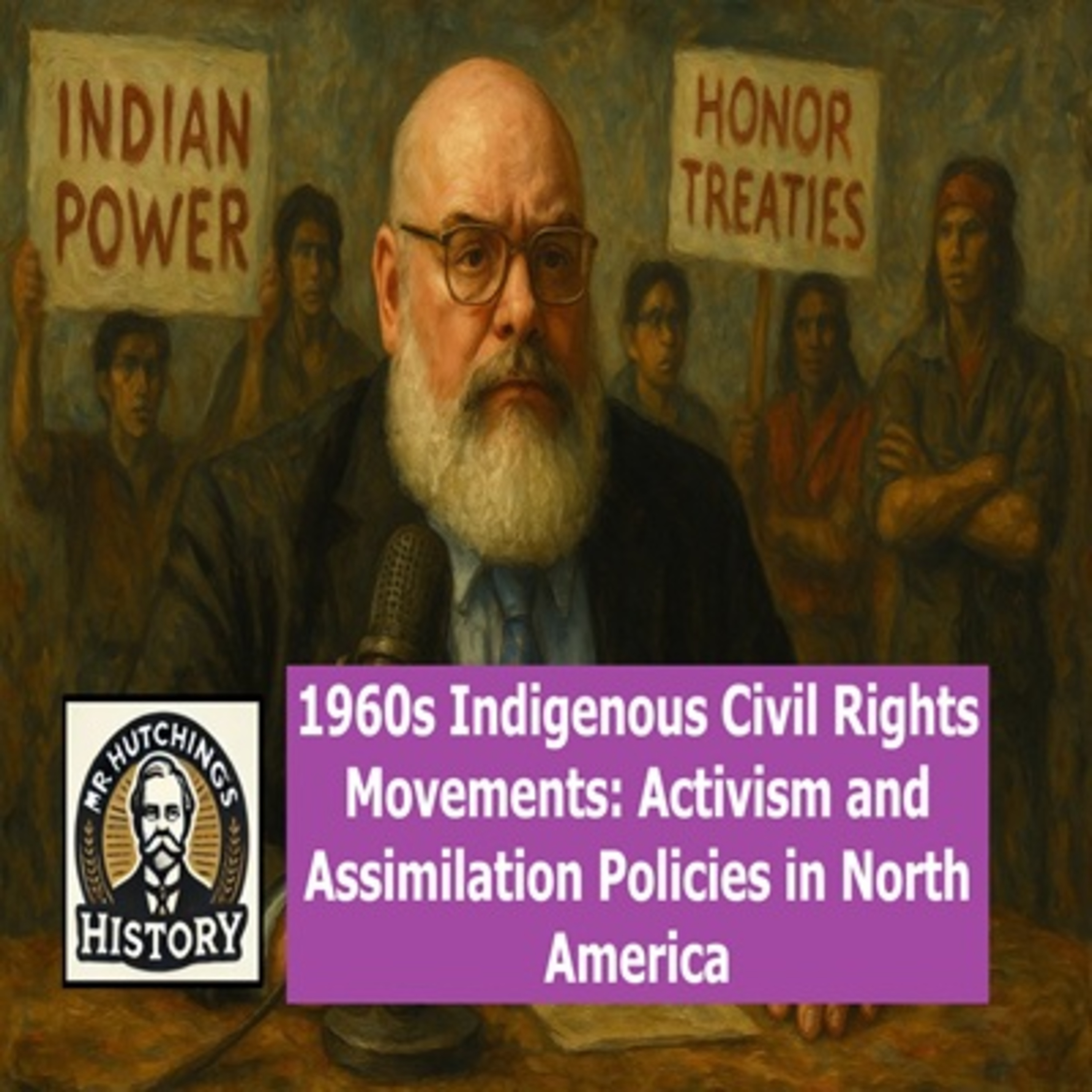
1960s Indigenous Civil Rights Movements: Activism and Assimilation Policies in North America episode artwork

EPISODE · Nov 22, 2024 · 14 MIN

1960s Indigenous Civil Rights Movements: Activism and Assimilation Policies in North America

from Mr. Hutchings History · host Produced, created, and written by Harold M. Hutchings

In this episode of Mr. Hutchings History, we delve into the transformative civil rights movements of the 1960s, as Native Americans and First Nations in North America fought against assimilation policies and for the recognition of their rights. From the “fish-ins” in Washington State to opposition to Canada's White Paper, Indigenous activism took on new forms, fueled by the rise of organizations like the NCAI, NIYC, and AIM. These groups were pivotal in challenging policies that sought to erase Native identities and limit sovereignty. We explore the broader impact of these movements, the rise of more militant activism, and the varied historical perspectives that interpret these events. Indigenous leaders, like Harold Cardinal in Canada and activists in the U.S., rejected assimilationist approaches and pushed for cultural preservation, self-determination, and treaty rights. This episode examines the legacy of 1960s activism and its lasting influence on Indigenous rights movements that followed. #Paper3HLoption2 #IndigenousRights #1960sActivism #NativeAmericanRights #FirstNationsRights #IndigenousCivilRights #NAACP #NCAI #IndianYouthCouncil #AIM #WhitePaperCanada #IndigenousSovereignty #FishIns #NativeAmericanHistory #FirstNationsHistory #IndigenousResistance #CivilRightsMovements #CulturalPreservation #AssimilationPolicies #SelfDetermination #IndigenousHistory Works Cited Cardinal, Harold. The Unjust Society: The Tragedy of Canada’s Indians. M.G. Hurtig Ltd, 1969. Final Report of the Truth and Reconciliation Commission of Canada, Volume One: Summary. Truth and Reconciliation Commission of Canada. James Lorimer & Co., 2015. Fixico, Donald L. Termination and Relocation: Federal Indian Policy, 1945–1960. University of New Mexico Press, 1986. Prucha, Francis Paul. American Indian Treaties: The History of a Political Anomaly. University of California Press, 1994. Chapters (0:00) Introduction (0:18) Life Before the 1960s (1:07) Resource Extraction and Conflict (1:49) Key Organizations in the US (2:36) NCAI and Strategic Litigation (3:43) NIYC and Direct Action (4:37) Canadian Indigenous Activism (5:28) Resistance to the White Paper (6:14) Lingering Issues in Canada (7:00) The Rise of AIM in the US (7:47) Cross-Border Inspiration (8:30) Historiographical Perspectives (10:05) Lasting Impacts of the 1960s Activism (11:40) Lessons from the 1960s (13:50) Conclusion

In this episode of Mr. Hutchings History, we delve into the transformative civil rights movements of the 1960s, as Native Americans and First Nations in North America fought against assimilation policies and for the recognition of their rights. From the “fish-ins” in Washington State to opposition to Canada's White Paper, Indigenous activism took on new forms, fueled by the rise of organizations like the NCAI, NIYC, and AIM. These groups were pivotal in challenging policies that sought to erase Native identities and limit sovereignty. We explore the broader impact of these movements, the rise of more militant activism, and the varied historical perspectives that interpret these events. Indigenous leaders, like Harold Cardinal in Canada and activists in the U.S., rejected assimilationist approaches and pushed for cultural preservation, self-determination, and treaty rights. This episode examines the legacy of 1960s activism and its lasting influence on Indigenous rights movements that followed. #Paper3HLoption2 #IndigenousRights #1960sActivism #NativeAmericanRights #FirstNationsRights #IndigenousCivilRights #NAACP #NCAI #IndianYouthCouncil #AIM #WhitePaperCanada #IndigenousSovereignty #FishIns #NativeAmericanHistory #FirstNationsHistory #IndigenousResistance #CivilRightsMovements #CulturalPreservation #AssimilationPolicies #SelfDetermination #IndigenousHistory Works Cited Cardinal, Harold. The Unjust Society: The Tragedy of Canada’s Indians. M.G. Hurtig Ltd, 1969. Final Report of the Truth and Reconciliation Commission of Canada, Volume One: Summary. Truth and Reconciliation Commission of Canada. James Lorimer & Co., 2015. Fixico, Donald L. Termination and Relocation: Federal Indian Policy, 1945–1960. University of New Mexico Press, 1986. Prucha, Francis Paul. American Indian Treaties: The History of a Political Anomaly. University of California Press, 1994. Chapters (0:00) Introduction (0:18) Life Before the 1960s (1:07) Resource Extraction and Conflict (1:49) Key Organizations in the US (2:36) NCAI and Strategic Litigation (3:43) NIYC and Direct Action (4:37) Canadian Indigenous Activism (5:28) Resistance to the White Paper (6:14) Lingering Issues in Canada (7:00) The Rise of AIM in the US (7:47) Cross-Border Inspiration (8:30) Historiographical Perspectives (10:05) Lasting Impacts of the 1960s Activism (11:40) Lessons from the 1960s (13:50) Conclusion

NOW PLAYING

1960s Indigenous Civil Rights Movements: Activism and Assimilation Policies in North America

0:00 14:43

No transcript for this episode yet

We transcribe on demand. Request one and we'll notify you when it's ready — usually under 10 minutes.

The 48 Laws of Power by Robert Greene (Full Audiobook) Robert Greene Amoral, cunning, ruthless, and instructive, this multi-million-copy New York Times bestseller is the definitive manual for anyone interested in gaining, observing, or defending against ultimate control – from the author of The Laws of Human Nature.In the book that People magazine proclaimed “beguiling” and “fascinating,” Robert Greene and Joost Elffers have distilled three thousand years of the history of power into 48 essential laws by drawing from the philosophies of Machiavelli, Sun Tzu, and Carl Von Clausewitz and also from the lives of figures ranging from Henry Kissinger to P.T. Barnum.Some laws teach the need for prudence (“Law 1: Never Outshine the Master”), others teach the value of confidence (“Law 28: Enter Action with Boldness”), and many recommend absolute self-preservation (“Law 15: Crush Your Enemy Totally”). Every law, though, has one thing in common: an interest in t The Laura Ingraham Show Laura Ingraham The most-watched woman in the history of cable news brings her no-holds-barred political and cultural commentary to podcasting with The Laura Ingraham Show. A bestselling author, breast cancer survivor, and mother of three internationally adopted children, Laura was the most listened-to woman in talk radio before launching her own podcast. A trailblazer across media platforms, she brings a unique perspective to this twice-weekly show, drawing on her experience as a white-collar criminal defense litigator and a Supreme Court law clerk.New episodes drop twice a week—delivering the clarity, courage, and common sense America needs. Vampires of the Paper Flower Consortium Elizabeth Guizzetti Come for the evening, stay for eternity! Paper Flower Consortium is a podcast from the largest vampire coven in Seattle. Their stories are told by Loretta Fabron Onfoy, coven historian and librarian, in the hope that the modern vampire's way of life is not lost during the next great language transformation. Some tales in this anthology are horrific, some are droll, some are filled with misadventure--just like any eternal existence. Episodes sponsored by the Paper Flower Consortium's Business Community. The history is followed by questions from curious initiates. Want to ask Lady Loretta a question about vampirism? Have a topic you want to see discussed? Email [email protected] WW2 - the Key Questions, answered by Laurence Rees. Laurence Rees A former Head of BBC TV History programmes, Laurence has specialized in writing books and making television documentaries about World War Two, the Nazis and Stalinism for thirty years. He won a BAFTA and a Peabody for his TV series 'The Nazis: A Warning from History' and a British Book Award for his book on Auschwitz, which is also the world's best selling book on this notorious camp. His book 'the Holocaust: A New History' was described by the Times as 'exemplary' and by the Daily Telegraph as 'the best single volume account of the atrocity ever written'. Educated at Oxford University, for several years he was a visiting senior fellow at the London School of Economics, London University. He holds honorary doctorates from the University of Sheffield and the Open University. Professor Robert Service, of Oxford University, described Rees as 'one of the world's experts on the Second World War'. Sir Max Hastings wrote in the Sunday Times, in a review of Laurence Rees' 'World War Two: Behi

Frequently Asked Questions

How long is this episode of Mr. Hutchings History?

This episode is 14 minutes long.

When was this Mr. Hutchings History episode published?

This episode was published on November 22, 2024.

What is this episode about?

In this episode of Mr. Hutchings History, we delve into the transformative civil rights movements of the 1960s, as Native Americans and First Nations in North America fought against assimilation policies and for the recognition of their rights. From...

Can I download this Mr. Hutchings History episode?

Yes, you can download this episode by clicking the download button on the episode player, or subscribe to the podcast in your preferred podcast app for automatic downloads.
URL copied to clipboard!