
EPISODE · Dec 31, 2025 · 10 MIN
2.3. Asia — The Clocks of Heaven
from A brief history of AI from ancient times to the present day · host Kristy Anamoutou
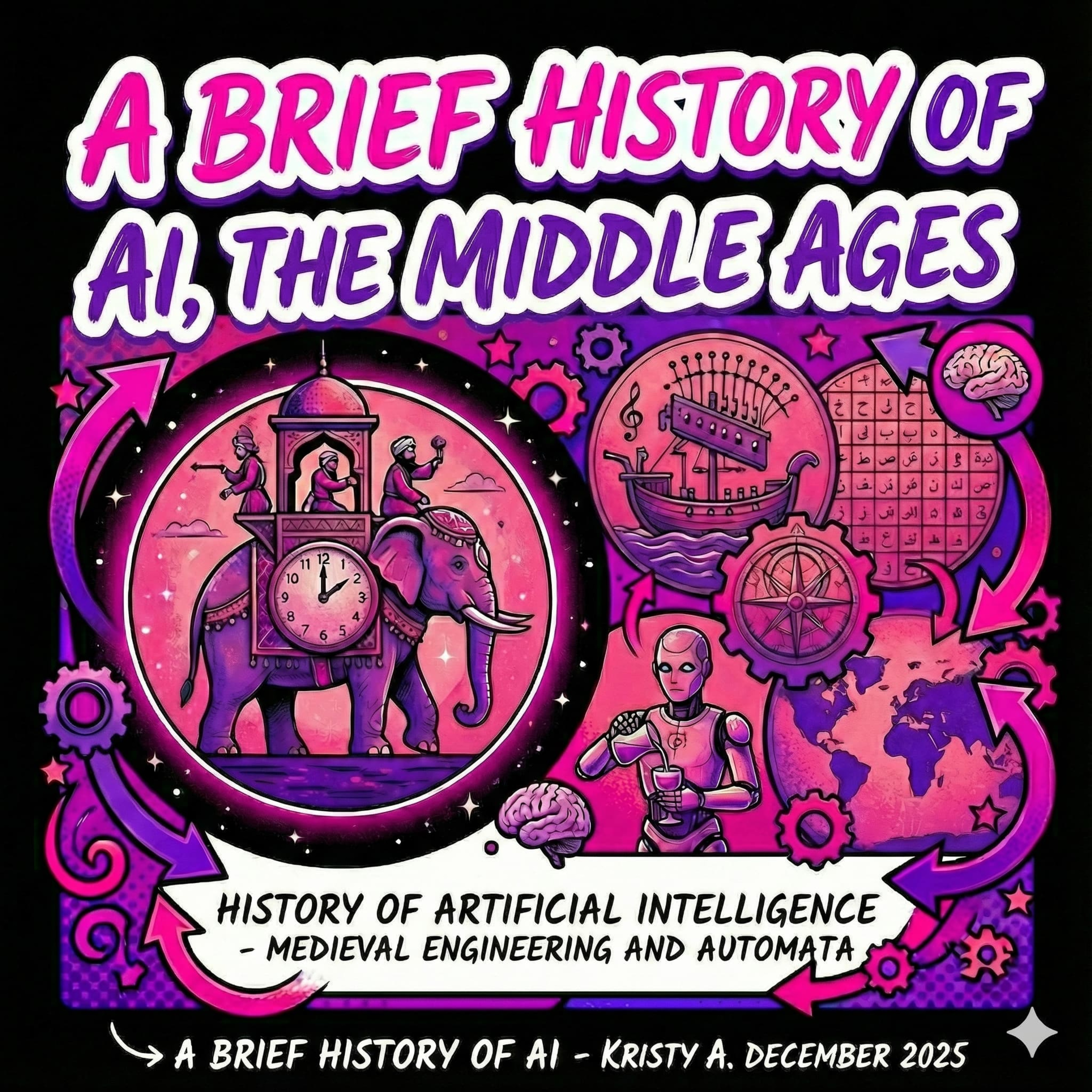
The Clocks of Heaven: How Medieval Asia Mechanized Time and KnowledgeA clock is not just a measuring instrument. It is a promise: that the world obeys rules, that the future can be predicted.In this episode, we discover how medieval Asia built machines capable of reproducing the movement of the heavens — two centuries before Europe.In 725, in the capital of the Tang Dynasty, a Buddhist monk named Yi Xing completed what no one had ever achieved: a machine capable of measuring time by itself. His secret: the escapement, that mechanism which transforms continuous movement into regular pulses. Europe would not invent its own for another two centuries.Three and a half centuries later, Su Song brought this tradition to its pinnacle. His clock tower, built in Kaifeng, rose to twelve meters. It housed one hundred and thirty-three mechanical figurines sounding the hours, the oldest known chain drive, and a mechanism so complex that the Jurchen conquerors, after dismantling it, never managed to reassemble it.You will discover Bi Sheng, who invented movable type printing in 1040 — four hundred years before Gutenberg. The mathematicians Yang Hui and Zhu Shijie, who discovered Pascal's triangle five centuries before Pascal, and methods for solving polynomial equations five hundred and seventy years before Europeans.Further south, in the Indian state of Kerala, Madhava of Sangamagrama developed around 1380 the first infinite series to calculate π — the beginnings of infinitesimal calculus, two to three centuries before Newton and Leibniz.And in Samarkand, the observatory of Ulugh Beg measured stellar positions with a precision that Europe would not achieve until Tycho Brahe.These inventions circulated. The Silk Road carried ideas as much as goods. The engineer Al-Jazari, in the Middle East, synthesized traditions from China, India, Greece, and Egypt in his elephant clock — a multicultural manifesto.Medieval Asia had understood something essential: intelligence begins with precision. Breaking down, measuring, recombining — these are the fundamental operations of any algorithm. Asia had invented them in bronze, porcelain, and wooden gears.When the Jurchen dismantled the Kaifeng tower, they thought they were carrying off a clock. They were carrying off the beginnings of a revolution.
What this episode covers
The Clocks of Heaven: How Medieval Asia Mechanized Time and KnowledgeA clock is not just a measuring instrument. It is a promise: that the world obeys rules, that the future can be predicted.In this episode, we discover how medieval Asia built machines capable of reproducing the movement of the heavens — two centuries before Europe.In 725, in the capital of the Tang Dynasty, a Buddhist monk named Yi Xing completed what no one had ever achieved: a machine capable of measuring time by itself. His secret: the escapement, that mechanism which transforms continuous movement into regular pulses. Europe would not invent its own for another two centuries.Three and a half centuries later, Su Song brought this tradition to its pinnacle. His clock tower, built in Kaifeng, rose to twelve meters. It housed one hundred and thirty-three mechanical figurines sounding the hours, the oldest known chain drive, and a mechanism so complex that the Jurchen conquerors, after dismantling it, never managed to reassemble it.You will discover Bi Sheng, who invented movable type printing in 1040 — four hundred years before Gutenberg. The mathematicians Yang Hui and Zhu Shijie, who discovered Pascal's triangle five centuries before Pascal, and methods for solving polynomial equations five hundred and seventy years before Europeans.Further south, in the Indian state of Kerala, Madhava of Sangamagrama developed around 1380 the first infinite series to calculate π — the beginnings of infinitesimal calculus, two to three centuries before Newton and Leibniz.And in Samarkand, the observatory of Ulugh Beg measured stellar positions with a precision that Europe would not achieve until Tycho Brahe.These inventions circulated. The Silk Road carried ideas as much as goods. The engineer Al-Jazari, in the Middle East, synthesized traditions from China, India, Greece, and Egypt in his elephant clock — a multicultural manifesto.Medieval Asia had understood something essential: intelligence begins with precision. Breaking down, measuring, recombining — these are the fundamental operations of any algorithm. Asia had invented them in bronze, porcelain, and wooden gears.When the Jurchen dismantled the Kaifeng tower, they thought they were carrying off a clock. They were carrying off the beginnings of a revolution.
NOW PLAYING
2.3. Asia — The Clocks of Heaven
No transcript for this episode yet
Similar Episodes
Mar 26, 2026 ·1m
Mar 19, 2026 ·34m
Feb 18, 2026 ·11m
Feb 11, 2026 ·45m