
EPISODE · Dec 31, 2025 · 10 MIN
2.4 Europe — The Wheels of Reason
from A brief history of AI from ancient times to the present day · host Kristy Anamoutou
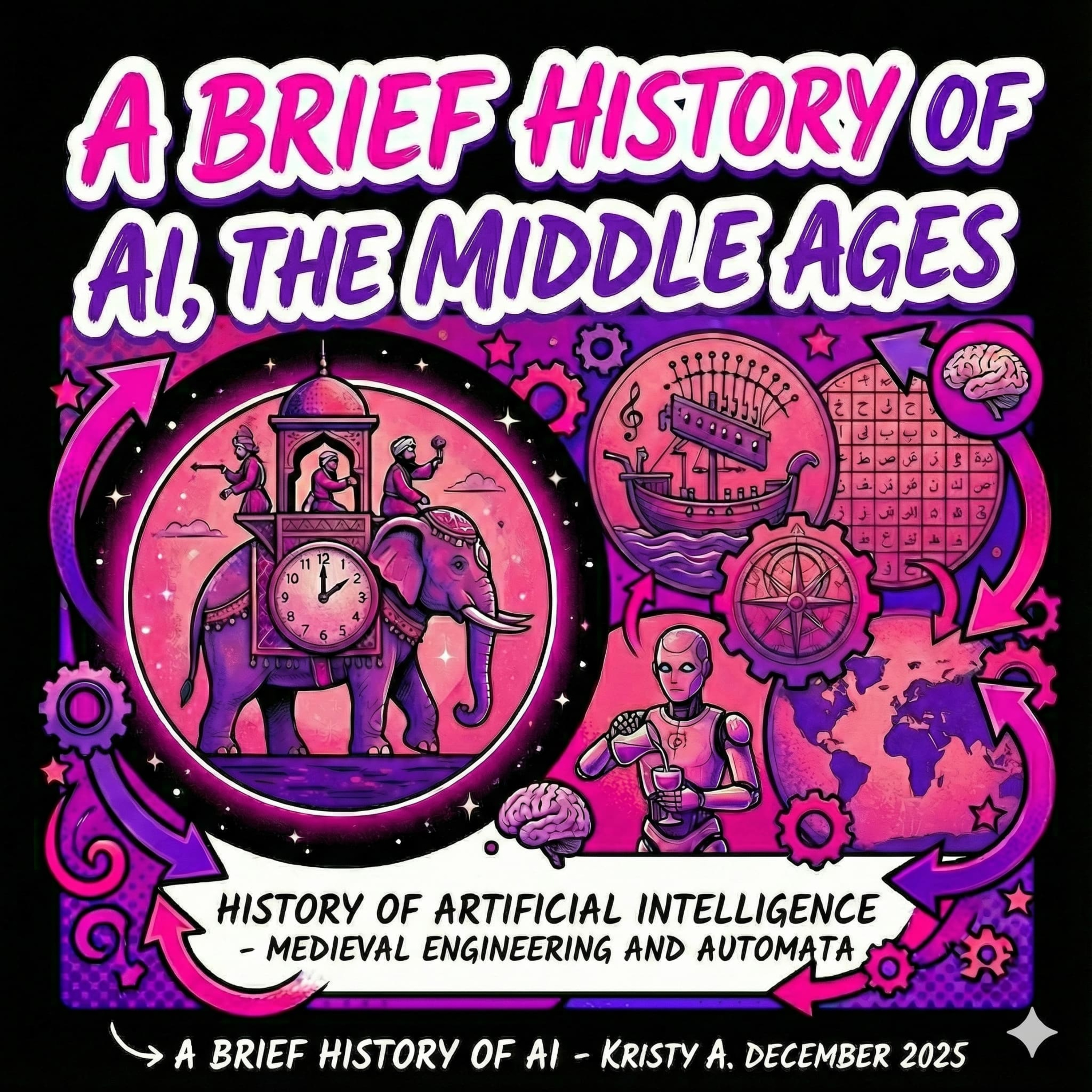
The Wheels of Reason: How Medieval Europe Built the First Thinking MachinesA wheel can transmit movement or transform it. It can also reproduce the path of thought in a mind.In this episode, we discover how medieval Europe invented the first reasoning machines.On the island of Majorca, around 1275, Ramon Llull conceived a strange machine. Concentric disks bearing letters and symbols, which could be rotated to generate combinations of concepts. Llull's Art rested on nine fundamental principles — goodness, greatness, duration, power, wisdom... — and rules for combining them. Llull had invented a thinking machine. Four centuries later, Leibniz would draw inspiration from it for his logical calculus.You will hear the legends of the brazen heads — those bronze automatons attributed to the greatest scholars. Albertus Magnus allegedly spent thirty years building one, before his student Thomas Aquinas destroyed it with a blow of his staff, exasperated by its chatter. These legends testified to a conviction: reasoning could be mechanized.You will visit the workshops where Richard of Wallingford completed his astronomical clock in 1336 — lunar phases, eclipses, tides of London Bridge, all with a theoretical error of seven parts per million. And the astrarium of Giovanni Dondi in Padua: seven faces, one hundred and seven gear wheels, the positions of the planets. Leonardo da Vinci drew its dials.You will discover Ockham's razor, that principle formulated by William of Ockham in the fourteenth century: "Do not multiply entities beyond necessity." This is exactly the principle that guides machine learning today: avoid overfitting, prefer simple models.And Fibonacci, who introduced Arabic numerals to Europe in 1202. Gerard of Cremona, who translated Al-Khwarizmi's Algebra — the mathematician whose name would give us the word "algorithm." Robert Grosseteste, who formulated the heart of the scientific method: generalizing observations into universal laws, then using those laws to predict.Medieval Europe bequeathed us a method — formalization — and a principle — parsimony. The wheels of the cosmos and the wheels of reason turned together.The brazen heads have fallen silent. But the wheels they set in motion still turn — in our servers, our algorithms, our learning machines.Article is available online here.
What this episode covers
The Wheels of Reason: How Medieval Europe Built the First Thinking MachinesA wheel can transmit movement or transform it. It can also reproduce the path of thought in a mind.In this episode, we discover how medieval Europe invented the first reasoning machines.On the island of Majorca, around 1275, Ramon Llull conceived a strange machine. Concentric disks bearing letters and symbols, which could be rotated to generate combinations of concepts. Llull's Art rested on nine fundamental principles — goodness, greatness, duration, power, wisdom... — and rules for combining them. Llull had invented a thinking machine. Four centuries later, Leibniz would draw inspiration from it for his logical calculus.You will hear the legends of the brazen heads — those bronze automatons attributed to the greatest scholars. Albertus Magnus allegedly spent thirty years building one, before his student Thomas Aquinas destroyed it with a blow of his staff, exasperated by its chatter. These legends testified to a conviction: reasoning could be mechanized.You will visit the workshops where Richard of Wallingford completed his astronomical clock in 1336 — lunar phases, eclipses, tides of London Bridge, all with a theoretical error of seven parts per million. And the astrarium of Giovanni Dondi in Padua: seven faces, one hundred and seven gear wheels, the positions of the planets. Leonardo da Vinci drew its dials.You will discover Ockham's razor, that principle formulated by William of Ockham in the fourteenth century: "Do not multiply entities beyond necessity." This is exactly the principle that guides machine learning today: avoid overfitting, prefer simple models.And Fibonacci, who introduced Arabic numerals to Europe in 1202. Gerard of Cremona, who translated Al-Khwarizmi's Algebra — the mathematician whose name would give us the word "algorithm." Robert Grosseteste, who formulated the heart of the scientific method: generalizing observations into universal laws, then using those laws to predict.Medieval Europe bequeathed us a method — formalization — and a principle — parsimony. The wheels of the cosmos and the wheels of reason turned together.The brazen heads have fallen silent. But the wheels they set in motion still turn — in our servers, our algorithms, our learning machines.Article is available online here.
NOW PLAYING
2.4 Europe — The Wheels of Reason
No transcript for this episode yet
Similar Episodes
Mar 26, 2026 ·1m
Mar 19, 2026 ·34m
Feb 18, 2026 ·11m
Feb 11, 2026 ·45m