
EPISODE · Dec 31, 2025 · 24 MIN
2.5 Middle East — The Architects of Mechanical Thought
from A brief history of AI from ancient times to the present day · host Kristy Anamoutou
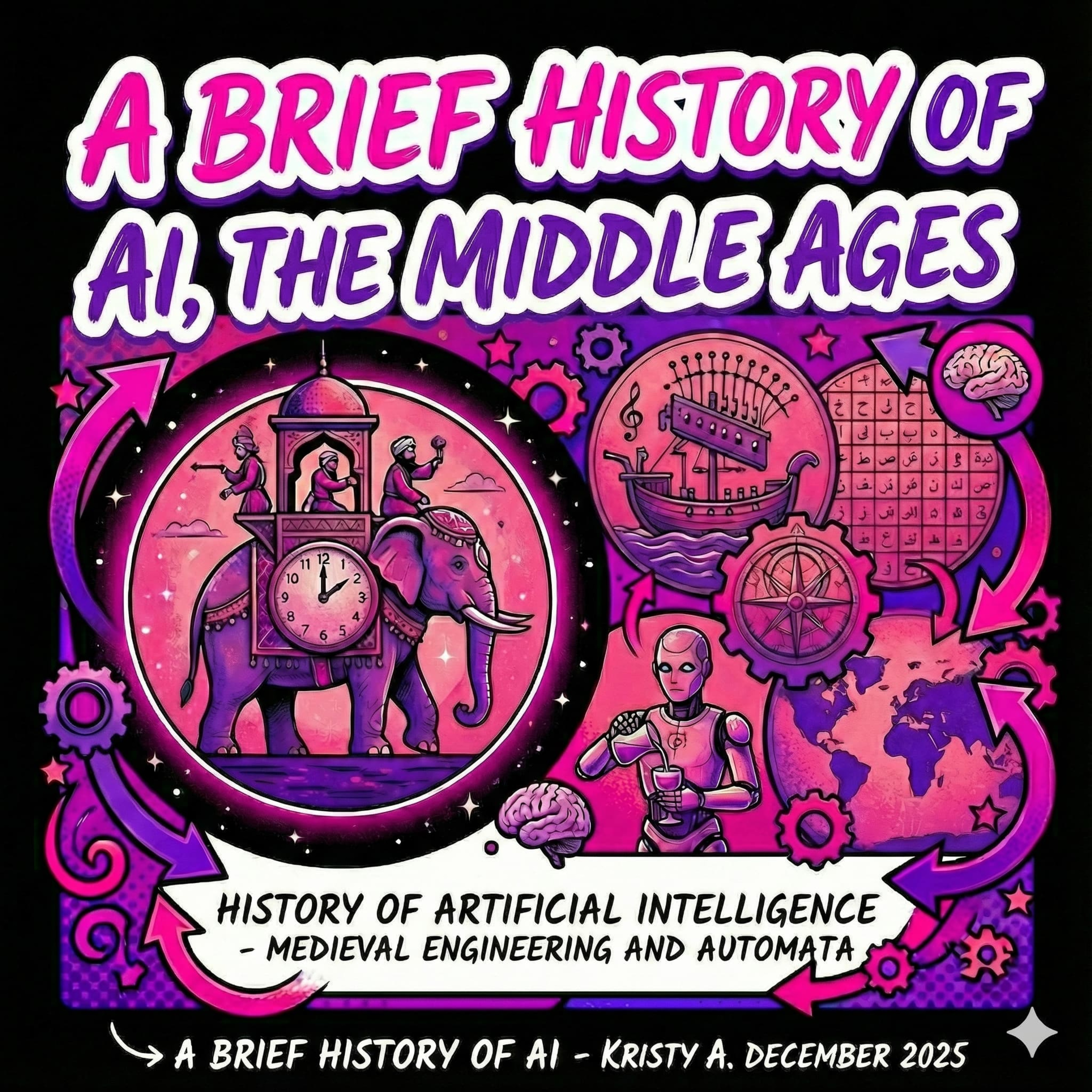
The Architects of Mechanical Thought: How the Medieval Middle East Laid the Foundations of Artificial IntelligenceEvery technological revolution has its forgotten ancestors. Artificial intelligence was born in Baghdad, in the ninth century.In this episode, we discover the architects who built, brick by brick, the conceptual edifice on which AI rests today.In 813, Caliph Al-Ma'mun founded the House of Wisdom — Bayt al-Hikma — where astronomers, mathematicians, and translators from Persia, India, Greece, and China crossed paths. It was there that Al-Khwarizmi worked, whose Latinized name would give us the word "algorithm," and whose treatise al-Jabr would give us the word "algebra."What Al-Khwarizmi invented was not a formula. It was a method: a series of step-by-step instructions, reproducible, that could be executed by someone who does not understand what they are doing. We have just described the fundamental principle of every computer program.You will meet the Banu Musa brothers, who built in 850 an automatic flute capable of playing different melodies according to the configuration of interchangeable cylinders. The first programmable machine in history — a thousand years before computers.Al-Jazari, who created in 1206 a boat carrying four mechanical musicians, an automatic waitress, and the elephant clock. "Al-Jazari precedes Leonardo da Vinci by two hundred and fifty years," historians note.Ibn al-Haytham, who invented the experimental scientific method: observe, formulate a hypothesis, design an experiment, verify the results. His method would transform European thought.Al-Kindi, who developed frequency analysis — the first automated information processing, ancestor of pattern recognition.Avicenna, who mapped the architecture of the mind — the different mental operations located in distinct regions of the brain.Averroes, whose commentaries on Aristotle would influence Thomas Aquinas and all of European scholasticism.In 1258, the Mongols destroyed the House of Wisdom. But the ideas had already traveled. They waited in the libraries of Toledo and Palermo, ready to germinate.Artificial intelligence was not born in an American laboratory. It began in Baghdad, when a Persian mathematician had the idea of describing a procedure so clear that it could be executed by anyone — or anything.
What this episode covers
The Architects of Mechanical Thought: How the Medieval Middle East Laid the Foundations of Artificial IntelligenceEvery technological revolution has its forgotten ancestors. Artificial intelligence was born in Baghdad, in the ninth century.In this episode, we discover the architects who built, brick by brick, the conceptual edifice on which AI rests today.In 813, Caliph Al-Ma'mun founded the House of Wisdom — Bayt al-Hikma — where astronomers, mathematicians, and translators from Persia, India, Greece, and China crossed paths. It was there that Al-Khwarizmi worked, whose Latinized name would give us the word "algorithm," and whose treatise al-Jabr would give us the word "algebra."What Al-Khwarizmi invented was not a formula. It was a method: a series of step-by-step instructions, reproducible, that could be executed by someone who does not understand what they are doing. We have just described the fundamental principle of every computer program.You will meet the Banu Musa brothers, who built in 850 an automatic flute capable of playing different melodies according to the configuration of interchangeable cylinders. The first programmable machine in history — a thousand years before computers.Al-Jazari, who created in 1206 a boat carrying four mechanical musicians, an automatic waitress, and the elephant clock. "Al-Jazari precedes Leonardo da Vinci by two hundred and fifty years," historians note.Ibn al-Haytham, who invented the experimental scientific method: observe, formulate a hypothesis, design an experiment, verify the results. His method would transform European thought.Al-Kindi, who developed frequency analysis — the first automated information processing, ancestor of pattern recognition.Avicenna, who mapped the architecture of the mind — the different mental operations located in distinct regions of the brain.Averroes, whose commentaries on Aristotle would influence Thomas Aquinas and all of European scholasticism.In 1258, the Mongols destroyed the House of Wisdom. But the ideas had already traveled. They waited in the libraries of Toledo and Palermo, ready to germinate.Artificial intelligence was not born in an American laboratory. It began in Baghdad, when a Persian mathematician had the idea of describing a procedure so clear that it could be executed by anyone — or anything.
NOW PLAYING
2.5 Middle East — The Architects of Mechanical Thought
No transcript for this episode yet
Similar Episodes
Mar 26, 2026 ·1m
Mar 19, 2026 ·34m
Feb 18, 2026 ·11m
Feb 11, 2026 ·45m