
EPISODE · Dec 31, 2025 · 13 MIN
2.7 Conclusion — What the Middle Ages Bequeathed Us
from A brief history of AI from ancient times to the present day · host Kristy Anamoutou
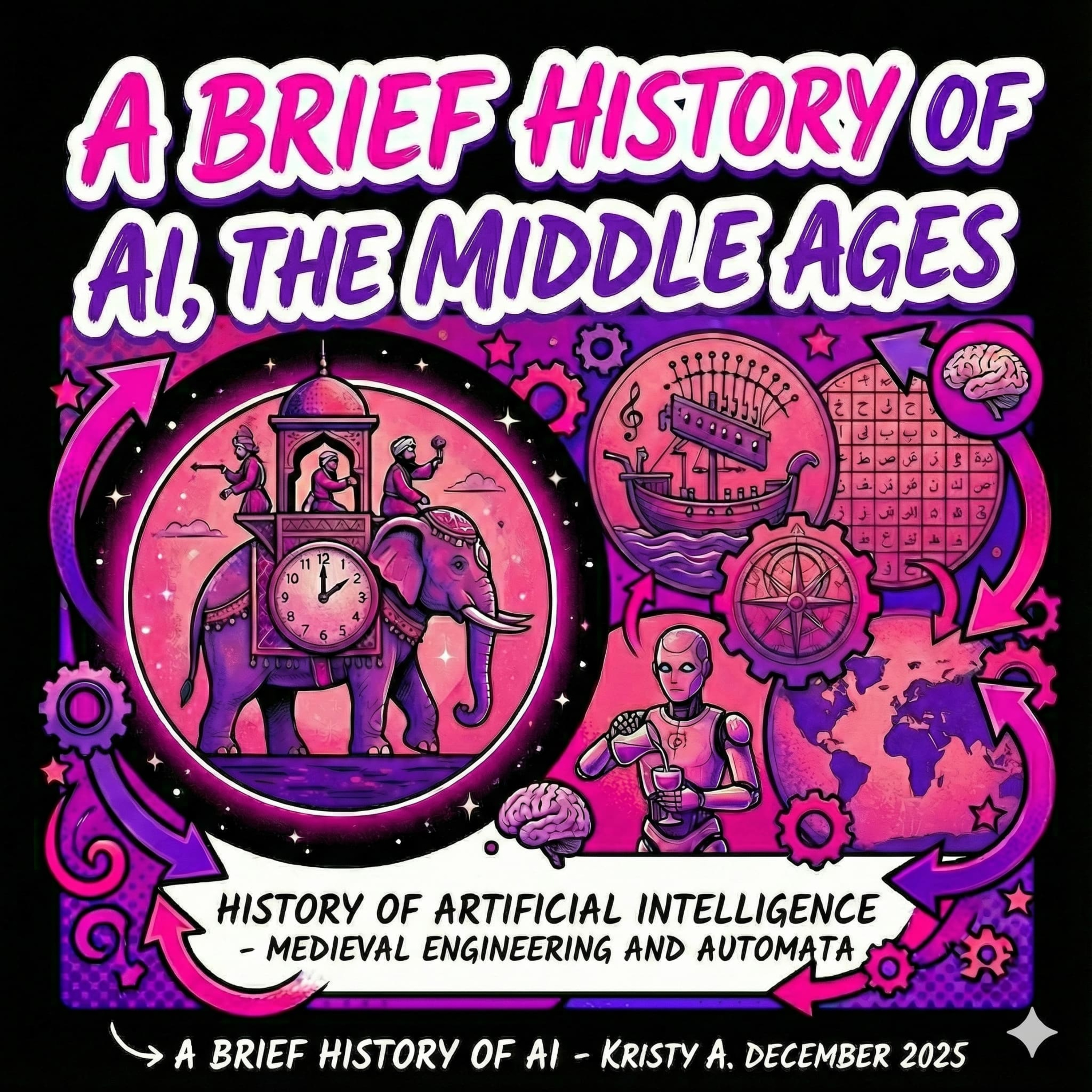
What the Middle Ages Bequeathed Us: Conclusion and Opening to the RenaissanceFrom the sand libraries of Timbuktu to the stone observatories of the Yucatan. From the clockmaking workshops of Kaifeng to the scriptoria of European monasteries. From the House of Wisdom in Baghdad to the canoes crossing the Pacific. Six continents. A thousand years of history. What does this journey teach us?In this final episode, we weave together the threads that connect all the stories we have told.Five convergences run through this millennium. The sky as the first problem — everywhere, astronomy was the matrix of computation. Memory as technology — from African griots to Inca quipucamayocs, every civilization invented its devices to extend memory beyond the limits of the body. The automation of reasoning — from Llull to Al-Jazari, the dream of a machine capable of reasoning. Training as investment — ten years to become a babalawo, decades to master Polynesian navigation. The network as condition — no civilization innovated alone.And six singularities. Africa made calculation a dialogue with the invisible. The Americas made calculation a language of the cosmos. Asia made calculation a material precision. Europe made calculation a quest for certainty. The Middle East made calculation a universal translation. Oceania made calculation an embodiment.Three fundamental dimensions of intelligence emerge: abstract calculation, favored by the Middle East and Europe. Extended memory, favored by Africa and the Americas. Relational embodiment, favored by Asia and Oceania. None is complete without the others.The Middle Ages also bequeaths us two questions. How to transmit? Three modes: institutional, lineage-based, immersive. Who has the right to decide? Four forms of authority: divine, cosmic, logical, relational.There is not one single history of artificial intelligence, but several parallel histories. The Middle East gave us the algorithm. Europe gave us formal logic. Asia gave us mechanical precision. The Americas gave us cyclical thinking. Africa gave us the integration of calculation into meaning. Oceania gave us embodied intelligence.The future of artificial intelligence is plural. The Middle Ages had already taught us this. The Early Modern Era, which now opens before us, will unfold it.The journey continues.
What this episode covers
What the Middle Ages Bequeathed Us: Conclusion and Opening to the RenaissanceFrom the sand libraries of Timbuktu to the stone observatories of the Yucatan. From the clockmaking workshops of Kaifeng to the scriptoria of European monasteries. From the House of Wisdom in Baghdad to the canoes crossing the Pacific. Six continents. A thousand years of history. What does this journey teach us?In this final episode, we weave together the threads that connect all the stories we have told.Five convergences run through this millennium. The sky as the first problem — everywhere, astronomy was the matrix of computation. Memory as technology — from African griots to Inca quipucamayocs, every civilization invented its devices to extend memory beyond the limits of the body. The automation of reasoning — from Llull to Al-Jazari, the dream of a machine capable of reasoning. Training as investment — ten years to become a babalawo, decades to master Polynesian navigation. The network as condition — no civilization innovated alone.And six singularities. Africa made calculation a dialogue with the invisible. The Americas made calculation a language of the cosmos. Asia made calculation a material precision. Europe made calculation a quest for certainty. The Middle East made calculation a universal translation. Oceania made calculation an embodiment.Three fundamental dimensions of intelligence emerge: abstract calculation, favored by the Middle East and Europe. Extended memory, favored by Africa and the Americas. Relational embodiment, favored by Asia and Oceania. None is complete without the others.The Middle Ages also bequeaths us two questions. How to transmit? Three modes: institutional, lineage-based, immersive. Who has the right to decide? Four forms of authority: divine, cosmic, logical, relational.There is not one single history of artificial intelligence, but several parallel histories. The Middle East gave us the algorithm. Europe gave us formal logic. Asia gave us mechanical precision. The Americas gave us cyclical thinking. Africa gave us the integration of calculation into meaning. Oceania gave us embodied intelligence.The future of artificial intelligence is plural. The Middle Ages had already taught us this. The Early Modern Era, which now opens before us, will unfold it.The journey continues.
NOW PLAYING
2.7 Conclusion — What the Middle Ages Bequeathed Us
No transcript for this episode yet
Similar Episodes
Mar 26, 2026 ·1m
Mar 19, 2026 ·34m
Feb 18, 2026 ·11m
Feb 11, 2026 ·45m