
EPISODE · Dec 31, 2025 · 3 MIN
2. Introduction to the Middle Ages
from A brief history of AI from ancient times to the present day · host Kristy Anamoutou
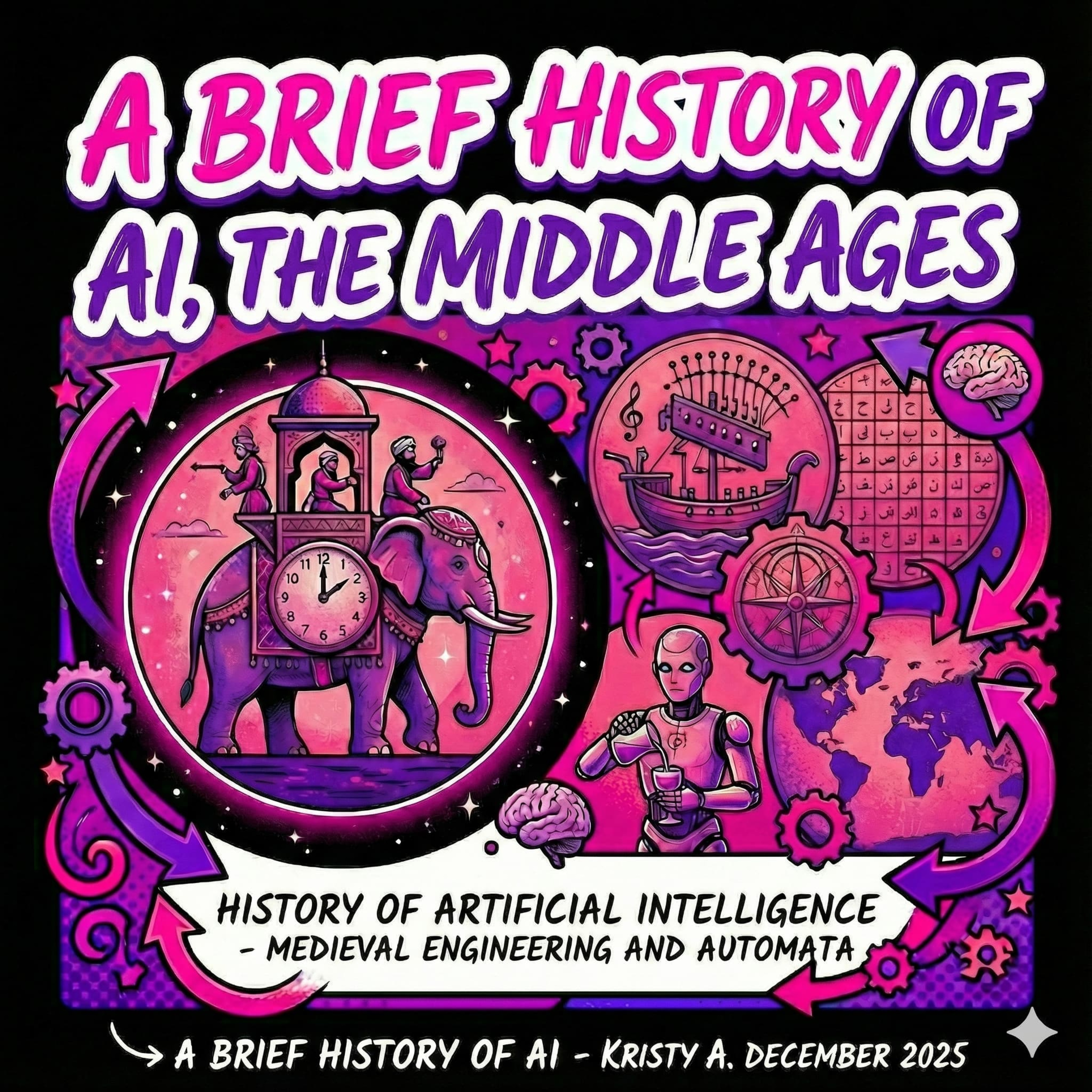
The Age of Foundations: How the Middle Ages Laid the Groundwork for Artificial IntelligenceThe official history will tell you that the Middle Ages was a dark age. A thousand years of obscurantism between the glory of Antiquity and the brilliance of the Renaissance. This history is false.Between 476 and 1492, while Europe sought light in its monasteries, the rest of the world was building the foundations of what we now call artificial intelligence. In Baghdad, a mathematician invented the algorithm. In Timbuktu, scholars compiled hundreds of thousands of manuscripts. In China, clockmakers built mechanical towers twelve meters high. In the Yucatan, astronomers calculated eclipses with greater precision than Europe. And in the Pacific, navigators crossed thousands of kilometers of ocean with no instrument but their bodies and the stars.In this new season of Avalon, we continue our journey through the forgotten roots of AI.You will discover how the word "algorithm" was born from the name of a scholar from Baghdad — Al-Khwarizmi — and how his step-by-step procedures established the fundamental principle of every computer program. How the Banu Musa brothers built the first programmable machine in history — an automatic flute playing different melodies according to the configuration of interchangeable cylinders. How Al-Jazari created the first humanoid robot, two hundred and fifty years before Leonardo da Vinci.You will explore the sand libraries of medieval Africa — those of Timbuktu, but also those of the griots, those "living libraries" who memorized genealogies spanning forty generations. The eclipse tables of the Maya, valid for five centuries. The Inca quipus, those portable databases capable of storing thousands of pieces of information in a few grams of cotton.You will meet the Chinese clockmakers and their escapement mechanism, invented two centuries before Europe. The European philosophers and their combinatory wheels, the first thinking machines. The Polynesian navigators and their stick charts, which they memorized before the voyage and then left on the shore.Six continents. A thousand years of history. And everywhere, the same quest: to give form to thought, to delegate calculation to matter, to preserve knowledge against oblivion.The Middle Ages was not a dark age. It was the age when humanity laid the foundations of artificial intelligence.Welcome to A Brief History of AI, Season 2.The companion articles are available online.
What this episode covers
The Age of Foundations: How the Middle Ages Laid the Groundwork for Artificial IntelligenceThe official history will tell you that the Middle Ages was a dark age. A thousand years of obscurantism between the glory of Antiquity and the brilliance of the Renaissance. This history is false.Between 476 and 1492, while Europe sought light in its monasteries, the rest of the world was building the foundations of what we now call artificial intelligence. In Baghdad, a mathematician invented the algorithm. In Timbuktu, scholars compiled hundreds of thousands of manuscripts. In China, clockmakers built mechanical towers twelve meters high. In the Yucatan, astronomers calculated eclipses with greater precision than Europe. And in the Pacific, navigators crossed thousands of kilometers of ocean with no instrument but their bodies and the stars.In this new season of Avalon, we continue our journey through the forgotten roots of AI.You will discover how the word "algorithm" was born from the name of a scholar from Baghdad — Al-Khwarizmi — and how his step-by-step procedures established the fundamental principle of every computer program. How the Banu Musa brothers built the first programmable machine in history — an automatic flute playing different melodies according to the configuration of interchangeable cylinders. How Al-Jazari created the first humanoid robot, two hundred and fifty years before Leonardo da Vinci.You will explore the sand libraries of medieval Africa — those of Timbuktu, but also those of the griots, those "living libraries" who memorized genealogies spanning forty generations. The eclipse tables of the Maya, valid for five centuries. The Inca quipus, those portable databases capable of storing thousands of pieces of information in a few grams of cotton.You will meet the Chinese clockmakers and their escapement mechanism, invented two centuries before Europe. The European philosophers and their combinatory wheels, the first thinking machines. The Polynesian navigators and their stick charts, which they memorized before the voyage and then left on the shore.Six continents. A thousand years of history. And everywhere, the same quest: to give form to thought, to delegate calculation to matter, to preserve knowledge against oblivion.The Middle Ages was not a dark age. It was the age when humanity laid the foundations of artificial intelligence.Welcome to A Brief History of AI, Season 2.The companion articles are available online.
NOW PLAYING
2. Introduction to the Middle Ages
No transcript for this episode yet
Similar Episodes
Mar 26, 2026 ·1m
Mar 19, 2026 ·34m
Feb 18, 2026 ·11m
Feb 11, 2026 ·45m