
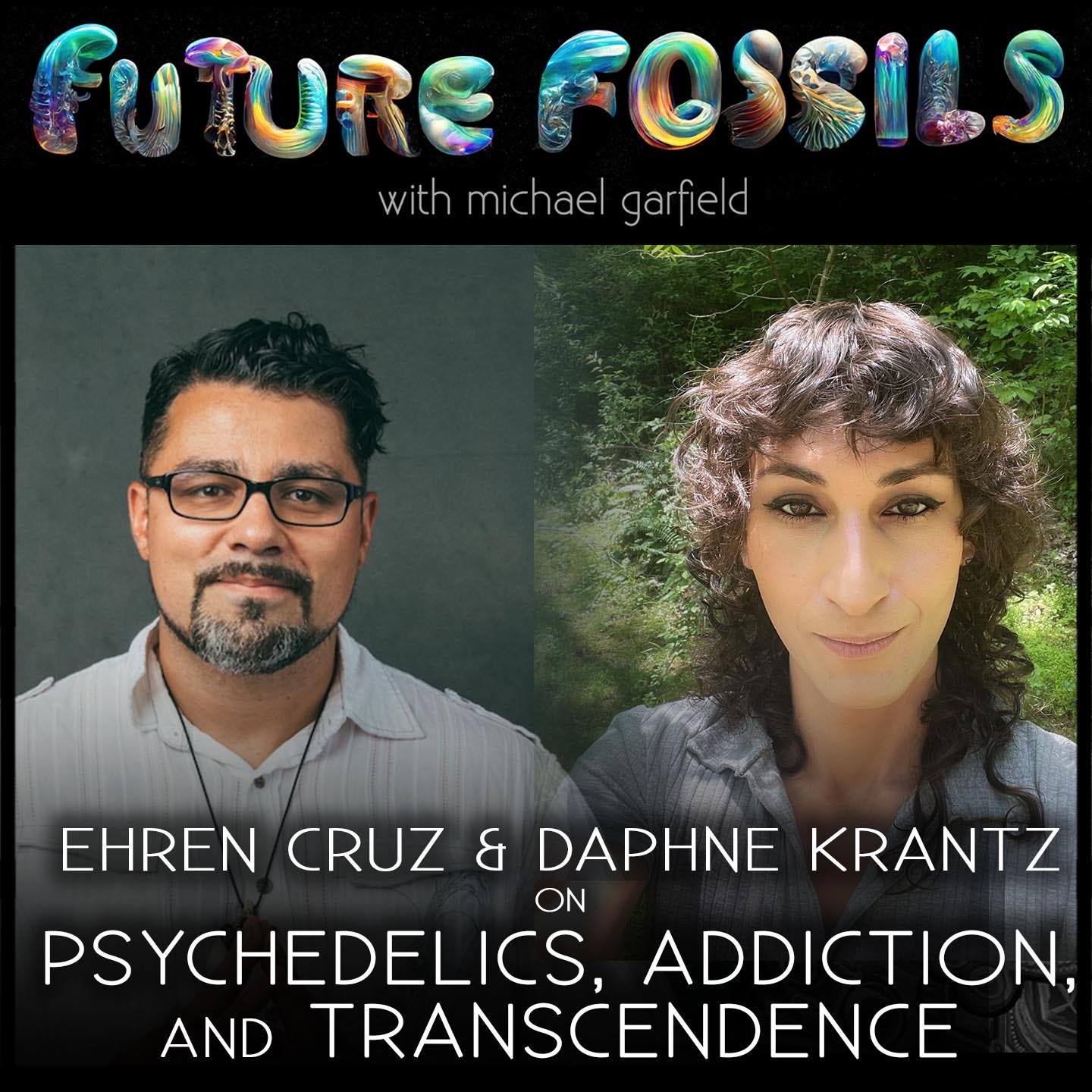
Greetings, Future Fossils. This is Michael Garfield welcoming you to episode 200 of the podcast that explores our place in time. My god, we made it here. What?
A view from the summit? It's incredible. And for this episode, I have two very special guests, two very old friends. I mean, they're not very old.
They're just friends I've had for a very long time. Aaron Cruz and Daphne Krantz. Aaron is a psychedelic experience facilitator. Daphne is an addiction counselor, but I met them both in the festival world when Aaron and I were working on the visionary art web magazine Soul Purpose back in a decade ago.
And Daphne was producing electronic music under the alias few texture. Daphne was a self-identified man at the time. David Krantz appeared on the show episode 63 talking about cannabis and nutritionism. So, I mean, all of us have been through just extraordinary transformations.
Aaron Cruz was the guy who ceremonially blessed my Google Glass before I performed with it in a world-first, self-streaming performance at Gradiflac Festival in 2013. So, yeah, there's a lot of archival materials unpacked here, but we don't spend a lot of time ruminating on history. Instead, we discuss the present moment of the landscape of our society and people's trauma and drive for transcendence and the way that this collides with consumer culture and transformational festival scene where we all met one another. And it's an extraordinary episode.
And I know a lot of people out there are having a really hard time right now. And I am with you. I have huge news to share soon. I want you to know that you are not alone in your efforts to work things out.
And if you need support, there is support for you. I really hope that you get something out of this conversation. I, myself, found just simply relistening to the recording to be truly healing. And I'm really grateful that I get to share it with you.
But before I do that, I want to pay tribute to everyone who is supporting this show. Patreon, Substack, everyone who is subscribing to my music on Bandcamp. The latest Patreon supporters included Darius Strussell and Samantha Lutz. Thank you both so much.
Thank you also to the hundreds of other people who are helping me pay my mortgage and feed my kids with this subscription service, one form or another. I have plenty of awesome new things for you, including speaking of psychedelics, a live taping of the two sets I just played opening for to be in Shane Moss here in Santa Fe at the John Cottos Cinema. Sold out shows, excellent evening. I just posted the little teaser clip of the song Transparent, which was a song from that 2013 Google S performance, actually.
It was an inaugural debut. I've refined it over the last decade and I submitted it to NPR's tiny desk concert and you can find it up on YouTube if you want to taste the electroacoustic inventions that I will be treating subscribers to here in short order. Patreon.com.com.com.com.com.com.com.com.com.com which is where this podcast is currently hosted by RSS Feed. And thanks to everybody who has been reading and reviewing the show on Apple Podcasts, Spotify and whatever.
You're wonderful. You've got this. Whatever you're going through, you can do it. I believe in you.
And do not hesitate to reach out to me or to my fabulous guests or to other members of our community if you need the support. Thank you. Enjoy this episode. Be well and much more coming soon.
I have two extraordinary conversations in the can. One with Kevin Wollmott, my dear friend here in Santa Fe and KMO, the notorious legendary Infantorate podcaster who just published a trial log, the first part of the trial log between three of us on his own show. Highly recommend you check that out. And then also an episode with caveat Magister, the resident philosopher of Burning Man, who published an extraordinary book last year, turned your life into art, which resulted in a very long, vulnerable, profound and hilarious conversation between two of us about our own adventures and misadventures and the relationship between psychomagic and Burning Man and the Owl of Disney Jurassic Park.
Oh, and speaking of which, another piece of bait to throw on the hook for you subscribers. I am about to start a Jurassic Park book club. This spring, I will be leading the group in the Discord server and in the Facebook group and on live calls, chapter by chapter, through the book that changed the world. I have intense and intimate relationship with this book.
I was there at the World Premiere in 1993. I grew up doing dinosaur digs with the book's primary paleo-sological consultant Robert Barker. I had a dress with a tattoo, etc. I've sold the painting to you in the pen, not to be enough, but to jump out gloom.
I didn't name my son after that mathematician. Anyway, yes, much, much, much to discuss, especially because, you know, one of the craziest things about this year is that the proverbial velociraptors have escaped the island, you know, and open AI. What's in a name? Everything is just transforming so fast now.
And so I am the dispossessed Cassandra that will lead you through some kibbutzes in Doug Rushcoast language. Please join us. Everybody subscribing to Substack or anybody on Patreon at 5 bucks or more will be privy to those live calls. And I really hope to see you in there.
And with all of that shilling behind me now, please give it up for the marvelous Aaron Cruz, Daffy Krantz, to people with whom I can confidently entrust your minds. Enjoy. Okay, let's dive in. Aaron, Daffy, your fossils, you're here.
Awesome. This took us like, what, nine months to schedule this? That's a slow burn, but here we go. It's great to hear your boat.
It is. And once again, anything that gets rescheduled, always ends up turning out better. Like, I was just thinking, I'm really glad we actually didn't do this interview nine months ago, just in terms of life experience between now and then. I don't know what that's going to translate to in a conversation, but personally, I feel a lot more prepared to talk to you right now.
Unpercentory. Cool. Okay, so let's just dive in then. Both of you are doing really interesting work in the explosive emerging sector of, in one way or another, dealing with people's trauma, dealing with people's various things.
With people's various life crisis issues. And having met both of you through the festival world, which was a scene of pretty rampant abuse and escapism. And I met you both as what my friend in town here, Michmaniano, would call like psychedelic conservatives, where I felt like there were a bunch of like elder millennials who were kind of trying to help that have been in the scene for a little while. They were really working to steer people into a more grounded and integrated approach to ex-dasis in the festival world.
And all of us have seen our fair share of, and perhaps also lived through our fair share of right and wrong relationship to the tools and technologies of transcendence. So that's going to where I want to take this. And I think maybe the way to start is just by having both of you introduce yourselves and talk a little bit about your path and the various roles that you've kept over the years in this and adjacent spheres and what led you into the work that you're doing now. And then yeah, from there we can take it wherever the conversation chooses to lead us.
Daphne, we've got to show before. So why don't we have Aaron go first. Let's do that. Okay.
Awesome. Thank you, Mike. Yeah, we appreciate you. Really eloquent way of creating an environment to kind of settle into here.
So Aaron Cruz, I've been really deeply immersed in psychedelics for 15 years, my first foray into the world or in curiosity was actually going to school and Ohio State University for fellowship and anthropology and coming from the perspective of looking at 1615th century around the time of the conquest and indigenous cultures utilizing plant medicine ceremony ritual as a community harmonizer agent, as a tool for collective wisdom and also for ceremonial divine communion, but very much from an ivory tower perspective. I was not very much engaged with psychedelics at that particular lens outside of a foray into a couple of opportunities at all good music festival or different things like that, but I beg the question about is using these plant medicines with intentionality will it create a more symbiotic way of life, a way of understanding the independence between the natural landscape, humanity culture, community building and personal evolution. So it wasn't until major cycle experience in 2008 where I had probably an advisable amount of LSD in the middle of an event and went into a whole system that was all to the degree I actually even know my name for several hours. But what I did feel that times recognized was just this deep sense of connection to the soul of others, a sense that each one of us better best efforts with cultural conditioning, social conditioning, how we're raised as peers, we had a desire to be loved, appreciated, embraced.
There's this deep sense of tribal kinship that I think I felt from everybody wanted to explain whether they were wearing a grateful dead shirt, a ballerina to to or black cap or whatever it was, but we wear these different types of masks of phone safety and security and sense of self but beneath that facade, I just felt this deep rich desire to be a sense of belonging and connection and desire to be a child of the universe for lack of a better term. So that kind of really set me off from that tone as you shared is that this rapidly celebrated from place of recreation to a deep of place of deep spiritual potency. And from that place on the alchemical frontier is I call that kind of festival type around where many whether they're using compounds for skapism or they're trying to embody or embrace a particular lifestyle that they can then translate and seed into their own default realities or whatever that is almost, Jedi training grounds or whatever you consider that to be. However, your orientation around it, that is, I just felt the deep devotion to trying to support those particular realms first and workshop ceremony and cultivation of experiences that had some integrity and bones to using these things mindfully.
Eventually to producing events, I was producing a co-producing ritual back in the day where I live a mention mic with root wire with the pop toseo about 2010 through 2013 or 9 through 12, maybe one of those epochs, but learned a lot. It was a lot of bootstrapping and blood sweat and everything else trying to get those events going and what they really created these containers of radical creativity and self-expression and where music and visionary arts can be upheld in a new model of honoring them and mutual out something that never took root as much as I'd love to do. And then kind of translated into producing leaf festival here in Ashwood, North Carolina for six years and the ethos behind that was trying to create a dynamic cultural atmosphere, 10 to 15 different nations, people of all walks of life or traditions, expressing their music arts culture ceremony, and using that as a catalyst to kind of break down isms to reveal that the true depth and value that the rich creative and cultural expression has beyond politic, beyond social conditioning. You hear one thing about Iranians on TV, but if you see them doing their Sufi circle dance and chanting and when they're cooking their food at the end of the day, it just really it's amazing how humanity and expression in those places would really quickly help people bypass certain pressure.
And then bypass certain prejudices without saying word, we're often dialogue, even intentional and conscious dialogues tend to fail, expression goes beyond that. So, and of course there are still rich cultural psychedelics and these places are, it's kind of underground, it's not necessarily, there's no curated container specifically to facilitate initiation or rights of passage, it's a little bit more rogue, rogue experiencing. So after that kind of materialized up to COVID where I was really actually even at that point seeking an exit strategy from that realm, the intensity producing events is extremely vigorous. So, remember 2019 I had 7,800 emails and countless calls just coordinating three festivals and I got children, my three girls just hanging on every limb and that one more call, one more thing.
So, it was becoming quite burned out and COVID kind of did me at the time and I think so, a bit of a favor and then giving me kind of forcing me into an exit strategy to reidentify myself, not as just a producer and an event organizer, but someone that is deeply passionate about initiatory culture. My catalyst was festivals for initiation or creative initiation and then I went back to where it all began, really sat with the medicine once again, brought myself back into sacramental ceremony and then I started really gazing at the broad sweeping frontier, the vanguard of the psychedelic emergency now and saying, this may be a time I could be transparent and real and open about my deep care and use of these plans and medicines for almost 15 years. And so I went ahead and I got a professional coaching certification from ICF. I got a third wave psychedelic certification as the first psychedelic coaching program in the nation back in 2020 and six months of learning the panoramic of psychedelics preparation integration, the neuroplasticity, the ethics considerations, dosageing, compound understanding.
So getting that whole holistic review and then cultivating a practice of facilitation coaching practice based upon using that psychedelic as a catalyst, but in a continuum of deeply intentional self work and self care and moving into that space with an openness to receive insights. But then really about embodiment, what you do after you have those light and bolts of revelation and how you make that have an impact in your life. So that's been my last few years is serving as a ceremonial facilitator and coach in the psychedelic realm and also harm reductionist people are looking for a high integrity experience, but have a compound. Don't really know how to go about it in a way that's intentional and safe, really kind of stepping into that space and holding that container for them and being an ally.
Awesome. Daphne. Hi. Lovely to be back here with you Michael.
So I'll start from the beginning and kind of give my whole story inspired by Aaron in the way he just articulated that trajectory and I started out with each other. We might admit each other also at rewire back in that era. And I found myself in this world as a music producer. I was really heavily investing time and energy into building a music career, DJing, producing and doing a few texture for a long time, starting in around 2009.
And that was my main gig for about six years and had some early psychedelic experiences when I was pretty young, 14, 15, 16 kind of set me off on a path to where I really had a strong inclination that there was something there and was always very interested in them. And came into the festival world into the music world with a very idealistic lens of what these substances could do for us individually as humanity. And had my ideals broken completely in a lot of ways. And what I experienced personally through relationships with collaborators, through my own inability to show up in the way that I wanted to in terms of my own ideals, thinking that because I took psychedelics, I was going to somehow magically be this person who could live up to these ideals of relational integrity and honesty and really being a beacon of what I perceived as light, right?
And really had some issues with spiritual ego when I was younger and kind of had the sense of I've seen these other realms I know more than other people. I'm special. I had all that story and really ended up harming me and other people around me. And it took some pretty significant relational abuse actually that I was experiencing and participating in the creative relationship to kind of break me out of that illusion, right?
Because I'm creating interesting, forward thinking music with a psychedelic bent in this kind of wild and free community festival community that somehow I was immune from all of the shadow that exists in our culture, in the psyche, in all of these places that I was just very blind to. And I think it's a pretty normal developmental thing in your early 20s, I mean, at any age, ongoing, of course, to be to have places that are less conscious. And those are blind spots, right? And so I really was forced through my musical career, through my participation in psychedelic culture, to either have the choice to look at those blind spots or continue to ignore them.
And I look back and I'm really grateful that I really did at a certain point be like, damn, I need to go to therapy. You can't do this on my own. I'm really hurting. And in about 2015, I kind of stepped away from music, pretty hardcore and really shifted my focus because I was in too much pain.
I experienced a lot of relational trauma around that time and started to just do other things, preferably related to music. I moved for a little bit building synthesizers and found myself doing a lot of personal healing work, kind of getting really real about my own inability to show up at the time I was perceiving as a good person and retrospect. There was so much more complex than that. And over time, being able to drop the layers of shame and the layers of self-judgment around a lot of those relational patterns.
I was living out that, of course, are familial and cultural and all these other things. But I ended up starting doing health coaching work around that time. And, Michael, that's something that we've connected on the past episodes around some of the epigenetic coaching work. I do a lot of personalizing nutrition and performance type work.
And I was doing that pretty steadily from about 2015 to 2000. I'm still doing it, but over the last three and a half years or so, went and got a Masters in mental health counseling. I started to really find that a lot of the people I was working with and drawing from my own experiences in therapy and healing. I was like, okay, nutrition and all of these physiological things are very important.
And what I'm seeing is most of these people need emotional healing. Most of these people need more psycho emotional awareness and healing from trauma and relational patterns. And I just felt really unprepared to do that work as a coach at the time and also had just tremendous openings into understanding myself better, into being able to be with discomfort and be with pain in a way that when I was younger, was totally off the table. It was like, I'm just going to distract myself fully from all of that through through drugs, through sensory experiences, through the festival world.
That's where I got drawn. And no regret. Like, I loved that. It was what shaped me.
And I still engage in all of that just with a slightly different way of being with it, not as an escape, but as a way of celebration in contrast with really being able to also be with the more difficult, darker shadow aspects of life and seeing that as a pathway to wholeness rather than avoiding those things. And so that's the work I'm doing now as a therapist, as someone who does psychedelic integration work. I've also done publications on psychedelics. I've had an article that was in the journal of mental health counseling a couple of years ago.
I have another one that's pending right now on psilocybinist group therapy that I hope gets through in the international journal group psychotherapy right now. And I'm planning some research also on gender and psychedelics in terms of the way psychedelic experiences impact gender nonconforming and gender expansive people's perception of gender. And I know for me that was one of the early indications that I was transgender was a mushroom experience when I was in my early twenties when I was like, wait, I think I'm a lesbian. I have no idea what this means.
And I had no idea how to process it. And I kind of stepped it back down for years until it was just too obvious. But I have, yeah, that's in the works working on I would be a provol for that this year. So yeah, kind of have a research band do general therapy work with people do psychedelic assisted work.
Also still do genetic testing, epigenetic coaching, working on more of the physiological side with people and coming from a holistic health perspective. But yeah, just also to add the other piece in here, I did my internship and worked for a little over a year, substance abuse rehab as well doing therapy there. And so as someone who's been a longtime proponent of psychedelics and the potential healing capacity of them still fully believe that despite my own, and I've had many important experiences that I encountered when I was saying earlier around them also creating sometimes an idealized version of self without doing the work to get there. I worked in rehab working with people who've had maladaptive relationships with substances.
And it was a very important counter to my own, again, idealized image and idealized perception of the human relationship with substances. And so I've come out of that. I actually left in December, starting and opening up my private practice with, I think, a much more balanced understanding of all the different ways humans can do in relationship to substances from full on avoidance to transcendive relationships. And I really love to be able to hold both of those perspectives and work with people on all sides of that spectrum because there's not just necessarily a clean one thing, one way or the other people.
I find myself, and Michael, you're not talking about this, weaving in and out of those relationships of where we end up relating to different substances in good or more harmful ways. And I think there's an importance to be able to be honest with ourselves and with people that we're working with around, yeah, what is this really, what is this really doing for me. And what am I getting out of this? Sometimes it's okay to lean on a substance for pain relief or for disassociation intentionally, right?
But like at a certain point, like, how do we learn how to take what, and I think this is true regardless of how we're using any substance, how do we learn from it and take what this substance is helping us with and kind of learn how to do it on our own in certain ways. And so that's, I think, maybe where this roundabout description of my life right now is leading to is that point of I'm very interested in, regardless of the substance, regardless of what it is, whether it's heroin, whether you're using heroin to avoid painful emotion, how do you learn how to be without yourself without substance, right? Or whether you're using my OOSG or LSD to access the transcendent and become more aware of the deep capacity for interleaving compassion that's already inside of you. Like, how do you learn how to do that in a stable grounded way on your own?
Right? I think there's a parallel, right? That I think is lost in the discourse about drugs in general that I'd love to bring in. So that's actually right where I want to be for this, because I think it should not come as a surprise to anyone that there is this rather obvious isomorphism, I guess, in people's relationship to ecstatic events generally to the festival as a phenomenon that has its origins in the acknowledgement and recognition and enactment of a relationship to sort of vertical axis or a horizontal, like a transcendent experience of time rather than just a one damn thing after another duration, chronos, clock time, that there's an observance of a kind of a holy dimension to our lives.
And at one point, these were all woven together much more intimately than they are today in our lives. The holiday has become something that is in the festivals generally have become something that is more about a pressure valve or kind of escape from the oppression. So that's something that's not a matter of our lives rather than something that's woven into the fabric of our everyday expect the observances of sacred hours in a monastic sense. And so, likewise, I think if you were to believe the anthropological take on substance use, the various substances were held more formally.
I think that all of us have participated in a number of discussions that are well aware of ayahuasca in particular being something that is still very much imbricated within this fabric of specific cultural utility under understanding and practice. But a lot of these things exist, for instance, ketamine is something that is either in, it's used as a medical anesthetic primarily until just a few years ago, or it's used as a club drug. And so there's a, it doesn't have that same sort of unity of purpose and the same clarity as far as the way that it's being applied and it lacks a lineage or a continuity where it's not like John Lilly had a tribe of people that he coped with. So it was like people experimenting on their own.
And I mean, the same goes also for other more recently discovered synthetic substances like LSD and also for substances that had a more focused and time honored indigenous tradition around them like psilocybin, but either through just the proliferation of garage band type experimentation taking over as the primary cultural mode or whatever. So there's this whole spectrum of the ways that different substances either have managed to maintain or never or have gotten away from or never actually even had a system of protocols within which their use could be more or less responsibly engaged. And of course, I'm not saying that there's a ton of examples in which ayahuasca is not even within settings that claim to be responsible. Anyway, this is just an imbus of considerations around the question, which is where is the line between escapism, healthier approaches or like sometimes escapism, like you just said, definitely is actually healthy if it's encountered in a way or if we people are engaging this in a way that is not just con ongoing I mean, I think one more thing I'll say to this is that I've seen people and I'm sure anyone who has also seen people who engage traditions that are about more you might think like endogenous substances like running or meditation that have strong cultural containers, but there are always leaks in these containers or these containers themselves are not typically are not healthy.
Like I've seen ayahuasca ceremonies that were the that particular community depended on the patronage in order to do its work of people who had managed to kind of trick themselves into thinking that they were doing important spiritual work, but were just kind of had become gluttons or for punishment or like masochists that were just in there to urge or heal the DNA traumas or whatever for their retroactive, healing week after week after week and nothing was actually changing. They got themselves into a loop. And so I'm curious. How does one ever how does one actually even begin to recognize when something has crossed over from healthy into unhealthy?
Like, what is where is the line? It seems rather contextual. I mean, there were it's funny because I mean just to bring it back to festivals, no stop. It wasn't ever really clear to me.
I mean, it was clear when lip service was being paid to transformation and that was a load of shit because I think that was used as a lure by instill is by event organizers and promoters to bait people. into buying a ticket, but wasn't really held in the right way in those events. And then there are times when every effort is made to do this stuff sincerely, but it's not really handled in a way that makes it success. You know, and the same can be said for anything.
I mean, for like educational television is an example of something that people have been fighting over for almost a century, whether the medium, whether the format of this makes these two effective potentially effective problematic in their actual implementation, etc. So this is a much bigger conversation than a conversation about drugs really. It's a conversation about how far we can engage in a particular type of relation to a practice of self transformation or transcendence or illumination or education or whatever before it becomes more troubled than it's worth or before we need to call in some sort of balancing factor and curious to hear your thoughts and I'd love to hear you kind of back and forth about this. Yeah, there's so much there, man.
That is a panoramic for sure. One of the things to kind of look at here is that the idea of the recreational use of a psychoactive or psychedelic compound is 50, 60 years old, the lineage of using sacramental and piojentil. Compound is at least 40,000 years old. The time of megalithic cave paintings, size of football fields made with depth pigmentation that is with techniques that has have some of the endurance to be still on those walls.
This year later with ceremonial initiations and massedons and sabertutes and mini mushrooms along the bottom. So perhaps even people have said such a stem, it's a mechanic. The origin of cultural creativity of artistic creativity might have been spawned or germinated through the use of psychedelic compounds, self-awareness and potential for that interdimensional realization. But you can look at the kooky on that was used with eliciting mysteries.
The type of reverence people have taken for one time in their entire life to walk to the eliciting temple from Athens, the distance of a marathon, fasting, moving into that experience with great care, great reverence, having initiation with an ergodic wine compound that's now synthesized in the LSDS and 47, but originally was the ride of Arlie Green, the ergod in their infuse into a beverage and seeing the immortality of the soul dramatized in front of you by our initiatory rites of passage theater. And then Egypt and the temples of Osiris, which had little mandricks wrapped around its feet, or Isis, which had little mushrooms at the feet in those particular lineages of priesthoods and priestesses with utilized compounds to commune, and learn the subtle language of that particular medicine in collaboration with ritual and practice to help to uphold virtues and different aspects of the civilization. You go all around from the Enochtil of flesh of the gods, Aztec, Manistec, Olmec, Toltec, cultures, Ayahuasca, Yolche, there's by ten different ruse in that region thousands of years old. Adrichany Pateri Bush, Ibo, gun west Africa, is still sodden everywhere, druids, Nordic culture.
But you look at the way upon which peyote, watchuma, cactus, you use it in a way that was like here is an ally, here is a teacher, here is a compatriot, an essence of something that I work in cohesion with, in order for me to learn how to navigate my own life evolutionary process in greater symbiotic relationship with the world around me, how I commune with the divine and with more visceral potency to allow that philosophical faith that aspiring Christians across the world hold this philosophic, off an arm-length faith that in things so sour, we're sending love and light, when things are fine, I forget I'm even belegated or associated with any kind of a nomination. It's really an interesting thing when you have a different mindset of we're in a continuum of connectivity to an interdimensional web of life and that there's an interdependence between us and these different realms of being to try to embody and embrace a life that is of virtue or integrity or create community based around these deeper ethics and values that are being kind of almost divinely inspired. And now you're coming into a time phrase where that has been systematically eradicated beyond all else, whether it's the early Catholic Church with the Council of Nicaea that brought plant medicine, the original mix and move was in 389 AD, pretty much when the plant medicine was absolutely persecuted feminine, that helps the hosts where the feminine energy that often was to be catalysts working together and continuing with the plants and offering it to be original catacombs and not the catacombs where they find ergoded wines and such that and probably the original Eucharist was a psychedelic medicine, all of that was completely ousted and nothing has been persecuted harder than plant medicine. And so then coming into contemporary society, the reintroduction, whether it was through the scientific, land-rope experimentation, barche of the way Western psychotherapy has developed over the last 100 years because Michael, as he brought up, we don't have a lineage necessarily that we're drawing from as these things are starting to become back into research, back into culture, John Lilly didn't have a tribe to draw from, right?
He was out there outlaw on his own doing it. And in so many ways, what we're seeing right now is the people that have been experimenting, coming back together, having the capacity to get federal grant funding, and having these inroads into saying, all right, now that we've had these experiences, how do we codify them and present them in a way that's powerful. I want to present them in a way that's palatable to the skeptics, to the people that have assumed that this is just for hippies and people that, you know, off their rocker. And what I want to look at is like the sense of when psychedelics were being explored in the 50s and 60s, the dominant modalities and theories that were being used therapeutically were still very Freudian and psychodynamic, psychoanalytic, really, meaning that predominantly they were not necessarily the component of the body being brought in, and then, assault therapy, definitely the early kind of version of a lot of somatic therapies that are more popular now.
But that wasn't popular therapy at that time. It was being developed in the 50s and 60s, but it didn't make its way into a larger mainstream understanding of the importance of an embodied relationship to the mind and to the emotions until much later on. And especially in the 90s, early 2000s, and up to now, there's been a pretty strong somatic revolution in psychotherapy saying, we need to incorporate the body, we need to incorporate the way that most people have heard at this point the idea that trauma is stored in the body in the nervous system. And there's absolutely a truth to that.
And it's kind of an oversimplification of it, but it's true that order to access the way we can reprocess memories, the way we can repelter our nervous system, we do have to include the body for the most part, sometimes insight is enough, but rarely. And so that's the trap that psychotherapy and talk therapy found itself in for a long time was not including that. And so that was also the frame that psychedelic work was being looked at when it was being researched in the 50s, when it was being explored also through the kind of the outliers as well. I don't think there was as much of a understanding of that embodied nature of the experience as we're talking about now.
And when you look at some of the models that are being put forth, specifically thinking of Rosalind Watts at Imperial College in London, has this really beautiful model called ACE model or accept connect body model that they're using in psilocybin research that really includes the body, right? Includes what is happening in your body in this moment as you're experiencing this and is it possible to move towards this and treat whatever is happening, whether it's painful, disturbing, difficult to be with compassion and with acceptance. And that parallels most, if not all, of the current understandings of some of the best ways to do therapy with people looking at things like internal family systems or EMDR or many of the therapeutic modalities that essentially ask people to revisit traumatic memories or traumatic experiences, traumatic emotions with a deeper sense of love and compassion. And when you look at the core, a lot of what the psychedelic research is showing, I think, around why these things work for trauma healing, why these things work for PTSD, why these things work for long-standing depression or addiction, it's because they do give people access, like you said, to that remembrance of I'm more than this limited ego self that experiences pain and suffering.
I actually have access. I can remember this access to some source of love that I feel in my body, I feel in my heart and I can use that as a way to soften and be with the parts of me that I generally don't want to be with. It opens up that capacity to do that. It's the same thing that I do with clients through internal family systems and other ways of psychotherapy.
It just magnifies that capacity for people to find that within themselves really fast and really quickly. If you've ever done MDMA, you just want to love everyone. You feel it. It's an embodied experience.
The levels of that which people can access that in those states gives people this greater capacity than, like you said, to almost bookmark that or have a way of coming back to it and remembering ongoing. And so that's the integration work. And I want to bring this back, Michael, also what you were saying about the institutions of festival culture taking these experiences and marketing them as transformational and actually somehow pulling that label away from that embodied experience of what it's like to have that remembrance that, at the end of the right conditions and circumstances, creates the conditions for internal transformation through that remembering. That's the individual experience that sometimes happens in a place where you have autonomy to do whatever drugs you want and beyond whatever way you want to get on with a bunch of people who are also doing the same thing, that approximates in some ways what we're seeing in the therapeutic research, just not in a contained setting.
And then seeing festival culture take that and label the festival as that. Rather than the experience that some people have as that. And I think that it brings up this larger conversation right now around the psychedelic industry and what we can learn maybe from the failures of transformational festival culture and the successes when we're talking about how psychedelics might be marketed to people as a therapeutic tool. Because I see the exact same pitfalls.
I see the exact same appeal to any company that wants to present the psychedelic experience as inherently healing no matter what in the same way that a transformational festival wants to present the idea that coming to the festival is going to create transformation for you no matter what. And leaves out all of the specific conditions and containers and importance of all the pieces that come together to create the safety, create the container, create the ripening of that internal remembering what you do with it, right? What do you actually do with it? How are you being prompted to know what to do with it?
And I assume Michael, remember the notion of the transformational festival and going, what does this actually mean? What are we trying to transform into? What is this thing? What is this thing?
What is this buzzword? And it's funny because the most of the transformation I've experienced in my own life has come from outside of that. And then those experiences now actually are like the celebratory experiences that I'm not running away from. At the time, there are more these escapist type things.
And again, I'm going to steer it back to that question. Like, where's that line? Because I think it's in context with all this, all the things I've just mentioned around. It's so contextual.
It's so individual around where that line is for people. It's so individual where that line is between going and wanting to have an experience versus actually having it. And there's no way for me or you or Erin to be an arbiter of that for someone. It has to someone deciding but doing it in an honest way, right?
Of like, how much am I actually moving towards parts of myself that I haven't been able to be with or haven't been able to understand or haven't been able to find love and compassion for or treat in a way that's more humane or more in relationship to a higher set of ideals or perhaps a more maybe something like an indigenously informed set of ideals around interconnectedness? And how much am I continuing to engage with substances as a way to trick myself into thinking that I might be doing that or that just I'm straight up just having a great time so I don't have to deal with that shit. And I think that there's the potential for either that in the festival world, in the commercialized, institutionalized, medicalized model, in the coaching model, in any of these places. And I think I'm going to just speak for my own experience as a therapist, like working in a rehab, right?
Like I've seen people, you know, substances aside come in and pretend like they're doing the work and just totally deluding themselves and we see what that looks like. But sometimes it's easier for people just to kind of pretend like they're going through the steps and the motions and that's what people are ready for. And that's okay too. That has to be part of the process.
I've experienced that. I've experienced that self-delusion of thinking I'm going somewhere when I'm really just dreading water. And there's I think it's an important and a natural step actually in any part, right? It's kind of the pre-contemplation part in the stages of change where you have to want to change before you want to change before you change.
And I don't necessarily think it's a bad thing that the idea of transformation might be prompted by something like a transformational festival or by the idea of doing therapy or by the idea of whatever modality you're seeking to change with. Yeah, I just get the sense that there's no clear answer to that question around where that line is individual and that I'm curious to explore more around like how we've experienced that festival realm and how that might translate into the work we're doing now and what we're seeing in the larger context of kind of the rollout of a more mainstream version of psychedelics. Can I focus this a little bit before I bounce back to you, Aaron? Because I think thank you both for that.
One of the things that strikes me about all of this is that I think about that classic rat park experiment that, you know, where it showed that laboratory rats don't just by default prefer the cocaine button over food that there are these unhealthy addictive patterns are actually and I talked about this another expert and unhealthy addictive patterns Charles Shaw, right? Old friend and complicated figure. I love that episode, by the way. Way back.
Charles is somebody who has been a real pain in the ass to a lot of people over the years, but I think really walks this line now and he's he's kind of matured as a wounded healer into the role of addiction, the counselor and helping people through these same kind of trials that he himself has been through in his life. And Charles made the point in that I think it was episode 58 where they're about that the addiction is actually the brain doing what it should be doing. No, it's not be talking about this was neuroscientists at some point this year also that the brain, if you think about it as like an uncertainty reduction or free energy minimization, these terms that are floating around now, that the brain is tool for inference. And so it likes to be able to make parsimonious predictions about its own future states and about the future of its environment.
And in a weird way, addiction facilitates in that like when I had Eric Wargo on the show, he was talking about how many people he thinks are pre cognitive individuals like Harlan Ellison, famous science fiction writer, who read a lot of time travel fiction and has a lot of these people have problems with alcoholism or drug use, Phil K. Dick, is a way in which I'm drunk today, I'm going to be drunk tomorrow is actually doing is the brain doing what it's been tasked to do. So there's that on one piece. And then the other piece is that the rat park thing when that experiment, when you put rats together with one another in an environment that allows a much more like a greater surface area for social encounters and more exercise and so on, that they actually prefer the company of other rats and quote unquote healthy behaviors over these repetitive self stimulating addictive behaviors.
And I look at the last few years and how COVID in particular seems it's the lockdowns, people getting stuck in their home for months at a time, the uncertainty of a really turbulent environment, the specter of these an ever tightening, cinch or vice of government interventions, or just the fear of people being ass hats and not doing socially responsible behaviors as a reaction to this crisis. I mean, there's this like all of these ways that mental health has come to the foreground through all of us going through this collective trauma together. And like Aaron and I were talking about before the call started, the living in Santa Fe in New Mexico in a place that is so much of its character is about it being a concentration of indigenous people living on reservation, trying to make their way in community with wave after wave of European colonists. The matters of like this relationship between oppression, trauma, substance abuse, or addictive behavior, it's all really interesting.
And like the last piece I'll second this is when I had Tyson, you know, Caporta on the show and Tyson talked about how that this kind of pattern is not unique to people's that have a very centuries long history of abuse and oppression. There is, you see opioid crisis coming up very prominently in Pennsylvania coal mining communities whose way of life has been disrupted by changes in the energy sector, by massive motions in the world market. And so suddenly you have lots of alcoholism and oxycontin and fentanyl abuse and so on in these places as well. I guess, Daphne, especially curious in your sense, you know, in this relationship with your thinking on transgender matters issues.
This thing about this relationship between, like you said earlier, about getting yourself out of the cage of a particular maladaptive model of self and the way that's related to getting oneself out of the cage of one's condition, like the actual material conditions of one's life because again, just the last call back to another episode, the episode I had with Chris Ryan who his book Civilized to Death talks about how far we've gone in the modern era from kind of environment that is actually good for the human body and the human mind and how, you know, that COVID being a kind of apotheosis of that of everyone living almost entirely in these digital spaces or being forced to economic concerns to work in very dangerous environments without adequate protection. So I mean, I just, yeah, the yarn ball of stuff, but really curious about this. And I feel like you've both addressed some of this already, but just to refocus on this particular corner of it, the way that, you know, addictive behaviors and abusive patterns seem to be the result of structural issues and that the self is also something that emerges out of a dynamic and relational set of feedbacks with that environment. And so who you are is a kind of reflection of, or ever evolving trace fossil of the world in which you find yourself.
And so when people talk about getting over trauma, like one of the big three main things that people talk about it again and again, and all of them find some sort of foot hold in or expression in various psychedelic practices, but one is service, one is creative work, writing or inquiry, right, autobiographical writing, especially. And then one is travel or pilgrimage. And there's a way in which the psychedelic ceremonial container can facilitate anyone or all three of those. But yeah, I mean, it just strikes me that like, as more and more people come out as neurodivergent or come out as trans in some way or another or are trying to maintain their sanity in a set of socioeconomic circumstances everywhere.
So they have no control that there's something that comes into light here about the way that we're no long like, you know, I don't know, I put like self discovery of our parents' generation of a second wave of psychedelics in the West was in its own way more about breaking free of the strictures of square dumb, but had an emphasis on much like it was part and parcel with this other thing that was going on, which was this proliferation of lifestyle consumerism. And Charles Sean, I talked about that too, about the way that these drives for transcendence were co-opted by finding yourself meaning settling into kind of understanding rather than a phase change into a more plural or multidimensional or metamorphic understanding of the self. And especially in a regime of extremely granular and pervasive and pernicious behavioral engineering empowered by digital surveillance technologies, it strikes me that there's something that Richard Doyle has talked about this, that like psychedelics are kind of a training wheels for the trans human condition and for what it means to live in a network society where you may not actually want to settle on an identity at all, you know, that the identity itself is the trap. So I don't know, I thought I was focusing things, but I just blew it up into it.
Anyway, I'd love to hear your thoughts on that particular matter. I'll speak briefly to just that notion around connection and social in the rap park piece. I mean, there's a reason why any type of addiction therapy is like the gold standard is group therapy and why AA groups and all these things despite their problems still are so popular is because getting connected with community and people that actually understand you is probably the most healing thing out of anything more. I mean, working through trauma is important, but having a network of people that you can call and be in relationship to is what I've seen to be the most healing thing for people.
And it actually brings up this revision of what I was saying before and away around the transformational festivals where in retrospect, the most transformational thing for me about those spaces I was in happening for so long are these sustained, continued connections that we have now with each other, right? And like that's where the real magic was actually gaining these deeper relationships with people who understand us. And I think when we look at oppression and look at the systems that prevent people from feeling like it's okay to be who they are or that there's an inherent shame in the case of trans people or inherent fear of being seen or in the case of economic disparity that like you are stuck in this place and you're going to be stripped and taken advantage of and there's no way out, right? It's a very disconnecting, isolating thing.
And even though there can be these pockets of connection between people that are continuously stuck in poverty or continuously stuck in a sense of as a trans person, I'm constantly being repressed and targeted and there is community in that. Very often the most healing thing that's needed is to actually integrate back into culture and to change the systems that are creating that disconnection and oppression in the first place, right? And it's this open question right now for me in terms of when we're talking about substance abuse, like those communities are breeding grounds for it because that's the way people deal. That's their work, right?
Substances work. That's why people use them. And I was looking at like there's nothing wrong with you for going with a strategy that works. But when it comes to psychedelics, what you're saying I think is really important around how do we actually integrate this into an understanding of how we are interconnected with other people and that our own personal work needs to include a justice component or a component of social change or influencing other people's healing to other people's place in the world.
And like I say this right now out loud and I go, wow, I can do a lot better with that, right? Like it's this constant assessment not to also shame myself and say, I'm not doing enough and so I need to exist in this kind of hyper-PC liberal version of self-chasticity. But how do I have this balanced approach of my own internal work and that place of being able to find love for myself after existing in a culture that has essentially for a very long time given access to a way of finding compassion and love for the gender nonconforming parts of myself that I thought were not okay to ever tell anyone about or express or be honest with myself about? Like how do I take that and then translate that into something else that quote unquote changes the world not in this like idealistic conceptual sense but in the actual embodied way of making small incremental changes for other people?
And that's an open question I don't have an answer for but I think that's the inquiry into what the healing potential psychedelics could represent if prompted and if put into a container that asks those questions of people in parallel with the individual healing experience they might provide. Yeah, that's really awesome. I'll come right off of that Daphne because the fact of the matter is that we live in an idealized society that has been orchestrated or curated around these myths that being strong stoic suppressing emotion being focused on isolating getting mine achieving wealth, material resource, having a competitive edge showing bravado being in a position of power authority and agency comes from the gravity of personal attainment prestige status claim. All these things are all these incredibly daunting prerequisites to self actualization or perceived self actualization where people are always feeling a sense of dramatic lack and disempowerment.
And then when you look at wanting to try to shift this dystopian view of everyone who needs to be their own king or queen and their own fiefdom of success is that then comes to a place of how can I have agency. I don't have privilege or power or resource or people telling me that I'm fantastic because of my look and my vibe or these different elements. So then the inversion is I'm going to isolate. I'm going to find safety and survival.
I'm going to be small and quiet. I'm going to iconize people that are able to do that yet in the mindset of that can never be me. And then also that's compounded by this proudest and worth ethic thing that I have to grind to deserve or earn anything. I can't just be worthy of healing and worthy of buoyancy and joy and well being unless I punish myself for 60 hours a week to earn a vacation and give everybody everything I have and then drink the dreads.
If I don't end these things have just entrenched this mindset is deeply isolating and this is the way to go disease of consumerism. And you end up in a position where you just have entire aspects of society that are feeling so ill because they deep down they want to be connected. They want to impact. They want to uplift and have influence.
But they're so repressed by the expectations of culture that they just sit back in resistance and they might try to formulate ideas of how to do something because of that mindset again. They get stuck in the analysis paralysis. I have to be perfect. I have to I can't come out with paper.
I just act to come out with a fully honed plan. And again, that just disempowers and creates this lack of movement and ingenuity. And that's why I often feel the psychedelics invert that sense of I'm already enough. And that's from the neurochemistry, adding some serotonin for a sense of contentment buoyancy and joy and the oxytocin for that compassion or empathy awareness and some plasticity to be able to perceive that same way of trigger or reactive thinking that you have is just one way.
There's actually other ways to to orient and giving you that spaciousness to feel the sense of that you can change and transform. But the biggest thing that I noticed was a wonderful homological scaffolding study in 2014 where they show those little circles. And one of them is the default mode network. It's like how your brain works normally.
It's very cool lines, very precise things. What's efficient? What's effective? What's my story?
And then you add some assignments. It's incredible. Miriad Web is what the hell? Everything's possible.
You know? You can change the story right now. You can do things something right now. And even though it's temporary, just the shattering, just the shaking of the snow globe is probably what I would say, just kind of shock paddles the soul in a way.
It's whoa, I was in this crazy ass spiral. I'm just going to go that way. I'm just going to extract. I'm going to just choose something different and see where that goes and not have this sense of I require a structure plan or anything to get moving.
It helps to bring about that intuitive compass on again. It just feels right. That just aligns. That just resonates.
And I'm going to flow with that. And if I take a chance and hey, it's not going to be perfect, you know what? Of course, correct. I'll add a new brush.
I'll stroke there. I'll learn. I'll grow. I'll just be.
And they compared that one, that patterned web on that one thing and they did a testing look at the brain of a five-year-old. And that's what the brain of a five-year-old does. My daughter, Aylin, comes down the morning. She's not, I'm not good enough to make a change today.
You know what? I'm not going to judge me from my shoe. All of that is so far away. It's just, you know what?
A child of the universe, I'm coming out here. I'm excited by what's possible. Your way's different, but it's not better, less than my way. Let's learn.
Let's grow. Let's explore. Let's expand. That whole energy.
I think that's anything psychedelic capacity to reorient people to that kind of more primordial primal origin space of just openness, of just getting out of the square or cube that society and structure and these systems say that this is the, this is how you live. This is how you be. And now I just take that one further too. When, you know, as you're saying, Daphne, one of the most powerful things you do with authentic expression, once you start breaking that paradigm for the self is you start recognizing how all these, the corems, you go into room and we only talk when we raise our thumbs and when we go like this and you're supposed to be in a particular type of business casual with one button open, you start, you come as you and you come exactly who you are.
And all of a sudden in a couple of minutes, I was like, Oh God, finally, someone has invited genuineness. I can actually take this mask off. I could actually have a real dialogue and actually invites vulnerability. And that element, that component is what often shakes things up and allows people to be more open is that if you're courageous enough to embody your own sense of who you are, expressively and show up at the board meeting with your kafau and have a divergent view and just say that's part of your experience and growth.
And then by the end of the meeting, lots of buttons are loosening up, hair is shuffling out and people are like, wow, I'm so grateful and the undertext of being, having permission to not conform. So I think one of the part that I'm feeling in this, whether it's active behavior, everything, is people are utilizing these compounds or utilizing these different things to escape from the oppression of an unfathomably unrealistic ideal, that this archetype of perfection that is so oppressive that no one embodies, that no one actually knows what it even looks like, what is actually actualized. And then they're like, I can't do that. I want to make a change and the change is burning bright in my heart, but I don't have the agency to do it, so I'm just going to quiet myself down.
I'm going to know myself. I'm going to take some SSR eyes. I'm going to smooth the edges over. I'm going to live in the middle stream and I'm going to be a good whatever.
And the psychedelics are often alike and those other body therapies are like, you know what, just be and express and share and trust, that will go find the can. You'll find the things that goes beyond the strategy and into a space of contemporary vigilance where you're learning on the fly and on the flies where we do our best work. None of us had any preconditions to these questions we share from streams of what we truly feel and often that's the most honest and powerful thing we can do, which is being who we are in the moment and being courageous enough to do. Oh, well, David, you're muted.
Go ahead. Thank you. So I want to respond to that and push back just a little bit if that's okay. Yes, to all of that.
And you mentioned the idea that still side the other psychedelics disrupt the default mode network in a way that makes people's brains act look somewhat like a five year olds and makes people open to change and suggestibility and a sense of anything as possible. And I want to bring in Brian Pace's work on right wing psychedelia. And I don't know if you've read this article. A show.
Yeah, but this is an exploration of how psychedelics have also been used throughout history and in modern times to funnel people into the pretty significantly harmful ideologies and to use transcendent experience is actually to reinforce ideologies of division and hate and better than right there being a sense of divine divine ordinance to my superiority to other people right and psychedelics themselves they use this wonderful phrase in that paper that kind of taking off the idea of them being a non specific amplifier in general that their cultural and political non specific amplifiers to whatever is being presented they have the capacity to further emphasize. And I think Aaron, what you're saying, I am hoping is generally true that the way that people are perceiving themselves becomes more opening, more questioning of social conventions and norms that are limiting or not really serving the expression itself. And it's also very clear that under the right conditions, psychedelics can equally be used to reinforce ideologies of hate and division and things that we, I think all can agree in this conversation don't want to see proliferate. But there's not necessarily a moral compass always to psychedelic use that's inherent to itself.
It can be maneuvered in many ways. And I think that we need to have this happening in the conversation around how are these experiences framed, right? Who is guiding them? Who is right?
Like actually, we talk about this a lot in the therapy world around really noticing our bias as therapists and being a constant monitoring of am I honoring clients autonomy or am I inserting my own sense of morals or my own sense of politics or cultural, it's like I can be sitting in front of someone who's transphobic and it's holding these very posing views to what I believe myself and it may not serve the client therapeutically for me to actually try and challenge that necessarily. Like, sometimes I have to bracket my own sense of what is right or wrong in order to provide good therapy for someone, right? And it's the same, I think the same thing comes in psychedelic work that I don't know how much is being addressed, right? And how do we, there's no easy answer to this, but I just want to push back against that idea that it's inherently are going to push people into this more, I would say altruistic mindset.
It's yes, that's a possibility. And also based on what we see in the world, like it can also reinforce highly ego, a narcissistic sense of I'm better than. And I would say that I would guess all of us in our own ways have probably experienced that through transcendent states coming back and going, Holy shit, I just saw something that no one else has seen. And that means that I'm special and I have access to this knowledge or this place that that can be a pretty potent way to create hierarchy or create distance between people or groups.
And I want to bring that in just as a counterpoint to the idealism of psychedelic themselves, right? Because we're talking about psychedelics being this potential antidote or opening into understanding the ways that our projections are actually falling short of reality. I think we need to also question our projections and idealization of psychedelics themselves in order to have a more grounded, accurate assessment of both the benefits and the pitfalls in all these ways. Absolutely.
Yeah. And I think that's a wonderful, you know, the psychedelic narcissism, messianic complexes, a lot of those things are actually quite prevalent in the psychedelic experience. And so when you are in that plastic state, when you are in that kind of dissolved inverative space where you are now open and suggestible to newer orientations of how you navigate your life, that's where there's always that threat of who's hosting a container, what environment, what sets setting context are you immersed in that then influences that very vulnerable, very malleable state of being to inform what that next embodied action or the aspects of your forward progress looks like. And that's one of the real challenges of this particular Renaissance is that because of the oppression of facilitation for so long, they're not being lineages of initiated or deeply compassionate and caring and skilled models of imbuing people with skill sets and also keeping them close in a mentorship relationship over long periods of time to ensure that deep ethics and virtues and those aspects become the core fabric of someone's facilitated service where those things just have not been present or prevalent in our particular, you know, in some indigenous spaces.
And that's where you get your eye wascable that went down three times and comes back and thinks that he's some, I mean, got profit that is here now to imbue the Western culture with the wisdom of the indigenous truth. And like you have those elements. And so as we're gingerly walking into this and foray into this, well, definitely you're in a realm where you have your HIPAA laws and you have your ethical guidelines, recycled therapy, the ethics of ceremonial facilitation is wild west. And so we are in many ways having to be visit and evaluate what is it within ourselves issues of transference, issues of our own personal biases, issues of our own particular desired outcome for some facilities coming with their own checklist of success for someone's journey.
Like those things are very real. And I think we're going to have to go through a very real sincere consecration period of distilling down right practice of feeling out how to host those containers in a way that is extremely responsible to those very subtly vulnerable states. Now, a lot of people that move into those types of narcissist spaces are people that are more self, also, or as kids say a lot over most, but self-medicating or utilizing them in these open spaces or having these revelations, they're having these insights, they're thinking that they're divinely touched, they're coming back in without the framework of prep, integration, embodiment, awareness of some of those elements. And then they're having the course of direct over time.
I had this wonderful conversation Rebecca Hayden who does ayahuasca speaks podcast recently. And the fact is that most narcissists, when I come through spiritual narcissists, they do have a deep desire to be of service. There is, I think, an initial earnest intention there where it's like I want to make a change. I see the issues of the pain of our culture and the dystopia of our community.
I want to come back and I want to thread the good news to all my friends and let them know that this is the way and I'll share with them these insights as best I can, the evangelize that whole experience. But a part of the message that's often missed is that we all have the capacity, we all have the ability to heal and actually throw our actions and emanations. We have way more influence than our directives and our prerogatives that we share upon others and our prescriptions for how to reach transcendence. So there's a real big question here.
And I think when it comes down to psychedelics too, there's the indigenous would say, well, that's the kind of the difference between the entheogen and the kind of synthesized psychedelic is that there's this idea and insight and working with some of the time for a while of there being a diva or spirit or an intelligence or presence in the plant that often helps us for willing and opens to receive, get a deeper sense of how do we live in community toss with them with people around us. How can we be a little bit more humble about that approach where some synthetics, they say just kind of is where the spirit of that type of intelligent helps us as in terms of guardianship kind of keep us on the path. Just to kind of wrap up on that thought here, I think when we're moving into a culture that's blossoming and blooming with psychedelics, that's why the paramount message I feel like support this is not a panacea. This isn't something that you take in as a cure wall.
This isn't something that's your insta wisdom and you've reached level seven of the enlightenment totem and now you can come out and be this profit. This is a tool. It is a catalyst. It is a resource and as much as it's important when I talk about the cyclic experience that people have facility impacts with, I think we're starting look at the arc of a rainbow preparation going into this with health and body and mind being clear of what your community support system looks like being clear of your environment being clear of your accountability to others around you.
That's 40% of the leg psychedelic experience 20%. That's the rainbow that cusp's about the clouds. You get that panoramic 360 view. You get that 30,000 foot.
You get to see how your lineage has informed you to now and where your resources and where you can be and dynamic creativity and ingenuity and what can happen move forward. But then that's just an awesome, as lucid dream. If you don't follow that other 40% of the leg of how do I make sure that I'm attuning to what's important in my life, I'm making decisions, choice-based decisions to actively release things that no longer serve me, invite things in that really help to create us and support a holistic well-being and really staying focused and diligent more vigilant than ever on how I can be more mindful of what I have agency for and what I'm responsible for, all those things. You'll think that they have arrived.
They're at base camp every single time. This is a continuum. This is a world of process. That's really important.
I really appreciate you bringing that up because this isn't the answer. Everybody does psychedelics. It's probably a hot mess. There's a lot of things that's coming on the front end and the back end to make sure that that grounds in a safe way.
That brings us to the last question I have for the two of you, which is that there is a sense in which, Zigman Baumann, who wrote Liquid Modernity, talks about the modern world having a conflicted nature, that modernity is, on the one hand about control. On the other hand, it is about liberation and self-transformation. Either of those drives as manifested through the use of technology to achieve greater agency over the world. On the other hand, the use of technology to open what Stuart Kaufman calls the adjacent possible, to open up the panorama of what could be.
They're inherently odd with each other. To the extent that we regard psychedelics through the frame of technology, we bring to it all of these challenging and, ultimately, I think, irresolvable conflicts into this stuff. As both of you have just outlined, there's a sense in which the use of psychedelics and use of meditation, if it's not held within a certain kind of context, can, just as biotechnology or anything else, can result in these sort of nightmarish scenarios. Just because I'm a little sick in the head.
I'm curious to know what the two of you see as the likely greatest perils moving forward in the next few decades. What are the bumps in the road here? What are the ways in which taking our foot off the brakes of the regulation of these tools or in re-regulating them in ways that enable access, but also perhaps put the control and determination of the future of these two, or if you want to even talk about it just as put access to the kinship and learning from the beings that people experience them as. To me, everything just kind of boils down, comes back to Jurassic Park.
Five movies later, God knows how many video games and so on, everyone knows that this is a doomed project, and yet no one can stop it. That was the lesson of the first thing, right? You shouldn't do this, and yet you go on Twitter and you see people being like, I would still pay for it. I would still go in on Jurassic Park.
Like, why isn't this happening? Why? And it's just hilarious, and I can see something very much like that. That's what the core theme of the show is.
Everybody wants super intelligent computers to automate the things we don't like to do. Then you run into all of these. We can't think our way out of the knock-on effects, the horrible, unintended consequences of this stuff. Yeah.
Now, just to double down on my psychedelic conservatism, I would love to know from you both what you see as either avoidable or unavoidable. What do you see as the greatest issues confronting us as the dinosaurs escape the park? I mean, a lot of these have been talked to death. I mean, there's one of them is obviously that this stuff.
There's a big argument between decriminalization and regulation, right? Where organizations like Compass Pathways are trying to patent shit, like the use of sofas in psychedelic therapy, or they're trying to find some way to patent a specific vehicle for formulation of psilocybin. And this gets tied up in stuff with IP law and the enclosure of the commons and people's access to nature itself. And at what point have we allowed these large institutional actors to shut off our own, to pay gate or to determine the course of, but even in situations of decriminalization, shout out to Colorado for just decriminalizing so many of these substances.
But you end up in this age-old argument between the benefits of regulation and deregulation. So I don't know what your thoughts are on all of that. And of course, as you both mentioned, there are also plenty of psychic casualties that come as a byproduct of making mental health technologies available to more people. It doesn't seem to be a way, this is a theological thing, right?
It doesn't seem to be a way to give people more agency in their lives without allowing them to make affording them to make really bad self-destructive decisions. Yeah, I'd love to, but you both wrap this on where you see the greatest pitfalls ahead of us and if there is anything that we can do, avoid them or if these are just going to be the new focal areas for a concerted collective effort to continue to try to adapt to the crises created by innovation. I could attempt to foray into this one. Yeah, it's a significant question.
I mean, you look at contemporary challenges without even opening the floodgates because of the general renaissance of interest in psychedelics, indigenous plight of the peyote cactus and how people are just driving out to Mexico and Arizona and plucking these plants up and bringing them back home and thinking that they're going to pop off in some kind of illuminated experiences while they've been. There's only a certain region that grows them. It's been ceremoniously used as a sacrament for hundreds and thousands of years and it's part of a lineage of initiation and healing that's used in a very particular way by groups of people that have deep reverence and the privileged, the hardest thing of this all is the privileged kind of entitled mindset that is just so proliferated in our culture that we have just the right to do anything we want. Like freedom means do anything we want.
There's not a sense of real consideration for the collective well-being. Maria Sabina offers the magic mushroom and thousands of people show up at her town demanding service and ceremony and you go down to Peru right now in Cusco and every corner has a shaman that's offering an ayahuasca journey and everybody's a facilitator and people are getting entrenched in all types of horrific circumstances because of this desire to have an experience and it's just disrupting the capacity of people to genuinely hold and facilitate the space, the actual production of the material. So when you open up the true floodgates and all this, I anticipate that we may go through some form of a collective purge of sorts where we all, numerous people, various walks of life will have their first encounter in various levels of integrity of container or non-container and have to move through some form of a personalized initiation of what that actually results on in their life and it anticipates some of it's not going to be pretty and because of there's going to be some interesting boundary regulatory settings as to how do we offer these compounds in a way that can somewhat ensure that there's the priority of safety is at the heartbeat of the psychological safety of the people that are actually ingesting. So it's a complex one, at one point I'm like yeah I would love to see acceleration of decriminalization and these things to take form and the other says there's not nearly enough people that actually facilitate with these things yet.
If you open the floodgates you feel that genuinely have an embodied sense of the gravity and the power and intensity of this work and can actually sit in a container. I mean I feel like I'm a doula sometimes more than a facilitator and how powerful that those experiences can genuinely be and how sensitive they genuinely own organs too. They're looking at legalizing framework and what are we doing in spiritual settings, what we're doing in one of ones, what makes a group able to do this, what criteria allows somebody to be ready. So I think we're going to have some real growing pains but what I feel at the result of the shakeup at the end of the day is consciousness freedom is going to be a pretty awesome thing to perceive and see.
I just really look at how sometimes I see the entrenchment of certain people that come into an experience and they're very isolated with trauma constricted and then also they come out and they have this different sense of possibility on a very important sense. That could go in a lot of directions but when you start to come into this deeper sense of as a human being I'm a dynamic creator that's only checked and bound by my perception of limitation and my sense of what my own capacity is based upon my cultural conditioning. When that gets broken, interesting things happen. I'm for one to see the fireworks that being broken for major swaths of people because I think in some ways there will be disruption, there will be purging, there will be some mess, absolutely clean up on aisle four, five and six and after five or ten years of re-aclamating to what that actually means, I anticipate some dynamic discovery, I anticipate some deep realization on more collective scales and hopefully I anticipate some real forward movements on the ability to move away from the material industrialized complex to more of a hybrid symbiotic lifestyle that just takes into account a lot more factors for what makes success or well-being or overall a sense of community co-interdependence that might cross-pollinate from just having those blinders and those really powerful parameters that are placed upon so long just popped off.
So I might have a little bit of I think more of the idealistic view that I think we could pull through this for the better by just freeing consciousness but I'm not, I'm not versed to say that there's going to be a learning curve for everybody involved here and we're going to have to really start to look at some of the things that are going to be falling out and some of the things that are going to be we're going to have to work through when you just take a lid out the gene off the bottle over something that powerful that strong and I'm just hoping as well as I adhere as well that we have a lot of respect for the Indigenous peoples, for the peoples that have held this in sacred importance for a long period of time and not just say hey we got this we're more advanced we know actually we're babies in that world compared to lineages that have held it sacred and safe for long periods of time so there's going to be some hopefully there's some real inversion there and who we look to for guidance not just all white coats and not to say that whole clinical basis off base but many psychotherapists that are getting this work have never experienced it many people so there's going to have a growing edge on all sides to really understand how to work with this as a collective in a way that allows it to be supportive and not just massively disruptive for the time ahead. Do you want to close this out? Let's do it. So I'll start by framing this and saying I'm in Enneagram type 7 so I'm going to lean on the side of optimism in general and that's just how I attend the few things and also I do see probably the biggest pitfall that continues to be the continued exclusion of marginalized groups in this type of work and therapy.
You see it in the research that's coming out, 80-90% of study participants in the maps trials are white, there's almost no gender expansive people in those trials because of my personal interest that's where I'm focused in terms of getting some more research done when people inherently have some gender realization experiences in psychedelic therapy so standard therapists might have some basis to know what to do or that this is a possibility. I think there's a lot of good work being done or at least people trying to start this work to expand the capacity for lack indigenous people of color, gender nonconforming people, other indigenous and marginalized groups to have access to these things in an equal way who experience rates of trauma and oppression at higher rates and arguably could benefit from psychedelic assisted therapy or ceremonial work in ways that I don't want to put anyone, everyone is like everyone can benefit and also there are certain conditions culturally that have led to higher rates of say suicide substance abuse things that are real crises for certain groups that can really benefit from the potential accelerated healing benefits of psychedelic. So I see that the stove piping and gatekeeping and who's going to just pay the most money for this as one of the major pitfalls that groups like Compass and other things like that are I mean maybe having some lip service about but when you again Michael you brought the patenting and the IP it's like what's the real end it's profit it's the continued rollout of the hyper capitalist corporate model right and so I see that also I know you said this has been talked to death but there's a reason for that it's probably because it's the most glaring obvious potential pitfall of this is that psychedelics just become another form of nature commodified and I don't think we can afford that at this point if we want to course correct as a species and also I tend to hold the view that you know and this is my escapist meta view coming out that at the end of the day nature is going to course correct itself with or without humans but I hope we can be a part of it and I do see that there's this need to recreate these systems of incentivization and financial you know that the strength will hold out the financial systems that we've built have on our culture and on groups and Michael oh hi bringing in beautiful child hello yeah I mean that's it so why do we want to actually build the world as for the future I think that if we're looking at everyone as a whole when I look at this type of work it's like how do we actually give access to people that historically have denied access to cutting and treatments and equal and supportive ways of resources and yeah I just see that as the biggest piece and I want to close here just with one other piece that feels relevant and it got sparked before it I kind of flagged it but one of the things that I found so interesting pertinent is when you look at lifetime psychedelic use there's this beautiful scale called the nature related miscal that's a validated psychological measure that basically looks at how people feel connected to nature do they feel like they're a part of it or do they feel like they're separate from it and lifetime psychedelic use is correlated pretty strongly with feeling as though we are a part of nature and that we're actually part of an interconnected system and despite all my misgivings and all of my skepticism that I brought up with right when psychedelic work and every little counterpoint I've added I do have this optimism that's generated from this seemingly inherent capacity for people to feel more interconnected at some level with the world we live in breaking down this nature not nature divide in a way that I think is an inherent fallacy of the english language and modern civilization that indigenous cultures really did not have language for right it was there was always this and psychedelic seem to bring that forth in people and furthermore when we're talking about healing and connection the attachment relationship that people can have with nature itself with the world with reality with that sense of interconnectedness is such a profoundly healing thing that I feel is broken in modern culture that's broken by the colonization of an industrialization of indigenous interconnected culture and so like I have again I'm going to bring my type seven optimism into this is that's where it comes from is this sort of re-establishment of a nurturing attachment relationship with our embeddedness and reality itself and if we're able to cultivate that I think there's some hope and if we continue to just milk the profit out of every little last drop and continue the path we're on I don't know I see that as both the hope right and the pitfall is like that embeddedness in the world that psychedelics bring up and the inherent background network of love or compassion that's accessible through that and also limiting access to that to the highest bidder as the pitfall awesome you both are beautiful thank you so much for being on the show I will link to your respective websites in the show notes obviously folks if you want more information you can contact them directly support this podcast on sub-stack or patreon which and my daughter wants you to see this little electric fish that she gave me for Christmas all right much love you both thanks so much for taking the time thank you michael it's been an honor pleasure thank you definitely love reflections thank you again thanks again for listening future fossils is an independent ad-free entirely listener supported program if you believe in the work that I'm doing you want to help see it thrive into the unimaginable future then you can avail yourself of all the backstage goodies at patreon.com slash michael garfield or you can just leave a review at apple podcasts that's more helpful than you know reach out to me personally at michael garfield on twitter or instagram and have a wonderful yon