
One of the things I'm into Albert Murray says is that jazz developed within the context of free enterprise. And there's a distinction between free enterprise and capitalism, okay? But the point is that, and it's not necessary just an economic, it's an orientation to how we engage with one another. You can have competition, but there's also cooperation, in fact, you need to have both.
There's confrontation and challenge, but then there's embrace and acceptance. But all of those are part of this free enterprise system where it's not coming down from one high. It's not being dictated by a central committee. One of that, this is within the context of democracy.
One of the beauties of jazz is that it actually is an embodiment and an enactment of the realization of democratic principles and values in sound and in action. Greetings, future fossils. This is paleontologist, futurist Michael Garfield welcoming you back for episode 205, podcast that explores our place in time. I mean that literally our place in time.
Until very recently I worked at the Santa Fe Institute for almost five years. This is a place where former future fossils guessed the evolutionary theorist Stuart Kaufman, whom I interviewed on episode 125, helped pioneer a theory of rugged fitness landscapes, landscapes and possibilities, mathematical objects that allow researchers to visualize what opportunities are available to organisms based on what they are right now, what possibilities are available to ecosystems based on the technological and political resources available. Years after Stu Kaufman helped midwife the idea of the NK fitness landscape into the scientific lexicon, other people came forward and suggested that this rugged landscape may not be a solid object, but that sometimes change happens so rapidly that the landscape of possibility boils. That door is to different futures open and close in ways that are extremely difficult to predict.
In the other podcast I launched, hosted and produced for the Santa Fe Institute complexity podcast. One of my favorite episodes was with mathematician Tyler Margitis, now what you see her said, who looked at the ways that jazz ensembles, improvising together, can be studied with quantitative methods and that those methods can determine when the entire flock of musicians is about to pivot and twist into a new musical motif. These moments are not unlike the moments that the landscape of possibility boils. These are moments that philosopher Robert Anton Wilson talked about as chapel perilous, transitional crucible between the personal and transpersonal in the journey of a psychonaut.
When everything starts connecting to everything else, everything is suffused with meaning and starts making too much sense. And either you pass through the gauntlet of super-conciliant hyper-connectivity into metanoia, into a stable new state of consciousness, or you lose your mind. Now I'm not the first person, by any measure, to draw correlations between the phenomenology of psychedelics and what we are living through right now as a planet. Alan Combs, many years ago, wrote a book on chaos theory and states of consciousness, and generally speaking, hundreds of scholars have talked about bifurcation catastrophes in both mind and ecology.
What am I getting at here? Firstly, there is a deep underlying commonality in the structure between the passage from one way of being into another as a person, moving through phenomenal qualitative states, and the passage from one world era into another of a much larger space-u-temporal scale. That we might be in a kind of gloaming or hypnagogic or hypnopompic state between one world age and the next. What Charles Eisenstein, in his writing and in our conversation for Future Fuzzles episode 1985, called The Space Between Stories.
A space characterized by what Future Fuzzles gets Doug Rushkoff called narrative collapse in his book, Present Shock, which was a huge inspiration to the show. And of course I was pleased to see Doug years after I gave a talk on the internet as a psychedelic substance at the Commonwealth Bank of Australia, a talk you can find on my YouTube channel. Made the same point in an essay that he wrote about the internet as LSD. You can see the functional connectivity of a psilocybin influenced brain increase, and those diagrams look just like the maps that people have made of the worldwide web.
And you see the same type of auto-correlation spike in the studies that Margitus was making of jazz ensembles right before the break drops and they swing into some new pattern. There's no judgment to be made here in contrasting the characteristics of one state of mind with those of another or of one world age with those of another. Historical epochs are just different. They abide by different rules.
But the point is that sometimes you have to throw away the sheet music you've been playing from and listen carefully to the other members of your group. And sometimes things are too noisy even for that and you simply have to roll the dice and hope for the best. These complicated, complex and chaotic regimes are perhaps not so much ontological categories. There you go, folks.
Drinking bingo use of ontological. So much as they are about the relationship between the pace at which we can individually and collectively process information and respond to the world around us and the pace at which the world itself is changing. The Long Now Foundations Stuart Brand created and popularized a diagram of these so-called pace layers, the slowest of which on Earth are geology the fastest fashion. But these layers are in no permanently fixed order.
Occasionally, as we see all around us in the so-called Anthropocene, the relatively small and fast layer of human society swaps with and leaves a permanent record in the geological pace layer. We live in an upside down distorted funhouse world right now in this particular age of transition, one in which futures markets determine the spatial scope and biodiversity of entire rainforests, one in which the whims of billionaires permanently reshape the media landscape, creating and abolishing Internet agore. How do you confidently set sail and tack into the wind when the wind keeps changing? When the maps you're using no longer correlate with mutable ocean currents.
Well friends, this is when we need to lean in to one another, open our minds to possibilities that had once seemed closed, seriously consider the unthinkable, and learn the value to leadership of jazz. Those of you who have been listening to the show for a while know that I intended to dedicate most of this year's episodes to the theme of improvisation, being a professional improviser myself in conversation, in music, and in visual art, not to mention parenting. The work of Greg Thomas and Jule Kinch Thomas at the jazz leadership project is very dear to my heart. Those who remember episode 196 I recorded with Robert Pointen, someone who also teaches improvisation in corporate spaces.
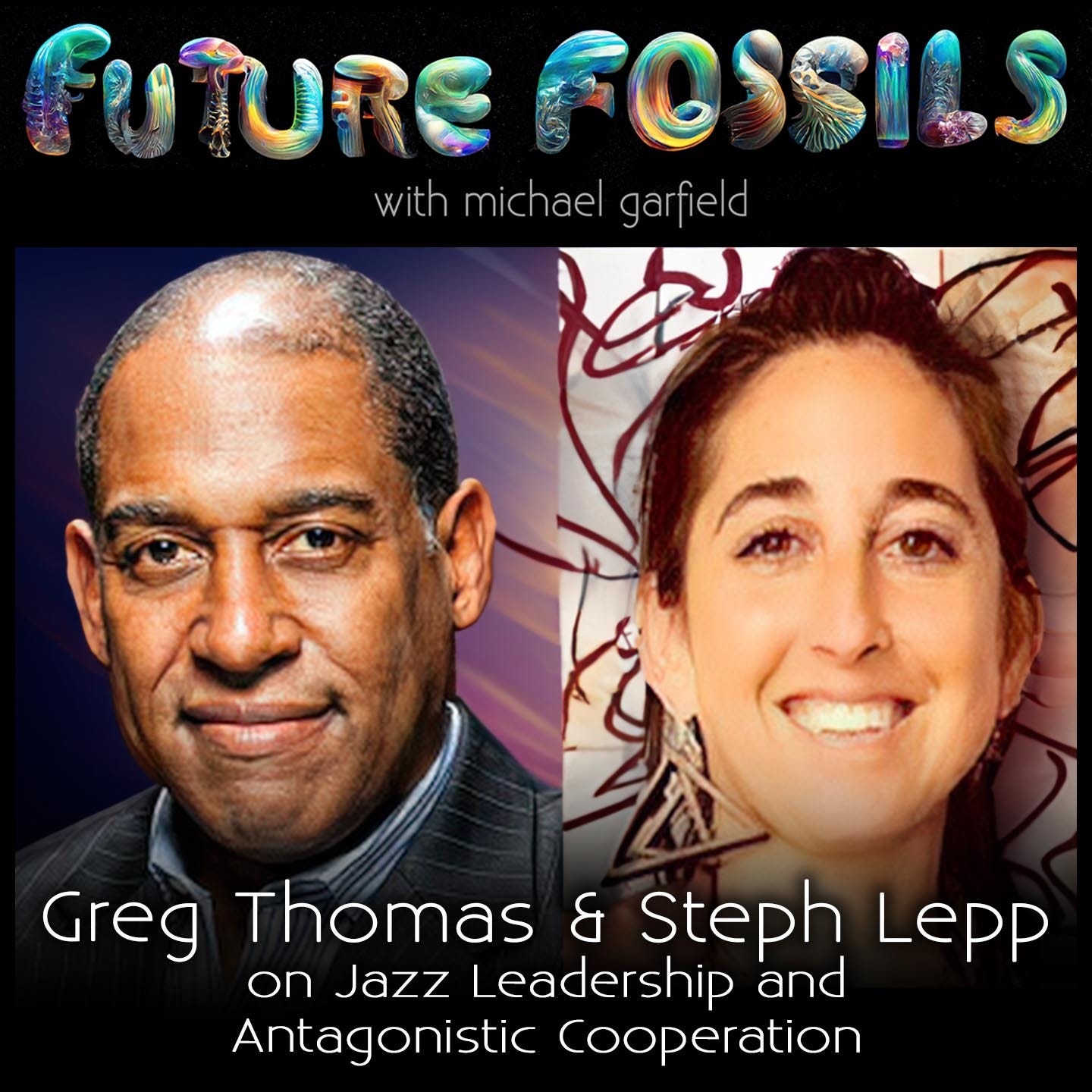
You know how crucial and important I believe this to be and why it strikes me that people affecting change in these spaces deserve as much attention as we can give them right now. So it is with great pleasure that after much patient rescheduling, I can finally share this conversation with Greg Thomas and our mutual friend, Stephanie Lepp, former executive director for the Institute for Cultural Revolution and former executive producer at the Center for Humane Technology, who joins me as a guest co-host in a tri-log exploring jazz leadership and how to apply principles from both the musical world and the world of evolutionary biology to establish more fruitful, synthetic discourse in the United States and elsewhere. But before we dive into this episode, I want to give my deep and lasting thanks to every single person who is supporting this show on Patreon or on sub-stack or by buying my artwork or by making one-off donations because until I get the next thing figured out, this is it. Future Fossils is the money that I'm making to support my family and that's insane.
It's just not sustainable right now, but every little thing helps. And in the time since my departure from SFI, my profound appreciation for every single one of you helping me make some money on this show, literally helping to keep the lights on and keep food in the bellies of my kids. I mean, I know I'm not the only person having a real year, but a lot of you are and you are still helping and I cannot thank you enough. I'd like to give a special shout out right now to those new supporters, folks that have started chipping in since the last episode.
Mark Corey, Peter Serato, Illumin Dark, Sebastian Machuca, Rex Washburn, Gregory Landua, Tiffany, Keith Singery, Gubow96, Van Loyts, Neil Porter, you're amazing and I value your contributions however small or large from the bottom of my heart. All of you equally so. If you've been on the fence about becoming a patron, now is the time because I have created whole new areas available only to members in the Discord server and in my regular sub-stack and Patreon mailings. I'm doing a lot more of the work of commenting on and synthesizing other people's articles and podcasts and so on as I ramp up work on my second book manuscript.
We've been doing live book club calls again and I just recorded a ton of amazing stuff at the Psychedelic Science Conference, some of which will be made freely publicly available and other stuff that will be reserved for patrons only. So the next few months are going to be a glorious effler essence for future fossils and I'm excited about all the stuff I've already captured and will be making available to you on a much more frequent basis as we move into the fall. So yeah, now's the time. Please subscribe at patreon.com slash Michael Garfield or microgarfield.substack.com or take those fat stacks you're making on the new psychedelic industry and deposit them at future fossils on Van Loyts.
Yeah, all right shameless plug is over. Thank you for listening. I'm honored to welcome you to this trial log with Greg Thomas and Stephanie Leb. Thanks for listening.
Reach out anytime and enjoy. I've been reading and okay so the problem that I always come to is that I read a whole bunch of stuff before we talk and then I have too many things I want to talk about. So I'm going to take a step back. Stephanie right before you join Greg was asking me how I'm doing and how I'm doing is I'm pulling a group improv monthly social event series that I tried to launch here this year in Santa Fe through a creative accelerator program like for creative startups and I'm deciding in the course of this that I feel like I'm swimming upstream and that people involved in this are not taking ownership of this project the way I had hoped and so I feel like I just want to kill the Buddha like I just think I just want to kill this project because it's not doing what I there's conflicts between the kind of flocking that I'm hoping to do with people and the way that they are relating to me as a leader.
So this is basically like jazz leadership right here and you and your wife are masters on this. I want to embody this in the conversation and just take a step back and let all three of us determine where this unfolds as soon as we pull the cord does that sound good. All right. That sounds fine to me.
I'm ready to flow and swing we need to. So if that's fine with Stephanie that's certainly fine with me. I'm cool with whatever. Yeah.
I think we have great people to jam with so I trust what flows from here. Perfect. In that case the one thing I do want to make sure that we get to just as run of course is just short introductions. So Stephanie you've been on the show already.
I do want to get to you too. But Greg I'd love for you to just talk a little bit about who you are and how you have come into doing the work that you're doing now. Okay. Well as far as a general introduction I am a writer.
I'm organizational leader both of a business organization jazz leadership project and social and civic organizations. The Omni American Future project is the social entrepreneurial and civic organization that I co-lead. I lecturer an educator. I've worn a lot of hats over the course of my life and I'm still wearing a bunch but happen not to have a hat on at the moment.
But yeah so maybe they'll suffice. Sure. Stephanie. An introduction.
Yes please. Hello. Hello again. Future fossils.
Yes I'm Stephanie left. I am a producer and a storyteller. I was the executive producer at the Center for Humane Technology which you might be familiar with from the Netflix documentary The Social Dilemma. I was then the executive director at the Institute for Cultural Evolution where I have the pleasure of working with Greg Thomas.
Although thankfully we are still working together. I'm now in the process of launching Synthesis Media which is a non-partisan nonprofit production studio devoted to producing media that integrates the perspectives of different world views in order to build social cohesion and help over-compolarization but I would say as importantly in order to fully leverage the ingenuity of humanity. No insight left behind is the tagline that I'm playing with. So with that yeah behind the back to you Michael.
Sure. So because this conversation was initially motivated simply by the words jazz leadership and I was like yes this is where we are. We're in a world where I'm grateful to observe that people are recognizing the importance of improvisation in a landscape of uncertainty in a way that didn't seem to me like they were even just a few years ago. And so I would really love to Greg have you start and then you know Stephanie however you want to riff on this or co-host run with this however you want.
I would really love to hear. There's actually an article by your wife Jewel Kinch Thomas on Lessons for Conversation from jazz improv and maybe that's the right place to start. Like I would love to hear you talking a little bit about bringing your love for and familiarity with jazz into the space of corporate leadership and into the space of conversation and like how that actually looks and what you actually find yourself teaching people to do. Okay well first of all jazz is certainly a conversational art form in which the different instruments talk speak to each other.
In fact my mentor Albert Murray actually called art aesthetic statement for that similar reason. These are artistic ways of speaking and being in communion in conversation with one another. So if you look at a big band you have the different sections or the different ensembles. You have the trumpet section, trombone section, sax section and the rhythm section right rhythm section piano bass drums and each section they're sharing their reading when they're not improvising their reading a score or sort and they are in conversation with the other sections.
Sometimes they're playing with sometimes they're playing against and that's true in a smaller ensemble also. So you might have the rhythm section supporting a particular soloist on trumpet or saxophone set and they are in a supportive capacity as the strumpler or saxophoneist solos but they're in conversation with each other as they're doing that. They each have roles and responsibilities based on the instrument that they play but they're not just playing without tuning in and listening deeply to what the others are doing. So there's a call and response dynamic that goes on when oftentimes you hear a soloist who may respond to something that one of the other players does and they might echo it or do a variation of it and that's an example of a conversation.
The bassist and the drummer in the rhythm section they're in charge of the rhythmic emphasis of jazz which is swing and they do it in a way where they are emphasizing certain beats together but there's also variation. So there's a tension there in fact oftentimes you find that the bass and the drummer one might say man you're dragging the time and the other might say you're going too fast. You need to slow your role. So there's a negotiation also.
There's a conversation but it's negotiating and one of the keys and the beauty of the art form is that in that conversation and in that negotiation you can both express your own individuality, your own way of interpreting how you approach the song, the melody, the harmony, the chords, the mood of the song in your own way but you're also doing it with a group of people and ensemble right and so yes you are definitely expressing who you are, your own identity but you're not doing that in a vacuum. It's in concert and conversation and dialogue with the others and that's why it's a model for social practices in the society. It's a model for corporations because you have both individual leadership and group collaboration within the art form and what we do for the jazz, through the jazz leadership project is that we translate, we bridge from the music to the workplace and we do that through discussing certain principles and practices of jazz that they can then not only understand conceptually but hear, see and feel and then say oh okay so how can I apply this for myself so that we can be as good as they sound so we can communicate as well as those musicians are and that's a goal, an aspirational aspect of what we do. I love that.
There's two things I love actually about using jazz the way that you articulated in order to teach leadership slash just yeah you just call it social practice. One is I think it offers a beautiful vision for the goal, what you just said is like what are we trying to achieve here even just within the context of let's say equality or justice like what is it just like everyone gets exactly the equal amount of air time and some kind of like preordained or top down way or is it within the context of jazz it's just so we can play right so we can just make sure we all have our individuality and yet we're still coordinated as a group. I feel like it's a beautiful vision for where we're trying we're using these training wheels in order to get to a place where someone can just solo and it can be amazing for all of us and they can enjoy it and we can enjoy it can be more of a conversation so I just think jazz is a beautiful vision for where we want to head let's say and then the second thing I love is that beauty is meaningful how do we know we've succeeded not just because everyone feels that they're playing their part but because it sounds good it's beautiful it just sounds beautiful and we can tell so yeah I love jazz as a metaphor or a training wheels or a framework through which to but seems very potent as a way to learn how to coordinate and do our human thing in an effective way. Definitely is definitely referred to as a model a metaphor it's a praxis there's a theoretical dimension that then gets put into action when you put into action that's when you're dealing with a pragmatic orientation to it so the idea is once they put into action they have impact in the world that's the foundation of American pragmatism and it's coming out of American overall context and within the American context it was innovated and created by black Americans afro-americans, Negro Americans whatever term you want to use as a group of people who developed a specific group of practices and responses to the particularness that they were in and those responses those cultural responses those values those meanings that were then expressed in particular forms whether it's folklore whether it's storytelling in myths whether it's the music or dance or ways of speaking with into one another all of those are cultural complex and so jazz is a very high representation of a black American cultural dynamic but it's within an American context so you'll see aspects that are particular to what we call a black American idiom but it's still within that American framework so I'll give you an example so one of the things I'm into Albert Murray says is that jazz developed within the context of free enterprise and there's a distinction between free enterprise and capitalism okay but the point is that and it's not necessary just an economic it's an orientation to how we engage with one another you can have competition but there's also cooperation in fact you need to have both there's confrontation and challenge but then there's embrace and acceptance but all of those are part of this free enterprise system where it's not coming down from one high it's not being dictated by a central committee none of that this is within the context of democracy and one of the beauties of jazz is that it actually is an embodiment and an abment of the realization of democratic principles and values in sound and in action so it's not just about the theory we can look at we can hear it we can feel it and we can say and see how individual individuality is perspective in fact one of the fundamental practices of jazz leadership project is your sound each one of us has a particular fingerprint and footprint that nobody else has to me that's physical evidence of individuality and uniqueness but we don't have to go to a place or ideology of rugged individualism we respect and honor the classically liberal notion of individuality but it's still in relation and in conversation with other people so that's that tension and that's the balance that jazz actually demonstrates in sound how do we respect what the contributions of each individual person is within the context of a whole how do we do that jazz is an example of how that's negotiated and how it actually comes to life this is exactly where I wanted this to go because Stephanie a huge piece of what you were doing with Greg and others at Institutional Revolution and a big piece of the pitch deck that you sent me for synthesis media focuses on this kind of thing like finding new means by which to bring this kind of sensibility into the sphere of American political discourse in ways that are empowered by new technologies rather than just challenged by them I want to invite you at some point to speak about the anti-debate as an example of this first I just want to make a point I'll link to this in the show notes Ian Leslie at Eon magazine wrote a piece I really loved a couple years ago called A Good Scrap the tag for this is disagreements can be unpleasant even offensive but they are vital to human reason without them we remain in the dark and I think about oh who was it that was commenting on this is probably a bad example the Grateful Dead keyboardist and his lover and how you could never tell if they were making love or they were fighting it sounded like two cats there's like okay so there's this piece about from a an evolutionary biology angle you've got all of the laissez-faire capitalists that are justifying an unfair competitive economic frame through a misread of Darwinian evolutionary theory and then you've got this hyper emphasis on the individual and on all against all competition between individuals and then you've got like Lynn Margulis and her argument that the biosphere is determined primarily by cooperation that major evolutionary transitions happen in something that looks like jazz where a new level of individuality forms through associations in which bacteria become obligate dependence in symbiotes with one another inside complex cells and so like I know Greg you also you're an advisor at conciliants right I think a lot of people listening this are familiar with Dan Schmachtenberger and Zach Stein both of whom have appeared on the show and this emphasis on non-zero dynamics but what I want to invite beyond simply just talking about the anti-debate is because both of you have thought about this in terms of psychological development and being able to even move between the two frames of affirming the modern liberal actor and then also understanding it in context of relationality is that requires a level of nuance and the ability to hold multiple different perspectives in one's mind and to be able to rotate between them and that's also essential to the kind of constructive argument that Ian Leslie is talking about in his piece where you're able to take a position without becoming overwhelmed or possessed by the desire to win the argument and so yeah I would love to just steer it in that direction and do comment on that however you see fit why don't you go first Stefan I was gonna say go for it yeah go for maybe I can't I don't mind I can definitely can well from the perspective of jazz yeah and the jazz leadership project we have four principles I'm going to say what the four principles are and emphasize one the first two are from the individual perspective the next two are from a group or an ensemble perspective so the first two one is individual excellence to play jazz well you have to work on your craft you have to work on your sound you have to work on your scales your chords you have to then not only develop the technical capacity to play along with others and improvise you have to be able to do it in a way at some point where you're not just sounding like someone else when you when you grow and you learn you imitate others so it's understandable that there are greats how you model and who work on their solos and they inspire you and they really motivate you to develop your own capacities right but that has to be an individual commitment to develop those skills that craft those habits then there's antagonist cooperation which is the term that I think of when I heard what you were saying Michael in terms of this article which in a very basic way is a perspective that does that we will have challenges we will have conflict competition but rather than being things that tear us down it can actually build itself so that we can learn and grow from it then the two that are more group-oriented is shared leadership and ensemble mindset shared leadership is basically an idea that says we each have our own leadership capacity and the potential to develop and grow one's leadership and we respect that capacity in others and we're able to coordinate and work together in a way where we can each contribute to the whole ensemble mindset is even a higher dimensional level where everything is in flow everything is swinging to use that term from jazz and where the sum is greater the whole is greater than the sum of its parts something bigger is created in the interaction so those are the four principles antagonist cooperation if you want to look at the derivation or the provenance of the term it actually comes from the hero's journey tradition and model Joseph Campbell called that the model myth and Joseph Campbell was very influenced by another mythologist Heinrich Zimmer who actually coined the expression antagonistic cooperation that term was a favorite term of two of my favorites Ralph Ellison and Albert Perry who I've mentioned and it's saying you can deal with the tensions the opposition the challenges that will come up in life and in one's own journey but they don't have to be something to tear you down it can actually build you up so one can become let's take trauma for example trauma is real tragedy is real but so is resilience so is an antifragile perspective where one is able to actually not only rebound but actually get stronger through challenges that's so I'm saying we have to be able to have these various perspectives through which we can view the way we interact and communicate with each other but antagonist cooperation is a very powerful principle that we use in jazz leadership project and a lot of the companies we work with they really gravitate to it because it's a very competitive environment that that companies are in so you competing for resources dollars and marketplace and this and that so antagonist cooperation is I think a strong way of describing what you were referring to Michael.
Well I'm glad you went first because now I can actually yeah I'm happy to explain what an anti-debat is in this context I'm gonna and I'm gonna ask you a question about jazz so yes the idea of an anti-debate is that and this idea has come from various places Peter Limbert has written about it but it definitely draws from Socratic dialogue and other ancient traditions but the idea is that in a traditional debate only one perspective can win right which incentivizes strong meaning right if it was me to make your my opponents position sound weaker in order to make my position sound stronger in an anti-debate and an anti-debate we don't totally know what it is it's more of a concept still than a full-fledged kind of templated practice but the idea of an anti-debate is that the person who quote unquote wins is the person who best integrates the other people's perspectives into their own position which would incentivize steel manics I'm gonna have to really be listening to what you're saying in good faith if I'm gonna find some negative gold in there that I want to incorporate into my point of view right and so theoretically you could say political debates or presidential debate good be and perhaps should be an anti-debate perhaps the person who wins should be the person who takes the best ideas no matter where they come from but an anti-debate doesn't fully exist yet in this kind of format again we see it we see flavors of this obviously it's a Socratic dialogue in the Jewish practice of hebrutah and Judaism we are supposed to only study Talmud in pairs because the idea is by virtue of having different perspectives that is how we sharpen each other's intellect right we are antagonistically cooperating to wrestle with and understand the Talmud but when I talk about the anti-debate with people and I am I am working on a project bring the anti-debate to life first figure out the terms how does it work what are the steps that we know how it debate works produce basically like a version 1.0 how to guide produce a video so that people can see what it looks like it would probably have to be scripted on a stage with podiums or it could be artificial intelligence perhaps that's a deep fake artificial intelligence versions of Thomas Jefferson and Frederick Douglas that show us what an anti-debate looks like but either way a video that allows people to see what it looks like and then we have and this is very version 1.0 but we have that product that we can share with platforms with hosts like Michael as a model of something that they can do on their show but as I've been talking about this concept with people sometimes people I just want to be really this is not replacing debate I would say let schools have a debate club and let them have an anti you go to the debate club to crystallize to do the individual excellence right you crystallize your perspective and then you go to the anti-debate club maybe in this framework to do the antagonistic cooperation right to bring your individual excellence and integrate with other I don't know if it perfectly maps onto your four principles Bragg but in my mind it's like we cultivate these different capacities let's say and then we can come together and do the and ultimately then do the ensemble mindset once we have all these capacities then we can really just let it flow then we can just let the music we play surprise us like we don't even know what we're gonna play but we trust the fact that we know how to be individually excellent we know how to do and talk and we know how to do the debate we know how to do the anti-debate now we can just come together and let whatever emerges surprise us but the question then that I would ask you is I'm curious about the chronology is there a chronology I imagine individual excellence is first but is there like a non jazz thing we need to do first thing in order to get ready to learn how to play jazz or what is the kind of trajectory of the pedagogy here if I understand your question correctly you can tell me based on my answer whether I did I think that in jazz one has to mean in any craft you have to learn the basics the fundamentals so what are the fundamentals of of communication what are the goals of communication and what's the context that we're dealing in now from a pedagogical and educational perspective you start with the base six so that you have a ground and foundation to build upon and that goes of course from primary to secondary school to college and postgraduate so it seems to me that if we use the liberal arts college model as a central place that we can hold onto for a second because the ideal of the liberal arts has to do with developing one's capacity and one's knowledge and the foundation for knowledge in a general way where you have understanding of what are the humanities about what are the sciences about what about the arts and social sciences, humanities social sciences hard sciences and this is a foundation for lifelong learning and then you can specialize as you go to grad school by focusing on particular areas so in order to play jazz let's say we're talking about how do we develop skills of citizenship what are the fundamental skills of citizenship well to do that we need to have an understanding of some of the fundamental principles and values that this country represents what you find at you find that in the founding documents you find that in the Declaration of Independence Constitution Bill of Rights and other great examples of either speeches or writings that embody the aspirational direction of the United States of America it's the aspirational aspects of freedom and liberty and justice and equality that has inspired millions of people to come to this country so we can't downplay the vision and the values of the United States of America because it's a beacon and a magnet and it has been and it still is okay with all of the words with all of the flaws with all of the horrific history it still remains a beacon of possibility that inspires folks right so we need to have a fundamental understanding of those so those could be analogized to understanding your basic scales and the harmonic chord changes and the songs of a particular tradition in jazz is the American songbook the blues certain song forms and you learn those to be able to be in a position to play right yes and the reason that I ask is so then what's the analogy to that because let's say within the context of justice or social justice or even democracy I feel like there's a little bit of like why aren't we playing jazz yet well there are some things we need to learn our basic scales first but it's we're almost like a little bit impatient it's cool the basic scales are on the way to jazz right so I don't know what you would equate to basic scales but I would say those fundamental principles the fundamental principles upon which the nation was founded even though they limited it this is this book right here by Daniel Allen just just by means of democracy she discusses how the founders that the fundamental flaw aside from of course server two domination enslavement of course but was that it's not that they had the wrong principles and it's not just that they were hypocrites it was that they were too narrow and limited in their their ability to have the vision and the capacity to offer that to a wider swath of people not just property males who are racialized as white that was that's the fundamental flaw so the aspiration and goal of this incredible book is to lay out very comprehensively and methodically a way for us to expand our our justice by means of democracy through certain principles and practices in social economic and political domains and through particular cultural practices so for example a fundamental principle of this book is what she calls power sharing liberalism we have to literally share power and we have to empower others so that they can engage in the civic and political process another principle is non-domination we find that a domination and not just in modernity but let's talk about modernity in particular where the idea of the sovereign man or male right because this is where it shows up and has shown up most a sovereign individual but then if you take from that that where you have a narrow vision of I think therefore I am and you look at the blessings of nature around you that you did not create that you were born into and rather than respecting and honoring nature as was done in earlier times by people that in some traditions they call pre-traditional peoples but there's a fundamental respect for nature so what do you do you extract from it you use it you try to dominate it so the principle of non-domination is a fundamental principle that she and other scholars are trying to put forth for how we move forward as an American democracy so we got to have people get to a place where they can understand what these values are what these principles are the meaning of them and how we have either violated them or how we can make them real both ourselves individually and in our engagements with other people at institutions so I'm glad you brought up Daniel Allen's book I actually wanted to bring up in this conversation an article another article written by your wife Jewel on reciprocity and obviously ebb and flow of relationships a lot of this I love this thing I love because I think about this all the time I had the t-fairy on the show long ago and we were talking about this again like if you include the sort of axis of scale that discovering the microbiome and discovering the wood wide web all the mycorrhizal affiliations underground in the woods all these things the more we learn about the biosphere the more we realize that we're like babes in a cradle that are completely unaware of how much work goes into supporting us like the way not super not a super fan of like the term ecosystem services because financialization of everything makes me deeply anxious but I remember in college hearing one of my biology professors make the point that the all of the money measured in the human economy is like less than 10 percent of what it would cost to restore like the water cycle and carbon cycle and like create breathable air and drinkable water if we destroyed those things that there's not enough money in the world by an order of magnitude so like this is where the gratitude comes back in right and so anyway Daniel Allen's book as far as this relates to life in human society like the question I want to post to the two of you has to do with again this point that was made by Peter Limburg about like a speculative anti-debate stuff that shared this passage that he wrote in your pitch deck which was about how like perhaps conceding to agree to disagree would be like losing a point in the debate and yet like we need viewpoint diversity and like there is a reason that there are individual organisms and individual like breeding populations that not interbreeding in the biosphere right there there are natural boundaries that create this kind of these productive tensions of like in this synthetic and generative antagonism in the biosphere like there's a reason why you need different ingredients to make a cake right right it can't just all blend together into one homogeneous monocrop like like Blade Runner it's just like it's just people but even in Blade Runner 2049 it's like there's different kinds of humanoid beings right so it's like anyway what I'm getting at is that like Daniel Allen says quote their wife uses in this article reciprocity concerns the relational ethic that citizens have with one another the ability to look one another in the eye the ability to propose the need for redress or grievance and to be secure in the expectation that redress will be possible within constraints of reasonableness and rights and yet we're at a point in history where it seems like I think about just how like what a rude awakening it was for people to realize after Hurricane Katrina that FEMA was not helping that I had friends living down there that were in like risking imprisonment from the United States government because they were leaving their homes to help their neighbors because no one was coming to help and so like I think about power and conflict not just between people on this scale right but between the individual and the state and also like economic systems that we've become dependent on for convenience due to the economies of scale so like the last piece I have and I don't even know like if this question is making sense but take it whatever you want I was on Facebook this morning talking with Tamson Woolley Barker and Tamson said I'm excited about AI because finally we'll have to drop the delusion that we can scale the mutual trust required to be a whole human in community we'll trust people we know physically our worlds will grow smaller and richer and the next thing you know will be human again and I was like yeah that's a nice idea but then there's also the part about something we talk about on the show a lot is that for some people it's a privilege to be able to retreat from an urban environment and go home setting and like grow all your own food and unschool your kids and and for other people they're going to be caught in a food desert when supply chains fail and so I don't know what I'm getting at except I think like there's something about the nexus of all of these conversations about what a social contract actually means what it means to like in what ways like agreeing to disagree is a failure and in what way is it to success like what are the conditions where it's actually to our benefit to like bring things back to a smaller organizational scale and then the fact is that we all still live in a sort of global situation no I don't know that's just everything I felt like thrown on the table for y'all to riff on a lot they I'm not quite sure where things this definitely has an entry point I'm happy to try to yeah respond yeah I mean I forget how you framed it but I would maybe ask I don't like when do we when is yeah I mean there's a question there I think about under what circumstances is disagreement productive versus destructive or is it about the disagreement itself and there are just some forms of disagreement that are inherently more productive than others I think it's probably a both I don't have like an immediate kind of I think maybe the way that I would connect to Greg is something like I love these four principles because again I think if you really and I get that the last one is a little more emergent the ensemble mind it's like once we have like develop our capacity for individual excellence and antagonistic collaboration and that allows us to do the shared leadership then we can be in like and so there's something about learning these different capacities that then allows you to not have to like figure out as much like what kind of disagreement do we want to have versus like then we can more just be in the flow maybe and allow the productive to emerge and summarize it that said yeah I think there I think there are forms of disagreement let's say that are more productive than others and I don't know yeah I don't know there's also something there maybe about yeah the holding of the we are individual and we are collective we are all unique snowflakes and we are one and once we fully inhabit both of those realities we just have infinitely more ingredients to work with right like when people it's like right now we're in this moment of let's say it's like it was black and white and now gray it's like no you realize you just collapsed from two shades into one right like can we just have black white and gray can't we just have like all the colors let's go for all of them but there is and this is why I was curious about the pedagogy is like you don't just start with every single color like maybe you start with black and white I am a parent of young children so some things are black and white like you hold my hand when we cross the street you wear your seat belt in the car starting with black and white like here's an example and then they all take a back to go like so I'm starting with but it's like you can't like what would I my daughter's not old enough yet but some it's like you can't you obviously can't drive after drinking and so if somebody she'll come back to me eventually and be like but guess what I can sleep in my car so it'll it'll go from black and white to gray to I don't know I don't know if that's a good example but either way yeah there's something about starting with fewer ingredients and having them each be clear and then and then eventually having more and more ingredients that include the more ingredients also include the we are one we can like eventually have it all in a way I don't know if that makes sense I'll leave it there already Greg well as far as music if you want to take it back to the original point about it being conversational I could play examples of two or more instrumentalists playing together and playing in a way where you're not quite sure if it is competition or cooperation or collaboration because it's all of that so there's something in leadership called situational leadership so michael we could be abstract in theoretical and say well if you agree to disagree that means it's situational that's what Stephanie's example shows there are situations based on the developmental level of who you're dealing with where something is going to be more appropriate than other there is black and white not only are black and white actual colors but if you are trying to protect a child who doesn't know any better certain things are not up for discussion it's just the way it is as they get older and they grow and develop their understanding grows then you can have conversations about more things as they grow because you are preparing them to become the old expression productive contributors to society you're preparing them to become adults and being an adult and maturing means that you are able to not only exercise certain freedoms that you're able to exercise responsibility good judgment and that takes time because we develop not just cognitively but emotionally sometimes we have emotional drives that will override the cognitive you might know that something's right or wrong but you've got a drive to try or to experiment so it's really situational it's a situational thing where I don't think we need to say either or sometimes as you suggest it's definitely it's both and so we would have to say but getting back to jazz we have instances like great disaglastomy when he had sunny Rollins and sunny stipp playing together and there's a famous song called the eternal triangle where it's a fast blistering song and sunny stit and sunny Rollins end up going head to head trading expressions trading phrases now the thing about antagonist cooperation is so powerful is that it was competitive but it was also cooperative at the same time and that's a cultural form that says you can state what your perspective I can state my perspective I don't have to be in unison with what you said I have my own take on it I have my own angle on it and we can go back and forth and it can create something that's beautiful even if we come from different perspectives give another example using sunny Rollins sunny Rollins style from the beginning of when he got came on the scene in the early 50s very big sound intense in his remember seeing him I'm gonna come back to the example I'm missing in the Carnegie Hall playing with Branford Marsalis and this was in pretty sure the 90s and Branford Marsalis of his generation is definitely one of the top saxophone it's tenor saxophone it's a particular of his generation no question and he is very studied in school I've seen Branford play a song and he'll play in the style of Coleman Hawkins they know playing the style of Lester Young then you'll play in the style of Wayne Shorter then in the style of Sonny Rollins so when they started playing together the Branford was playing early Sonny to Sonny but what was the difference when Sonny Rollins blew and the first note it was like a Mac truck his sound so completely overwhelmed Branford that it was like oh my god so so back to Sonny so that was this a little aside but Sonny Rollins went through a period where he wasn't playing with piano plays he was playing with guitarists or sometimes just a bass and a drums and there's a great guitarist Jim Hall who is like the yin to Sonny's yang is one wrong and the other right no so it's not so black and white sometimes a matter of style differences in the way that you do things so they're not a dimension to us I was trying to expand the way that you know you deal with it Michael and confront it Mike Woodley I mean I'll be giving you a direct answer but I'm trying to say it's more complex and more nuanced and situational thank you yeah let me pull just one one like thread out of that yarn ball and it rolled over to you because you know I think one of the things speaking of the situatedness of all of this speaking of the contextual piece we're having this conversation at a time where it feels like a lot of the conversations that I've been having on the show over the last couple years especially are about the you know trying to see the challenge to the collapse of some of the institutions and the systems that most of us listening to this I think grew up taking for granted even on both sides like not just systems of oppression also are being refigured right now and so like there is a piece of this which is like yeah it's good sometimes for there to be the opportunity that was I think I've been in the 90s and just like oh everything was so like raw global village like let's it was the script about like unifying everything and bringing it together and then over the last like in science like people were talking about the theory of everything like a grand unifying theory and I don't hear scientists talking about that anymore I hear people talking about bringing multiple models to bear on things that no one model is sufficient and the way that it is enacted socially is through this like we live in the United States and in some respect all of us have a contract with and a responsibility to one another and it's to our deficit it's to our detriment that we act as if that is untrue but we're also facing you know what like a little dug rush cough called fractal noia which is kinds of mental and social pathologies that come from connecting everything to everything else and like we we suffer the spread of a pandemic or cascading bank failures because we've pursued that kind of unifying logic to its extreme and now where it seems like when I say we I mean like American society is figuring out how to back down from that somewhat or like figuring out the importance of backing of figuring out how to survive when we're being forced to back down from that because the systems are failing so yeah I don't know if I could I would think of it maybe as like a right sizing rather it's like and this is very this is me coming from my integral perspective the way that I would tell that story maybe is something like once upon a time we came up with a way of doing things and we were like this way is the one and only right way and then the circumstance has changed and so we had to develop new way of doing things we were like that previous way oh my god like this is the way that we should do and then circumstances changed again and we had to and after a while we were like wait a second I'm noticing a pattern here perhaps the current way is not the forever and always right way of doing things like thank god we've given birth to so many ways of doing things like wow like different ways are useful in different circumstances some ways we're ready to just leave off the table forever because they sucked and we only use them in an emergency situation for the most part thank god for the cornucopia of ways and I would even say the global village is like a way that is maybe not useful in all or even most circumstances but thank look at this cornucopia just look at the abundance what an abundance and again very clear some ways we're just ready to never go back to slavery we're done but other ways it's like yeah it's not plan A it's not plan B maybe it's plan C or Z but generally yeah I think this is maybe the shift let's say from first year to second year and I'm getting jargony but you get to a place where you can actually just stop doing the current way right previous way wrong and just look at all of the ways and right size them and see them as like a veritable abundance of like just like abundance of and production of just human ingenuity and creativity I've got to get my computer charger before my computer cuts off so I apologize what is he gonna say I'll be my what I'll be right thank I'm sorry okay okay maybe that can be like a cut to music yeah jazz jazz cut to jazz or yeah this is this episode will be a good episode for me to I just dropped some of the recordings from that improv sessions thing I've been doing and after reading some of Greg's writing on the matter I'm not sure that it's actually jazz I don't know but a qualified that's maybe a good question to start the post intermission is what is your definition of jazz yeah I don't know if Greg if you can hear us oh there you go hi Greg after my thing we just cut to music we just cut to music and then we're gonna come back or Michael would you like to ask the question well yeah yeah or would you like to respond or anything I think one thing that I want to foreground here that maybe like implied by the conversation so far but I don't know that we've made it super explicit is that you worked as a jazz writer and critic in a number of different print and web publications now for decades and that's kind of that's informing and inspiring a lot of this what we haven't really done because like some of the writing on your jazz leadership blog is about the way and because this is this will get us I think ultimately to I want to talk about de-racialization because this is such an such a key piece of some of your recent writings and appearances but maybe we can do it through defining jazz and then referencing some of what you have said about the way that certain artists have claimed jazz when what they're doing isn't really jazz as a way of selling the cool of jazz and selling their work through the cool of jazz and that anyway I'll let's get spicy but I'm here for it so maybe when you define jazz and what it's not and then we can jump across the ravine into that other stuff sure first let me say that I will use the title of a recent movie that won a lot of Oscars last year in response to what you said before and that is everything everywhere all it wants that's my response to that this that's what it is everything everywhere all it wants that's the situation now everything everywhere all it wants include nothing nowhere never because it's also not sausage right what's not sausage what's not sausage like that's it's not just gray right we still can have black and white we have we have the capacity for everything everywhere all of us and we maintain the capacity for nothing nowhere never oh sure yes definitely it's not because that's because you have a phrase that signifies one thing it doesn't mean that the complement or the counter to that or the the other side of the coin isn't there too so I would say yes and which is an expression that comes out of improv theater and improv comedy so yes and cool all right now so i'm just tournes pore hargans actually when he was on the show talking about how to understand like the ufo phenomenon talked about the like how it's not enough to think of things as like true or false when you're researching the weird and he says like so the Buddhist logic something can be true false both true and false or neither true nor false that's that kind of quadratic thinking both of your calling us into but anyway all right so let me just say this by ufo's do you ever wonder why the picture is always grainy do you ever wonder why when they have these cameras that could be lord knows how far away and they can zoom in on fine details that never happens with ufo's just asking questions okay all right i'll just leave it i'll just leave that there as i say no hall used to say makes you want to go all right all right so to answer your question regarding the definition of jazz now this is a this is a loaded question in that over the course of jazz is history starting in the at the turn of the century into new all the ends being the place where there was a lot of consolidation of various musical forms that came together and you had a combination of blues and marching band music ragtime you had all these different things and then that's like a more collective dynamic and then you have great soloists who surfaced Sidney Bache on soprano saxophone clarinet luis armstrong on cornet and trumpet and it became identified with the great soloist so jazz is many things jazz is a cultural art form jazz is a way of being in the world jazz is a cultural art form and a cultural technology is both jazz has certain elements to it that are fundamental and i think that's where you would begin so some of the fundamental aspects of jazz are a particular orientation to the fundamentals of music the fundamentals of music are melody harmony tone color or timbre and rhythm so rhythmically and this is when you talk about any musical style it's the rhythm that makes the music the music you can have a melodic form you can have mari had a little lamb and if it has a certain groove and beat it could be looked at as a reggae tune if it has the swing rhythm that's jazz not that every single song has the sing with them but swing is fundamental to jazz blues is fundamental to jazz is every song of blues of course not but the blues is not only a 12 bar form 12 measured form but the blues is an orientation to life it has philosophical dimensions so blues is a foundation swing is a foundation swing and these certain metaphors you have to use when you have the origins of a musical form like like jazz coming from a people who were enslaved and didn't have the ability to have control over their movements how far they can go and if they went far they had to show all that kind of stuff you have an orientation towards freedom so now we're talking about certain qualities that are embodied in jazz there's something about freedom in jazz so when you have the drummer in the swing rhythm what is he doing he's riding the cymbal it's a movement metaphor what is the bass player doing he's walking so these metaphors are describing parts of the music's spirit okay but you have the drummer and the basses who are carrying forth this swing rhythm which is usually like four four time or three four time and when you hear it you know what it is and we're talking about swing bass walks the drummer's riding the cymbal and it gives a buoyancy on which the soloists can ride it's like the swing rhythm is like a wave that a soloist can play over can ride that wave you have to ultimately use certain metaphors improvisation is fundamental to jazz so we've got a swimming rhythm we've got improvisation and we've got a blues not only form but a blues sensibility that's a part of jazz just as fundamental elements right so when we talk about what's not jazz if it's missing some of those basic elements it's not evaluating other musical forms and saying that they're bad it is saying it's not jazz you know what i mean so if you look at rock music it has some of those elements okay that's where you get into levels of technical sophistication in music so Albert Murray talked about folk art popular art fine art okay so basic blues forms is basically like a folk form okay but you can have pop versions of that right like a lot of rock tunes that popular it's got a blues form but when you're talking about fine art you're talking about a couple of things and jazz at its best is a fine art so we're talking about the capacity in your aesthetic statement to encompass a deeper and richer range of human emotion and human feeling then you can find in other forms in both folk and pop we're also talking about the realm of masterpieces where there are masters and grandmasters that create work that create solos and improvisations songs that become masterpieces and that therefore as a masterpiece maintains a certain timelessness sweet from a classic something that stands the test of time so masterpieces have a timeless and so when you look at something created by Michelangelo Leonardo da Vinci Greek sculpture some of the African sculptures that are just wonders to behold they may have been made in a particular time and place but their value remains such that the quality and what is evoked from it in terms of the level of human achievement that it represents it's not as time bound as certain folk and pop arts are okay so I'm getting into a lot of like almost aesthetic theory here but now to go to what you were suggesting so take someone like Kini G all right now in the jazz world Kini G is the butt of a lot of jokes is the butt of a lot of derision why because and I always say this Kini G has a beautiful sound Kini G can play the saxophone well there's just no question about but it's not so much Kini G himself it's the way that the music industry the radio industry the mainstream press they will put the label of jazz on him and I don't think that's accurate okay he improvises but you rarely if ever hear him with a swing beat okay he has some elements of the blues in his playing because he's a good player I remember Kini G when he was with the Jeff Loebar back in the 70s he's been around a long time but it's how you compare him to another Kini G Kini Garrett who is probably the most influential alto saxophonist of his generation he is recognized within jazz but in terms of popularity can't compare to a Kini G but that doesn't mean that the aesthetic quality and weight of the two are saying just because they're popular or one is able to command an audience of thousands of people that make a lot of money there's a distinction between aesthetic value and influence of an artist that's the one measure how influential is an artist within the art form in sports how influential is someone in terms of being able to not just win championships but the way they play is so influential that they influence others these are different ways of evaluating artistic and aesthetic worth within a form okay so as far as race I think you're probably talking about some of the pieces that I recently wrote on the blog like to an inter-leadership blog where it's it's a piece that's in a book called ain't but a few of us and it's a account of basically black american music writers and about jazz in particular and relative to the number of people who are writing about the art form and who are looked at as authorities well there's not a lot of us I'm talking about black americans ethnically and culturally I'm not talking racially okay so I make that distinction so in this essay I take on the issue of race and jazz I take on the issue of why are certain artists more popular than others why is it that Chris Bodie and Nora Jones and I forget the other person I named in my latest piece why is it that they can develop this big following and playing a less experimental very mellow style of music now one of the things I say is that I don't fault those artists they have their particular style that's their choice and what the radio industry and the mainstream press and popularity in popular culture if they become more popular in that domain that's fine some of it has to do with the legacy of race and racialization that doesn't mean they're not good musicians that doesn't mean that they don't have integrity that's why these are nuanced discussions it's a part of the picture but race that is but it's far from the whole picture when you're talking about an art form like jazz hopefully that long riff at least touch on some of the things you were looking for I hope Michael oh definitely before it might be just like a we rip off the band aid and go straight into de-racialization but definitely do you want to say anything before we we dive into that no I probably can't say too much after half past me either yeah we don't have much time unfortunately we might just make this a teaser for the other stuff I really appreciate both of you doing this and yeah but I do just want to give you Greg the opportunity to point to and I'll link to some of the show notes because I think all of the stuff that we've been talking about up to this point in the call describes a set of competencies or like a kind of psychological set of psychological fluency that brings us up to the course you taught on culture and cosmos and comments you've made in conversation with Glenn Larry elsewhere about why it's time to invite people into something beyond racist essentialism and because especially because I've talked about cultural semantics on the show already I don't know if we have time for it but feel free to like at least make an advertisement for people to follow up on and encounter this part of your work well they can find some of this on to interleadership.com you can find my some pieces at the developmentalists of the Institute for Cultural Evolution they can find some at free black thought particular online platform where I've been publishing what you're referring to is my take on what's called cultural intelligence name of course that I taught several years ago was cultural intelligence transcending race embracing cosmos in that course we actually look at culture through various lenses one of my key points is that race and culture is not the same thing matter of fact they are very distinct and it's important to make that clear distinction so you don't keep confusing and conflating them that's one thing and once you can make that separation between race and culture race as something that was created for the very purpose of divide and conquer for the very purpose of putting some people who are racialized as white in the numeral uno position whether you say white supremacy white superiority that was real there's no question about it that was based on a fallacious idea of race which basically says that there are different species among human beings not just one human species you got a species that's called black and they are a lesser species of human being check out how insidious that very idea is feel into how insidious that she is okay and you have some others who are racialized as white and they represent all that's good okay what the whole issue with cultural intelligence that's so important is that we started the course with cultural literacy what is culture how does culture work and what can culture do okay how can we not only be used by culture how can we use culture to liberate ourselves from some of the mental and social psychological and institutional strictures that we get caught up in this matrix this racial matrix then there's cultural intelligence which means how do we solve problems through culture in a very basic way it means more than that but you know how much time but what are we striving for what we're trying to get to cultural wisdom is what we're trying that's what we're trying to land where the values and the meanings that we derive from what's most important to us spiritually and culturally and by cultural not just us as individuals but us in relation to others what are the things that we're going to emphasize there what are we going to identify as false and foolish and then how can we get from under the net the matrix of race as an idea racialization as a process through which race is created a racial worldview which is looking at the world through the lens of race where I'm in a racial world and I'm a racial agent in that world as opposed to I am a cultural agent in a cultural world and I'm a cultural agent in that cultural world just those distinctions and however that landed in your body to me is indicative of the distinctions that we're talking about right so cultural semantics we had a session dealing with cultural semantics where we dealt with trauma but we dealt with individual trauma where we dealt with group trauma and where we dealt with larger societal trauma we dealt with each of those levels because we have to be able to confront the trauma that has been the havoc that has been wreaked upon us in the west for several hundred years now through this fallacious concept of race through this very dangerous deleterious process called racialization through this demi-reality boss car it's demi-reality called a racial worldview where you have disunity within difference rather than tolerance or even be able to leverage difference in a very mature way so I've said a lot there and it is a little teaser but hopefully through what I said and the way I said it you can tell where I stand on some of these issues and what directions I think we should move into and what I think we should avoid and move away from Awesome thank you both for not only the time you've allocated to this call and the like insane amount of scheduling that is required yeah folks know it took us like four months to get this yeah I'm glad we finally were able to do it but also for the work that we're doing out in the world and just for being I think of you both as guiding lights as inspirations to people that are trying to figure out how to think and live through these issues and these concerns and like how do we how do we do it like how do we pull this off so thanks you both I could say one last little piece too just a little attempted an advertisement for Greg tying it back to jazz I would say something like what is the goal what are we trying to do here what has been the context of racial justice what is the goal if we were to think of it as jazz maybe it's like being able to play jazz together then the question might be how can we relate to race in a way that serves our capacity to play jazz and for that you can go and read what it goes and for me you can like for me you can find me keep in touch with me on Twitter at step left thank you Michael Greg sorry did you want to say something else yeah I was just gonna say I would just I'm always gonna replace race with culture to be able to play to be able to play on the level we're talking about in our society and amongst each other and because that's the thing about jazz the question is can you play I think race gets in the way of us being able to play well together and as well as we could awesome all right thanks y'all thanks for listening I hope you enjoyed that episode and would love to hear your reflections in the open future fossils discord server or in the patrons only facebook group you can also find me on threads regardless of my ambivalence about joining yet another social platform it's always exciting when something fresh and clean and the newsfeed isn't algorithmic yet so find me there and one last big announcement I will be starting a six week online course with neural learning on Jurassic worlding which is my book in progress about science and philosophy of the analog digital transition as seen through the lens of the Jurassic Park books and films this is going to be a really exciting and intimate discussion and study group I will be leading watch alongs and reading discussion groups for each of the six Jurassic Park films and a whole cornucopia of related short online content this is a course hosted by neural learning my friend Jeremy Johnson's project and it starts again the evening of August 1st and proceeds for six consecutive Tuesdays everything will be recorded if you can't make the sessions live and then we're going to have a really lively and dynamic asynchronous chat in the neural learning mighty networks app also everyone who signs up for that course gets access to all of the patrons only facebook and discord stuff so I mean it's quite a deal if you're listening to the show and you want a discount code for the course future fossil at checkout go to neuro learning org that's n-u-r-a learning dot org find me find Jurassic worlding hit future fossil at checkout and I look forward to riffing with you all at the intersection of runaway technologies capitalization of science digital cinema sense making crisis and just good old fashioned rampant dinosaur fun thanks again so much for listening I will have a new episode of future fossils for you every week at least through the remainder of the month as I try to get this show back up to cruising altitude stay tuned subscribe like review share and have a most excellent week