
I say we as human beings, because I think that's it. It's like we as a planet. It's no longer we as a nation or my tribe. No, those days are over.
Like the complexity now is it's not that we're saving the planet. We need to kind of redirect ourselves so we can survive on the planet. I feel like there's an elephant in the room here regarding the emergence of large language model AI stuff lately. And the importance at this crucial point of our development to align AI with human interests.
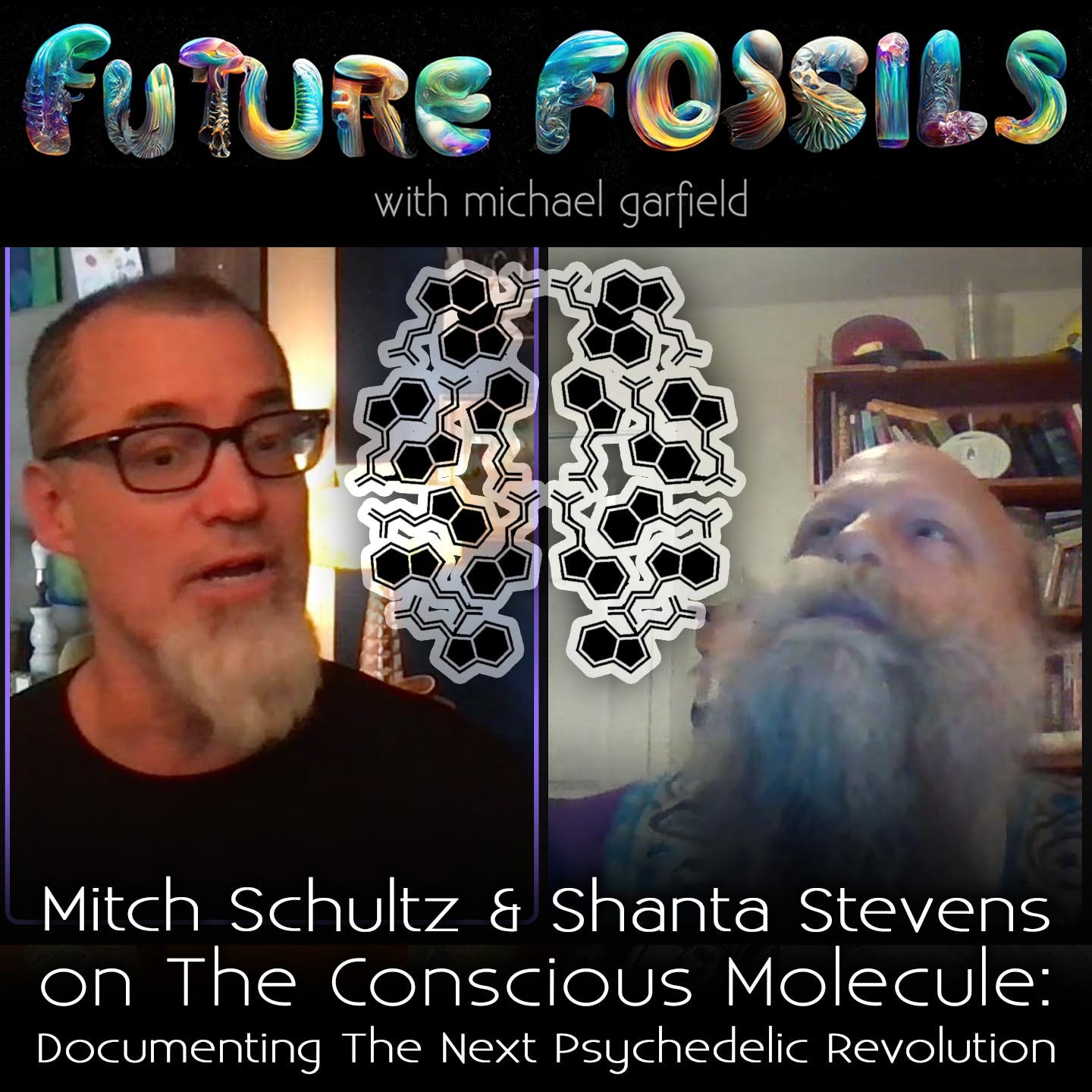
And I can think of no better way to do this than by raising our children better. Greetings, Future Fossils and welcome to episode 210, a podcast that explores our place in time. Today I welcome back one of Future Fossils first guests, filmmaker Mitch Schulz, whose 2012 documentary DMT, The Spirit Molecule, based on the book by Rick Strassmann, was then and is now still one of the greatest psychedelic documentaries of all time. I met Mitch at the DMT remix party at South by Southwest in 2012, I got to play music and ended up also meeting most of the crew that became my close cohort in Austin, Texas.
And in that group was also our other guest for this episode, Shonta Stevens, who has teamed up with Mitch in Unifi Studio to produce the conscious molecule, a follow-up documentary and transmedia project exploring information theory, quantum physics, the science and philosophy of consciousness, five MEODMT, and so much more that I honestly don't even know where to start with this project. It is one of the most ambitious media endeavors I have ever heard of, and I am delighted and honored that I got to help in a small way by helping Mitch and Shonta hack into the 2023 S in the complex philosophical overlays of what our late friend James Orock identified as a third Western psychedelic revolution. In the conversation that follows, which we recorded on July 21st, the day that both Barbie and Oppenheimer portentiously hit theaters, we discuss information bombs, transformations of consciousness brought by digital media, the work of psychonauts in cyberculture, and so, so much more. But first, I want to remind you that this is a listener-supported program and that it is purely through your contributions that I am able to continue in all of the research, recording, and supplementary media production that makes future fossils much more than a podcast, but the seed crystal around which a remarkable online community has self-organized, and the vessel through which my own transmedia explorations all find their space for incubation and a channel into the world.
This show, and everything I do, is a labor of love, and my answer to the question of how the decisions that I make on a daily basis are shaped by reckoning with the presence of the unborn generations to which I and we are ancestors. I want to give a special thanks to new Patreon and substack supporters, on Dean Norman, Joshua Sax, Rob Town, and Gilberto Vendromine, and to thank everyone else who's continued financial support, as well as your ratings and reviews and recommendations of this podcast, motivate me to continue in what is most of the time rather lonely work, but I expect things to be changing here soon. I just put out a call inviting other members of the future fossils community to step up as stakeholders, so you can expect, over the next few months, a stream of experiments with new guest co-hosts and new episode formats, and hopefully a return to inspiring short-form synesthetic videos, and a lot more. I'd finally finish the album I've been working on for 15 years and will very soon be sharing it with Patreon and substack supporters in a private YouTube playlist, featuring 44 minutes of utterly psychedelic AI music videos that carry you through a kind of contemplative dreamscape.
There are only a few creative projects I've spent more time on than this album and feel better about. Really, the only one is my relationship with my wife, with whom I celebrate today, September 20th, 19 years since our first date. I love you, Nikki, but I also can't share you in the way that I can share this music. So, if you would like to be in the pre-release audience for this album while I keep it under wraps and submit it to major record labels I've dreamed of working with since I've been teenager, patreon.com slash Michael Garfield or Michael Garfield dot substack dot com.
Thank you, thank you, thank you for helping me make art and still somehow feed my kids. And with that, I am so very happy to share this conversation with two of the wildest, most enthusiastic, provocative, thoughtful, creative, and caring people that I know, Mitch Schultz, Shonta Stevens, the Kickstarter for the Conscious Molecule, we'll go live any day now. So, find the links to their social media accounts in Michonos and subscribe to them all. And, of course, if you happen to have very deep pockets, fund their movie.
I believe that this is where true impact and import at a time when all of us are tripping balls on the internet and can benefit from just this kind of trickster psychopomp. Enjoying and at this point. Really, it's about putting it into a human lens, right? And saying, look, this is just part of the whole picture.
But pulling it back with that interface essentially and mapping to kind of these informational paradigms or informational spheres that humans have, not just from our DNA, but the social structures, the other information, the art throughout time is all of that. That mapping that is not just a self-tool, but also as an interface for this potential AGI, right? Because if everyone's fear, it becomes this kind of like, here is my human interface from these different kind of systems of spheres of information. How is it interacting?
And you have complete control over that. We're creating that interface directly from the biological up to these, again, the metaverse, if you will, but it's even deeper than that. Shutterily, shot today. Well, one of the things that I have been getting through my research this morning is this sort of recognition that the accelerationist point we are inhabiting right now in the media consumption cycle, where people's information is just overloading people and they don't know how to properly prioritize or use critical thinking or easily propagandized and misinformed.
It's a cycle that keeps people in a fight or flight, kind of fear-based mindset, where all these integrated shadows come up. And so we have a great deal of them, particularly in the West here, about the lack of reciprocation that has transpired for thousands of years as this Leviathan has marched across the Earth. And it's time for some kind of accounting to be done. And we've seen this before, but we have an opportunity now to do this if people will take the time.
And that's the big question, is like time is money. There's a lot of desperation as people are, again, in the cycle of fight or flight or freeze, and they don't know where to start. So how, we can talk about this sort of thing all day, but my biggest question for y'all is, how do we make this fun or how do we move beyond fun and find some other way to motivate people? So I keep seeing it more as play or encouraging play, and that can be done through a lot of different design techniques, whether it's two-dimensional screen or physical space, go on and on.
How can we do that kind of with ideas across these different scales? Let's take the first DMC film for us. It's like, oh, I really want to make this interesting talk about this crazy molecule and scientific experiment. I thought it was going to be one way.
It turned into a much different film. The idea was to literally change the dialogue out there in the world about psychedelics. And so that, again, it's actually one of these information spinner but through this lens, for instance. And it could be a number of different things, whatever you do in the world.
How do we, in all of our interactions, encourage this play? It's not a demanding thing. It's not an expectation thing. Because that helps process, I think, the overload of information that we're not aware of.
For one, we can't process our information. We're seeing that add up collectively, I don't mean individually all the way up, right? And that's got to come to a stop. But then there's also, yeah, this new technology that's layering this constant feed of everything and most of it kind of feeding your worst fears along the way.
So of course that's going to drive psychosis. Of course that's going to be driven by it. So shifting people as much as we can away from that. I know that's been part of the talk and looking at what social media has done and the number of different arenas.
But every, again, every aspect of that sense of self and then how our spheres are operating in this big pinball machine called life with other spheres and other people and their spheres. And I guess I'm just trying to kind of put a physical flow kind of thing around it. But it's a resonance in and out of these balls of being. So if I can try and wrangle all of what both of you just said into a proper prompt with which to launch this conversation, then this one I'm glad we have to work towards a prompt.
That's part of the human interface with this next layer, right? Genre of AI. The actual language processing. So, okay.
Computer. Now, what I hear swirling around in the last few minutes here is, okay, it's Barb and Heimer Day. We're talking about, on the one hand, this economic and cultural innovation, the toy, right? On the other hand, there's militaristic innovation of the bomb.
And the thing that's missing, it's like, it never occurred to me that Barbie was the Trinity here. I've always thought that I had. But it's well reported that the bomb and LSD were discovered at the same time. And so you have computers.
Yeah, computers and the whole mix of all this stuff is like, that's why I love Blade Runner. And I love looking at these kinds of addressing parts, these films that explore the intersection of amusement and war. Jurassic Park, I've never heard that from you. Don't worry about it.
Just checking in. All some toys. Right. All some toys, you know.
Right. Yeah, there's this thing of like plastic, plastic toys, soft pattern. Plastic. You know, it's fantastic.
So at any rate, we've got a function to keep up with this. I commend you and want to hear from you and the Squared Server because this still feels like we're playing inside your baseball. But like, this is the point. The father of the son of the Holy Ghost, right?
The son is the brother of the father of the baby. Right. Right. The maybe the son is LSD, Albert, the problem child, you know, or like maybe, you know, we've got the bomb.
The father and the Barbie is a Holy Ghost or the Virgin Mother. Right. Okay. Whatever.
The Virgin Mother. Yes. She has no parts, you know. But so at any rate, the asteroid city is the baby.
Can also then be by that rationale also be the Virgin Mother or Virgin. Yes. Okay. All right.
I gotta get it on the rails before we can keep it on the rails. So, you know, because we are here to discuss, you know, what is being called workshop as the conscious molecule. And this, you know, transmedia project, this follow up to DMT, the spirit molecule that's at least in part chronicling this Renaissance in psychotechnologies and in the philosophy and science of consciousness as it appears, you know, in a number of different domains. Like, I feel like this conversation is continuous with a number of other conversations ahead lately.
You both just kind of made this point that the exoteric explosion of the bomb being met by the esoteric explosion of the second American psychedelic Renaissance is a kind of playbook or, you know, a frame through which we can understand how the children of those projects, which are artificial intelligence as, you know, a mature computational platform. And, you know, this whole new wave of psychedelics that have become popularized in the last few years, principally in an MDMT and 5MEO DMT, as far as I feel this conversation is concerned, are leading to a kind of philosophical and technological and cultural turning in the same way that we saw about 80 years ago, or at least, you know, we're on the cusp of this kind of thing. And so, you know, it's the next wave of that complexity, I think, right? That like, viral dynamic.
Right. Yeah. And Graves kind of nailed that. And those like those, it's not that we moved completely, right?
It's like these nested layers, right? These constantly influencing again one another in such dynamic ways. But yeah, similar thing. Another major turning point, Graves would even call it a momentous leap for mankind or humankind because it was, he thinks that next, this next, well, maybe not even this one, but even the one following, you know, could be the transition to another species almost.
And yeah, I guess that's the, is that what's coming, you know, as where this emergent technology is coming out of us that we're dreaming up and putting our worst fears and also our greatest imaginations into what does that generate? We got to be careful what we're wishing for and not just one genie, but a lot of genies come out of the bottle really quick and putting one back in as we know is challenging. I thought Ghostbusters, right? Right.
Well, yeah, there you go. We go to the machines. I feel like there's an elephant in the room here regarding the emergence of large language model AI stuff lately and the importance at this crucial point of our development to align AI with human interests. And I can think of no better way to do this than by raising our children better.
We can do better. We can. And this is sort of the opportunity to show the ethical ways of evolving cooperation that are mutually beneficial, synergetic ways that humankind has enabled us or are sort of along with the competitive strain of evolution. There's also this cooperative element that had enabled you to cellular creatures to form colonies and creep away from the geysers three and a half billion years ago when the Stromadolites formed.
And, you know, like this sort of it's an opportunity for us to celebrate reciprocity. And that brings good fortune, if you will. And, you know, like at the same time, you can't be a Pollyanna about it. Like their humans are also predators and like you can't, you know, you can't be too idealistic.
You have to be realistic about people, you know, the predators, the parasites, the neighbors, you know, might not have your best interest at heart. And so we now have the ability to like outline and see this dynamic information in real time, right? For the first time in human history, right? We can start seeing our flows and what we're doing.
We're starting to become aware of that literally as an entire species. A lot of people see it, but there are a lot of people that don't still see it until they're kind of forced to or have a certain level of complexity. And that's part of what's going on. But, yeah, what happens when we get the wheel to the bus, the cosmic bus as we're driving it and we're, you know, switching our DNA and we're literally now driving that evolutionary process.
You know, we want to do that as knowingly as possible and make sure that we have a permit potentially or be able to kind of take it for a test pin around the cosmic parking lot or. So who do we trust is what I'm getting at? And because there's a lot of data streams, but not all of them are quite as accurate as one another. Right.
So I think part of it is that we have to kind of have, we have to encourage people, organizations, governments, all of it to be able to kind of put their streams out there. And we as individuals, but also as collectives, start to kind of decipher what those are. And they're probably going to be different for different organizations. Right?
I do think that the more complexity and the more awareness that we have of those systems, the better chances we have of survival. So these life affirming ways of, I think that that plays and we see that trend in humanity, all these different layers. We are getting quote unquote better and less violent and we are at a point where we have to dump some stuff and do complexity is coming out of us. Just this we use speaker of Gimel Sade.
I say we as human beings, because I think that's it. It's like we as a planet. It's no longer we as a nation or my tribe. No, those days are over.
Like the complexity now is it's not that we're saving the planet. We need to kind of redirect ourselves so we can survive on the planet. So Jeremy Rifton talks about the empathic civilization and like being like reaching out. And I would suggest like that there is a pattern for this in human history of like all the way back to like through the legal system to Cicero and you know, fathers of philosophical thought that suggests stepping into someone else's shoes and seeing things from their perspective is a benefit.
I think that's actually happening on a species level. Like on a major way people that's the kind of level that's actually we're actually forming that we can see that through the evolution of our brain right in our nervous system. But people are starting to get that right that's why there's so much oh my god I feel the whole world shit happening. It's because we're starting to say oh wow I do this here that affects so and so over here whether that's.
I would say it's not enough and that's why I hit this point. I understand I think it's but the reason we've hit this point is because it's not happening enough I think from that point we're getting forced into a new kind of like trajectory because we haven't been paying attention and that's kind of what we're being driven to is a new awareness right. We're being forced to see the complexity in this and think about how we're moving around the world and understand that we're making a difference not just on other humans but the entire planet the entire life system of the planet and if we don't learn how to improve basic life conditions for as much as we can not just humans. Then there's a good chance that we could see a major demise.
So can I ask for for us to to do this we can do this so I say there are the rails over there on the hill. I see. Can I ask for us to resolve this point and allow me to introduce a thought experiment. Please yes yeah.
Okay so one of the things that's come across my desk in the past few days is this question of if we're trying to communicate with aliens on other planets which we are quite frankly you know xenobiologists are searching for signals and we have a lot of patterns that we think we can recognize that's great. What about alien life forms on this planet what about interspecies communication here and community with the birds you know what's left of the dinosaurs or the cetaceans or the pack of germs or the canines and felines and urzines and you know octopi there's all kinds of different lessons we can learn. From aliens on this planet and I think a lot of people are like kind of ignoring those voices and they're starting to rise up and like orcas tearing propellers off of boats in mass you know numbers and think you know like there's something happening and like I think they noticed a change when we shut down during the pandemic and they're like oh maybe this is our time to rise up. I like the honor stealing surfboards that's that's a fun one out Santa Cruz it just keeps like literally stealing people surfboards.
Nice. They don't get off and I'm like yeah go otter. Yes. So.
I'm at a revolution. Where did those rails go? Yeah they're over the rainbow. So okay now that people I feel have a pretty solid introduction to the two of you as voices.
I want to give people a place to start and where I want to where I hope this this starts is in a bit of exposition about this particular project and we've danced around it obviously all three of us are very you know motivated by this basket of ideas and you know feel us wrong. Ethical impulse. Here's what I know. Yeah coming off the spirit molecule and seeing where things have gone with the whole psychedelic community really a lot of new research about DMT and it's neurogenesis and endogenous aspect that is just fascinating right we have this crazy compounds that are endogenous within us all over nature and it produces these experiences but they also seem to have like awesome qualities to them right and we shouldn't have been all of our science that I don't want to spend a bunch of time looking at why we're not doing that because I think it's starting to happen I'd like to introduce some of those things that they're looking at and then literally use it as a place to jump off from like the simple molecules within nature having experiences and changing people's consciousness and part of that is my own personal experience that I can see it throughout society and culture and how what does that tell us about consciousness in general about ourselves and how we're making choices or not making choices or moving to the world but then also what does that mean about the nature of reality all the way up to the cosmos and I know it's a huge story but we're at that kind of critical point in time as we're saying but it's kind of the through line is like this kind of microscopic level from these molecules the information that we're seeing is going to be what they do to consciousness at a particular scale and then what that actually means within kind of the continuum of all of that so it's a big kind of cosmic story but also hopefully a very personal human story.
One of the biggest part of the point. One of the things I have is is you know like what definitions of consciousness are we going to play with today and I could list like a five or six if that if that helps and ask y'all which which path y'all want to travel down because I think. I mean we talk about the pan psychic end of the spectrum a lot when we communicate about our psychedelic experiences as a species but there's also like very materialist oriented neurobiological models like Dr. Hübenren and Tynone and Kach or fond of or the functionalist version emergent version of Dr.
there's there's a this naturalistic dualism from Dr. David Chalmers or the more like. Yes I want to talk about that. N Well I want to start by expressing my frustration with the fact that so much of the scientific community seems to be committing a category error in its efforts to solve the so called hard problem of consciousness by finding ways that the self organization of matter somehow miraculously produces qualitative experience this does not hold water to me and doesn't hold water to a great many other people with considerably more investment in both empirical and phenomenological research of this subject.
And I think that there is something really interesting about the you know the consciousness in the way that it's being explored as a property correlated with emergence in the sense that complexity of the qualitative experience of some kind of agent is correlated with the complexity of its material organization. Now that that seems inarguable to me but this notion that basically I'm quite fond of there's a paper I'll link in an article in AON magazine I'll link to in the show notes by Daniel Dennett and Michael Levin at Tufts on the cognition all the way down. And they're not willing to push it all the way down to individual subatomic particles although if you look at somebody like Seth Lloyd. This is a good place yeah it's like how do we define consciousness because there are things within this environment or atoms that don't have to have a mind to be part of what makes a mind right.
And they're still integral in that they're just not they're part of the hold on right and that's a place there right is this idea of a whole on this broader sense of self being a part of something you're just a cog but also an important part of the call of that you know. So my friend, Vyur Mishra wrote this book that was published by my common mentor Richard Doyle, the Enzo Boris, recursion across mind matter and information I made the cover for this book. I'm really happy with it it's a beautiful thing and Vyur who is like one of the most rich and I were both just astonished at how advanced this guy was both as a mind and as a meditator as an undergraduate it's like ridiculous that he wrote in his early 20s. He's looking at it across a number of different disciplines and principally in terms of information theoretic principle.
That's right. That's what I'm going on. And just saying that like you know if you want to talk about like somebody like Alfred North Whitehead who you know wants to talk about this term prevention and the notion of the interiority of like a photon right as they're being a quantum of experience just as there's a quantum of material organization. They're on or off right.
So there's questions like well there's no content inside the quote unquote mind of a photon but nonetheless is implicated in these self referential mutual information relationships with its environment. So you know that's the quantum physics thing. And so his point is that because you get people like Greg Bates and saying it's the difference that makes a difference when we're talking about information. It's like a difference to whom and that piece the to whom has been conveniently ignored by a lot of the people that are working on information theory and also uncomfortable with the idea that you can push cognition in correlation with some kind of interior state all the way down to the most rudimentary organization of matter.
So that's part of the key and that's where Buddha's and almost dies in is this idea that consciousness needs body right it needs to inhabit physical space right because that's even the relative nature of other right life or death. So that I think might be the key there is like there seems to be this kind of base duality that underlies it doesn't have to have all these experiences it can just be a pixel within all possibilities and it's like the game of life right where it squares next to you are on and off and you make your determination on how that that moves. There are epigenetic factors that are you know exogenous to the individual form of consciousness though that affect it and interplay with it in a semi open semi closed system kind of a way that's a little bit transcendental when we get down to it and requires us to shift from one mode of like logic to another. If we're going to speak about one then we get out with the other the other quite as well and it's it's like which one do you which direction do you want to focus on.
So yeah I want to focus on and thank you for like helping us establish a kind of lexicon in this conversation I don't know if we actually did listeners well it's random. Well I thought we have to go here but I anytime anyone brings a randomness on the show I have to you know assert that instead of randomness and an epistemic property rather than an on a logical property and it's like at least it's impossible to distinguish the difference between the two because the very nature of randomness is that you don't perceive a pattern so there's kind of no way to conclude that something is random truly in any kind of like objective sense and it's the same thing seems to be true of the consciousness at the very micro and macro and macro and macro and so on. And then imagine this entanglement right across all space and time and these these atoms and things moving back and forth at instant instant. So this structure in motion of this is constantly shifting and changing from these minute little on off switches right but has this kind of macro transcendent ability as you said.
Yeah how we navigate that how we interface with that makes a difference on kind of where it goes right but it's probably not random if it is all connected so to speak right. And what do we do with that like that's the thing is like not to wow it all but like yeah so what do we do with that if we can for the first time in human evolution we start to know what the life force is doing not just reacting. What do we do with that how to which way do we go as a species but again also as individuals because that will trans I think that's part of this transformation is that. And this technology what it is is redistributing that power that decentralization that that financial even kind of economic power but political power all of it through the system.
I think what I meant is actually arbitrary I meant what like I don't care where we start or what terms we use as long as we're having a good conversation fair. Well we should ask our listeners we all have a good conversation so far. Sometimes we don't know and then sometimes we think we do I think we are so far I just meant like which direction would you like to talk about like the molecular level of endogenous consciousness or would you like to talk about like the spiral dynamics epigenetic level. What I want to ask is really mundane or at least it can start out as mundane which is that y'all have actually been filming a series of conversations we have and these are two people or three people sitting in physical seats across from one another with actual equipment I was there in the hotel room in Denver watching this very orderly enterprise unfold and you've got this extraordinary list of people you've already captured for the film and so I just want to ask this kind of stock interviewer question which is who have you been talking to and how have these conversations shaped the embryo genesis of this project and you're starting to see major themes unfold we've certainly teased a bunch of them in this conversation but you've got for instance footage with Reggie Watts, Melissa Etheridge, Bruce Damer you've got real wide range of people that are asking really potent you are asking potent questions about only consciousness science and philosophy but also the way that culture is making sense new cultural forms are emerging in this time talking about psychedelic integration is a thing but I'd love to hear you kind of just reflect on what you've shown so far and what it's bringing up for you.
Sure, sure, yeah, I mean it's an amalgamation for sure I think it kind of all kicked off during the pandemic only when I'm pretty sure Andrew reached out and was like hey it's been a decade, what do you think about making a follow up to the spirit of molecule people have been asking for a while and so we started conceptualizing it and you know first it's like a sequel but wanted to like really focus on the DMT stuff bringing it out to consciousness but really still kind of heavily laid in the psychedelic space in research. I think we decided to do some kind of introductory interviews if you will and just start to kind of get a sense of what that was and you know you bet some Reggie and my mentor Tommy Palata who's a producer, he's kind of visionary producers that's unusual and wonderful things, got him clean erwin out no way and those were kind of first three like alright here's kind of a range of folks and ideas that we want to explore and then our partner friend collaborator Dennis McKenna did the ESPD 55 so we went out there and shot that captured interviews of a good number of the presenters and that was amazing. Go on that site for Michael drop that in there there were some amazing talks Bruce was one of them way Davis, Giuliani furry a lot of people please please go check that out so we captured some of those interviews in the context of the psychopharmacology of plants and medicines and some of that psychoactive but then also a whole range of stuff and that was pretty amazing in the UK and then maps just had their big psychedelic science, a 2023 in Denver and you know pitches the largest psychedelic conference ever or 13,000 people and so that was kind of like alright here's another big opportunity to kind of get our thumb on the pole see what's happening in the UK and kind of what's happening there at this conference and now I think we got a pretty good sense of maybe what we want to go with this and it's not going to be as heavily grounded in psychedelics as it was last time that's going to be kind of our jumping off point really to tell this bigger story of consciousness kind of through the human lens but really that cosmic story of pure awareness if you will we can describe it in any number of ways and hopefully maybe have that overview of overview of overview of overview effect on our space and time as humans right now at this critical point in time also the most amazing point in time with all these new technologies and ways of being there that are kind of emerging and unfolding because there's a lot of shit but there's also a lot of beauty out there that's happening and I think we have to kind of remind ourselves of that and that's kind of now the focus it's more of like where do we want to go in the future and what do we have around us that we've learned and explored for our psychedelic experiences but also just life that we can kind of use as kind of compass now and integrating all of those things in a kind of holistic way to say oh that's doing this oh why am I doing this I don't need to do this we can kind of dump off the shit that isn't really working or that we don't need in our kind of psychological framework we can kind of cleanse the system and shake it off and so that's where we want to go on and on but I guess that's the long and short of it so to speak and I'm sure Shanta has maybe some things to say on that as well I think you nailed it there's a thread up in here that I feel is important regarding this this point in time that we've reached where we you're having to like Hollywood's on strike with all the writers and the actors unions are rising up to demand that humans are considered that creatives are compensated for their work and that the production companies don't just like grift off of us forever and it's been pointed out that in previous times that this has happened in history documentary funding has been on the rise and that there is a further need for this process to shift for people to remember that the journalistic principles that underlie our access to information you know it used to be the news was heavily subsidized because it ran at a loss in media channels and so the government would like provide funding for that I'm sure they'd still do to some point but not nearly as much as the entertainment news that passes for journalism these days and I think that it's time for documentaries to be received by a larger audience as a source of accuracy in reporting and fairness in coverage so yeah we have the opportunity to host that kind of conversation here I think there's I mean we're going to be launching Kickstarter soon to enable some crowdfunding for our specific role in at this time and we've been submitting for a lot of grants and I've funded it out of my pocket as other people and it's a community venture that we are we are open to others are sending for our longer term impact campaign as well in regarding the integration of experiences of altered states of consciousness because we feel that there are important lessons that we can learn about the human experience here I've planted on the magic word that I have wanted to take the conversation in this direction already before you brought up in a grail. Yes we found the rails so I mean you know okay so one thing I was expecting to happen in this call was to talk about where we all just were right which was the psychedelic science conference in Denver and you brought it up it was this in the largest in history and you know we're not the first to say by a mile that this was a very unusual confluence of what seemed like beings with very different assumptions and goals and expectations about the way that this is going to unfold culturally socioeconomically etc that's human yeah exactly right so it's like this is not by any means the uncontested victory of the psychedelic underground of the 1960s hold that and then hold this which is that a lot of what I'm seeing offered now in these above board spaces that are formalizing themselves you know as the weird quote unquote turn pro I mean yes there are a lot of places that are like okay Trep that's what we're offering you but I was delighted to see that at least around me and maybe I'm just lucky the majority of the people that are stepping up as professionals in the psychedelic sector are stepping up as peer counsel and integration professionals and the way I see it and I've been saying this for what feels like my entire adult life now is that we don't need to push the river the world is already opiously psychedelic you know there are there are senses in which like I know Bruce is working to launch this project for what he calls solutioning where people get get into the use what in physics you know physical simulated annealing right where you go noisy and then you hammer it back into shape and you've managed to explore the space of a basic possibility considerably faster than you would otherwise so you know this is it's true I mean like Silicon Valley is on the one hand living proof of the efficacy of the use of psychedelics for innovation on the other hand it conveniently ignores the fact that if you innovate at too high a great you are innovating beyond the window of adaptability of the systems you know like we can't keep up with all of this innovation and so something you said at the very beginning of the conversation about like you know about play and about you know grounded humanity is you know this question of okay like even factoring psychedelics completely out of the picture which is hard when all these technologies have their roots in psychedelic California and culture in some respect I mean yeah I mean you got a file right but I mean yes the western world right there's a lens there's a lens there's a lens there's a lens right there's a lens there's a lens there's a right considerable number of the compounds that exist now did not and came out of garages or you know but take a take a second second like you're saying though we are technological developers not only ones that see and this is I guess a way of looking at it, but it's devolving faster than us as a society and as a species, our systems to deal with that complexity, right?
We're just blindly throwing things in and building things. That's at this point in history, if we really aren't going to guide ourselves, right? We've got to pull back and take a moment and evaluate those things and do an assessment. I feel like y'all have made some references to some kind of compass or orientation here.
There's definitely a metaphor here, I believe, to the Odyssey. I've worked on this angle of interpreting classical civilization from the lens of the Alien in the Odyssey for a while. This is clearly the return home. It's quite an adventure.
It takes you to know we're definitely going through the belly of the beast here to get home. And the psychedelic Leviathan has reared its head, and so it must be confronted and we have to integrate that shadow. We are shifting from the Renaissance into the Industrial Age squarely, and there are a lot of really important lessons to be learned. I recommend reading an essay called Corporate Metabolism by Paco Zander-Nathan to get a perspective on the larger scheme and then applying that to what is clearly going on since the international multi-billion dollar industry is forming around psychedelics now that we can see that there's neurogenesis leading to treatment of everything from ischemic stroke recovery and Alzheimer's disease to who knows maybe helping the blind to see and the deaf to hear if you believe the way that science is accelerating at this point.
So I mean definitely I don't want to lean too heavily into this long termism. We're going to transcend the limitations of this planet and leave the whole polluted husk behind and explore the stars because as a lot of people do experience with it, they go into orbit and have that overview effect. This is all we've got right now and maybe for a good time yet we better make it work here first. We'll have a better chance of survival once we get off planet to survive if we work on improving life conditions here.
We can do that. We'll have a better chance getting off. So full love paid to William Shatner's rant at 890 about how he's like, you know, I spent my whole life championing and evangelizing the final frontier. But then you get out there and you realize, I thought I was going to experience this.
The offany, this motivation to go out into the enterprise on a five year voyage and instead I just wanted to weep and kiss the ground. It was beneath your feet the entire time. There's no place like home. Right.
At that point, I want to go somewhere a little strange, but I know you guys not only can hack it, but probably I want to go in drama too, man. I'd love to go there. I cannot wait. So this is something I've given a lot of thought to.
I got involved with the Santa Fe Institute through their interplanetary project, the interplanetary festival, you know, which they I really liked that principle of, you know, throwing a kind of ecstatic gathering of people. So as to fold attention through the lens of complex system science on some of the biggest engineering and cultural and social problems that we have that are going to really, really come to the fore as we move into space. Very cool. Right.
But of course, in 2018, when I was there, my friend Mark Nelson was on the panel about autonomous ecological systems. And Mark being, you know, one of the biospherians who lived in the close system experiment of Biosphere 2 for years has, you know, first hand understanding of what happens when you try to miniaturize the complexity of the biosphere into a spacecraft and how insanely difficult it is. Right. It was interesting to watch over the last three years of that, you know, the three years of that festival was held, how by 2022 they skipped, you know, COVID years, but by 22, the panel on the human limits of performance in space was almost entirely critical, negative and pessimistic about the possibility that human beings as we understand them are ever going to make it out there.
It's pretty good to come out there for life. Right. And so I want to take that and if you indulge me, I want to turn, I want to invalute this because I just listened to Andrew Gallimore on the concrete podcast interview by Danny Jones and Gallimore says, you know, a lot of people think that the aliens are out there, but you know, he's doing his extended state DMT studies. Yes.
He's encouraged this with rich strawsmen and now other people around the world are doing them. He says, I'm beginning to wonder because there's the cartagev scale of energy utilization as society grows. But of course, that's a house of cards, right? All of those cards are the tower.
And that's not, you know, like I have strong doubt that we can pull this kind of thing off. Frankly, but I have a lot more optimism that we can do what I forget who it was a few years ago proposed the Transcension Hypothesis, which is that entered that basically information density in advanced civilization leads to the civilization disappearing into its own metaverse, basically through the bedrock, you know, it's physical. Well, I would also kind of tie into a fractal nature of life and death, right? Recruiting itself into these on off systems of being, right?
Right. And just to like sort of finish this, Mondela, I want you to riff on, this is precisely what seems to be converging hypothesis about what's going on with the UFO phenomenon, that, you know, it seems not to be to the extent that we take them seriously as physical objects, they seem not to be traversing physical space in the way that we understand them. And so this question of like, maybe we're looking in the wrong direction. Maybe we should be looking down into, you know, past the smallest units of analysis and into ourselves.
And so, and so, and so, and right with just the quantum research world and how that getting out of the idea of the physical, separate world, starting to kind of come to terms with the fact that there's this whole underlying much different kind of way of being and kind of structure, really, or information, really, that's there and that's playing a bigger role and probably foundational in some ways to the physical world. Two fingers out means go. So I'm recalling words that I shared. The three of us were in the room with Dennis McKenna, just having a little credit chat.
And it reminded me, talking about the DMT extended experiments that are going on in Imperial College of London, keep thinking of this quote from Terence McKenna that was published in the Archaic Revival, that the human soul is so alienated from us in our present culture that we treat it as an extraterrestrial. That there's something here that others might call the Egragor, or you know, like there's something that we're, we're communing with in our own soul for lack of better words. And there's something that people keep contacting me asking me, are we mapping the DMT realm as if it's like a clear, like, you can go from point A to point B in the hyperdimensional space and you'll always, you know, these, and I would suggest that that that space depends on what you bring with you, how it is defined. So if you've constructed an orientation for hyperdimensional space or astral traveler, you know, DMT experience or whatever you want to call it.
Oh, I don't know about that though. I said that could be a key underlying element, which could be quantum to our physical space. And that's the, that I think is like the cognitive dissonance of when we see things that might be alien. It's not one thing or another.
It can all of it's all of it's permutations upon the theme that are also affected by what you bring with you. It's an uncertain, depensible thing that even if there is a territory there, the way you see it is prejudiced by the lens that you're bringing with you. And there are some lenses that are more effective than others. And just to wrap this all up in a metaphor, there's that experience of the, I've shoot, it's the, the Kenebow are familiar with this indigenous culture.
They don't have a word for dragons. And this guy was trying to communicate with a blind shaman about these entities that communed with him. Giant bat was the closest that he could bring to it. And he said that they told him that they were like the creators of space and time and masters of the universe and the blind john said that they're always saying that.
And so that's a tradition. They are actually always saying that. And it's weird, but like encountered this metaphor before. And so what does that tell us that we want to find that?
That there is something there that maybe both maybe neither. But what do we take from that? I take that it's important to banish with laughter. Don't take yourself too seriously that you know, it's that tools like, you know, metaphor about, you know, you don't shit the bad again.
Like, it's only for Mondays. That's what I've moved my serious. That's my serious day. Okay.
That's that three. Yeah. And then there's a ice cream. No, you're right.
I like it. And it's, you know, being able, I think it's not mapped the DMT space. I think where I've come to now is we need to map our human space, our human psychological space, the chunks of information that are like getting clogged up. We can find out how to move that information around and process it.
But the DMT is released in our birth in many cases, if not all. And if you talk to women who didn't get a whole bunch of other anesthesia you know, they'll produce their own in childbirth because it is a near death experience in many cases, if not all. So there's this very crucial like, perinatal experience, as Dan as I'll graph would call it, that seems to kind of color the rest of our lives to a great extent. We can reprogram it, what have you, but sometimes throughout history, traditionally there have been initiations where you're encouraged to have these transcendence or mystical experiences to repattern that basic core archetype.
And we can learn lessons from it. And there are also lessons that we've learned like throughout history that can guide that in those times of need. The key there though, I thought or I picked up on there is like that we can reprogram that, right? We can.
So we're not beholden to, oh, that's just in my mind. That's because I came from this and I got, you know, those are all stories. It's like we can reprogram this thing. We call self.
It's like a modern age and I, but it's that kind of now have the ability to see and understand these information flows and that and that should at least give us some hope, you know, right? That we can, we can shake out these bits of whatever it is. Or what it's worth the most powerful metaphor that I've been encountering lately while working on this project is that we get the assignment for, you know, our integration during these altered states of consciousness, but we have to do the everyday work in our everyday lives with other people. I mean, maybe they'd be in somewhat altered states of consciousness, all, you know, all throughout the day.
But mostly there's a sort of baseline that people return to, you know, like that has, you know, to do with interacting with other organisms. And that's where the, the real integration begins. And if we keep going to these other states of consciousness to try and figure out, you know, some lesson or reprogram things, then we're missing out on the opportunity to explore it in everyday life. And you know, I do recognize there are also other people who are able to maintain these altered states of consciousness for long periods of time.
But usually they have other people to like drive for them and, you know, like use fire and stuff like that. And Ramana Maharshi found at age 16 meditating under a bridge and starving to death, getting surrounded by an entourage of acolytes who remember, help him remember to eat. Yes, exactly. That's what we don't want.
That's what Ken Wilbur was always stressing as far as shadow work and integration with one's meditation practice. And I think that, you know, if we want to land this somewhere as practical as you're, yeah, pointing as you know, where you're pointing this, you know, I guess I want to provide one more kind of provocative question based on everything that you just said, which is that the world has at least apparently become considerably weirder, right? But again, we're talking about in the course of our lives. And I remember my grandfather never getting a PC never opening an email address and calling the world that I consider normal and that I take for granted as unfathomably and uncomfortably strange.
And you know, I look around at my kids and my kids are growing up in this thing that already makes me uncomfortable that they just take for granted. And so when I think about best case outcome that I can imagine in the next generation of humanity is one in which people have a comfort and fluency in the transmigration of state's of consciousness. Right. Right.
So it's not necessarily even really considering one of them baseline. It's like, you know, all of these things are normal. There's a normal, you know, you look at like the Tibetan yogas of dream and sleep and you know, that was really the first book that I feel like really clicked for me in my own spiritual journey. It tends to be a brand new book about how all of these things are just arising within the pure light of awareness that like you are rising within pure light of awareness.
And so that seems to me to be the real ground here. It's not the waking baseline consciousness that we take for granted because that's where we grew up. But actually, when you look at that baseline consciousness, it's like inconceivably alien to someone living in the 1920s. And so I'd love to just prompt with that and see, you know, how we make sense of that in a trial, I mean, I could guess put it from a personal lens turning 50 in about a month, being a generation that didn't have technology the way we have technology and being able to see kind of developmental patterns and then where it took me, you know, falling into that.
Oh, there it is. The excitement going down the big internet rabbit hole. It's going to change humanity and then being completely overwhelmed by its energetic, light over stimulating human sensory awareness. And I don't think it's just that.
It's also kind of the way we work or the way I was working. And I think again, to me, that's like there's like, there's a direct relationship with the technology that we're developing naturally. It's not separate from us. It's going to have a direct life impact on us, not just psychologically, but biologically and environmentally.
And those are the kind of things, even just some basic levels of those complexities for us to think about going forward. We can take some of those into account. It makes a big difference. And that's, I guess what I'm trying to do in my personal life, kind of answering that kind of technological jump and seeing it in my own 50 years on the planet, but then thinking about what that means for our brothers and sisters all over the planet doing the same sort of thing at different levels of being in complexities, you know, yeah, taking it out of account as much as we can.
I feel like the current state of machine learning and AI using these neural nets and large language models and various schema, we have systems that can understand form, but not meaning. And what is required of us at this point to achieve cybernetic literacy is a sort of meta-systematic fluidity that we have to be able to code switch between different archetypes of meaningness. Right. Right.
This is the human OS interface we've been talking about, Jens. I mean, I love the way you just said that, Shonta, that it is. That's, to me, that's the lens that we can hopefully develop as a way to kind of use it as a compass, right? Going forward, seeing how these systems in real time are influencing us, how it's making us feel, how we're reacting to people or situations, how that asshole that cut me off in the car, or whatever it might be, you know, all of those things, you know, raise a heart rate or make the dopamine go up or down.
And we can now show that man. And that's amazing. So that I want to develop that. And that's kind of what we've been envisioning.
And that's where we're going beyond just this film. The film is kind of the calling card to this bigger project, but it ties in in a lot of different ways. But it's here is that hopefully best use of we know and what we've kind of been building for most of us are lifetimes in a lot of ways, right? It's all the pieces are now there and we're just kind of, okay, let's put this up.
There's a corner piece. There's this right. There's our puzzle. There's the picture because it's not just for our own self-gratification.
This is this is for hopefully to help with a little bit of a safety net for humanity going forward, you know, because there's there's some big changes coming. There are some big changes coming. I think we're just seeing kind of the beginnings of a lot of this before it fully shakes out. So that flexibility is going to be key.
But that also means like having as much of those dynamic systems available to our senses that we're aware of to make the best quote unquote choice going forward. Can I provoke you to make a long bet about how you see this shaking out? I don't make bets per se. They just ended that one that was 25 years about whether or not we'd see we'd know what consciousness is, right?
That we'd be able to describe it easily. I will say what I think clearly and come of this is we can see. Secure our well-being on this planet and celebrate the diversity and complexity of humanity and also kind of help spawn that into a planet that doesn't have the crime. It's not getting rid of all these things because they're all going to be part of it.
It's like less of all the things we don't want to see. Actually all that energy and that shift can be an amazing interconnected holistic kind of shifting, morphing, feel-good, joyous experience of life. Not a challenge uphill battle pushing a fucking boulder. That I think is my vision of it and that's where I see the long term, 30 to 50 years.
It's a big time frame, but 30 years on the low 50, I think we'll be in a much different place than we are now and a much healthier place, I think, across the board. Do we need to go through the Eugenics Wars first? We've already been doing that. I think we're clear that diversity and that.
Those are the shadows you were talking about that have to be cleared up before this major leap, right? There are those things still kind of embedded and we're seeing that in the authoritarian nationalist racist stuff coming up. Those are the, I think, a lot of those shadows there from that space. What about you, Shantos?
As effective as it might or might not be to proclaim that we are all one, if people haven't had that experience of gnosis, once you are initiated and you've had that experience, it's like that old adage about those who know, don't ask, those who ask, don't know. So maybe it's not we are one. What about it is one? Sure.
You can use whatever pronoun you want. I'm not, you know, it's not really up to me. Finally. Like, ask to honor your choices and remember them maybe when you'd name tags or something.
I just really help me out here. It's all in the two way years on your forehead. That's all I ask. I don't need a mark of the beast to trade.
I'll be fine. I'll just, you know, like grow my own and, you know, like hopefully find enough clean water or like beetles to eat, you know, like it'll be fine. You'll survive. You'll find out a reality NFT PFP helping you like collection of them that.
OG. I'll get rid of them. Go ahead. Here we go.
Because actually this is a serious question. This is bonus round nonsense. The other day you brought up code switching on the other day. This came up in conversation because we're talking about, you know, the use of AI as like a sense making augment helping people.
Now, you know, we've been talking about on and off through this whole conversation. And you know, something I've been thinking about a lot over the last few years is what Harvard developmental psychologist Robert Keegan in his book, In Over Our Heads, The Mental Demands of Modern Life points to that great deal of the neurosis of modernity is because people have been lifted out of these contexts in which there is unanimity of meaning space. Right? Like you lived in a village in medieval Europe and everyone had the same religion and everyone just did the same rules and their role within that rule scheme.
And then the modern world, you know, in great part due to the Capricorn beast of the corporation awakening on New Year's Eve of 1600 as Paco mentions in his talk, that capitalism is like born and suddenly we have all this intercontinental trade and also the system will grow and all this stuff. And so people are exposed at an unprecedented rate to other ways of making sense of the world and other ways of constructing one's identity within those things. Of course, you know, at the time identity construction was not obvious the way it has become obvious in postmodern era. But the point being that in the modern world, you're having to switch between one persona and another as you move from one social space to another.
And now we're in a world that's exceedingly more complex than it was even when Keegan wrote this book because the internet is this portal to every possible space and every possible configuration of spaces where you have to somehow present simultaneously as multiple different personi because you know it's not a bit rich. Yeah. So the question for me is going to be the case. And I think it will.
You know, we're already seeing that AR face filters my daughter is obsessed with when we're away from one another and she wants to connect with me over a video call and be a unicorn and then swap out and be a squid, you know, and all this stuff. And it's like, that's her native world space, right? And I'm thinking about like, well, what is that mature into? And to me, it seems like it matures into non transferable token of some kind that you can collect and then appears to other people based on like an algorithmic recommendation platform that establishes relevance of this like your particular LinkedIn profile is going to show up for this person instead of your Instagram profile.
It's going to help you present as whatever is going to connect with the people around you most effectively. Yeah. You're kind of describing what I've seen about like this kind of media ecosystem that we want to develop in these kind of hyperdimensional passports, right? So your movement through the system changes your hyperdimensional passport, you collect your metaphysical stamps along the way and you know, you can leave a comment and a thought or an idea or even a location, you know, a geo located piece and a build out those information systems.
And that's kind of one of the things that we like to create within our kind of like story verse or data verse, if you will, how do you take these hundred, maybe thousand dollars of footage and put it into an idea system, an ecosystem that people can navigate and have brand new iterations of the movie or movies all the time on consciousness or psychedelics or ayahuasca or autism or whatever it might be, right? What are these different forms of sense in the environment and how can we start showing them and visualizing that in data structures? So I see the light bulb of your head, Shout out to you. We're heading towards the technological singularity and I get that.
We're not going towards it. No, we're not in it. We're on the liminal phase about to enter. We're on the far side of the uncanny valley, but the adventure is not done.
We aren't quite there to where everyone has recognized. I think it goes beyond this going towards an event with technology merging with us. I think it's more of we're actually in this and it's happening in all. I hear you, but the discussion I'm not having is about how to represent things in a symbolic system.
And what I'm trying to represent the opposite end of that time and point out, you can tune into this persistent non symbolic experience also. Right. And that's not something I mean, as much as people want to talk about like techno deluxe can produce this state. You can't transmit it to another person yet.
We don't have that mind to mind like through a technological portal, a way that we do in actual rooms together when humans and other animals can adopt a cohesive state of neurological alignment. And you can say that, yeah, there's this way to do it all around the world through like some newosphere like imminence, but I have yet to see that. And if Michael Persinger, what about the God helmet, like Alex, it doesn't work for everyone. What I'm saying is this is we're just stretching the surface, but I think we're getting to a place where you can do this on a reliable basis, right?
Even with DNA structure. People don't have the time or the money to do it, but we do have the biology to do it. And if we align one another with some kind of structures that are life affirming and currently the implementation of this Leviathan behemoth is not life affirming. So it needs to be corrected is all I'm saying.
So here we are. And the question I think was that as I hear we are finally at the question I had for you, Shanta, because in the least half a dozen conversations with me and other people since the mass conference, you brought up this piece about this article, I began as not the cure to the opioid crisis. Correct. Right.
And so this is just even as I want to assert that in theory, getting more and more fluent about swapping personi is actually loosening our grip on the symbolic through the like, genonna yoga, like through taking the, you know, symbolic technologies to the absolute extreme, we realize they're in efficacy or they're inadequacy. And then also we get really good. We get code switching, you know, the chameleonic kind of thing that people like Bruce Damer exemplifies so well in being able to move from like, like festivals to like department of defense contracting and NASA stuff. If it's being used as an as a way to check in with who you're being and identity and that's great.
If it's to hide from who you're afraid of being, then I don't think that that is the way to go. But it can absolutely show you some transdimensional and very personal psychological kind of formations. So what are you saying that spirit taking form is hiding from itself and that that's that sounds very perevod and Buddhist that like you're saying, this is this is flawed. The whole enterprise is flawed from the beginning.
I don't think anything's flawed. I think everything is just perfect. Actually, it's actually more from that perspective of even the trauma, you know, things yes can be enacted upon us. But then what we do with those, right, how we go back out of the world and how we then sense and interpret the rest of the world and how we act based off of that previous trauma or how we adjust to it, it's the act of doing and learning that is important, not the heightened experience or the transdimensional experience itself.
Fair. Yeah. So Shanta, Ibogaine village. Right.
So I'm holding this in contrast to the way that I got to see, like it's actually going to be performed. Okay. I'm going to wrap this up first before we get there. I got to say that there is a lesson from Lovecraft here of all places that just because you can't like succeed and conquering these ancient alien deities that want to destroy our planet doesn't mean you shouldn't try.
The dignity and honor and civility and you know, this life affirming spirit of the human species as well as other aligned life forces is do what we can, even if we die trying, we've at least done so in an ethical, moral dignified way. And so I hope I come back as you and I die. So you're saying a little bit less Odysseus and more Leonidas. So when I'll bring it back and tie that thread up beautiful, baby.
Talk about good work. Thanks. You know, it's time to replace an old metaphor of circling the wagons with aligning our craft in formation. Again, it's that cybernetic principle.
And if we're if we're going to try and allow the current Leviathan to be that orientation, I don't think it's in our best interest. Ultimately, it may be for the individual, but not for the collective and like it's important to like I was raised with the wisdom of Bucky Fuller and I think there's enough to go around if we only like will organize and you know, so this is mutual aid is the core principle that's coming out of all of this lately. We have to figure out who the other people are in our village. Look for the helper.
There's baby. Find the others. And that's what we're here to do today, right? Is ask everybody out there, find the others and battle the Leviathan.
I mean, that's it. Especially when it's in our own souls and we're a part of it, you know, because that's the only place where we can start. Right. Right.
The internal battle. Well, shit. I think round one thing and you know, I look forward to you again in the ring with you again soon and maybe a fourth sparring partner. That'd be great.
Well, and that's before we channel malloc in conversation and see. So and that's what we've always wanted to do with the meditation deathmatch project is. We're all on the same team. You know, we can train one another by, you know, like similar to the way that like the Celtic tribes would like cattle raid their neighbors and cousins because if you can't defend yourself against, you know, like a sporting relative or friends, then you certainly can't defend yourself against raiding enemies that have no care whether or not they spill your blood.
Speaking of, I'm going to let my big pet guard dog out to make sure the neighbors don't come steal my slide. This has been fun. Always great to go. Thank y'all.
So what a big starter. So what a big starter. Check out unifying.studio. UniPHI.studio.
We can do this. We can do better together. After all, cheers. Take care y'all.
Thanks, man. Thank you so much for listening. If you're inspired, stimulated, provoked, or curious about the stuff that came through in this episode, feel free to reach out to me directly. I am extremely online and easy to find and I would love to hear from you.
Future Fossils is a listener supported program. If you want to back this work, I will be deeply grateful. patreon.com slash Michael Garfield, Michael Garfield dot sub stack dot com. And lastly, if you think that you have something you could offer an emerging team, I'm really eager to make this more than just a solo project.
Hit me up and let me know. Thanks and stay tuned. Next week I'm talking with Adam Aronovich of healing from healing about the absurdities of psychedelic culture and bizarre trends at the intersection of spirituality and capitalism. It's a ripper folks.
Subscribe and stand at you.