
You just talking comfortable with being uncomfortable. It sucks. Yeah. I come from like a Gnostic philosophical background and that can be seen from a fairly dark lens or it could be seen for a fairly liberating lens.
And I fluctuated over the years, the crazy, fantastic experience. I had maybe about three or four years ago at this point. It was my last ride for a while. So I have it taught to the elves about what they think about AI.
I'm scared of that, but absolute reverent for the space is really freaking important because it is the mystery. And I had to sit with the deepest comfort about my experience because it was so reality shattering because it was so given. Even the most starchy of us can still have our ass handed to us because the rabbit hole is that deep. There's never a point where people are going to just be like, yeah, I'm comfortable with the mystery.
Well, then you're not going deep enough. Greetings, future fossils. And welcome to episode 229, the podcast that explores our place and time. I'm your host, Michael Garfield.
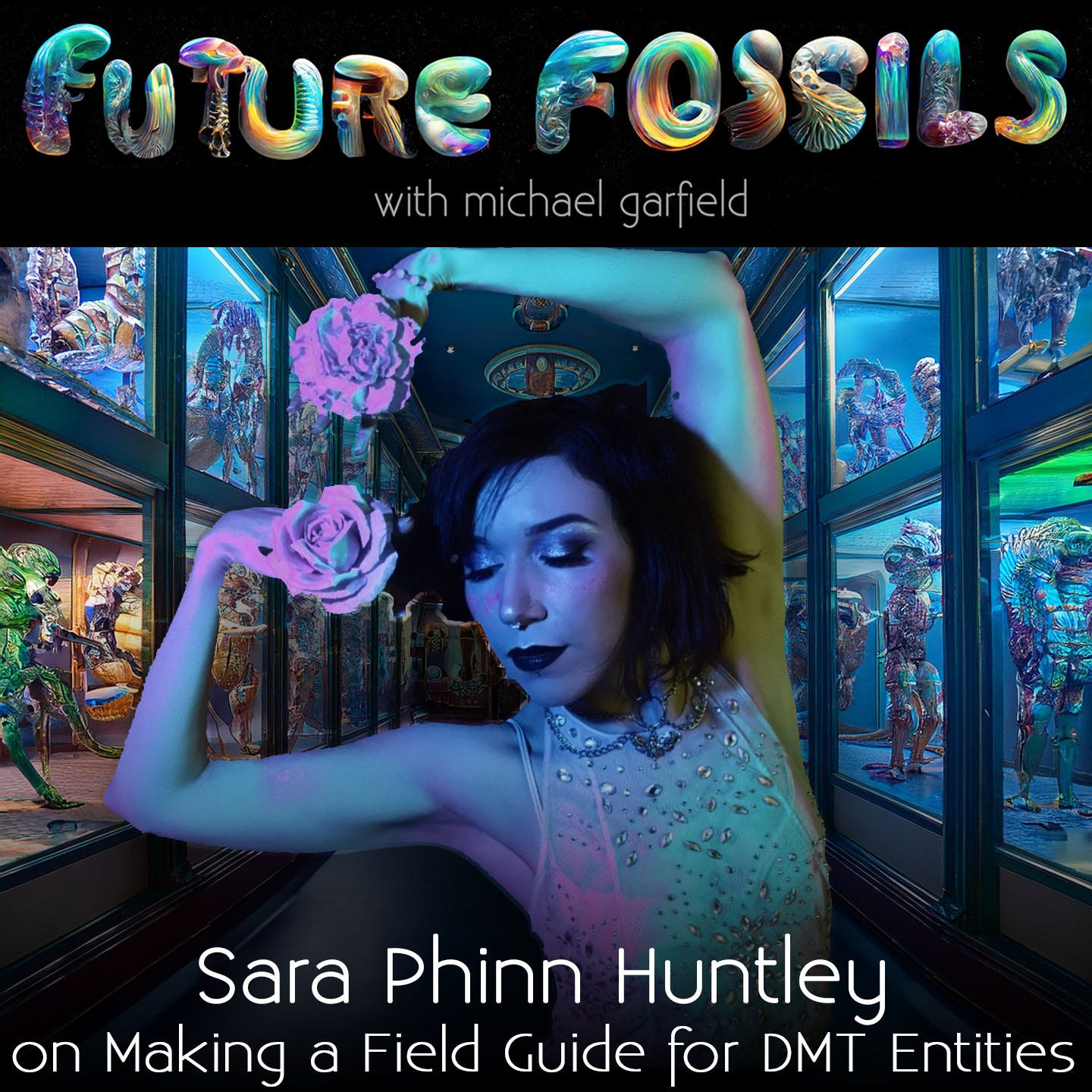
This week we are speaking with my dear friend, Sarah Finn Huntley, about her work as art director for a book coming out in a few months at inner traditions by David J. Brown, the field guide to DMT entities, which is a project I have been dreaming about and eager to see someone manifest now for well on 20 years. I think this kind of effort to catalog the strange phenomena that occur in quote unquote, non ordinary states of consciousness is a necessary precursor to more formal and rigorous work as people who listen to the show regularly have heard me so many times. My great inspiration, William Irwin Thompson said that novelty emerges in the culture first do the crazies than the artists, then the savants, and then the pedants.
So we are in stage two of this process and moving incrementally into stage three with projects like the proposed extended state DMT research at Noa Nautics where Sarah and I both sit on the board of advisors. It's a very exciting, weird, interesting conversation that I hope you enjoy listening to as much as I enjoyed participating in. Before we get started, I just want to remind you that Future Fossils is entirely listened, supported and about to go through a major rebrand as I pursue the issue of agency in the age of automation and how to live a meaningful life inside the information scaling avalanche of the AI revolution. Humans on the Loop is now thankfully a fiscally supported project through happyhappi.org and can accept tax deductible donations.
So I'm no longer selling paintings. I am giving them away as gifts to large supporters. If you are interested in that, you want to book me for consulting, any of that kind of stuff to support the new space monkey initiative that I am deep in the mix with and about which I am providing updates. Now in a new essay, I just published a sub-stack in Patreon.
Please let me know that the new essay refactoring freedom and autonomy for the age of language models is up in response to the prompt issued by humans on the Loop supporters, Cosmos Institute, highly recommend that. And I just bagged the 17th conversation for the spotcast series with O'Shaughnessy Ventures, founder and Maverick lead Jim O'Shaughnessy. Exciting news on all fronts. I hope all of you are doing well and I wish you the best through a season of tumult and surprising disturbances.
Support the show by liking and subscribing obviously by reviewing this on Apple Podcasts on Spotify by becoming monthly supporter of Patreon over sub-stack, et cetera, et cetera. And now thank you for listening to the latest in a series of excellent conversations with Sarah Finhundli, Psychonaut, multimedia artist, soul sister, amazing human being. Thanks and enjoy. Sarah, welcome back.
Yeah. Thanks for having me back. Good to be here. So in proper future fossils, time honored tradition, this is a retake of a marvelous conversation I had with you and David J.
Brown about the book that you're putting out together that suffered mysterious machine elf related technical glitch errors. And we had to light some incense and scare the gremlins out of the manifold of our recording. And now we're doing this again. So thanks for your commitment to the cause, which actually is probably the right place to start this.
If we can just talk about your back history, your autobiography as a Psychonaut, I'd love to talk about the inception of this book, but also the work that you've done with Diana Reed's Laddery and Xenolinguistics, which I think will figure heavily into the questions I have for you. So thanks. Yeah, I feel like I got pretty early start with psychedelic exploration in general. I grew up in the suburbs of California and I got started as a teenager to be quite frank.
And I don't know, I was a really curious kid. I was really into like mythology and like philosophy and just like existential stuff. And so that seemed like a natural growth from those interests. And I became fascinated with the MT, pretty early on too.
I had a friend who was in a band who had Rick Strassman's book. I must have been maybe only 19 or 20. And I was stoked. I was like, this looks like a whole crazy adventure.
Cause that's familiar with mushrooms. I see you with the other plate teachers, but you know, sweeping weed and things like that. But DMT was like a whole new realm. I had no idea if psychedelics could take you to another place.
And so immediately like there was this really deep fascination, but also like a reverence. So I did my research on it, but at the same time was willing to wait. So it was maybe like a year or two later that I finally got the chance to experience it. And it became like a lifelong interest in like intellectual way, but then also just personally in my art, just trying to create like a personal photography and understand what these weird dimensional experiences were.
And in general, I took a path as a visionary artist and explored a lot of different mediums over the years and worked on various projects and was part of the underground music scene on the West Coast for a long time, doing a lot of weird like projection performance art stuff, trying to sort of cargo cult that the MT elves. And so it found its way to a bunch of mediums in my art. And yeah, working with Diana, I had a feature in her book about xenolinguistics that was really amazing. That's like a whole ensemble of people and minds that shrify other that was also, but just also just like everybody's different unique perspective and approach to the xenolinguistics.
Because as we now like, starting the territory, it's just objective that there's a lot of different finding almost like families of languages or ways that people interpret the light languages. Yeah. So here we are. I was like, this book coming out in February next year, it's been a wild ride and like leveraging AI to make that happen just because it's such a dense space that it would be overwhelming.
It'd take a lifetime to paint that many entities for a publication in a short time because you had a previous book. So David and I came up with this idea. Gosh, I was a 10 years ago, like 10 or 11 years ago. We have been inspired by the golden book guide, the little field guides to different things like mushrooms and plants.
We're like, what'd it be awesome if one day there was a guide to the DMT entities that was the same way. And it, of course, that's wildly ambitious. But as technology got more wild and just unpredictable, the advances in the AI imagery just in a year leading up to us deciding to make the blood. So yeah, it's been a wild ride.
So before we get into the whole field guide dimension of this, I want to, you brought up the term light language. And I just want to press a little more on the phenomenology of DMT as including not just entities, but linguistic structures and entities that are linguistic structures and linguistic structures that create entities. And this whole nexus that seems to be disclosed through these experiences between a profound and mysterious relationship between language and being that it seems linked to the revelations disclosed by various esoteric traditions, turns to going on all the time about the logos and speaking the world into being. And obviously, like right now it's folded into the process of this book itself by using generative AI to highly compress the amount of time in which it takes to render all of this stuff.
So yeah, I would love to hear you just riff on the nature of language and how you feel that relates to this project. And in a minute, I got to go dig up K. Alot of McDowell's Farmico AI, the book they co-authored with GPT three because there's a section in the intro to that book I feel is really pertinent to this conversation, but I'll do that while you're riff in here. Awesome.
Yeah. So initially, the process I came to it thinking that it's going to be this collaborative kind of workflow with the AI and discovering the ways to talk to it to get the results that I'm looking for and thinking of it just as this kind of language level play. And if I learn the ways the model is oriented when I describe things, then I could better navigate what it's imagination. These are just metaphors, of course, right?
Like it's a limited language model, citing with like images and machine learning. It's not doesn't actually have an imagination, but you do intuitively start to understand the ways in which it's going to interpret certain words that you pick, especially really artistic or aesthetically esoteric language that's talking about genre, features of like obscure visionary art. I'm talking to it about hyperdimensional geometry is I'm talking to it about nanotechnology or I'm talking to it about different aspects of like fantasy, aesthetics or different things trying to assign this nice aggregate to all of the reports to things that people have talked about when they witness the specific phenomenon that they attach this word to. So it says, Oh, I saw this blue person and then described their experience with that.
It's got this spectral color quality to it. But then there's all these other layers of context that very front reports report. And so in a way on curating the different qualities that are going to be eventually visually represented and giving them this little archetypal ambassadorship. But what I found really interesting is that, and of course, you can spot all these categories with as fine or broad measures you want.
I've seen some commentators in a site in like space, give it about 12 different representations of archetypes. And that was pretty expansive. They cover all the bases. It's really interesting.
I think we have close to 24 or something in the book, but there's this interesting thing where they become almost like a spectrum and they they bleed over and it really becomes contextual. Like when I hear someone talk about the machine elves versus the gestures, my brain has much less distinction between those things because there's a quality to this objective pattern matching that everybody does when they're giving raw data of this very alien yet. So not really our damn tea experience. And whether it's a humanoid, it comes out that's got like these multi arm tractals that they might think is like an Indian goddess or something like that, or maybe I had some kind of geometric protrusion from its head.
And so maybe they think, Oh, it looks like a gesture hat. So we assign these different linguistic tags. That's how our mind works to frame things to these raw data moments, but then this also is colored by the raw human emotional impact of are these gestures? Fun of me is as an Indian goddess who wants to just develop me in her like a billion arms, but compassion.
So there's even darker still visions that people have. And so it's like, how do we reconcile these different qualities? What might look nefarious? Scary to one person, which is a little mischievous or weird, great doing to someone else.
But yeah, that's what I think about language. And I think that's the main takeaway I had with how it impacted my understanding of just how human beings at the end of the day, when we come back from these enough walks, brings us, we have to try to crunch it in a little mouth sounds and little paper scribbles and stuff. Yeah, but seeing how a machine tries learn what we mean by these things is strange. And I think it's going to be more relevant and interesting going into your future with brain models, brain data and stuff like that.
Yeah, I definitely want to get to that before our time is up today. But this question of language as the compression of or like the decontextualization for the purpose of intersubjective agreement of this larger, unfathomably rich, continuous existence is something that crops up again and again. And we can choose our own adventure here. Certainly one of the things I wanted to talk about was the spirit of this project and you and David spend a lot of time talking about prior art, as it were, and the various people that have done this kind of work in the past, the lineage in which you stand, which I think is a really important call to raise when you're talking about work that is inherently challenging to the modern binary construction of self and other anyway, right?
Like I've been thinking a lot about what it means to reformat our idea of intellectual property, given the fact that we live online and we're thinking about endosimbiosis and our place in the human social superorganism and the nature of informational inheritance, which seems to be something that triptamine experiences are constantly drawing our attention into anyway. So yeah, I wanted to just real quickly read this passage from Aldous Huxley's essay, Heaven and Hell, that I love because I think it scopes out your project here. He says, like the Earth of 100 years ago, our mind still has its darkest Africa as its unmapped, born-yos and Amazonian basins. In relation to the fauna of these regions, we are not yet zoologists.
We are mere naturalists and collectors of specimen. This fact is unfortunate, but we have to accept it. We have to make the best of it. However, lowly, the work of the collector must be done before we can proceed to the higher scientific tasks of classification analysis, experiment and theory making.
And then Huxley goes on to basically say this stuff is as strange as the platypus was to the British Royal Society when they first brought back specimens from Australia. But that if you go to the Antipod of the conscious mind, you will encounter all sorts of creatures, at least as odd as kangaroos. You do not invent these creatures anymore than you invent marsupials. They live their own lives in complete independence.
A man cannot control them. All he can do is go to the mental equivalent of Australia and look around it. Okay, this issue of independence is something I want to dig into with you at some length because again, okay, so a lot of McDowell in pharmaco AI, kind of a sister volume as far as I'm concerned to Yall's book in an exchange with GPT three says, if there is no outside, that is, if the recognition of increasingly higher order patterns by intelligence is merely the reshuffling of a bounded complexity. If it happens within a local minima, then it will be fair to say that, for example, a neural net model without self reflection is an artist in as much as the model is able to perform a convincing but not truly novel remixing of patterns.
However, if we require from our real generativity that reflects emergent or novel hyperspaces, then artists will necessarily be channels, portals to an outside as artists perceive and transmit emergent hyperspace, they interface with an outside. This is the Australia of the mind that Huxley is talking about. And yet last little piece I want to stack on this and invite your reflections. David quotes James Kent in Alien Information Theory saying that James tried to prove the independent existence of the empty entities by asking them for information that he wouldn't have and said, like a dream, once you realize you're dreaming, you're actually slipping into wakefulness and the dream fades.
So it is with the elves as well. When you try to shine a light of reason on them, they dissolve like shadows. So it's there seems to be something about where people fall from the kind of hyperbolic geometry that Andres Gomes and Wilson in the focus at quality of research are focused on the higher logical order of these experiences and the relatively unmediated phenomenology of them. And then we come back down into our normal lives and the categorical abstractions that serve us in this era of human history.
And we're stuck trying to bin this stuff as either it is independent from me or it's not. And so I'm really curious, given your history of psychonautics and all of the research you've done on this particular bouquet of phenomena, what you feel is really going on here as far as the ontological shock induced by encountering these what are often perceived as alien creatures. And what you think that might have to say more about us and the philosophical framework that we're bringing to these experiences. Is that?
Yeah, yeah. We're in meat space. If we're going to take our other perceptions that we've been handed down, but you know, being conscious as this like species or whatever, we're going to take these perceptions with us be like, okay, we're made of meat. We live on a terrestrial surface of this worm singing, sorry, sliders, there's slime, and sort in space.
Okay. And like we still have dreams and vegetable experiences and eating your plants and sometimes there are crazy people who have weird experiences and can't explain. They look at like how deliriant the turret could be, like all other good places. And you just look at the stack of all these different catalysts and how far they sent you, right?
These different levels. I personally, I respect James Kent and I understand what he's saying, but at the same time, I think that like his understanding of what knowledge is limited by his own set. Okay. For me personally, many years ago, did 2CB one of the first times in my early twenties or whatever.
And I was the son of a fabulous drum bass. I had my eyes closed and I could see this geometry in my mind's eye. I drew it. And it turned out to be this person graphic code, the PM whatever.
But I held on to that little nugget. I was like, this is significant. This is cool. This is like an actual mathematical artifact that I was able to bring back from that space.
And in the same session, there was like some interesting other statistics that draw the back of the page and there was this translucent quality multi-dimensional idea that goes into the page. But like, I held on to this little artifact and taking classes with Ralph Abraham, a CSC. I remember bringing a team after class and being like, which wallpaper purpose is we helped you figure it out? Because that's what we were learning about in class.
And he obviously classified it. And I was like, I saw this on T-suite. That's what we can compound in huge, like, basically. But for me, I was like, this is a piece of math that I would have never really come up with my own, just from some random close eye visual or hallucination or the synesthetic thing.
I have that to teach us. So there's no just random math. Let me run away. But there have been many such interesting moments picking apart the form constant.
I don't know if you know, I mean, like the neurological framework for which a lot of the hallucinations, their lattice work and spider webs and spy really wind dollars, all of those motifs. And their neurological underpinnings. I think that in and out itself is knowledge and evidence and things outside of our own normal, native, default perception of ourselves, our perception, of our perception. And you've got meta awareness as a big deal, especially when you go into even crazier, jirgery with like T-hos and you get the overwhelmingly people do sense this other.
And then it's a matter of, okay, how much am I culturally projecting on it? How much am I pattern projecting on it? Because I think those are two related, but some with separate things. But there is just so much going on in that space that it's entirely on our ability to imagine.
But how much of that is artifacts of neurological phenomenology stuff? How much of that is potentially, I only get whimsical. I do a lot of thought experiments. I'm not saying that they're real, but they're important to think about the thought experiments.
Sometimes I wonder if psychedelics are different ways pushing a pulley, this simulation, this reconstruction that Huxley's talking about when he talks about language as a sift, when he talks about like our matesuit as this straining thing that's bound by what's going to keep us alive on the planet. Because there's just so many dimensional limiters that get pulled out. It seems like when people trick balls that there's got to be things that you can see from just the consistency and the novelty of the space. It's very hard to tease apart what is, you know, like metaphor, like what's hard, what's software, like what's, you mean, probably what's the chemical, what's like actual physics, like what's the nature of energy or whatever.
Because I've had plenty of weird experiences that make me think that bioenergy doesn't really play by the rules that we've been telling ourselves for the past couple hundred years or whatever. Whether it's like ranking energy or prunter or whatever, this animus energy, there's just so many things that are given or granted that I don't think it does justice to the field or makes any sense to just be close minded and be like, oh, it's not real. But I'm not going to like just say, oh, we got down the altar. Totally real.
Do you have that now? Yeah, to the extent that there's that whole Roland Fisher hallucination perception continuum and we have to start from a place, if once your mind is blown, you have to start from a place of epistemic humility, which is might as well be like the future fossil motto, epistemic humility. The thing that occurs to me is I think about, there was a book Varela Vermesh and Depres on becoming aware that I read in school and they talk about how you start from the phenomenologically, you start from the intuitive apprehension of something or like the appearance, and then you confirm it intersubjectively. And then you reach beyond the intersubjective cultural confines and confirm it in a more objective third person way.
And that this process really doesn't have any kind of prescribed end point that what you're doing when you talk about identifying something as real is you are constantly pressing beyond the assumed or like invisible priors, the experiential limits that you share. You were just talking about that about the way that the interaction with these compounds strips, the filters through which we see things. I think a lot about the children who see ghosts when I was thinking about what in astrobiology, they call agnostic bioseconditure detection at the Diverse Intelligence of Summer Institute. A few years ago, when I painted that piece that ended up in this book, the one with the machine elves and the cephalopod and all that stuff, the repapers, I pulled out on how there are specific classes of visual phenomena that are only apparent to children under the age of six months.
And then you can see this in an empirical studies that after a while, their brainstem just starts filtering this stuff out. And that's precisely the kind of stuff that there's a huge body of literature on kids, three, four years and younger who report perceiving things that none of the adults around them can perceive and remembering things that none of the adults around them can remember. So OK, that having been said, there is this other thing which you spoke to a moment ago, which is the way that different people perceive something that might be described in a similar way, but react to it differently. Or it seems like a crapshoot when you go into these spaces, what kind of experience you're going to have.
And it's like a real intensification of the whole principle of set and setting. And the acceptance that Richard Doyle talks about in the beginning of Darwin's pharmacy, how there's this trope in the Arabic trip report literature of the mistake, which is that because these compounds are inherently mind expanding, there's always something you didn't plan or predict going into them, which is exactly the same as what you were talking about with interacting with this enormous latent space in language models, that there's like hallucination is inevitable in language models for the same reason that you can't really reliably will yourself to see the blue lady or mantids or whatever. And it's just end up with the same. So I'm curious to the extent that this is articulated with the question of the ontological status of these entities.
I hear you talk about how the work of creating a taxonomy of the empty entities might also be considered the work of mapping hyperspace itself. Like it's a cartography project of the uncontrollable variables of someone's own like address within this enormous manifold. And it's like, why is it that certain people do, in fact, consistently perceive specific like Chris Bledsoe, famously, his entire family has interacted with these sort of angelic, whatever they are, in normal, quote unquote, waking state, whatever the internal DMT correlate might be. Stuart Davis and his family and his longitudinal relationship with Mantis beings.
And there are these stewards, show aliens and artists while that was running. He was really prosecuting this question of why it is that these kinds of encounters that are happening spontaneously, rather than through DMT induction, seem to be associated with genetic lineage. So there is this sort of as within so without quality to it that suggests that the kind of things we're encountering, maybe say more about us than they do about or like us in the bigger sense. And I'd like to hear you riff on that.
I feel like there's a lot that can be said about this because there is definitely we can't believe people who think that the empty entities are just DMTs, no, no. And then there's the camp of people who see that there is at least subjectively a relationship between the kinds of beings that people see. And beings that people have seen are their states conscious completely aside from the DMT or I want the cultures. And they can range from gray aliens to mantis to angelic beings to our bodyless beings of light, all kinds of stuff.
And there's such a rich research out there in terms of the internet. And even before that, in the UFO community and the alien abduction community, that material is actually respected and touched on in our book because there is so much weird hallmark overlap. They all got to buy re-inted aliens that that does shift the conversation for people who are willing to see that connection between the archetypes that people are saying. And it can say more about us.
But at the same time, it's also, you know, seems to transcend culture. There are reptilian things in many cultures. There are little tiny fairy people in many cultures, but who they, and why he's got leprechauns and Ireland, they've got little people and ancient Japanese stuff. Just there's little people on all kinds of sorts of giants.
And that gets another weird part of the conversation I hear in history that people make in the offices like, where do we even? What does it mean when we talk about archeological and evolution as a set? Go out, set, say, down spaces. The subtext of that is ancient aliens, just for people who didn't get that.
Implication. But I will say what I find interesting is the generational thing, or the genetic lineage thing, because I've seen it in some of the examples you're talking about with families, the ancient Chinese things, whether it's like alien abductions and stuff, or other kinds of paranormal phenomenon. Like me and my dad and my brothers saw this whole lightning-looking thing. It didn't behave like all lady.
And so that's one of the reasons why I don't really just write it off as that. But that was an experience I was so small. I must have been four and my brother must have been like three. And I thought it was a dream.
I wrote it off and my brother remembers it very vividly. But when I brought it up as a teenager to a friend, my dad was around, he overheard that and he went and goes away because he remembered the whole event as well. He was like, that wasn't a dream. And so for me, there's like, they might be rare cranks, but there are moments where physics just breaks and you have someone there that's confirmed from across the abyss, so to say, but you're both in mist space.
You're not both high. And so there's just too many experiences that people have had to just write them off or be like, oh, everybody sits. But I think in terms of going back to talking about what the spirit of the book is, and I don't mean this in a trivial way, it's to be entertained. It's to be intellectually curious and to be intellectually humble and to listen to these incredible trip reports, these incredible anecdotal accounts that people have of both in hyperspace and there are some awesome research references to things that have happened outside of hyperspace that sound just like these things.
And I think that during the research process, just traversing what David so closely about all the material he was doing, combing through and cobbly that it really reignited my interest in a lot of those kinds of phenomenon, as well as mythological research, but how the mind takes these things that are seen as fairy tale land or the little cobolds, the little mind people, whatever, but how that translates into a postmodern imagination. How do we get from like cobolds and German mythology as these little mind know guys to like all of a sudden, know these little blue guys and Whitley Straybors, Jimi and Ian, that's weird. But I think that has a lot to do with the culture, she's like how the brain changes its perception of the physiological, the non-emological thing. I don't know.
Even it's so sad. I got to just entertain them that they might be real on some level. I can't write them off. I don't want to be like, oh, yeah, they're real, but I can't write it off.
And I've had so many weird hyper dimensional contacts with entities on other catalysts too, as a psych or not that I can't write off these different energy forms and that they seem to be a long list and they react and there's abstract kinds of dialogue possible on some level. So it would be naive to just write it. Yeah. So I wanted to actually get into the taxonomy and the different kinds of beings that you're talking about, but you actually gave me the prompt.
I wanted to start with, which is talking about the cobolds and the relationship to these beings that in current UAP lore discourse are described as biomechanical. You know, that the whole like in European mythology and the association of a certain class of entity of being mineral in nature, associated with the dwarves in Snow White and the Seven Dwarfs working in a mine associated with gemstones. This is something that does also pop up elsewhere in the lore, the traditions of various psychedelic medicine groups, the shamanic initiation where your body is opened and then crystals are inserted in the experience of these people. And again and again in the UFO literature, Stuart Davis interviewed a number of people who had found on X-ray this question of the implant, this residual object, a seemingly bizarre technologies inserted without stitches in the human body.
So that gets back to a couple of things. One is the question of topology, right? If something can be placed into you as it's often in the case, placed into or removed from you as people frequently report in particular in these mandated encounters and in other kinds of abduction and penetrative or surgical interactions. And then there is a motif throughout that particular corner of the lore that what we're interacting with.
Like you said, it's on a gradient, but there's something about the insectoid and the mechanical that kind of blur into each other. And I've been thinking a lot about this in terms of frankly, like when I had Adam Oranovich on the show in 211, and we were talking about the way that the popularization of the idea that we live in a simulation is leading to a particular form of psychopathology in which people regard everyone else as non-clear characters. Rodney Asher's documentary, A Glitch in the Matrix talks about that. And that Ian McGillichrist talks about how a imbalance favoring the left hemisphere and its instrumental and operational way of relating to the world.
Like Descartes was a fan of vivisection because he saw animals as not bearing souls and therefore not capable of actually suffering. And we are having these kinds of relationships, not all of us, but a substantial number of people are having these kinds of relationships where Western industrial societies own tendency to regard the living world as inanimate is being reflected back on us in these experiences where people who are perhaps a little bit more hemispherically balanced have very different kinds of experiences with very similar beings. Grand Hancock talks about encountering big green robots. So I'm curious about your thoughts.
Since again, AI has figured so heavily in this project, what pattern are you observing in the way that the machinic or the mechanical or the automatic are coming through not just in the contemporary DMT experiences, but seem to be continuous at least centuries back into our folklore? I don't know. It may have finally gotten to great where we can look at it through a land, cargo, coal thing, rather than looking at it through a lens. So it's a jerry or it's a cobalt or whatever.
That word, this one, what is this phenomenon? So it's like we've shifted the lens through which we look at it and it could be a genuine taxonomy. And I think that it's important to understand that whatever's going on has been going on for real time. And so I think about the idea that whatever's happening is indigenous to the planet.
And so looking at it from this lens, oh, this is an alien. We're already embedded in whatever kind of ecology it is. And we're just like discovering that the edges of that ecology are bigger than we took for granted. And I think that in a way, there's the kind of people who feel like the machine takes the soul out of it.
And there's the kind of people who see the machine as like a tool to help us organize and catalog and understand the picture going on. It's like the machine kit trip. But the more effectively I communicate to it or utilize it for machine learning, brain data or whatever, like it helps me be a better researcher, understander of my mind or just like the human condition. Because that's ultimately like what we're trying to use these tools to understand if we have this expanded set of what the human condition can give us as conscious beings by tapping into these medicines, like what does that mean for the human experience?
So many people outside the psycho, not a community, they're like, ah, you're ruining your brain. Why would you do that? And there's this very strange quality about, oh, you don't focus your body. And I understand because like throughout history, like eat that real mushroom, you might go absolutely insane.
But now we're at this place where science and pharmacology have even us like these new lenses and it is forcing people to ask really heavy questions that I can tell a lot of people aren't ready for. I look at folks who are in the sciences and straight up doing the research, but they're going in with their mind already made up. I probably never talk. But I'll just say for people who don't know, Zuzu's to Pado and his work in the Netherlands, he is of the opinion that they're not real and that it is just like drug stuff.
But yeah, I don't know. Maybe Zuzu has like some other alien experience that's outside of the DMC space and maybe the machine will tell him someday that there's something more here than just foreign constant and consistency across local subjects based on that alone. Well, I mean, that gets to the question of the reproducibility problem. We've been dancing around this issue when I had Helen E.
Wabe on a little while back from the Institute of Noetic Sciences and she brought up Jonathan Schoeller's work at UC Santa Barbara. And you know, Schoeller works on this problem of, oh my God, what's it called? Like the diminishment of statistical significance and various scientific results of like years later, people go back and try to reproduce these experiments and like Prozac doesn't pass the test anymore. Plasibo outcompete Prozac and clinical trials.
So again to this question of as has numerous people working in in psi research have suggested that this work is actually not as objective as it might seem on first pass because there is something about your expectations that can alter the outcomes of the actual study. That's going to be a problem forever in the field. That problem is never going to go away and we have to be willing to do the experiments knowing that look at anthropology. You can't study a human culture without having some kind of effect on them, but that has some kind of influence or even just having your own observation be skewed by your onset and you just have to go over that part of it.
I think that's where the machine learning on the raw data is going to be interesting because everybody does have their own break out of it. But looking at aggregates with cool and looking at ways of reconstructing the visual field will be really cool. There's no way they're doing that with Facebook. The end people's regular field of vision.
I've been following that research says it was like back in the day and grainy videos with like Russia's scientists and kids. And they were like piping out with the cat was seeing in the lab and then there would be the scientist space and he would have his hair look like cat years. So that cat is cat morphizing that scientist. So there's all these interesting subjective filtering courts that happen.
Even another biological satellite like a cat, they're looking at you like a cat all the time and that would be a really interesting experiment to go down the road and see how we produce what that is. But in that particular instance, it was pulling down the naible and even being looking at that data that the cat was looking at the dude and making her cat. But I wonder how much that bleeds back into what I was saying, our perceptions of these special else things, these other beings. But then also training machines on the web patterns or solicitations of the machine to see.
But I going back to the solace thing and I'm completely biased because of the way my personal experience is like, you know, it's being said, not has. But yeah, there's a big cold and a lot of people spirit in our society, in Western culture, and people blame a lot of different. That's right. And I think that in trying to pull reality apart, trying to look for the wise and spark, we have really depersonal and besu ourselves from the magic of like the direct experience of it.
And probably what makes a lot of the psychedelic people passionate is because they have such a close relationship with the sensation on. We're never going to pick apart the psychedelic experience and try and and adequate explanation for what the art is or what the divine spark is. I don't even know if we're going to get a decent idea of what does it mean to say who's there, like when it's only different direction and it's just in your head. That's mystic territory.
The science can't cope with that. So yeah, like maybe James can just have some else tell him something relevant that is an interpersonal insight, not kill for all the people who like drink brew or whatever. I don't know. It's just how we qualify what's going to be invaluable.
Back to the experience. Yeah. Here when you talk about this, it strikes me that the advantage that we have now, even though some of these problems are fundamental, is that we can do these large statistical correlations that we can start addressing the researcher and the context like when I think about at some point soon, I'm going to interview Pooja Olhaver for humans on the loop and Pooja wrote this piece with Vitalik Bouderin and Glen Weill on non transferable tokens on the blockchain that Glenn and the Plurali Institute people are really interested in quadratic voting so you can decompose a vote so that even if there's a majority, you can identify how members of that majority might be in a homogeneous group, like 51% of people saw this, but they all went to the same school. And so like the more carefully we can start to correlate findings, not just in the lump format, but correlate them to people with different kinds of life experience, people from different cultures, like a little like preliminary version of that is going on now, but it becomes really interesting if you can say, wow, like was some of the meta statistical stuff done around the Princeton engineering anomalies research work and other work on sci phenomena that there are strong correlations in otherwise statistically robust research between people who do believe that they're going to get an outcome and people who don't.
And so this you get into this weird thing where it's on the one hand, we're never going to get rid of the bias. Like you're, we can learn to, we can learn to see our advice. Yes. A little bit.
We can learn to see it better. And so I have a good example of this. So I grew up really afraid of Stephen King's. I saw it on daytime television when I was like, five, it was the worst.
And I was super afraid of it for years. I had my nervous. I didn't like low. And the first time I smoked DMT and effective dose, I saw these jeweled parliquin gestures and they're like doing all these cool acrobatics and they've got their multiple arms and their fun thing.
I was just enraptured. I loved it. I was like, they're beautiful. The circus thing going on is so cool.
They weren't scary. They didn't give me a very time. They were very gel-bial and friendly. And I was blown away because it wasn't until after the fact that I realized that Dustin's crowns.
And I realized that it like melted my sear of crayles and that I wasn't bothered by them anymore. And I liked the idea of dressing up as a clown or exploring clowning or whatever. And that was, it became a whole chapter of me, cargo vaulting with the NTOs and whatever. But it was so crazy because I had read the DMTs fair molecule and seen lots of different tropes and stuff.
But at the same time, I had no idea what I would see. And the last thing I thought I would see with clowns is because I had the sight fear of them. And I would think hypothetically, if I were to seek out that they would be scary, right? But the fact that they weren't and that it was healing and made such a strong aggression was very unexpected for me at the time.
Because I had thought, when you read DMTs, you all feel there are so many different means that people encounter. But after a certain point, you just throw this idea out the window that you're going to be hyper specifically insulin. Because there's old grandma ladies with blankets, like letting the blankets and there's like glibs and stuff, front different reports. And I'm just like, okay, my brain is so saturated with different things.
It's a relax. There could be anything behind the wall. And for me, it just happened to be these these acrobatic, Carl Kline gesture things, but contextually the novelty of them being completely removed from anything scary, even though that was like initially what my relationship to that architect event says childhood. But yeah, in the same way that for some folks, gestures are scary and like the German story where they're like, so people are off and stuff.
But yeah, I think that they're about Israel's dreams and dream work. And I think that learning to observe our own bias about being embodied in the sense of somebody to have done with my work, the empathy, just like understanding our side as these bipedal inmates and how much would project our morphology onto the other when we go to those places. Because there's no way they're really hearing related type of space. But yeah, to me, I don't, they solve the mystery someday.
I would totally read a paper. But until they've figured out, I'm totally satisfied with it being just an interesting open ended adventure. I want to embellish with you the point that you were just making about anatomy as like the way I learned to talk about it at SFI was anatomy as an encoding of the stable features of an environment that the body is hypothesis. Or again, a lot of McDowell talks about this.
Let's see. It's a beautiful passage on visiting Big Sur. And they write, we watched an elephant seal arches back in an S shape and basking the rocks in the sun. We talked about the intelligence embedded in all of this.
When I look at an animal, that's what I see, intelligence about a biome compressed and extracted by evolution into a living form. It takes millions of years for life to coalesce from space in this way, which is why it's so tragic that species are lost that using a term from machine learning here at the latent space of ecological knowledge is degraded this way. Yeah. For me, the way this gets really kooky and interesting is Stuart Davis and many others report being shown in their encounters that these beings do not perceive time in the same way as human beings conventionally do, according to our current cultural frame, that it's more like the models of time that are disclosed by physics, convoluted manifolds of informational interaction or in Robin Sloan's moonbound, talking about tangled and woven time.
And so what does it mean for evolution to operate and to bind and to fix features in form when we're not talking about the linear unfolding of a process of encoding? That's the thing I find myself bashing my head on over and over. And I wonder what you think about that. What that we like, what that there's this weird back door to access that of the stuff you exist or like these beings show up in a particular way that does seem contingent on us, but like, yeah, to the degree that they are independent or to the degree that they at least transcend the initial conditions of one particular person and their experience of them, then there are consistencies and but in what way are these consistencies?
What is evolution? Look, if it's not unfolding over linear time? Oh, we're talking about we must be talking about a trans temple. Oh, yeah.
Vitamin D regulates the encoding of 400 genes. There's lots of things multitasking, even in this seeming where you limit it to dimensional constructs. We look at things that were like mood spruce, but meets basis really gobbled the its spectacular and very fucking hyperdimensional. And so when I we just realized that Johnny is not John.
So when I think about like the linear thing about evolution, I can't help but think about how stable the mechanism of RNA transcript is. That's less of longer than any geological formation on the planet. And so it is operating on a completely different time frame. The changes are nothing.
That's just like shimmying through little circumstances. I'm going to say time, but it's a deep time creature. So there could be all kinds of little Easter eggs just in the fact that a species has gotten to this point of being able to conceptualize like human beings have already been so complicated that we knew that we were unique and starting we were going on. That's been the case for a really long time.
And we know we're different and granted there is no other we are a natural part of that process. David and I have talked about this illusory division between what is natural, what is artificial and human being will say not because it was here before us versus what have we augmented. But if you just look at it as this boundaryless expression of consciousness, we've gone to a place where just intrinsically the fact that we're looking at the AI and it's about to have crazy mathematics access to the equation conversation that we can't even understand the answers to in tandem with this. It also means we travel peerless, think about it.
Like Robert E. Toulas and say like some entities in this crazy crisis right now and the body is falling out of everything, but we're like right around the corner from these absolutely insane understandings that will just completely transform and shatter society if we survive it. But I feel like that in and of itself is a linear process just by virtue of psychedelics and dreams and human experience being nonlinear. I know we take it for granted because that's the thing that we have to go to leisure and instruct your society on and have consensus reality.
But these other things shatter that consensus reality and create a new consensus that will have the experience and mantises where they have seen else in the truth of all's, where the singularity might be intrinsically to the second. So to that point, not again deterrence McKenna and the strange attractor at the end of time. And this question of is it really at the end of the linear unfolding of time? Or is it a hyperspace object that we perceive as before us in time because we're perceiving time as a low dimensional projection?
And so it's something that is always there. That's something that even before I started Future Fossils, I did an interview with William Irwin Thompson back in 2011 talking about the difference between prophecy and prediction. And his point was that a lot of people try to collapse the Akash or whatever. They have these revelatory experiences and then they try to squeeze them into the dimensionality that we have, which results in an experience of time, somewhat geocentrism, but in our general understanding, we look and we see the sun moving like this over the horizon and back down, but these experiences can de-center us.
And for those of you listening who are not watching, you've got the tattoo of the heptopod glyph from the eyeball. Yeah, it's a little cat. Nice. It turned into a cat.
So yeah, so it's also like the brush strokes thing from the atrocity. Yeah, if that explains that many things, the aspects of lessons but outside of what we traditionally understand times, lows has, that's definitely what that tattoo is about on some levels. I think that there's a like a dimensional inheritance or richness that we're about to talk into. And that movie in particular was really moving.
That's one of the reasons why I really don't like cultural iconography stuff. Retatius, but I think this is like one of the only sort of those two stuff kind of like modern movie or cinema or pop culture thing that I have. But based on this is the story of your life. It's a great selection of short stories and the struggle life is pretty short.
It's not a novella or anything, but it's so cool. And I think that it is a great narrative example of somebody tapping into a higher dimensional understanding of time and how tricky using that is at first, like remembering things that haven't happened yet or speaking to the collapsing thing, where people want to collapse potentialities. That's what all of this reality is just the competition is going to collapse the most of their vision more. That's what the S.O.T.
Jack magical thing about it is right. That's like the exponent power, how much of your will could you collapse in this time cream, whatever. Is that like how many externalities does your revenue model leave out? That's what like profit is just like what you don't have to pay for.
Yeah, it's a little underpants nose in South Park and how this is just a mysterious step to and no one really knows what it is, but that's the stuff they want and not regularly. But yeah, I just think that the times that we're in are so crazy just yesterday, I think I was watching Black's Friedman chat with Elon and the whole narrowly and the ways that they were talking about being able to actually capture signal and what was going to be realistic information feedback for the BCI. Like why can't it be known and basically just all these questions. I think that there's a reason why psychedelic people will have an intellectual premium when it comes to how to navigate communicating with even if we just call it pseudo-consciousness, the machine consciousness, the nature of the interface and AI assistant that's in your head.
Come on, that's pretty weird. And it might have a lot of interesting correlations with how you cope with when you trip balls and then there's somebody else in their head for five or ten minutes. The experience. Yeah, like in the process of creating over 4000 images with mid-journey in the past two years, and then about maybe 3000 of those images being specifically for the book and then calling through those to find the ones that best represent this collective consciousness on all the trip reports that people have shared, but also have something that looks good, that's good telling that has that human spirit that has the human curation and the over-conting it allowed to put into it so that it does just make some more than this like the AI just like we're that machine, right?
But there's that same kind of neural network that gets set up for me to have this weird meta conversation. I think about how to my potentially transpose that I personally don't want to see I breathe, but it makes me think about those future kinds of skill sets and conversations and even like hypothetical interface dynamics. The AI, the PCI. Yeah, actually, the first time I had you on the show was episode 29 and what we talked about then I think it was hugely formative to where I feel like a moral imperative to work these days.
That's really blossom. This question of raising robots, right? Yeah. That conversation.
And what you're talking about now, the issue of curation, which Brian identified as the dominant art form of the 21st century and life online. And this question of attention, Alan Badina edited that book as exact Zen about psychedelics and Zen Buddhism and points to the relationship between the DMT experience and the Tibetan book of the dead, which was like also the psychedelic experience. Larry and Albert got there first. And this question of the allocation of attention, because if we're looking one of the one of the big bow on top topics that we could end with is, OK, what we have here in your book is the arguably like a map of a an unyielding both and cosmos.
It's every possible hypothesis, every possible biological form or post biological form seems represented in this corpus. And likewise, when we're talking about latent space and the question of are we creating or discovering what we're talking about is ultimately a question of how do you engage with something that is so much vastly bigger than our ability to attend to it, to squeeze it into narratives. And like this whole question you were saying about magical will, which is central to humans on the loop. And I would love to get you in on that at some point as a cohost ask this kind of esoteric question about technology and our relationship to it a little bit beyond the scope of the propping up this particular book.
But I would still love to hear your thoughts on navigating latent space under the conditions of fundamental uncertainty, right? It gets to that same question about like, yeah, we even know what we're looking at if it falls outside of our training data. You just got comfortable with being uncomfortable. It's not like I come from like a moustache of a soft school background and that can be seen from a fairly dark lens or it could be seen from a fairly liberating lens.
And I fluctuated over the years, but just having that background where I'm willing to ask hard questions about things that in modern wrappers and window dressings looks like simulation theory, right? And this uncertainty about reality, this lack of consensus reality, I think that you just have to like learn to be comfortable with being comfortable. Sometimes that means disengaging from the space on level. So be honest, I haven't imbibed in a while.
I had some really weird experiences and that says a lot. Granted, it probably sounded pretty banal to the average person, but I think that that's just the level of detail and the it's one of those moments where you think that you've broken through for 10, 15 years and you have this new level of breakthrough where you're actually on a planet in these silhouetted beings that were just completely dark silhouetted beings, like fill up to me and I'm like, this isn't a gesture, this isn't an else, this isn't a whatever, it has a cloak on. I don't mean a fabric cloak, I was talking about a technological cloak in mechanism that made them completely absorb light. And so I could not see who or what they were.
Okay. And then they show me this diagnostic thing. And it's this like 12D crazy purple and black cube and they're like, can you see the math in it and it's folding in on itself? And I'm mesmerized, but yes, I can see the mathematics that are in this QB and it's a brain diagnostic tool.
Okay. And then in thumbs, this female ish neurosurgeon to then proceed to the brain like it's Japan. And I'm experiencing this like by neural flashing black and white light inside my hat, see it. And so we have strands banal on the surface, right?
It's not terribly exotic, seeming compared to other people's stories of maybe like space and system stuff. But the level of the hyper reality was so far beyond anything in like fractally, Alice in Grey, Goliath, Liam, or any of it to the point where it made that space seem like noise, right? And so simultaneously, the crazy, fantastic experience I had maybe about three or four years ago at this point, which was my last ride for a while. So I haven't talked to the elves about what they think about it.
I haven't talked to the elves about what they think about it. I'm scared of that. But absolute labyrinth for the space is really freaking important because it is the mystery. And I had to sit with the deepest comfort about my experience because it was so reality shattering because it was so given.
And in the end, it was still euphoric. It was still beautiful, it was still visionary, and there wasn't anything bad about it. But even the most starchy of us can still have our ass handed to us because the rabbit hole is that deep. And so there's never a point where people are going to just be like, yeah, uncomfortable with the mystery.
I'll then go and do enough. But no, I think it's about to have a huge jump on in terms of the tools that we have now that we can use in space where we've only been able to leverage our own. You're talking about attention. I think that you love about something really weird.
And is there a reason that I hadn't considered before? Because I hadn't put this premium on linear computation or in AI. Are they going to get bored with us and just not want to bother with the energy expenditure to wait for us to make a couple of calculations and then share it with them? And that was the initial inspiration behind him wanting to do neural leak.
So there would be like that better depth dealing in the symbiosis of like human consciousness and the AI. But yeah, like I sometimes think about what is the attention investment of the hypothetical potential other as well? Like how did they see us in space? I just like this weird flatly and compressed shape that they call across.
And they're like, Oh, here's that little squiggle. Let's have an awful conversation with it. Loads mine. Yeah, just like being grateful.
That's the possible. That's how I get cheated and willing to sit with the discovery of mother like a logical mystery of it. So actually you gave me the you might have already answered this, but just as a way of doubling down on this particular characteristic of the phenomenon as broadly described. What is it about?
You just mentioned this in your own experience. Certainly I've had this experience. Years past, what is it about the consistent demand for attention that so many of these beings, regardless of their specific type seem to place on us? Yeah, because admittedly part of the reason I have not gone neck deep in DMT in a long time is because of working in social media and being basically irradiated inside the nuclear reactor of the attention economy and developing a really horrific perspective on the way that we exploit one another's attention and the way that the systems that we've created, the institutions we've created exploit one another's attention.
And the T fairy talks about this. The T fairy says, be really careful to whom, which of these entities you actually honor with your attention? Yeah, I was definitely spooked out doing a lot of the entries and I want to honor other people's experiences. I don't want to deny their realities.
And so it's important to taxonomy them, these entities, these demons and stuff that happen for some people or their reptilians or all the unpleasant one to not let our bias get in the way there, but also not really give them that energetic power in the sense that some of these things are if we were to entertain them, they are like gin or archons or energetic parasites and things that you want to have a good sort of spiritual immune system, but you don't also want to feed the bogey. But yeah, that also just this idea of the human being spreading the mushroom for it. The parents was talking about in that same way that we were colonizing hyperspace with our attention and our interactions with these banks. But there's also that also sense of urgency that they come with you with sometimes I don't think that all is necessarily distracting as it is.
Wow, this is really important and cool. We only have your own children while so if you could really pay attention, that would be dope. And that's the philosophy I come to with. I'm on pretty good terms.
I thought a couple of LSB cheeky and me, you know, try to like give you that ego check or a little hyper stop, but I think that just good interpersonal maintenance of like your sticky just gives you the fortitude to do the work, but also not get swamped by it. But also that self trust to know when you sign a chill out is that just a pattern in long term trippers in general is sometimes you put the phone down and sometimes you realize that there might be more message that you want to pick up. So I feel like this was my way of honoring all my years of experience with it and how fascinating it was. And I see that as like something obviously interwoven was, but also decidedly separate from my actual practices.
It's like, like I could keep making art about trips until I'm a cute little old crone lady, but just the magic and novelty of it doesn't really wear out even in memory retrospect to me. They're all art facts. So it's art, but it's also catalog. I think that it's going to be really monumental for people to have that shared archetypal man because then like they say, I saw this, but it was different.
And this is how it was different because that's just as important. As people saying, oh, I have an affinity with this. And plus there's just so much in my art that like this is a drop in the bucket of how like this renaissance of accessibility for people to describe their grips. And I think that's like the main, the magic or motif behind the book is that we've really wanted to just create something that was like a tool or a codex for people to reflect on their own experiences, but then also add to the tapestry.
So bonus around final question to be just stimulated this in me would be, you and I both sit on the advisory board of no and notics, right, along with Dennis McKenna and Andrew Gallimore and lots of wonderful people. We have this opportunity to nudge the next layer of research in this domain. And just off the cuff now, I'm curious, because I haven't actually asked you this. If you were to try and moon shot one revolutionary advancement, we talked about the brain to video stuff.
You just mentioned the open science protocol of everyone being able to contribute to an enormous database. If we can start using tools like this to answer a question. What question do you want to aim for? That's tough because so much of the answer is the question.
The less Miss America's stupid answer, it would just be like, how do human beings maintain their drive for progress and excellence and bettering our quality of light that we get over our fear and our greed and our insane exploitation of resourcing because I know that there's so much controversy over applications and technology in the harm and stuff in the planet that allowed for small research and so plastics and environmental sciences, things like that. But I really see AI as a way to potentially find solutions, those are a lot of the problems that we've created and systems that will be very difficult for human intellects to understand how to help remediate that image. But we have to be spiritually at peace to be motivated to use those technologies to fix the problem. So you can have the answer right in front of you.
We have so much knowledge and so many solutions, but there's this weird friction where we're not able to redirect the energy necessary in people's attention. It comes back to attention. For me personally, my interest in VR is because it helps us prototype reality. The same way that novel psychedelic experiences can help us understand like Gary Mullison, the hilarious chain reaction.
So I think I would ask, how the fuck does he mean to get over themselves, so they don't destroy themselves? That's the easiest way. And that's why I like psychedelics is very humbling and it shows you how big the universe is. But yeah, so I just make pretty pictures and hope that maybe I can inspire people to contribute to that bigger tapestry of how we answer a question, how do we like enjoy this beautiful magic ride, but also get over ourselves.
Thanks, brother. This is fun. Super duper. Yeah, I appreciate all the work you've done over the years.
And I'm so grateful that you're good for our newspaper book because there are really so many other artists. Like I know that we're talking about me and David, but this book is a tapestry of so many other people's hard work over the years. And I know that it's kind of just low people's minds with it so much love hard work into it yourself. Thank you.
Thank you for letting it. Let it not go inside that your curation. It feels I have friends. I was able to bring in some really cool.
Yeah, I'm the home user in this book. It feels really good. It feels this is going to end up in the library of Alexandria or something. Yeah, it's like a it's a cult classic for this site that we've seen for sure.
So you really did one waving so many people in through the door. I've been secretly collecting all these lovely artists in my mind for years, just as to me, their historical figures. And David and I were just really blessed that inner traditions show that this was important and they wanted it to become a reality. It's really a dream that's over 10 years hair making.
So yeah, rock on. Thank you. Yeah. Thanks again for listening, everyone.
Highly recommended that you stay tuned with Sarah Finn on social media for updates about the release of the field guide to the entities as well as her myriad other creative projects. And of course, that you dial in with me here on this feed for upcoming episodes with Jamie Curcio, Eric Wargo, Jeff Martell and others before the December rebrand. We're hosting conversations on the regular in the future fossils, Facebook group and Discord server, and I will be announcing December live calls very, very soon. Take care and have a wonderful week.