
EPISODE · Mar 30, 2026 · 1 MIN
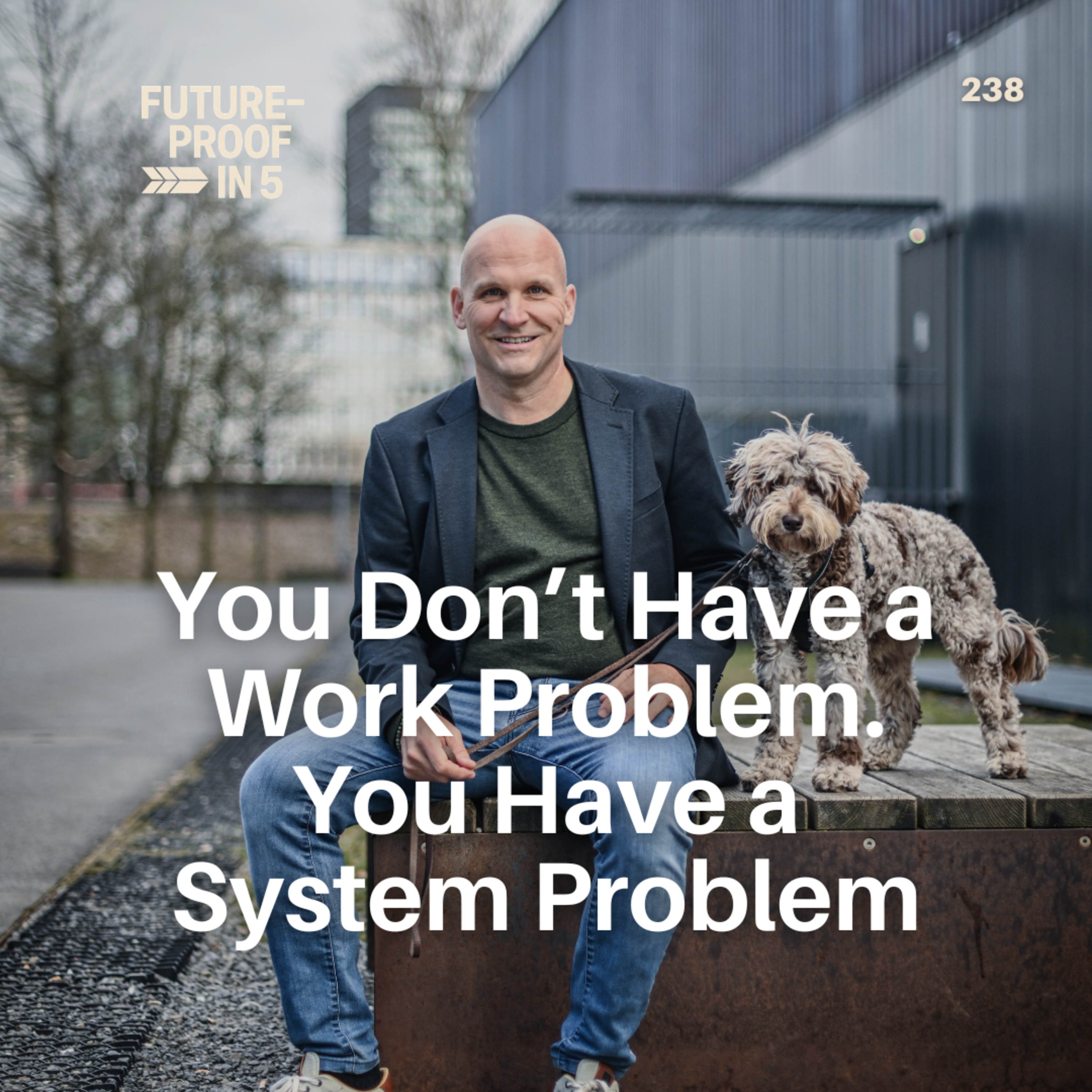
238 - You Don’t Have a Work Problem. You Have a System Problem.
from Future Proof in 5 by Marco Grüter · host Marco Grueter
Most founders misdiagnose their situation.They look at long hours, constant pressure, and decision fatigue, and assume the issue is personal. They think they need better productivity, stronger discipline, or more efficient routines.That is the wrong conclusion.The real issue is structural.When a business is designed in a way that routes every meaningful decision through the founder, overload is inevitable. Not because the founder is incapable, but because the system requires their constant involvement to function.This creates a hidden trap: success increases dependency.As the business grows, so does complexity. More clients lead to more exceptions. More team members create more coordination. More revenue generates more decisions. Without intentional design, all of that complexity flows upward to one person.The founder.What looks like growth is often just an expansion of responsibility concentrated at the top.This is why working harder never solves the problem. More effort only feeds a system that is already dependent on you. It may temporarily keep things moving, but it reinforces the very structure that causes the overload.The solution is not optimization. It is a redesign.A business that scales sustainably is built on clear architecture. Decision-making is distributed. Roles are defined by ownership, not escalation. Systems handle the predictable so people can focus on the exceptional.The shift is from being the center of the business to being the designer of it.A practical way to begin is with a simple diagnostic:Remove yourself from the business for a week—hypothetically.What breaks?Where do decisions stall?Where does progress stop?Where do clients or team members default back to you?This exercise reveals your structural dependencies.Each item on that list is not a failure. It is a signal. A precise indicator of where the system relies on you instead of operating independently.That list becomes your roadmap.Instead of asking, “How can I handle more?”The better question is, “Why does this require me at all?”This is the work that separates operators from architects.And ultimately, it is what transforms a business that depends on you into one that creates freedom, scalability, and long-term value.Highlights:00:00 The System Eats Time00:20 Growth Creates Complexity00:29 You’re Good Not Weak00:40 Redesign the Business00:47 One Week Disappearance Test00:57 Map Structural DependenciesLinks:Website: https://www.marcogrueter.com/LinkedIn: https://www.linkedin.com/in/marcogrueter/
Embed this episode
NOW PLAYING
238 - You Don’t Have a Work Problem. You Have a System Problem.
No transcript for this episode yet
Similar Episodes
No similar episodes found.
Similar Podcasts
No similar podcasts found.