
EPISODE · Feb 29, 2024 · 1H 54M
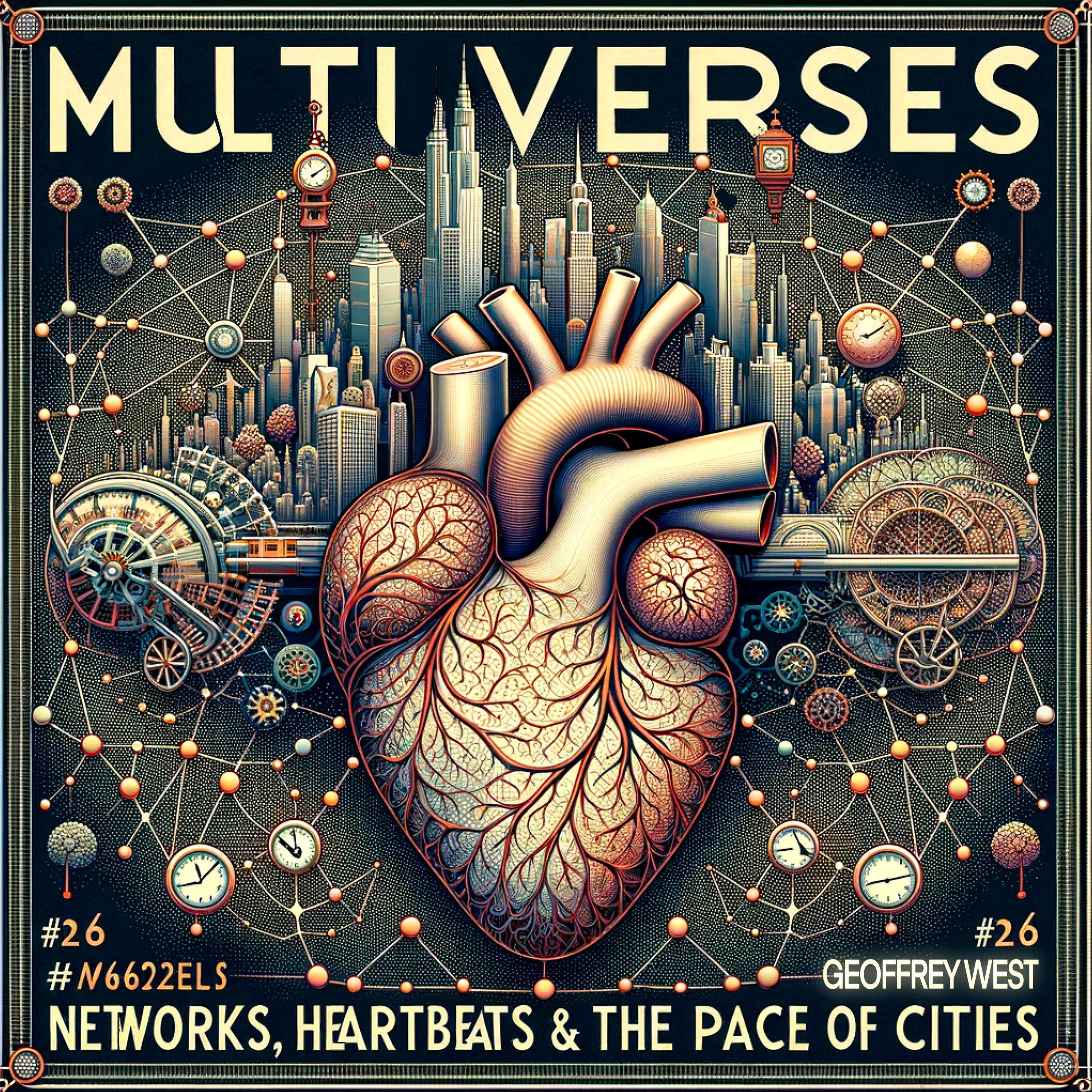
26| Networks, Heartbeats & the Pace of Cities — Geoffrey West
from MULTIVERSES · host James Robinson
Why do whales live longer than hummingbirds? What makes megacities more energy efficient than towns? Is the rate of technological innovation sustainable? Though apparently disparate the answer to these questions can be found in the work of theoretical physicist Geoffrey West. Geoffrey is Shannan Distinguished Professor at the Santa Fe Institute where he was formerly the president. By looking at the network structure of organisms, cities, and companies Geoffrey was able to explain mathematically the peculiar ways in which many features scale. For example, the California Sea Lion weighs twice as much as an Emperor Penguin, but it only consumes 75% more energy. This sub-linear scaling is incredibly regular, following the same pattern across many species and an epic range of sizes. This is an example of a scaling law. The heart of the explanation is this: optimal space-filling networks are fractal-like in nature and scale as if they acquire an extra dimension. A 3D fractal network scales as if it is 4D. Geoffrey's web page Geoffrey's book: ScaleChapters(00:00) Introduction(02:56) Start of conversation: Geoffrey's Career Journey(03:25) Transition from High Energy Physics to Biology(09:05) Exploring the Origin of Aging and Death(11:20) Discovering Scaling Laws in Biology(12:30) Understanding the Metabolic Rate and its Scaling(25:40) The Impact of the Molecular Revolution on Biology(28:39) The Role of Networks in Biological Systems(49:07) The Connection between Fractals and Biological Systems(01:00:29) Understanding the Growth and Supply of Cells(01:01:07) The Impact of Size on Energy Consumption(01:01:46) The Role of Networks in Growth and Supply(01:02:30) The Universality of Growth in Organisms(01:03:13) Exploring the Dynamics of Cities(01:06:12) The Scaling of Infrastructure and Socioeconomic Factors in Cities(01:07:36) The Implications of Superlinear Scaling in Cities(01:11:50) The Future of Cities and the Need for Innovation
What this episode covers
Why do whales live longer than hummingbirds? What makes megacities more energy efficient than towns? Is the rate of technological innovation sustainable? Though apparently disparate the answer to these questions can be found in the work of theoretical physicist Geoffrey West. Geoffrey is Shannan Distinguished Professor at the Santa Fe Institute where he was formerly the president. By looking at the network structure of organisms, cities, and companies Geoffrey was able to explain mathematically the peculiar ways in which many features scale. For example, the California Sea Lion weighs twice as much as an Emperor Penguin, but it only consumes 75% more energy. This sub-linear scaling is incredibly regular, following the same pattern across many species and an epic range of sizes. This is an example of a scaling law. The heart of the explanation is this: optimal space-filling networks are fractal-like in nature and scale as if they acquire an extra dimension. A 3D fractal network scales as if it is 4D. * Geoffrey's web page [https://www.santafe.edu/people/profile/geoffrey-west] * Geoffrey's book: Scale [https://www.amazon.co.uk/Scale-Universal-Organisms-Cities-Companies/dp/1780225598] Chapters (00:00) Introduction (02:56) Start of conversation: Geoffrey's Career Journey (03:25) Transition from High Energy Physics to Biology (09:05) Exploring the Origin of Aging and Death (11:20) Discovering Scaling Laws in Biology (12:30) Understanding the Metabolic Rate and its Scaling (25:40) The Impact of the Molecular Revolution on Biology (28:39) The Role of Networks in Biological Systems (49:07) The Connection between Fractals and Biological Systems (01:00:29) Understanding the Growth and Supply of Cells (01:01:07) The Impact of Size on Energy Consumption (01:01:46) The Role of Networks in Growth and Supply (01:02:30) The Universality of Growth in Organisms (01:03:13) Exploring the Dynamics of Cities (01:06:12) The Scaling of Infrastructure and Socioeconomic Factors in Cities (01:07:36) The Implications of Superlinear Scaling in Cities (01:11:50) The Future of Cities and the Need for Innovation
NOW PLAYING
26| Networks, Heartbeats & the Pace of Cities — Geoffrey West
No transcript for this episode yet
Similar Episodes
Jun 18, 2026 ·71m
Jun 4, 2026 ·67m
May 28, 2026 ·83m
May 21, 2026 ·70m
May 7, 2026 ·92m
Apr 29, 2026 ·81m