
EPISODE · Jul 23, 2025 · 13 MIN
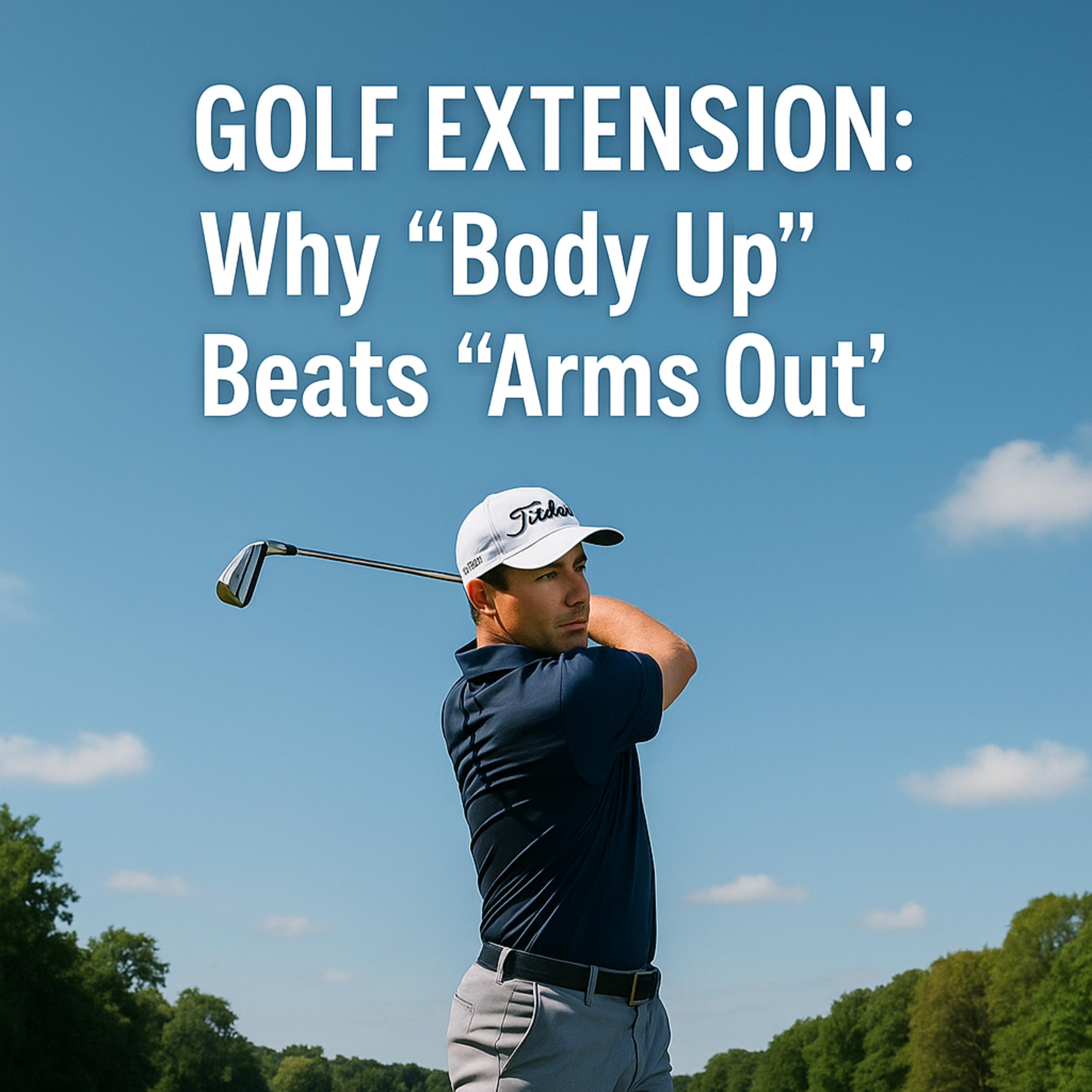
#293 Golf Extension: Why “Body Up” Beats “Arms Out”
from Golf 247.eu: The Global Platform for Innovative Technologies and Teaching Concepts. · host Golf247.eu
One of the most misunderstood aspects of the golf swing is post-impact extension. Recreational players often try to mimic the look of elite golfers by forcing their arms straight after impact—only to end up with a hunched posture and mishits. But true extension doesn’t start with the arms. It begins deep in the body.Modern motion analysis shows that consistent extension is not created by actively pushing the arms out. It’s the result of correct sequencing—particularly the upward and rotational movement of the pelvis and torso through and after impact.Here’s how natural extension really happens:Pelvis Movement: As the swing transitions past impact, the pelvis must tuck and rise, with the belt buckle pointing over the lead toe and slightly upward. This creates space and rotational freedom.Lead Leg Extension: The lead leg straightens, contributing to upward motion.Torso Rotation and Lift: The chest and torso rotate and lift. This lifts the arms—not by force, but through body motion.Arm-Body Sync: The arms remain under the chest and follow the body’s upward path, preventing “chicken-winging” or early flipping.This motion is often misunderstood. Many golfers fear “coming up” through the shot, wrongly assuming that lifting causes mishits. The truth is the opposite: upward movement is essential for clean contact and dynamic extension. Staying bent forward too long after impact leads to a collapsed finish—the infamous “bird-dog” look.Compare elite players with amateurs: professionals show rising pelvis and chest movement through impact, with hands staying below the chest. Amateurs often lock their trail hip and knee back, keeping the pelvis down while the arms lift alone—a "fake extension" that breaks the arm-body connection.This is like trying to stand up without using your legs. If the lower body doesn’t rise, the upper body remains hunched. Similarly, if the pelvis and torso don’t lift and rotate, the arms cannot stretch out naturally.Key obstacles to proper extension include:Holding forward spine bend too longFear of lifting through impactLack of upward pelvic and torso movementTrail hip and knee staying locked backAbsence of diagonal stretch (trail thigh to lead shoulder)Poor mobility in hips and coreForcing extension with the armsThink of a dancer performing a pirouette: they don’t push their arms out. Their core movement creates centrifugal force, and the arms follow. In golf, extension is not created—it’s allowed, by letting the body lead.Great extension is a hallmark of high-level golf—and one of the few non-negotiables in an elite swing. It powers both full swings and finesse shots. Trying to fake it with the arms is chasing a look, not a movement. Learn to move the body upward and around, and the arms will follow—naturally, powerfully, and beautifully.www.Golf247.eu
Embed this episode
NOW PLAYING
#293 Golf Extension: Why “Body Up” Beats “Arms Out”
No transcript for this episode yet
Similar Episodes
No similar episodes found.
Similar Podcasts
No similar podcasts found.