
EPISODE · Jan 4, 2026 · 4 MIN
3.1 Introduction to the Early Modern Period
from A brief history of AI from ancient times to the present day · host Kristy Anamoutou
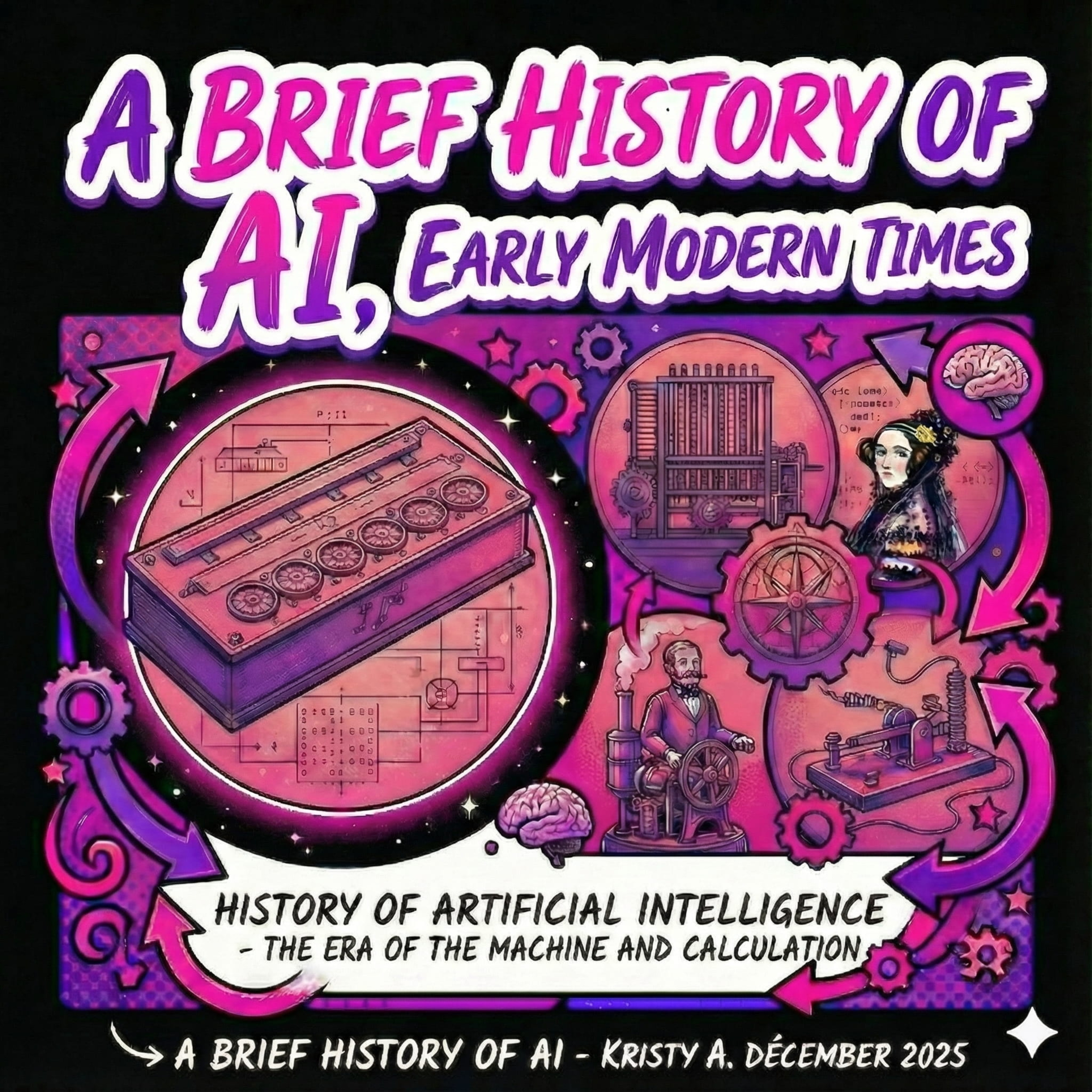
The Age of Encounters: How the Early Modern Period Formulated the Program of Artificial IntelligenceIn 1703, Gottfried Wilhelm Leibniz published an article on binary arithmetic—that system of zeros and ones upon which all our computers rest today. The same year, a French Jesuit in China revealed a troubling coincidence: the hexagrams of the I Ching, three millennia old, formed exactly the same system. Two traditions separated by oceans and millennia arrived at the same structure. It was neither transmission nor chance. It was a mirror.In this new season of Avalon, we enter the Early Modern Period—from 1492 to 1789, from the discovery of the New World to the French Revolution. Three centuries when, for the first time, civilizations that had developed separately found themselves face to face.You will meet Matteo Ricci, that Italian Jesuit who learned Chinese to teach Euclid to the Emperor of China. Tupaia, that Polynesian navigator who boarded Cook's ship with a mental map of one hundred thirty islands. Seki Takakazu, that Japanese mathematician who discovered the same theorems as Leibniz without ever having heard of him.You will discover how Descartes posed the question that still haunts artificial intelligence: can one distinguish an automaton from a thinking being? How Pascal built the first commercially viable calculating machine. How Vaucanson created a mechanical duck capable of digesting—and a flute player capable of modulating its breath.You will explore the colonial archives of Mexico, where fragments of philosophies interrupted by conquest lie dormant. The ruins of Istanbul's observatory, destroyed three years after its completion by religious authorities' decree. The libraries of the Malian desert, where seven hundred thousand manuscripts await translation.The Early Modern Period was the era of encounters—successful and missed. Bridges were built between civilizations. Windows closed at the wrong moment. Knowledge was translated; other knowledge was lost forever.The artificial intelligence we are building today is the fruit of these three centuries of encounters and misunderstandings. It carries within it the questions of Descartes and the blind spots of Cook. It speaks the languages that were written, not those that were sung.Welcome to A Brief History of AI, Season 3.
What this episode covers
The Age of Encounters: How the Early Modern Period Formulated the Program of Artificial IntelligenceIn 1703, Gottfried Wilhelm Leibniz published an article on binary arithmetic—that system of zeros and ones upon which all our computers rest today. The same year, a French Jesuit in China revealed a troubling coincidence: the hexagrams of the I Ching, three millennia old, formed exactly the same system. Two traditions separated by oceans and millennia arrived at the same structure. It was neither transmission nor chance. It was a mirror.In this new season of Avalon, we enter the Early Modern Period—from 1492 to 1789, from the discovery of the New World to the French Revolution. Three centuries when, for the first time, civilizations that had developed separately found themselves face to face.You will meet Matteo Ricci, that Italian Jesuit who learned Chinese to teach Euclid to the Emperor of China. Tupaia, that Polynesian navigator who boarded Cook's ship with a mental map of one hundred thirty islands. Seki Takakazu, that Japanese mathematician who discovered the same theorems as Leibniz without ever having heard of him.You will discover how Descartes posed the question that still haunts artificial intelligence: can one distinguish an automaton from a thinking being? How Pascal built the first commercially viable calculating machine. How Vaucanson created a mechanical duck capable of digesting—and a flute player capable of modulating its breath.You will explore the colonial archives of Mexico, where fragments of philosophies interrupted by conquest lie dormant. The ruins of Istanbul's observatory, destroyed three years after its completion by religious authorities' decree. The libraries of the Malian desert, where seven hundred thousand manuscripts await translation.The Early Modern Period was the era of encounters—successful and missed. Bridges were built between civilizations. Windows closed at the wrong moment. Knowledge was translated; other knowledge was lost forever.The artificial intelligence we are building today is the fruit of these three centuries of encounters and misunderstandings. It carries within it the questions of Descartes and the blind spots of Cook. It speaks the languages that were written, not those that were sung.Welcome to A Brief History of AI, Season 3.
NOW PLAYING
3.1 Introduction to the Early Modern Period
No transcript for this episode yet
Similar Episodes
Mar 26, 2026 ·1m
Mar 19, 2026 ·34m
Feb 18, 2026 ·11m
Feb 11, 2026 ·45m