
EPISODE · Jan 4, 2026 · 23 MIN
3.5 Europe — Clocks of the Soul
from A brief history of AI from ancient times to the present day · host Kristy Anamoutou
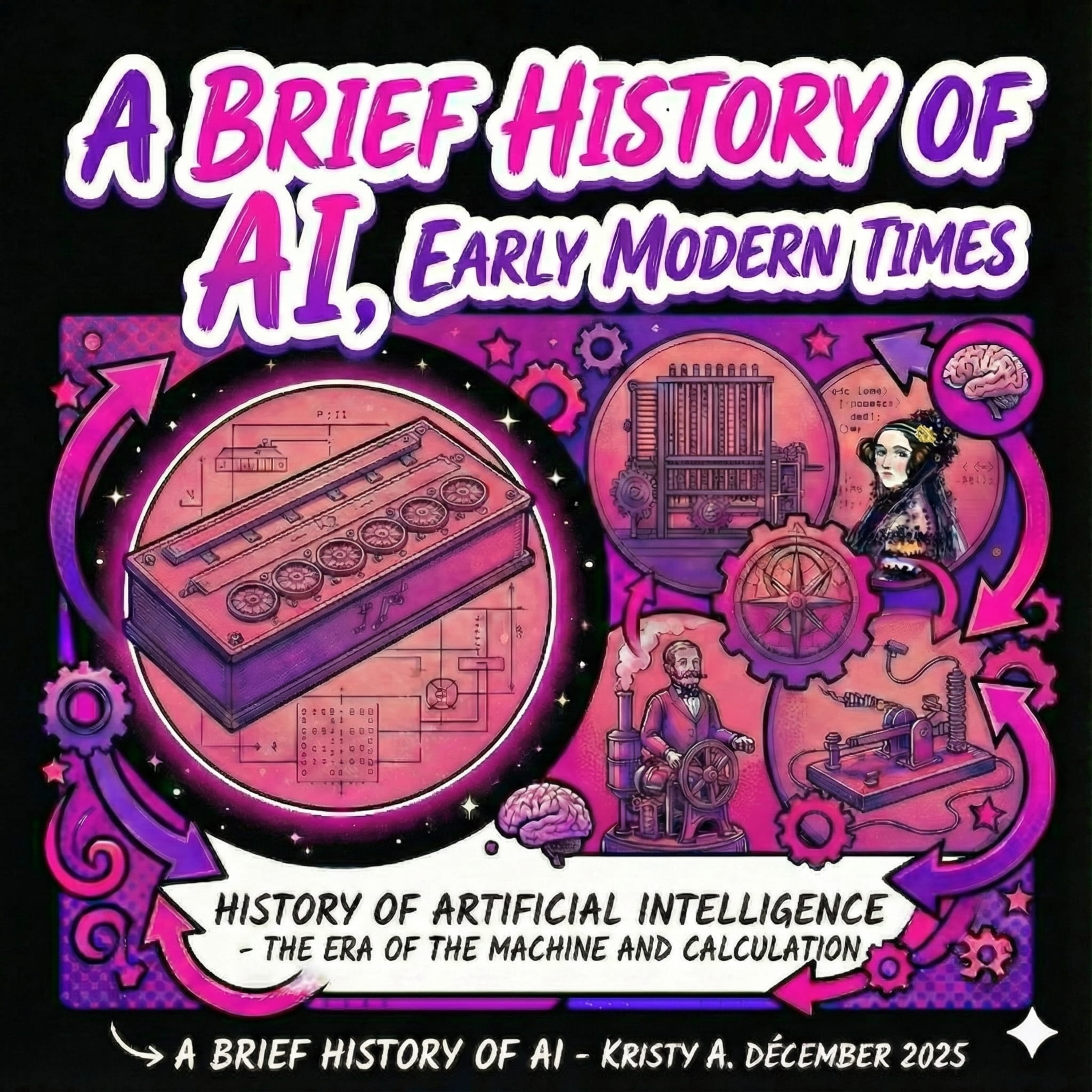
Clocks of the Soul: How Early Modern Europe Formulated the Program of Artificial IntelligenceA clock can measure time. But can it think?In this episode, we discover how Early Modern Europe dared a vertiginous question—and built the conceptual framework that would one day make artificial intelligence thinkable.In 1637, René Descartes published the Discourse on Method. He declared animals to be pure machines—automata of flesh incapable of true thought. And he proposed two criteria to distinguish man from automaton: language and universal reason. These criteria strangely resemble the Turing test and the dream of artificial general intelligence.You will meet Thomas Hobbes, who declared in 1651 that "reason is nothing but reckoning." Gottfried Wilhelm Leibniz, who dreamed of a characteristica universalis—a formal language capable of expressing all thought—and a calculus ratiocinator—a reasoning machine that would resolve disputes through calculation. "Calculemus!"—Let us calculate!—such was his program.You will discover Blaise Pascal, who built at nineteen the Pascaline—the first commercially viable calculating machine. Jacques de Vaucanson, whose mechanical flute player modulated its breath like a living musician. Pierre Jaquet-Droz, whose Writer could be programmed to write any text of forty characters—the first programmable computer in history, according to some historians.And Wolfgang von Kempelen's Mechanical Turk—that chess-playing automaton that defeated Napoleon and Benjamin Franklin. It was a hoax: a hidden human manipulated the machine. But the question it posed was sincere: can one distinguish real intelligence from simulated intelligence?Early Modern Europe did not merely build machines. It built the conceptual framework of artificial intelligence—with its assumptions, its ambitions, and its blind spots. Descartes' dualism, Hobbes' mechanism, Leibniz's rationalism: these ideas still structure how we think about AI.The clocks of the soul have become silicon computers. The question remains.
What this episode covers
Clocks of the Soul: How Early Modern Europe Formulated the Program of Artificial IntelligenceA clock can measure time. But can it think?In this episode, we discover how Early Modern Europe dared a vertiginous question—and built the conceptual framework that would one day make artificial intelligence thinkable.In 1637, René Descartes published the Discourse on Method. He declared animals to be pure machines—automata of flesh incapable of true thought. And he proposed two criteria to distinguish man from automaton: language and universal reason. These criteria strangely resemble the Turing test and the dream of artificial general intelligence.You will meet Thomas Hobbes, who declared in 1651 that "reason is nothing but reckoning." Gottfried Wilhelm Leibniz, who dreamed of a characteristica universalis—a formal language capable of expressing all thought—and a calculus ratiocinator—a reasoning machine that would resolve disputes through calculation. "Calculemus!"—Let us calculate!—such was his program.You will discover Blaise Pascal, who built at nineteen the Pascaline—the first commercially viable calculating machine. Jacques de Vaucanson, whose mechanical flute player modulated its breath like a living musician. Pierre Jaquet-Droz, whose Writer could be programmed to write any text of forty characters—the first programmable computer in history, according to some historians.And Wolfgang von Kempelen's Mechanical Turk—that chess-playing automaton that defeated Napoleon and Benjamin Franklin. It was a hoax: a hidden human manipulated the machine. But the question it posed was sincere: can one distinguish real intelligence from simulated intelligence?Early Modern Europe did not merely build machines. It built the conceptual framework of artificial intelligence—with its assumptions, its ambitions, and its blind spots. Descartes' dualism, Hobbes' mechanism, Leibniz's rationalism: these ideas still structure how we think about AI.The clocks of the soul have become silicon computers. The question remains.
NOW PLAYING
3.5 Europe — Clocks of the Soul
No transcript for this episode yet
Similar Episodes
Mar 26, 2026 ·1m
Mar 19, 2026 ·34m
Feb 18, 2026 ·11m
Feb 11, 2026 ·45m