#322 Fixing Golf Casting: Backswing Secrets Revealed episode artwork

EPISODE · Aug 21, 2025 · 9 MIN

#322 Fixing Golf Casting: Backswing Secrets Revealed

from Golf 247.eu: The Global Platform for Innovative Technologies and Teaching Concepts. · host Golf247.eu

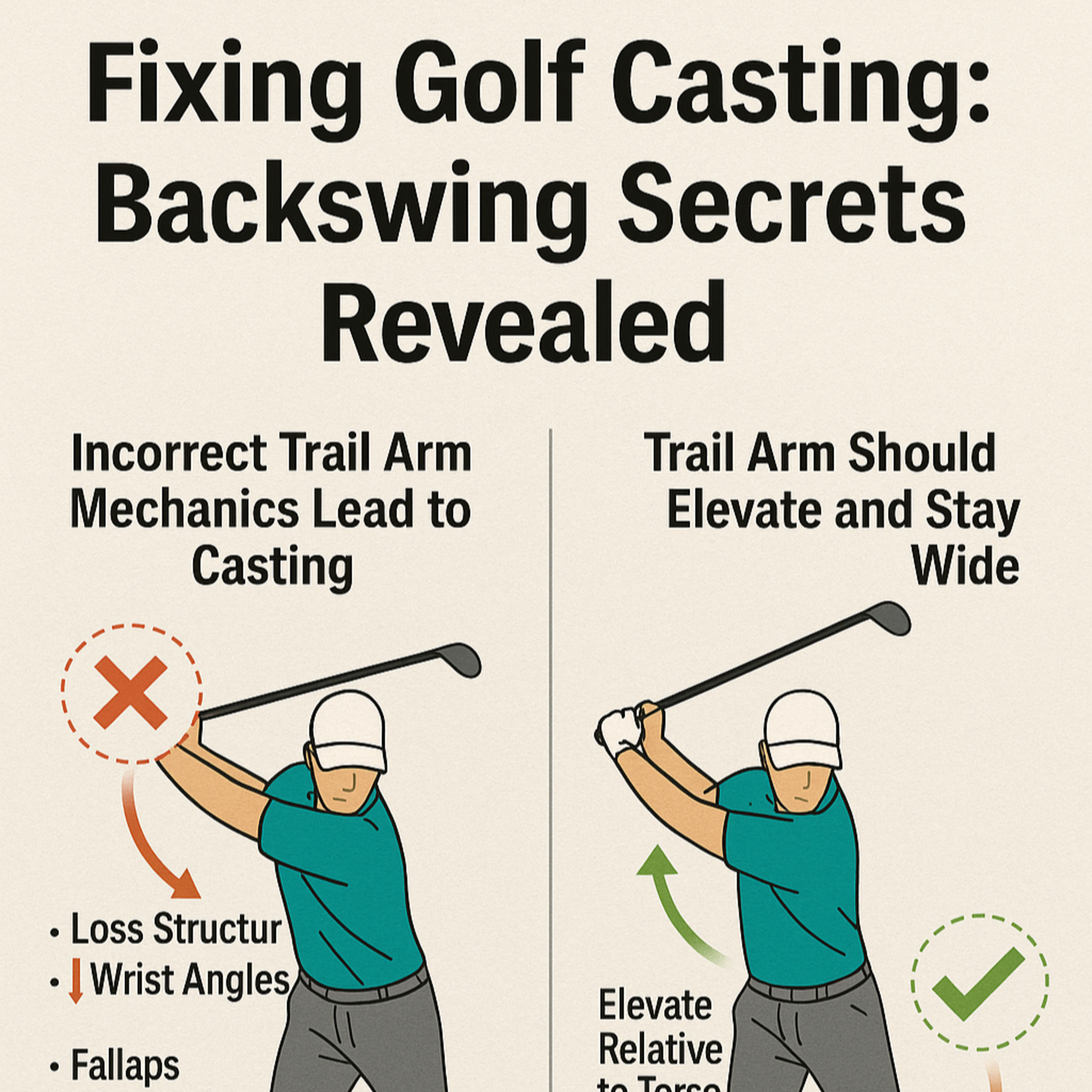
One of the most persistent faults in amateur golf is casting — the premature release of the club during the downswing. Traditionally, players and instructors have tried to solve this problem in the downswing itself. But what if the real culprit lies much earlier in the motion? According to top biomechanics experts and world-class coaches, the foundation of this flaw is most often rooted in the backswing. And more specifically, in the trail arm.The Casting Problem: Not What It SeemsCasting occurs when the wrists unhinge too early in the downswing, causing a loss of lag and a steep, weak impact position. Many golfers try to "hold their angles" longer, but this is often a band-aid solution. The true problem begins when the trail arm drops or collapses behind the body during the backswing. This seemingly minor breakdown in structure creates a chain reaction that leads to early release.Why the Trail Arm Is So ImportantWhen the trail arm lowers behind the torso instead of elevating, the body loses its spatial structure. This narrowing causes the wrists to unhinge prematurely, robbing the golfer of compression, distance, and consistency. It also throws off the entire kinetic chain, from torso rotation to wrist dynamics.Common Mistakes That Lead to CastingDropping the Trail Arm: Instead of staying elevated and wide, the arm collapses inward.Narrow Structure: With the trail arm tucked, the swing becomes compact and behind-the-body.Early Wrist Unhinging: The collapse leads to a loss of the crucial lag angle.Chain Reaction: Poor trail arm mechanics force a cast before the downswing even begins.Compensatory Movements: Players often tilt, slide, or over-rotate to "complete the turn," which only makes timing and sequencing worse.Butch Harmon’s Head Circle TestButch Harmon often uses a simple but powerful visual cue. Imagine a circle around your head during the backswing. If your hands move inside that circle, especially your trail hand, it’s a sign your trail arm is retracting too much. This over-retraction sets you up to cast.How It Should Look: The Professional ModelElevated Arm Path: The trail arm must lift relative to the torso, not drop behind it.Maintain Width: Keep arms away from the body throughout the motion.Hands Outside the Head: From a face-on view, your hands should stay outside your head throughout the backswing.Stable Wrist Angles: An elevated and structured arm path maintains the angles needed for a powerful release.The Drill That Fixes It All: Wide Arm Backswing DrillThis simple drill directly addresses the trail arm problem and encourages lag-friendly wrist mechanics.How to Do It:Grip the club with your hands shoulder-width apart.Use your torso and hips (not your arms) to lift the club into the backswing.Keep your trail arm wide and elevated. Ensure your hands remain outside your head.At the top, slide your hands together.Transition into a smooth downswing.Why It Works:Corrects Trail Arm Collapse: Forces width and elevation.Promotes Proper Sequence: Encourages torso-driven motion.Reinforces Wrist Angles: Helps maintain lag naturally.Improves Impact: Leads to better shaft lean, compression, and ball control.Immediate Benefits You’ll NoticeGolfers who perform this drill correctly often report a noticeable improvement in ball striking after just a few sessions. By fixing the trail arm path, they eliminate the need to force lag later in the swing. Instead, the lag happens naturally because the wrists are never set up to fail.Final ThoughtsThe next time you notice casting in your swing, don’t just focus on the release. Take a step back. Look at what your trail arm is doing in the takeaway and backswing. Chances are, that’s where the problem began.A structured, elevated trail arm not only fixes casting — it sets up a more powerful, efficient, and consistent golf swing.www.Golf247.eu

One of the most persistent faults in amateur golf is casting — the premature release of the club during the downswing. Traditionally, players and instructors have tried to solve this problem in the downswing itself. But what if the real culprit lies much earlier in the motion? According to top biomechanics experts and world-class coaches, the foundation of this flaw is most often rooted in the backswing. And more specifically, in the trail arm.The Casting Problem: Not What It SeemsCasting occurs when the wrists unhinge too early in the downswing, causing a loss of lag and a steep, weak impact position. Many golfers try to "hold their angles" longer, but this is often a band-aid solution. The true problem begins when the trail arm drops or collapses behind the body during the backswing. This seemingly minor breakdown in structure creates a chain reaction that leads to early release.Why the Trail Arm Is So ImportantWhen the trail arm lowers behind the torso instead of elevating, the body loses its spatial structure. This narrowing causes the wrists to unhinge prematurely, robbing the golfer of compression, distance, and consistency. It also throws off the entire kinetic chain, from torso rotation to wrist dynamics.Common Mistakes That Lead to CastingDropping the Trail Arm: Instead of staying elevated and wide, the arm collapses inward.Narrow Structure: With the trail arm tucked, the swing becomes compact and behind-the-body.Early Wrist Unhinging: The collapse leads to a loss of the crucial lag angle.Chain Reaction: Poor trail arm mechanics force a cast before the downswing even begins.Compensatory Movements: Players often tilt, slide, or over-rotate to "complete the turn," which only makes timing and sequencing worse.Butch Harmon’s Head Circle TestButch Harmon often uses a simple but powerful visual cue. Imagine a circle around your head during the backswing. If your hands move inside that circle, especially your trail hand, it’s a sign your trail arm is retracting too much. This over-retraction sets you up to cast.How It Should Look: The Professional ModelElevated Arm Path: The trail arm must lift relative to the torso, not drop behind it.Maintain Width: Keep arms away from the body throughout the motion.Hands Outside the Head: From a face-on view, your hands should stay outside your head throughout the backswing.Stable Wrist Angles: An elevated and structured arm path maintains the angles needed for a powerful release.The Drill That Fixes It All: Wide Arm Backswing DrillThis simple drill directly addresses the trail arm problem and encourages lag-friendly wrist mechanics.How to Do It:Grip the club with your hands shoulder-width apart.Use your torso and hips (not your arms) to lift the club into the backswing.Keep your trail arm wide and elevated. Ensure your hands remain outside your head.At the top, slide your hands together.Transition into a smooth downswing.Why It Works:Corrects Trail Arm Collapse: Forces width and elevation.Promotes Proper Sequence: Encourages torso-driven motion.Reinforces Wrist Angles: Helps maintain lag naturally.Improves Impact: Leads to better shaft lean, compression, and ball control.Immediate Benefits You’ll NoticeGolfers who perform this drill correctly often report a noticeable improvement in ball striking after just a few sessions. By fixing the trail arm path, they eliminate the need to force lag later in the swing. Instead, the lag happens naturally because the wrists are never set up to fail.Final ThoughtsThe next time you notice casting in your swing, don’t just focus on the release. Take a step back. Look at what your trail arm is doing in the takeaway and backswing. Chances are, that’s where the problem began.A structured, elevated trail arm not only fixes casting — it sets up a more powerful, efficient, and consistent golf swing.www.Golf247.eu

NOW PLAYING

#322 Fixing Golf Casting: Backswing Secrets Revealed

0:00 9:05

No transcript for this episode yet

We transcribe on demand. Request one and we'll notify you when it's ready — usually under 10 minutes.

Frequently Asked Questions

How long is this episode of Golf 247.eu: The Global Platform for Innovative Technologies and Teaching Concepts.?

This episode is 9 minutes long.

When was this Golf 247.eu: The Global Platform for Innovative Technologies and Teaching Concepts. episode published?

This episode was published on August 21, 2025.

What is this episode about?

One of the most persistent faults in amateur golf is casting — the premature release of the club during the downswing. Traditionally, players and instructors have tried to solve this problem in the downswing itself. But what if the real culprit lies...

Can I download this Golf 247.eu: The Global Platform for Innovative Technologies and Teaching Concepts. episode?

Yes, you can download this episode by clicking the download button on the episode player, or subscribe to the podcast in your preferred podcast app for automatic downloads.
URL copied to clipboard!