
EPISODE · Nov 4, 2025 · 13 MIN
#397 The Biomechanics of a Consistent Putting Stroke
from Golf 247.eu: The Global Platform for Innovative Technologies and Teaching Concepts. · host Golf247.eu
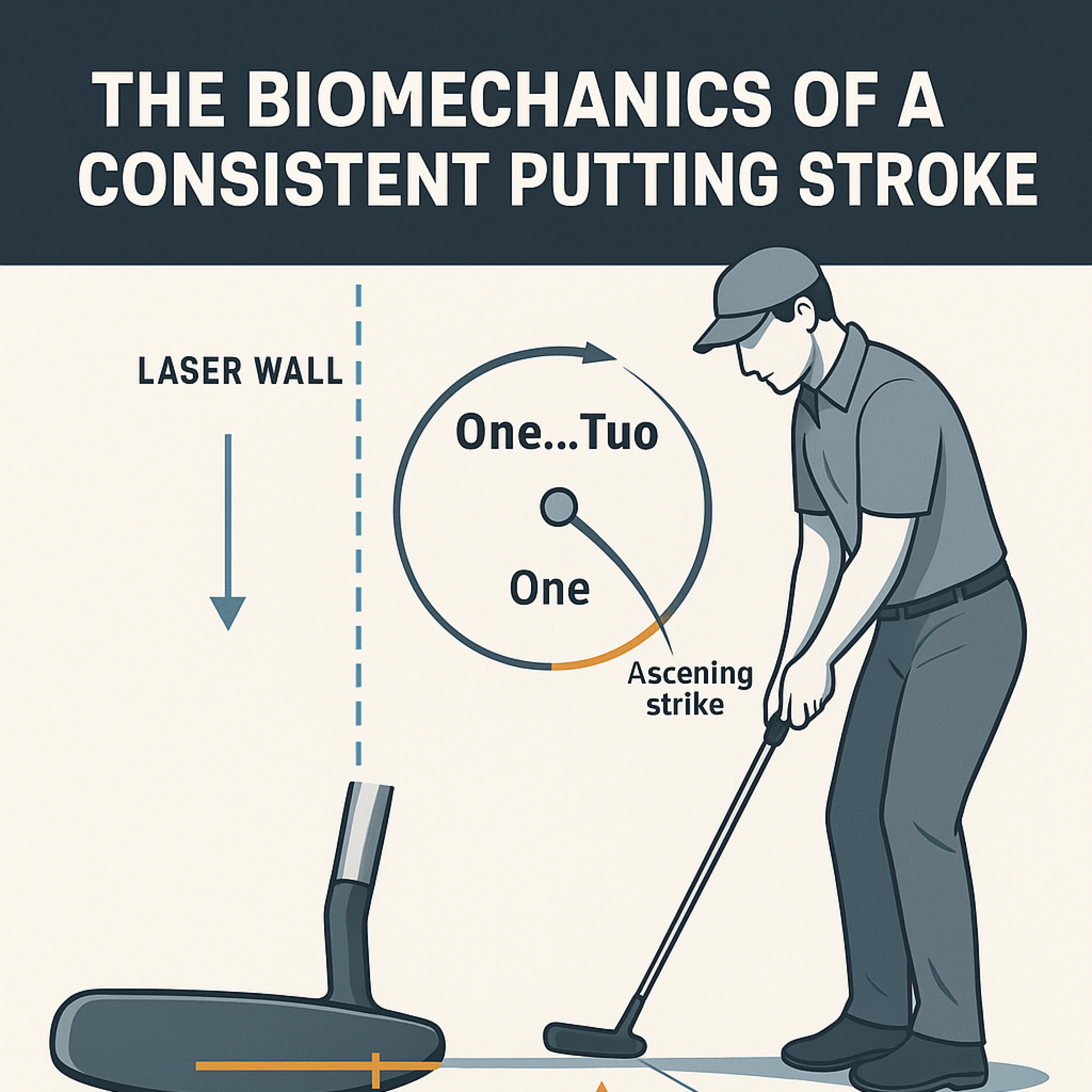
A successful putting stroke begins long before contact. One key setup detail is placing the putter head half a finger-width behind the ball. This pre-impact spacing acts as an insurance policy, helping the player swing through the ball, not just at it. It promotes a neutral path and prevents last-moment deceleration or face manipulation, improving pace and direction.Body Movement: The Laser WallImagine a vertical laser wall running through the center of your body. During the stroke, the body must remain stable—especially at impact. For right-handed players, the left shoulder rises, and the body subtly shifts right, avoiding lateral motion. This movement stabilizes face control and supports a natural arc.Ball Position and LaunchBall position should be slightly forward of center, allowing an ascending strike. This minimizes skid and airborne motion. The golden rule: skid + flight should not exceed 10% of the putt’s length. On a 10 m putt, that’s max. 1 m.Putter Loft and FittingIf your hands lean forward at impact, you’ll need more loft. If your hands are neutral, less loft may be better. Misfit loft leads to bouncing or trapping the ball. Tools like Quintic or Puttalyze help optimize your loft by analyzing launch angle, dynamic loft, and skid distance.2:1 Rhythm for Distance ControlThe ideal putting tempo follows a 2:1 rhythm:“One…Two” for backswing“One” for forward strokeThis rhythm stabilizes tempo, reduces acceleration errors, and improves distance control. A longer backswing = longer putt. A shorter backswing = shorter putt. The force doesn't change—rhythm governs distance.Final NoteThe 2:1 model is rooted in physics: 18th-century scientists used pendulum motion to define the meter. While minor gravity variations exist (e.g., Amsterdam vs. Mexico City), they’re negligible in putting. What matters most is developing a repeatable, internal rhythm.📺 The Explainerwww.Golf247.eu
Embed this episode
NOW PLAYING
#397 The Biomechanics of a Consistent Putting Stroke
No transcript for this episode yet
Similar Episodes
No similar episodes found.
Similar Podcasts
No similar podcasts found.