#406 Putter Loft: Impact on Roll and Performance episode artwork

EPISODE · Nov 13, 2025 · 15 MIN

#406 Putter Loft: Impact on Roll and Performance

from Golf 247.eu: The Global Platform for Innovative Technologies and Teaching Concepts. · host Golf247.eu

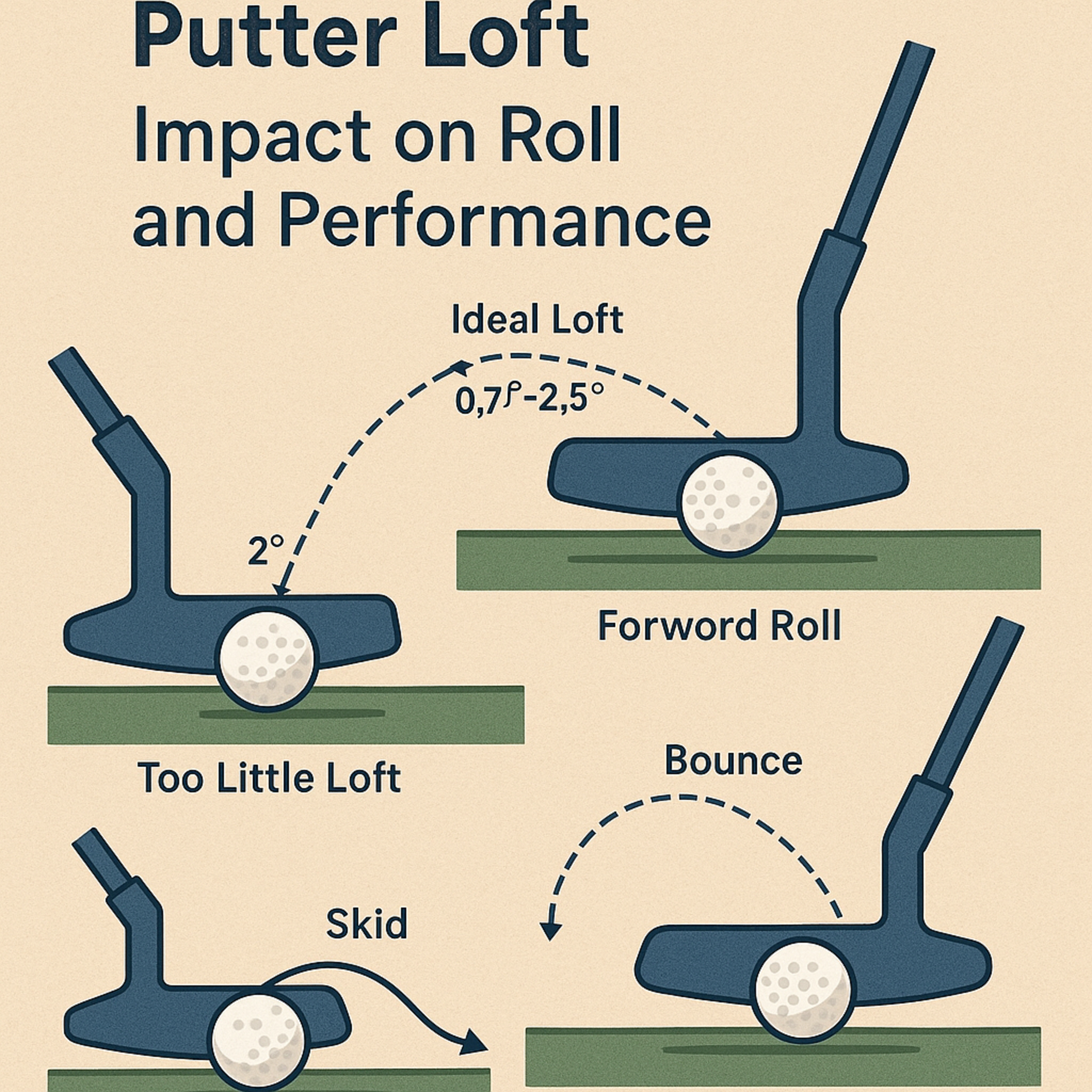
Putter loft—the face angle relative to vertical, usually 2°–4°—plays a decisive role in how the ball launches and rolls. Its goal is not to lift the ball but to raise it slightly from its green depression and start smooth forward roll as early as possible. Wrong loft—too little or too much—causes skidding, bouncing, and loss of distance and direction control.Function and Ideal RangeLoft controls launch angle and determines when the ball transitions from skid to roll. The ideal launch angle is narrow: 0.75°–2.5°. Too little loft (<1°) keeps the ball in its depression, producing long skid and “wobble.” Too much loft (>4°) lifts it too high, causing hop and bounce. The result in both cases is unstable roll and inconsistent pace.Dynamic Loft and FittingThe effective loft delivered at impact depends on stroke mechanics:Forward Press / Shaft Lean: De-lofts the putter; requires more static loft.Ball Back in Stance: De-lofts the face; needs more static loft.Green Speed: Fast greens → less loft; slow greens → more loft.Correct fitting measures dynamic loft at impact, not just static loft. Tools analyzing launch, skid, and roll phases help match loft precisely to each golfer’s stroke.Roll DynamicsOptimal loft achieves three effects:Lift – Raises the ball cleanly from its “nest.”Launch Control – Creates ideal launch (0.75°–2.5°) without hop or dig.Early True Roll – Minimizes skid and ensures consistent direction and speed.Performance ConsequencesToo Little Loft: Ball skids too long, may dig on soft greens, loses distance and line.Too Much Loft: Ball hops, loses stability, and veers offline—especially on fast greens.Analogy: Putter loft acts like a ramp angle. Too shallow (low loft) scrapes the floor; too steep (high loft) makes the ball bounce. The ideal ramp gives a clean, immediate roll.SummaryCorrect loft—typically 2°–4°, fine-tuned to stroke and green conditions—produces an efficient launch and early pure roll. The smallest deviation outside the 0.75°–2.5° launch window disrupts accuracy, pace, and feel. Proper loft fitting ensures every putt starts true and rolls consistently toward the hole.📺 The Explainerwww.Golf247.eu

Putter loft—the face angle relative to vertical, usually 2°–4°—plays a decisive role in how the ball launches and rolls. Its goal is not to lift the ball but to raise it slightly from its green depression and start smooth forward roll as early as possible. Wrong loft—too little or too much—causes skidding, bouncing, and loss of distance and direction control.Function and Ideal RangeLoft controls launch angle and determines when the ball transitions from skid to roll. The ideal launch angle is narrow: 0.75°–2.5°. Too little loft (<1°) keeps the ball in its depression, producing long skid and “wobble.” Too much loft (>4°) lifts it too high, causing hop and bounce. The result in both cases is unstable roll and inconsistent pace.Dynamic Loft and FittingThe effective loft delivered at impact depends on stroke mechanics:Forward Press / Shaft Lean: De-lofts the putter; requires more static loft.Ball Back in Stance: De-lofts the face; needs more static loft.Green Speed: Fast greens → less loft; slow greens → more loft.Correct fitting measures dynamic loft at impact, not just static loft. Tools analyzing launch, skid, and roll phases help match loft precisely to each golfer’s stroke.Roll DynamicsOptimal loft achieves three effects:Lift – Raises the ball cleanly from its “nest.”Launch Control – Creates ideal launch (0.75°–2.5°) without hop or dig.Early True Roll – Minimizes skid and ensures consistent direction and speed.Performance ConsequencesToo Little Loft: Ball skids too long, may dig on soft greens, loses distance and line.Too Much Loft: Ball hops, loses stability, and veers offline—especially on fast greens.Analogy: Putter loft acts like a ramp angle. Too shallow (low loft) scrapes the floor; too steep (high loft) makes the ball bounce. The ideal ramp gives a clean, immediate roll.SummaryCorrect loft—typically 2°–4°, fine-tuned to stroke and green conditions—produces an efficient launch and early pure roll. The smallest deviation outside the 0.75°–2.5° launch window disrupts accuracy, pace, and feel. Proper loft fitting ensures every putt starts true and rolls consistently toward the hole.📺 The Explainerwww.Golf247.eu

NOW PLAYING

#406 Putter Loft: Impact on Roll and Performance

0:00 15:07

No transcript for this episode yet

We transcribe on demand. Request one and we'll notify you when it's ready — usually under 10 minutes.

Frequently Asked Questions

How long is this episode of Golf 247.eu: The Global Platform for Innovative Technologies and Teaching Concepts.?

This episode is 15 minutes long.

When was this Golf 247.eu: The Global Platform for Innovative Technologies and Teaching Concepts. episode published?

This episode was published on November 13, 2025.

What is this episode about?

Putter loft—the face angle relative to vertical, usually 2°–4°—plays a decisive role in how the ball launches and rolls. Its goal is not to lift the ball but to raise it slightly from its green depression and start smooth forward roll as early as...

Can I download this Golf 247.eu: The Global Platform for Innovative Technologies and Teaching Concepts. episode?

Yes, you can download this episode by clicking the download button on the episode player, or subscribe to the podcast in your preferred podcast app for automatic downloads.
URL copied to clipboard!