
EPISODE · Jan 14, 2026 · 1H 2M
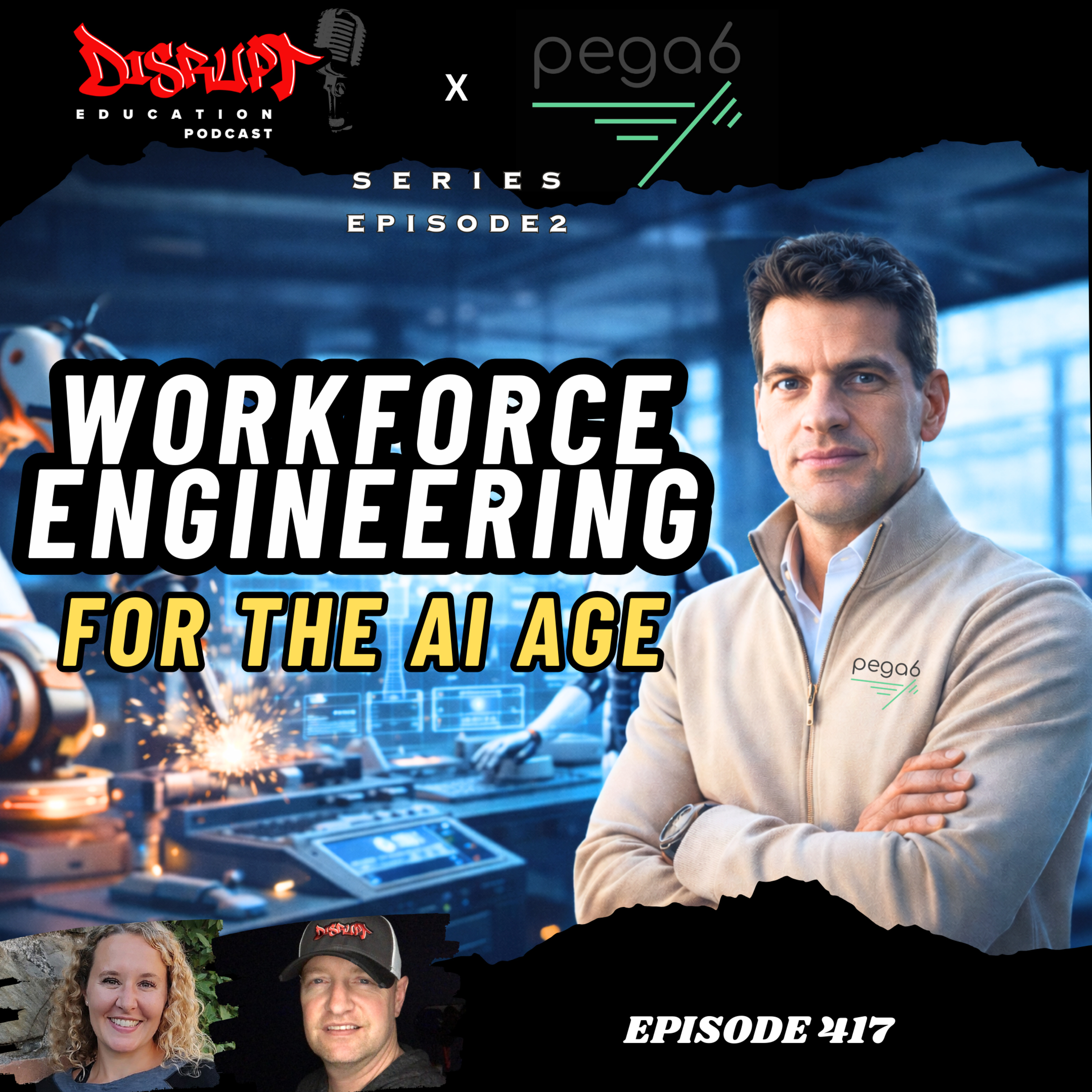
417 Workforce Engineering for the AI Age - pega6 Series Episode 2
from Disrupt Education Podcast · host Disrupt Education Podcast
After lighting up the college model in Episode 1, Peter and Alli come back with the real question: if higher ed is broken… what replaces it? Jeremy Smith (PEGA6 co-founder/CEO) answers with one phrase that frames the entire episode: workforce engineering.Jeremy argues that education shouldn’t be treated like a pipeline where students just get moved along. It should be treated like a supply chain where value is added at every stage—because the goal is not “school completion,” it’s readiness for the next step. And in his model, the customer isn’t the student (even though they pay)—the customer is the employer, because that’s where the best jobs and opportunities get decided.From there, Jeremy breaks “job-ready” into three non-negotiables for the AI age:Technical Skills — not “theory,” but real, usable tools and mechanics of the job (he references things like industry tools and workflows).Soft Skills — communication, professionalism, managing up, teamwork—the things that make people actually promotable and trusted.AI-First Approach — not just knowing AI tools, but thinking AI-first to accelerate work, then finishing with human judgment and technical fundamentals.Then the conversation gets spicy again—in the best way:Jeremy calls out the “college builds critical thinking” claim as a myth, arguing real critical thinking is a concrete set of skills (biases, logic, stats, fallacies) that most students aren’t systematically taught.Alli challenges the framing: “Are we just building workers? What about leaders?” Jeremy’s answer is timing: optimize for the next step first, then build leadership later through real experience (and future “Pegas7”-type progression).Peter hits the big fear word: pigeonholing. Jeremy flips it—being “open to everything” but skilled at nothing isn’t optionality; being skilled creates mobility. And the solution for students who don’t know their path is better “routing” earlier—he directly connects this to aptitude/fit tools like YouScience.The episode ends with a clean cliffhanger: next week they go inside PEGA6—how it’s being built, what the accelerator experience looks like, and how close it is to launch.If you came this far... head to www.pega6.com/dep You won't be disappointed!
What this episode covers
After lighting up the college model in Episode 1, Peter and Alli come back with the real question: if higher ed is broken… what replaces it? Jeremy Smith (PEGA6 co-founder/CEO) answers with one phrase that frames the entire episode: workforce engineering.Jeremy argues that education shouldn’t be treated like a pipeline where students just get moved along. It should be treated like a supply chain where value is added at every stage—because the goal is not “school completion,” it’s readiness for the next step. And in his model, the customer isn’t the student (even though they pay)—the customer is the employer, because that’s where the best jobs and opportunities get decided.From there, Jeremy breaks “job-ready” into three non-negotiables for the AI age:Technical Skills — not “theory,” but real, usable tools and mechanics of the job (he references things like industry tools and workflows).Soft Skills — communication, professionalism, managing up, teamwork—the things that make people actually promotable and trusted.AI-First Approach — not just knowing AI tools, but thinking AI-first to accelerate work, then finishing with human judgment and technical fundamentals.Then the conversation gets spicy again—in the best way:Jeremy calls out the “college builds critical thinking” claim as a myth, arguing real critical thinking is a concrete set of skills (biases, logic, stats, fallacies) that most students aren’t systematically taught.Alli challenges the framing: “Are we just building workers? What about leaders?” Jeremy’s answer is timing: optimize for the next step first, then build leadership later through real experience (and future “Pegas7”-type progression).Peter hits the big fear word: pigeonholing. Jeremy flips it—being “open to everything” but skilled at nothing isn’t optionality; being skilled creates mobility. And the solution for students who don’t know their path is better “routing” earlier—he directly connects this to aptitude/fit tools like YouScience.The episode ends with a clean cliffhanger: next week they go inside PEGA6—how it’s being built, what the accelerator experience looks like, and how close it is to launch.If you came this far... head to www.pega6.com/dep You won't be disappointed!
NOW PLAYING
417 Workforce Engineering for the AI Age - pega6 Series Episode 2
No transcript for this episode yet
Similar Episodes
No similar episodes found.
Similar Podcasts
No similar podcasts found.