
EPISODE · Feb 8, 2026 · 2 MIN
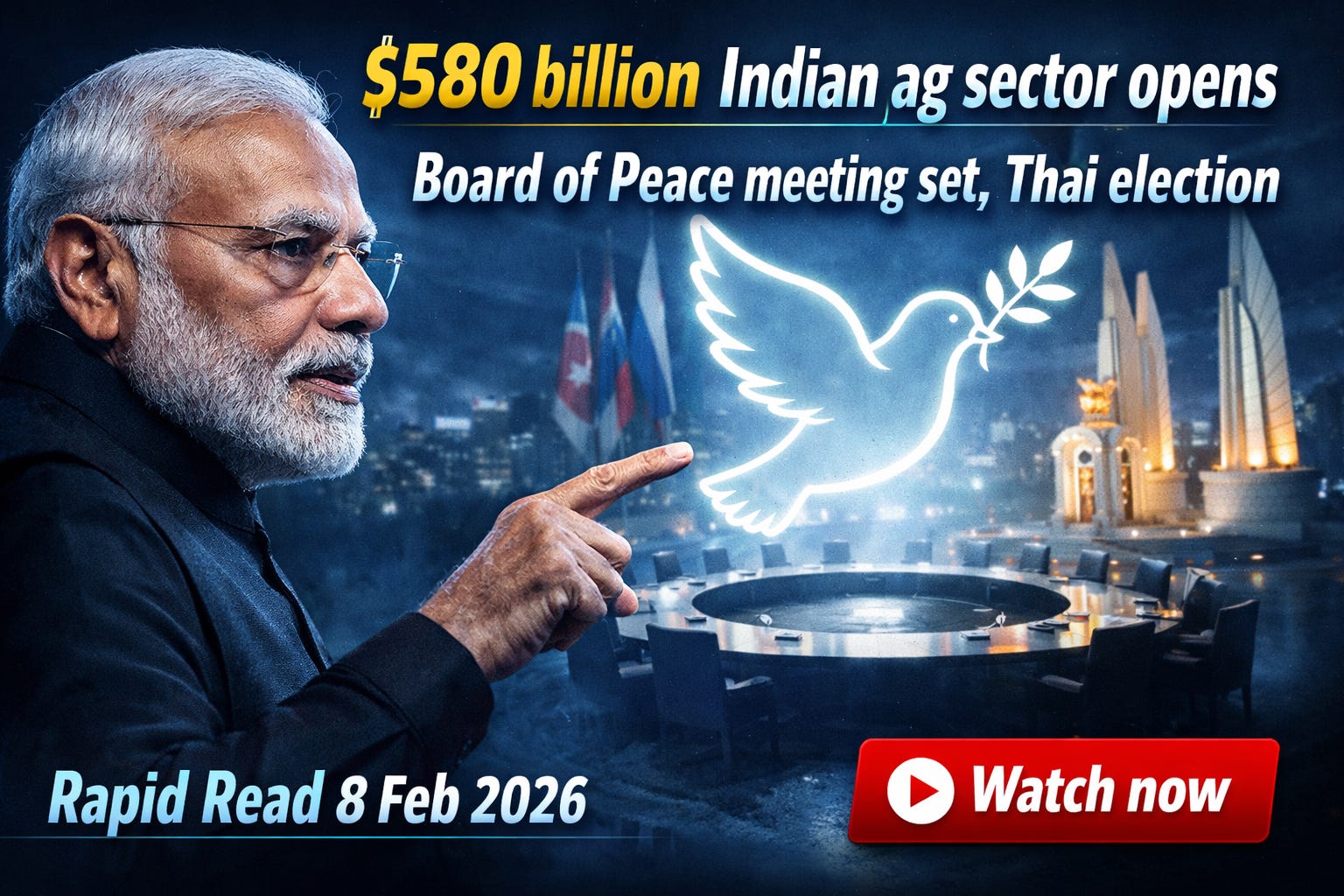
$580 billion Indian Ag Sector Opens, Board of Peace Meeting Set, Thai Election —Rapid Read 8 Feb 2026
from Geopolitics Unplugged · host GeopoliticsUnplugged
Shock LineUS constrains Iran’s nuclear access via sanction threats amid peace board formalization.What Changed (Last 24 Hours)* US schedules Board of Peace meeting to enforce Israel-Hamas ceasefire with 20 nations.* India opens up $580 billion agriculture sector to US potentially* US holds indirect nuclear talks with Iran in Oman, threatening energy sector sanctions.* India lowers import duties on US agricultural goods, easing non-tariff barriers.* Malawi delays electronic invoicing rollout after business shutdown protests.* Colombia polls show leftist-rightist deadlock in presidential race.* Thailand election risks stalemate in three-way party contest.Why This Matters (The System)Containment Leverage.This is about…Control vs negotiation.Access vs denial.Diplomacy vs coercion.This is not normalization.It is constraining directional flows.Hard anchor: 20-nation board locks ceasefire enforcement.What Breaks Next (Forward Risk)If Iran talks stall, energy sanctions spike Urals-WTI spreads by 10-15%.If Board formalizes, Hamas loses military resupply optionality via regional ports.If India deal advances, US gains first-mover feed export advantage, pressuring domestic producers.If Malawi protests escalate, foreign currency shortages trigger second-order aid cuts from donors.If Colombia deadlock persists, drug enforcement contracts limit anti-cartel troop movements for 6-12 months.If Thailand stalemate holds, alliance shifts weaken ASEAN infrastructure timelines by quarters.Signal vs. NoiseSignal: Sanction threats on energy; trade barrier reductions; election deadlocks altering authority.Noise: Humanoid robot investments; photonics tech shifts; orbital data center approvals.The Line to RememberConstraints compound; access regimes reroute before they break.Community Notes:We are very happy to announce that we have a new YouTube page.PLEASE go to www.YouTube.com/@GeopoliticsUnpluggedRapidRead and SUBSCRIBE.Below the paywall is the real actionMarket Snapshot as of publication time noted above (not to be relied on for trading purposes):Detailed News Summaries:India Partially Opens $580 Billion Agri Sector to Secure US Dealhttps://www.bloomberg.com/news/articles/2026-02-07/india-partially-opens-580-billion-agri-sector-to-secure-us-dealIndia has proposed easing restrictions on its agriculture sector to facilitate cheaper imports from the United States, aiming to reduce food and feed costs while addressing a framework for an interim trade agreement. The country agreed to lower or remove import duties on various US products such as distillers dried grains, red sorghum for animal feed, soybean oil, tree nuts, and both fresh and processed fruits. This move also seeks to resolve longstanding non-tariff barriers hindering US agricultural exports to India, potentially benefiting American farmers but increasing competition for domestic producers in the world’s most populous nation.Thousands of Malawi businesses close in protest over tax changeshttps://www.theguardian.com/global-development/2026/feb/07/businesses-close-protest-malawi-tax-changes-electronic-invoicing-systemThousands of small businesses in Malawi shut down in peaceful protests against a new electronic invoicing system introduced by the revenue authority, which they fear will devastate their operations amid economic hardships like foreign currency shortages and rising costs. The demonstrations, involving marches in major cities and petitions to tax officials, successfully delayed the system’s rollout from this week until April, highlighting broader unrest over government measures to stabilize the economy through increased revenue collection. Economists note that while such policies aim to combat tax evasion and improve administration, they risk straining informal sectors unless revenues lead to better infrastructure and services. Protesters, facing black market currency rates nearly triple the official ones, argue the changes will inflate commodity prices and threaten livelihoods in a country already grappling with aid cuts and inflation.Trump Plans for Board of Peace to Meet in Washington This Monthhttps://www.bloomberg.com/news/articles/2026-02-07/trump-plans-for-board-of-peace-to-meet-in-washington-this-monthPresident Trump intends to host the inaugural formal meeting of the Board of Peace in Washington on February 19, as announced by a US official. This board forms a key component of his 20-point plan that facilitated a ceasefire between Israel and Hamas in October, involving approximately 20 nations such as Belarus, Azerbaijan, and Hungary. The group’s initial assembly occurred in Davos, Switzerland, during the World Economic Forum in January, underscoring ongoing efforts to sustain peace initiatives in the region through international collaboration.Trump warns Iran of ‘steep’ consequences if no deal reached after ‘very good’ talkshttps://thehill.com/homenews/administration/5727581-trump-us-iran-talks-consequences-tariffs/President Trump described recent indirect negotiations with Iran in Oman as very good but emphasized that failure to reach a deal on the nuclear program would result in steep consequences, including new sanctions on Iran’s energy sector and potential tariffs on trading partners. He highlighted ongoing discussions with a high-level Iranian representative, noting no rush but firm resolve to prevent Iran from acquiring nuclear weapons, while supporting anti-government protesters and calling for regime change. Iranian Foreign Minister Abbas Araghchi echoed the positive start but stressed the need for an absence of US threats in future talks. The executive order imposes sanctions to hold Iran accountable for terrorism support, ballistic missiles, and regional destabilization, with potential relief if alignment with US policies occurs.Colombia’s Presidential Race Deadlocked Between Left and Righthttps://www.bloomberg.com/news/articles/2026-02-07/colombia-s-presidential-race-deadlocked-between-left-and-rightColombia’s presidential election remains tightly contested, with conservative lawyer Abelardo de la Espriella and leftist senator Iván Cepeda statistically tied in recent polls ahead of the May 31 vote. De la Espriella holds 32.1 percent support compared to Cepeda’s 31.4 percent in the AtlasIntel survey for Semana magazine, while former Antioquia governor Sergio Fajardo trails significantly at 7.6 percent. The results, excluding undecided voters and non-voters, indicate a polarized race between left and right ideologies, potentially influencing the nation’s political direction and policies on key issues.SpaceX seeks approval for a vast orbital data center in spacehttps://www.digitimes.com/news/a20260204PD234/spacex-data-center-fcc-starlink-data.htmlSpaceX is pursuing regulatory approval from the FCC to establish a massive orbital data center utilizing its Starlink satellite network, aiming to enhance data processing and storage capabilities in space. This initiative seeks to leverage low-Earth orbit for reduced latency and improved global connectivity, potentially revolutionizing cloud computing and AI applications by bypassing terrestrial infrastructure limitations. The project aligns with SpaceX’s broader ambitions to expand satellite-based services, though details on capacity, timelines, and technical specifications remain under review amid concerns over space debris and spectrum allocation.The Rapid Rise of Humanoid Robotshttps://oilprice.com/Energy/Energy-General/The-Rapid-Rise-of-Humanoid-Robots.htmlAutomakers like Tesla and Hyundai are investing heavily in humanoid robots to automate factory operations, viewing them as cost-efficient despite current productivity limitations of 30 to 50 percent compared to human workers. Tesla’s Optimus robots are slated for public sale by 2027 at $20,000 to $30,000, with plans to deploy them for complex tasks in facilities, while Hyundai aims to produce 30,000 units annually by 2028 for its US plants, potentially leading to mass layoffs amid union opposition. The humanoid robot market, valued at $2-3 billion, is projected to reach $40 billion by 2035, driven by AI advancements, though significant technical hurdles and employment disruptions persist.AMD’s investment in photonics and modular architecture signals shift in AI infrastructure developmenthttps://www.digitimes.com/news/a20260205PD219/amd-photonics-development-infrastructure-investment.htmlAMD is committing substantial resources to photonics and modular architecture, marking a pivotal evolution in AI infrastructure to enhance data processing speed and efficiency through light-based technologies. This investment aims to integrate optical interconnects and scalable designs, reducing power consumption and improving performance in data centers and high-performance computing. The strategy positions AMD to compete in the growing AI market by addressing bottlenecks in traditional electronic systems, fostering innovations that could transform semiconductor manufacturing and support advanced AI applications.Thailand Votes as Three-Way Race Raises Risk of Stalematehttps://www.bloomberg.com/news/articles/2026-02-08/thailand-votes-as-three-way-race-raises-risk-of-political-driftThailand’s election features a competitive three-way contest that heightens the possibility of political stalemate and prolonged instability, as voters cast ballots amid concerns over governance and economic policies. The race involves major parties vying for control, with potential coalition challenges risking policy drift and delayed reforms in key sectors. Analysts warn that unresolved outcomes could exacerbate divisions, impacting investor confidence and the nation’s recovery efforts in a post-pandemic landscape.Substack Articles of Note (not necessarily news but thought provoking articles):The US-Iran negotiations are unlikely to yield a breakthroughRecent US-Iran talks in Oman represent a critical but likely futile attempt at diplomacy amid escalating tensions, with the US aiming to prevent Iran’s nuclear acquisition to preserve Middle East hegemony and the petrodollar system. Iran pursues nuclear capabilities for national security, creating an irreconcilable conflict that could lead to regime change efforts by the US, including blockades, targeted strikes, and support for internal coups. The negotiations serve as a pretext for potential military action, as the US seeks to disrupt China’s Belt and Road Initiative and control energy supplies, while Iran’s economic collapse and public dissatisfaction weaken its position.AI: Spotlight on Corning, the 175 year old, overnight ‘AI Superstar’. RTZ #991Corning, a 175-year-old glassmaker, has emerged as a key player in AI infrastructure through its fiber-optic cables, which efficiently transmit data using light, powering connections in data centers for companies like Meta. The firm’s $6 billion deal with Meta and ongoing talks with others highlight its resurgence, driven by innovations in thinner, tougher fibers developed after insights from data center tours. Maintaining US manufacturing and a self-contained approach, Corning anticipates booming demand, with fiber for data centers becoming its fastest-growing segment amid the AI expansion.Waiting for the SparkElite overproduction, as conceptualized in cliodynamics, describes societies producing more claimants to power than can be absorbed, building pressures for instability akin to accumulating deadwood in a forest awaiting a spark. In Germany, this manifests through declining employment in productive sectors like manufacturing and construction, contrasted by growth in public services and state-adjacent roles, with government spending exceeding 50 percent of GDP. The EU mirrors this trend with expanding institutions, while the US under President Trump pursues bureaucratic cuts, highlighting divergent approaches to managing elite surplus and potential social combustion.Thanks for reading GeopoliticsUnplugged Substack! This post is public so feel free to share it.Additional value added behind the paywall:Behind the paywall, Our Take cuts through today’s noise to isolate what actually matters right now. We separate real catalysts from distractions, lay out what is most likely to happen over the next 7–30 days, and explain where market and diplomatic reactions are early, late, or wrong. Subscribers also get a concise contrarian view that challenges the dominant narrative without drifting outside mainstream analysis, a brief geopolitics-linked market note, and the Geopolitical Risk Scoreboard, ranking each major flashpoint by risk level, the single trigger to watch, and the outcome that matters if it breaks. Readers consistently tell us this is the section they reference in conversations, investment discussions, and policy debates. Upgrade to access the full, unfiltered read.GeopoliticsUnplugged Substack is a reader-supported publication. To receive new posts and support my work, consider becoming a free or paid subscriber.Our TakeToday’s key geopolitical developments center on U.S. efforts to constrain Iran’s nuclear ambitions through indirect talks in Oman, coupled with threats of new energy sector sanctions, while formalizing the Board of Peace to enforce the Israel-Hamas ceasefire. The Board of Peace, involving 20 nations and set for its inaugural meeting in Washington on February 19, represents a multilateral mechanism to sustain regional stability, but it underscores ongoing tensions in the Middle East where diplomacy intersects with coercion. Simultaneously, India’s partial opening of its $580 billion agriculture sector to U.S. imports by lowering duties on products like soybean oil and tree nuts signals a strategic trade alignment aimed at reducing food costs, potentially reshaping bilateral relations amid broader U.S. efforts to counterbalance influence in Asia. These flashpoints warrant close monitoring in the coming weeks due to their potential to escalate into broader conflicts or economic disruptions, particularly as U.S. sanction threats could tighten global energy supplies, while trade deals like India’s may trigger domestic backlash in key agricultural economies.Plausible follow-on geopolitical and economic impacts include cascading effects such as widened Urals-WTI crude spreads if Iran negotiations stall, leading to higher energy costs for importers and straining alliances dependent on Iranian oil. Alliance shifts could emerge if the Board of Peace solidifies, potentially isolating non-participating actors like Iran and altering regional power dynamics, with second-order effects including reduced military resupply options for groups like Hamas through constrained port access. Supply-chain risks are evident in agriculture, where U.S. gains in Indian markets could pressure local producers, resulting in food price volatility and potential protests that disrupt global feed supply chains. Policymakers in Iran are boxed in by U.S. threats, losing optionality in nuclear negotiations as domestic economic pressures mount from sanctions, while Indian leaders face constraints from balancing U.S. ties against farmer unrest. In Colombia, the deadlocked presidential race between leftist and rightist candidates risks prolonged policy paralysis, limiting anti-cartel operations and exacerbating drug-related instability with cross-border implications.A non-energy development of geopolitical significance is Thailand’s three-way election contest, which raises the risk of stalemate and policy drift, potentially weakening ASEAN cohesion on issues like South China Sea disputes. This matters because unresolved coalitions could delay infrastructure projects, eroding investor confidence and inviting external influences from powers like China or the U.S. to fill governance voids. Indicators to watch in the next 7-30 days include the February 19 Board of Peace meeting outcomes for signs of de-escalation through unified statements, or escalation via Iranian military movements in the Strait of Hormuz; market signals such as widening oil spreads indicating sanction enforcement; official U.S. statements on Iran deal progress; troop deployments in Colombia signaling election-related security measures; and coalition announcements in Thailand post-election for stalemate resolution. In Malawi, where protests delayed tax system rollout, monitor donor aid decisions for second-order cuts amid currency shortages, as these could amplify economic unrest with regional spillover.Geopolitical Risk BoardContrarian Point of ViewConsensus views the US-Iran talks as a genuine path to de-escalation, but evidence from ongoing threats suggests they primarily serve to justify future sanctions rather than achieve breakthroughs. While many anticipate the Board of Peace to stabilize the Middle East, its exclusionary nature could entrench divisions rather than foster inclusive peace. The India-US agri deal is often seen as a win-win for food security, yet it overlooks potential backlash that erodes India’s domestic agricultural autonomy. Thailand’s election is framed as a democratic exercise, but the risk of stalemate indicates deeper institutional frailties that could invite external meddling. Malawi’s protests are dismissed as local fiscal adjustments, though they highlight vulnerabilities in aid-dependent economies that could cascade regionally.Market summary:Energy commodities exhibited mixed movements influenced by U.S. geopolitical maneuvers, with WTI rising modestly to 63.55 USD per barrel amid threats of sanctions on Iran’s energy sector, signaling market anticipation of tighter supplies. Urals crude fell to 54.645 USD per barrel, widening its discount to WTI by approximately 9 USD, reflecting constrained export options for Russian-linked grades under broader sanction pressures. Western Canadian Select (WCS) edged up to 48.04 USD per barrel, narrowing its discount slightly as North American pipeline access remains stable, though potential alliance shifts from Middle East developments could indirectly affect heavy crude demand. Henry Hub natural gas declined to 3.42 USD per MMBtu, pressured by seasonal factors but buffered against sharper drops due to U.S. leverage in global LNG markets amid Iran tensions.Broader equity indices surged, with the DJIA up 2.47% to 50,115.67 and NASDAQ climbing 2.18% to 23,031.213, driven by optimism over U.S.-led diplomatic initiatives like the Board of Peace and India trade openings that bolster investor sentiment in tech and agriculture-linked sectors. European indices like the STOXX600 rose 0.89% to 617.12, reflecting cautious relief from Middle East stability efforts, while Asian markets showed divergence with NIKKEI up 0.81% but SHANGHAI down 0.25%, tied to election uncertainties in Thailand. Gold dipped slightly to 4,949.02 USD per ounce as risk appetite grew, but silver held steady at 77.77 USD per ounce amid industrial demand; copper advanced to 12,840.00 USD per ton, supported by infrastructure expectations despite geopolitical frictions. This is a public episode. If you'd like to discuss this with other subscribers or get access to bonus episodes, visit geopoliticsunplugged.substack.com/subscribe
Embed this episode
NOW PLAYING
$580 billion Indian Ag Sector Opens, Board of Peace Meeting Set, Thai Election —Rapid Read 8 Feb 2026
No transcript for this episode yet
Similar Episodes
No similar episodes found.