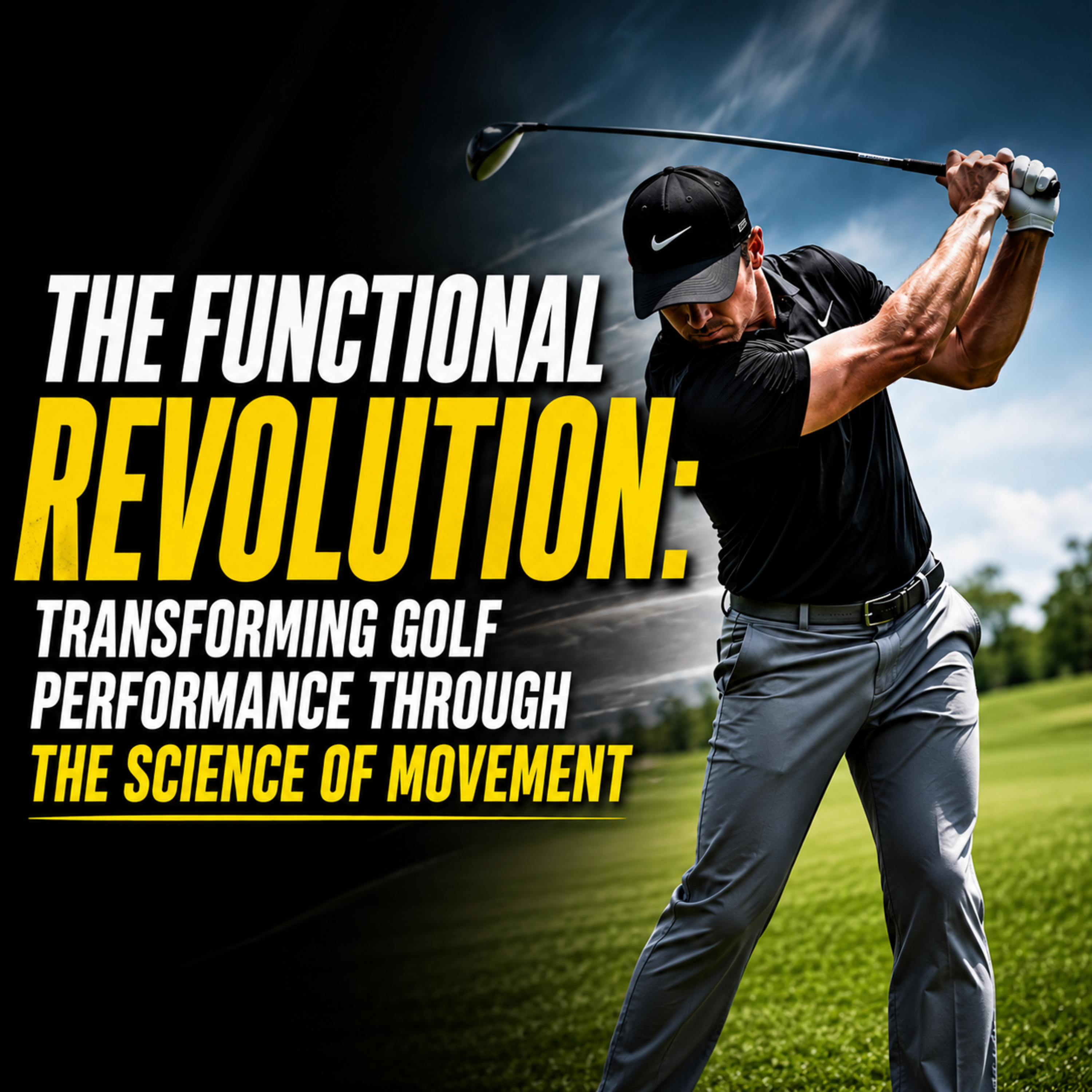
#625 The Functional Revolution: Transforming Golf Performance Through the Science of Movement episode artwork

EPISODE · Jun 20, 2026 · 22 MIN

#625 The Functional Revolution: Transforming Golf Performance Through the Science of Movement

from Golf 247.eu: The Global Platform for Innovative Technologies and Teaching Concepts. · host Golf247.eu

Golf performance has evolved far beyond the bodybuilding philosophy of the 1980s. Bigger muscles alone do not create longer drives. Excessive, non-functional mass often reduces mobility, limits swing speed, and increases injury risk. Modern golf training focuses on movement efficiency, biomechanics, and the body's ability to function as an integrated athletic system.Functional training develops strength that directly improves golf performance. The goal is not simply to build muscle, but to enhance the body's ability to transfer force efficiently from the ground, through the core, and into the clubhead.Three levels of strength are important:• Absolute Strength – maximum force production.• Relative Strength – strength compared to body weight.• Functional Strength – the ability to express force during the golf swing.Effective development follows a three-stage progression: general strength, special strength, and finally golf-specific strength. The objective is coordinated movement, not isolated muscle development.Golf performance relies on four key movement pillars:• Locomotion – single-leg stability and efficient weight transfer.• Level Changes – creating power through ankle, knee, and hip extension.• Push-Pull Mechanics – improving sequencing and rotational speed.• Rotation – the foundation of the golf swing and the body's primary power source.Elite power is created through diagonal muscle and fascial connections known as the Serape Effect. The posterior sling links the glutes and opposite latissimus dorsi during the backswing, while the anterior sling transfers energy through the core during the downswing. A stable core acts as a bridge, allowing force to travel efficiently from the ground to the clubhead.A critical distinction exists between balance and stability. Balance maintains equilibrium, while stability controls movement under high loads. Golf is primarily a single-leg sport. If lead-side stability is poor, the nervous system activates protective "neural brakes," reducing speed and power output.Ground reaction forces, gravity, momentum, and rotational mechanics form the operational environment of the golf swing. The ability to create force against the ground and transfer it through the body determines performance.The future of golf fitness is movement quality. Success is measured not by muscle size, but by stability, coordination, mobility, and efficient force transfer. The era of simply lifting weights has ended. The era of movement science has arrived.📺 The Explainerwww.eCoach360.com

Golf performance has evolved far beyond the bodybuilding philosophy of the 1980s. Bigger muscles alone do not create longer drives. Excessive, non-functional mass often reduces mobility, limits swing speed, and increases injury risk. Modern golf training focuses on movement efficiency, biomechanics, and the body's ability to function as an integrated athletic system.Functional training develops strength that directly improves golf performance. The goal is not simply to build muscle, but to enhance the body's ability to transfer force efficiently from the ground, through the core, and into the clubhead.Three levels of strength are important:• Absolute Strength – maximum force production.• Relative Strength – strength compared to body weight.• Functional Strength – the ability to express force during the golf swing.Effective development follows a three-stage progression: general strength, special strength, and finally golf-specific strength. The objective is coordinated movement, not isolated muscle development.Golf performance relies on four key movement pillars:• Locomotion – single-leg stability and efficient weight transfer.• Level Changes – creating power through ankle, knee, and hip extension.• Push-Pull Mechanics – improving sequencing and rotational speed.• Rotation – the foundation of the golf swing and the body's primary power source.Elite power is created through diagonal muscle and fascial connections known as the Serape Effect. The posterior sling links the glutes and opposite latissimus dorsi during the backswing, while the anterior sling transfers energy through the core during the downswing. A stable core acts as a bridge, allowing force to travel efficiently from the ground to the clubhead.A critical distinction exists between balance and stability. Balance maintains equilibrium, while stability controls movement under high loads. Golf is primarily a single-leg sport. If lead-side stability is poor, the nervous system activates protective "neural brakes," reducing speed and power output.Ground reaction forces, gravity, momentum, and rotational mechanics form the operational environment of the golf swing. The ability to create force against the ground and transfer it through the body determines performance.The future of golf fitness is movement quality. Success is measured not by muscle size, but by stability, coordination, mobility, and efficient force transfer. The era of simply lifting weights has ended. The era of movement science has arrived.📺 The Explainerwww.eCoach360.com

NOW PLAYING

#625 The Functional Revolution: Transforming Golf Performance Through the Science of Movement

0:00 22:59

No transcript for this episode yet

We transcribe on demand. Request one and we'll notify you when it's ready — usually under 10 minutes.

Frequently Asked Questions

How long is this episode of Golf 247.eu: The Global Platform for Innovative Technologies and Teaching Concepts.?

This episode is 22 minutes long.

When was this Golf 247.eu: The Global Platform for Innovative Technologies and Teaching Concepts. episode published?

This episode was published on June 20, 2026.

What is this episode about?

Golf performance has evolved far beyond the bodybuilding philosophy of the 1980s. Bigger muscles alone do not create longer drives. Excessive, non-functional mass often reduces mobility, limits swing speed, and increases injury risk. Modern golf...

Can I download this Golf 247.eu: The Global Platform for Innovative Technologies and Teaching Concepts. episode?

Yes, you can download this episode by clicking the download button on the episode player, or subscribe to the podcast in your preferred podcast app for automatic downloads.
URL copied to clipboard!