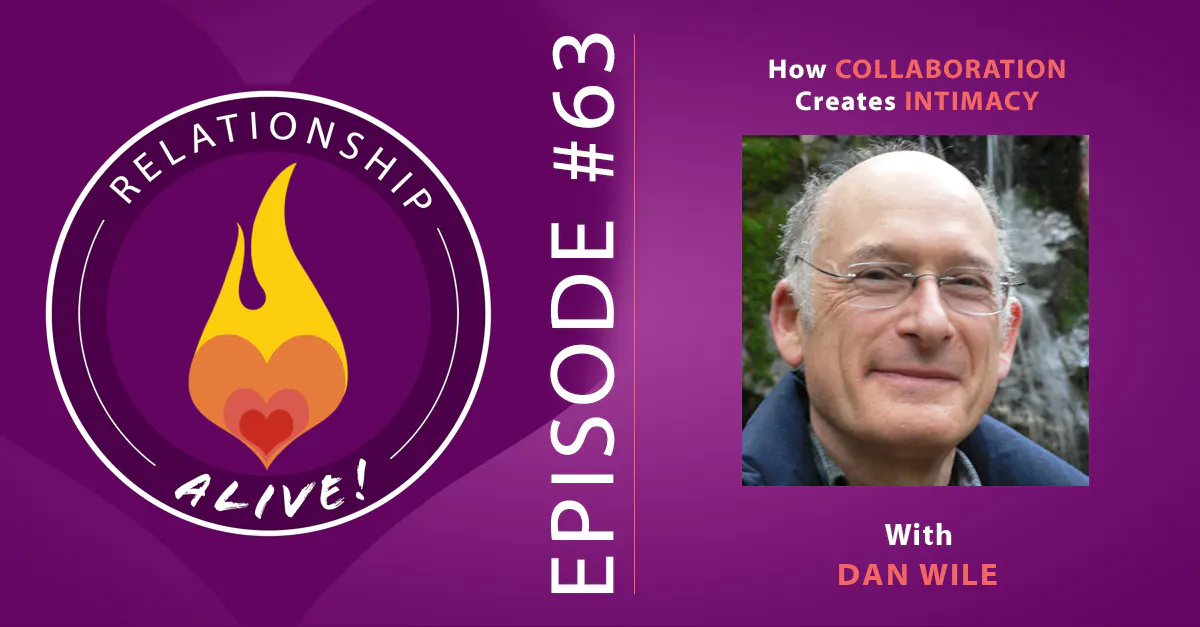
63: Dan Wile - How Collaboration Creates Intimacy episode artwork

EPISODE · Nov 2, 2016 · 1H 11M

63: Dan Wile - How Collaboration Creates Intimacy

from Relationship Alive! · host Neil Sattin

How do you foster intimacy, even when you're fighting? The recipe for a successful relationship involves learning how to collaborate even when things aren't going well. And once you learn how to do that, you'll find that opportunities to create intimacy are abundant in your relationship. It's the magic that happens when you're willing to work together no matter what's going on. In today's episode, we're talking to Dan Wile, the creator of Collaborative Couples Therapy. Along with seeing clients and conducting intensives for couples, Dan Wile trains therapists in Collaborative Couples Therapy, and his work is recommended by John Gottman as an embodiment of the principles recommended through his research and practice. Here are the details on what we cover: Create a loving conversation: Many couples struggle to communicate their way through conflict- so often resorting to withdrawing or fighting. Collaborative couple’s therapy helps couples learn to reach out to one another in difficult moments and around difficult topics so that they may create a loving conversation out of whatever it is they are going through. Through collaboration conflict can become intimate exchange. Self-reinforcing cycles: Dan Wile explains that many couples too easily find “themselves in an adversarial or withdrawn cycle without knowing how they got into it, not wanting to be in it, and not knowing how to get out of it”. Here are the 3 self-reinforcing cycles he identifies: Adversarial: Speaking from anger often begins a vicious cycle. When we speak from a charged place we often have a threatening tone, and we enter into either attack mode or defense mode. Biochemicals are released, and the sympathetic nervous system is leading the way, thus making us speak before we think. We make accusations that put our partner on the defensive and vice-versa, therefore reinforcing the intensity and increasing escalation. Withdrawn cycle: Another common reaction to conflict is the withdrawal cycle. This is when one partner, or both, use extreme cautiousness and avoid saying anything evocative. While this may seem like a safer strategy at first it is dangerous as it leads to mutual withdrawal, intense distancing, and a devitalization of the relationship. Empathic Cycle: Both the adversarial and withdrawal cycles can be shifted to a loving cycle through empathy. One partner must take a step out of their “i’m right, you are wrong” stance, and step towards their partner. When one partner acknowledges the otherness, or speaks for the ‘we’, they offer a moment of reconnection and an opportunity for repair. This can sound and look a lot of ways, for example “Wow- you seem to have a point, even if I do not agree I want to understand you more”, or “you know, I think I am saying a lot of things that I do not really mean right now because I am very angry”, or “even though this is really messy I am proud of us for trying to work through this difficult conversation because the topic is so important to us both”, or “I’m getting really upset because this is something I really care about, and I know you do too- I’m feeling like things are at stake and I’m feeling vulnerable”. Confessions such as these often helps the other partner acknowledge what is happening for them as well, and thus the couple finds themselves talking about the angry/frustration/sadness, rather than from it. The “We need to talk” talk.  There is a common pattern in which one partner will seek out the other and say something like “we need to have a talk”. This languaging gets registered as “I have a complaint” or “you did something wrong” and immediately the conversation is derailed into a conflict as the one partner goes into defense or withdraw mode. If you are the one initiating the conversation try to: Anticipate the struggle of your partner: Initiate difficult conversations by preemptively voicing the concern that often lead to the fight, such as “I want to talk about something difficult, and it might make you feel defensive, but I want to find a way for us to have this conversation that allows me to share in a way that you can hear and we can work through this together”. Or, “I want to talk about (the state of things in our kitchen) and I already know (that you might feel overwhelmed by this) and I totally understand and yet, we need to figure out how to solve this somehow”. Turn your complaint into a wish or a fear: Learn to express what your concern is by sharing the underside of the issue and making it more about you than about them- they will be much more receptive and able to stay present for solutions! Practice: Play with taking on your partner’s side and pretending to voice their side of the fight. This kind of role play can help increase understanding and empathy. From fight to intimacy: A fight occurs when there are two people who both feel too unheard to listen. Each person presents their point of view (often in a very charged way) and the other presents theirs and neither is acknowledging the other’s views or feelings. It is possible to shift from confrontation to intimacy. Intimacy comes from the ability to share what is most deeply on your mind- what is most alive for you in the moment. It is about sharing this feeling with your partner, and then hearing the same from them. In order to shift from fight to intimacy it is helpful to search for, and speak for the underbelly feelings/leading edge feelings: those feelings that are at the core of the conflict.   Leading edge feeling: Learn to get to the underlying current of what is happening for you by searching below the content for the emotions, fears, worries, and sensations that are informing how you are showing up in any given moment. Be curious and empathic with yourself as you search for the soft underbelly feelings. Once you have identified this, share it! As intimidating as these may seem at first, you will soon learn that it is the key to creating loving conversations and building intimacy with your partner. You will feel a great amount of relief once you have shared your truth and your struggle, and consequently your partner will often feel great relief as well as it allows them 1) insight into your vulnerabilities, 2) demonstrates your trust in them, and 3) may validate certain instincts or gut feelings they have had about what you have been going through. Get professional or personal support in learning to identify the underlying feelings, and then practice expressing it outward and making it known. When we can find our lost voice we allow for fuller expression of our inner struggles, and thus, create more opportunities for connections.   Self-empathy: When we have a lack of empathy for ourselves we are unable to get in touch with our leading edge feelings, and when this is true we either: Turn our feelings and struggles into something our partner is doing wrong. Such as if you are feeling unlovable you may believe or accuse your partner that they don’t love you. Get quiet. Sometimes if we cannot figure out how we are feeling or don't know how to speak for it we either blank out or say nothing at all. Other times we try to resolve the gap through actions. For example, if you are feeling uninteresting you might try to talk more and more. Or you turn to substances (food, drugs, alcohol) to try to self-soothe the inner struggle. None of these strategies end up helping us get to the core of the issue. Instead they distract us into a further place of disconnection not only from ourselves, but from our partner. If finding empathy with yourself is very difficult, you can try to imagine looking at your own struggle as if it was your friend’s- what would you say to that friend? Find resources and ways that help you come back to a centered place of compassion for yourself so that you can re-find your voice and speak for your vulnerabilities. Allow love in: While it is widely believed that you cannot love another until you love yourself, it is simultaneously true that you can learn to love yourself deeper and better if and when you feel loved by another person. As you increase your own sense of empathy for yourself, find ways to allow your partner to show up for you. This can be facilitated by sharing your struggle. By offering your partner a window into your tender places you invoke their sense of curiosity, their desire to support you, and their ability to help facilitate a warm nurturing environment for you to better step out of yourself and discover more of what you are truly feeling.   A relationship is how you deal with difficult moments. Healthy vibrant relationships are not devoid of difficulty, rather they have the capacity to find intimacy and connection through struggle. Work with yourself and your partner to get to the source of your feelings and speak about the deepest parts. As you do you'll help yourself and your partner get out of a triggered state, and into a compassionate and empathic place in which you are both more resourceful, creative, connected, and where you can actually repair!   Resources:   Read Daniel Wile’s book After the Honeymoon: How Conflict Can Improve your Relationship   Find out more about Dan’s work and workshops   www.neilsattin.com/wile Visit to download the show guide, or text “PASSION” to 33444 and follow the instructions to download the show guide to this episode with Aubrey Fuller.   Our Relationship Alive Community on Facebook   Amazing intro/outro music graciously provided courtesy of: The Railsplitters - Check them Out

How do you foster intimacy, even when you're fighting? The recipe for a successful relationship involves learning how to collaborate even when things aren't going well. And once you learn how to do that, you'll find that opportunities to create intimacy are abundant in your relationship. It's the magic that happens when you're willing to work together no matter what's going on. In today's episode, we're talking to Dan Wile, the creator of Collaborative Couples Therapy. Along with seeing clients and conducting intensives for couples, Dan Wile trains therapists in Collaborative Couples Therapy, and his work is recommended by John Gottman as an embodiment of the principles recommended through his research and practice. Here are the details on what we cover: Create a loving conversation: Many couples struggle to communicate their way through conflict- so often resorting to withdrawing or fighting. Collaborative couple’s therapy helps couples learn to reach out to one another in difficult moments and around difficult topics so that they may create a loving conversation out of whatever it is they are going through. Through collaboration conflict can become intimate exchange. Self-reinforcing cycles: Dan Wile explains that many couples too easily find “themselves in an adversarial or withdrawn cycle without knowing how they got into it, not wanting to be in it, and not knowing how to get out of it”. Here are the 3 self-reinforcing cycles he identifies: Adversarial: Speaking from anger often begins a vicious cycle. When we speak from a charged place we often have a threatening tone, and we enter into either attack mode or defense mode. Biochemicals are released, and the sympathetic nervous system is leading the way, thus making us speak before we think. We make accusations that put our partner on the defensive and vice-versa, therefore reinforcing the intensity and increasing escalation. Withdrawn cycle: Another common reaction to conflict is the withdrawal cycle. This is when one partner, or both, use extreme cautiousness and avoid saying anything evocative. While this may seem like a safer strategy at first it is dangerous as it leads to mutual withdrawal, intense distancing, and a devitalization of the relationship. Empathic Cycle: Both the adversarial and withdrawal cycles can be shifted to a loving cycle through empathy. One partner must take a step out of their “i’m right, you are wrong” stance, and step towards their partner. When one partner acknowledges the otherness, or speaks for the ‘we’, they offer a moment of reconnection and an opportunity for repair. This can sound and look a lot of ways, for example “Wow- you seem to have a point, even if I do not agree I want to understand you more”, or “you know, I think I am saying a lot of things that I do not really mean right now because I am very angry”, or “even though this is really messy I am proud of us for trying to work through this difficult conversation because the topic is so important to us both”, or “I’m getting really upset because this is something I really care about, and I know you do too- I’m feeling like things are at stake and I’m feeling vulnerable”. Confessions such as these often helps the other partner acknowledge what is happening for them as well, and thus the couple finds themselves talking about the angry/frustration/sadness, rather than from it. The “We need to talk” talk.  There is a common pattern in which one partner will seek out the other and say something like “we need to have a talk”. This languaging gets registered as “I have a complaint” or “you did something wrong” and immediately the conversation is derailed into a conflict as the one partner goes into defense or withdraw mode. If you are the one initiating the conversation try to: Anticipate the struggle of your partner: Initiate difficult conversations by preemptively voicing the concern that often lead to the fight, such as “I want to talk about something difficult, and it might make you feel defensive, but I want to find a way for us to have this conversation that allows me to share in a way that you can hear and we can work through this together”. Or, “I want to talk about (the state of things in our kitchen) and I already know (that you might feel overwhelmed by this) and I totally understand and yet, we need to figure out how to solve this somehow”. Turn your complaint into a wish or a fear: Learn to express what your concern is by sharing the underside of the issue and making it more about you than about them- they will be much more receptive and able to stay present for solutions! Practice: Play with taking on your partner’s side and pretending to voice their side of the fight. This kind of role play can help increase understanding and empathy. From fight to intimacy: A fight occurs when there are two people who both feel too unheard to listen. Each person presents their point of view (often in a very charged way) and the other presents theirs and neither is acknowledging the other’s views or feelings. It is possible to shift from confrontation to intimacy. Intimacy comes from the ability to share what is most deeply on your mind- what is most alive for you in the moment. It is about sharing this feeling with your partner, and then hearing the same from them. In order to shift from fight to intimacy it is helpful to search for, and speak for the underbelly feelings/leading edge feelings: those feelings that are at the core of the conflict.   Leading edge feeling: Learn to get to the underlying current of what is happening for you by searching below the content for the emotions, fears, worries, and sensations that are informing how you are showing up in any given moment. Be curious and empathic with yourself as you search for the soft underbelly feelings. Once you have identified this, share it! As intimidating as these may seem at first, you will soon learn that it is the key to creating loving conversations and building intimacy with your partner. You will feel a great amount of relief once you have shared your truth and your struggle, and consequently your partner will often feel great relief as well as it allows them 1) insight into your vulnerabilities, 2) demonstrates your trust in them, and 3) may validate certain instincts or gut feelings they have had about what you have been going through. Get professional or personal support in learning to identify the underlying feelings, and then practice expressing it outward and making it known. When we can find our lost voice we allow for fuller expression of our inner struggles, and thus, create more opportunities for connections.   Self-empathy: When we have a lack of empathy for ourselves we are unable to get in touch with our leading edge feelings, and when this is true we either: Turn our feelings and struggles into something our partner is doing wrong. Such as if you are feeling unlovable you may believe or accuse your partner that they don’t love you. Get quiet. Sometimes if we cannot figure out how we are feeling or don't know how to speak for it we either blank out or say nothing at all. Other times we try to resolve the gap through actions. For example, if you are feeling uninteresting you might try to talk more and more. Or you turn to substances (food, drugs, alcohol) to try to self-soothe the inner struggle. None of these strategies end up helping us get to the core of the issue. Instead they distract us into a further place of disconnection not only from ourselves, but from our partner. If finding empathy with yourself is very difficult, you can try to imagine looking at your own struggle as if it was your friend’s- what would you say to that friend? Find resources and ways that help you come back to a centered place of compassion for yourself so that you can re-find your voice and speak for your vulnerabilities. Allow love in: While it is widely believed that you cannot love another until you love yourself, it is simultaneously true that you can learn to love yourself deeper and better if and when you feel loved by another person. As you increase your own sense of empathy for yourself, find ways to allow your partner to show up for you. This can be facilitated by sharing your struggle. By offering your partner a window into your tender places you invoke their sense of curiosity, their desire to support you, and their ability to help facilitate a warm nurturing environment for you to better step out of yourself and discover more of what you are truly feeling.   A relationship is how you deal with difficult moments. Healthy vibrant relationships are not devoid of difficulty, rather they have the capacity to find intimacy and connection through struggle. Work with yourself and your partner to get to the source of your feelings and speak about the deepest parts. As you do you'll help yourself and your partner get out of a triggered state, and into a compassionate and empathic place in which you are both more resourceful, creative, connected, and where you can actually repair!   Resources:   Read Daniel Wile’s book After the Honeymoon: How Conflict Can Improve your Relationship   Find out more about Dan’s work and workshops   www.neilsattin.com/wile Visit to download the show guide, or text “PASSION” to 33444 and follow the instructions to download the show guide to this episode with Aubrey Fuller.   Our Relationship Alive Community on Facebook   Amazing intro/outro music graciously provided courtesy of: The Railsplitters - Check them Out

NOW PLAYING

63: Dan Wile - How Collaboration Creates Intimacy

0:00 1:11:36

No transcript for this episode yet

We transcribe on demand. Request one and we'll notify you when it's ready — usually under 10 minutes.

LIGHTS, CAMERA, SMILE! Creatives Club Media Lights, Camera, Smile, is a podcast for anyone with a dream to share something with the world, out of the overflow of themselves - be it their mind, their heart, their personalities, and much more. Each of us are alive in this moment in time, with an innate ability to have ideas and create various things to benefit both ourselves and the people around us for a reason, and here, you will find the encouragement, the inspiration, and the motivation to do just that. Hosted by Cicily, founder of Creatives Club, she dives into various topics surrounding creativity and business. Exploring entrepreneurship for creatives in a corporate reality, sharing tips and tricks in a media centered company, answering questions regarding what a creative actually is are just a few of the things discussed on this podcast. Be encouraged to create for yourself as Cicily gets vulnerable by pivoting the camera to herself for the first time.To submit questions for Cicily to answer, or have her address certain t Tao Te Ching by Laozi (Author), Stephen Mitchell (Full Audiobook) Laozi Lao-tzu's Tao Te Ching, or Book of the Way, is the classic manual on the art of living, and one of the wonders of the world. In eighty-one brief chapters, the Tao Te Ching looks at the basic predicament of being alive and gives advice that imparts balance and perspective, a serene and generous spirit. This book is about wisdom in action. It teaches how to work for the good with the effortless skill that comes from being in accord with the Tao (the basic principle of the universe) and applies equally to good government and sexual love; to child rearing, business, and ecology.Stephen Mitchell's bestselling version has been widely acclaimed as a gift to contemporary culture. Psychos with Ryan Williams Ryan Williams This is a podcast on healthcare, trauma, and the future of mental health.On Psychos, Ryan welcomes storytellers, researchers, comedians, actors, teachers, writers, musicians to discuss their relationship with their health. Ryan's conversational interview style gives guests a place to discuss how they are connected to their health, which will be completely new to listeners. We also have a few breathwork classes, and some older episodes from Ryan's old Influencer Economy podcast. You can follow the podcast on iTunes, Spotify, Stitcher, or anywhere else you listen to podcasts. Celebration of Life Church Bozeman COLC It is our desire at Celebration of Life Church to reach into Bozeman and the entire Gallatin Valley with the Gospel of Jesus Christ and impact it for the Kingdom of God; to go beyond the four walls of the church and touch people in our community with the love of God; and to share the goodness of God in such a way that it will draw all men into a loving relationship with the One True Living God. We also desire to train up in the Word of God and encourage them to take the Gospel message to our community through various outreaches and evangelism. Enjoy our podcast and feel free to visit us.

Frequently Asked Questions

How long is this episode of Relationship Alive!?

This episode is 1 hour and 11 minutes long.

When was this Relationship Alive! episode published?

This episode was published on November 2, 2016.

What is this episode about?

How do you foster intimacy, even when you're fighting? The recipe for a successful relationship involves learning how to collaborate even when things aren't going well. And once you learn how to do that, you'll find that opportunities to create...

Can I download this Relationship Alive! episode?

Yes, you can download this episode by clicking the download button on the episode player, or subscribe to the podcast in your preferred podcast app for automatic downloads.
URL copied to clipboard!