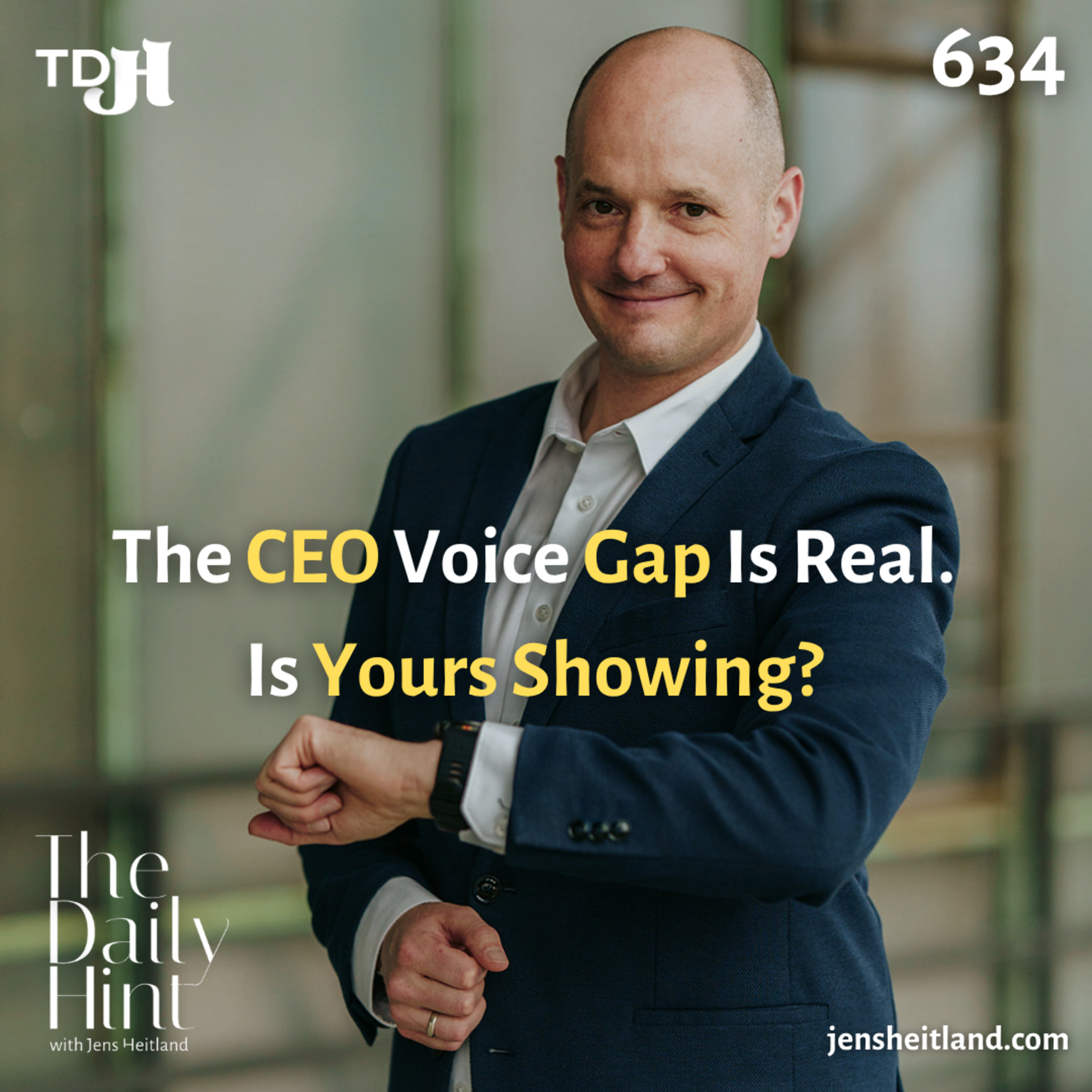
634 - Why CEOs Can No Longer Afford to Be Bad Communicators episode artwork

EPISODE · May 11, 2026 · 0 MIN

634 - Why CEOs Can No Longer Afford to Be Bad Communicators

from The Daily Hint with Jens Heitland · host Jens Heitland

Why CEOs Can No Longer Afford to Be Bad CommunicatorsPicture the CEO who runs the business brilliantly. Operations are tight. The team is aligned. The numbers move in the right direction. And yet, the moment a camera turns on, something shifts. The polish disappears. The confidence thins out. And what comes across feels nothing like leadership.A common situation. And for most of the last few decades, largely tolerable. No longer.Why public communication has become non-negotiableFor a long time, a CEO could delegate external communications. The PR team handled the press. Marketing ran the channels. The comms department drafted the statements. The CEO showed up and read from a script prepared by someone else.That structure worked when the pace of change was manageable and audiences weren't watching closely. Neither condition holds anymore.AI is reshaping industries in real time. Entire organizational structures are being questioned. Employees, customers, investors, and competitors are all watching how leaders respond. Not just what decisions get made, but how those decisions get communicated, and whether the person at the top actually understands what is happening.In that environment, the ability to communicate publicly becomes a core leadership function.The training gap most CEOs have not closedNobody required it of them until now. Not a reflection of intelligence or presence, just a gap that was never forced.They rose through the organization based on results. On execution. Communication at scale, on social platforms, on stage, in front of cameras, requires a different skill set entirely. And like any skill, building it takes training and repetition.A CEO who has given 500 public talks will perform differently from one who has given 5. Not a personality difference. A practice difference.Most leaders have not accumulated those repetitions. They haven't built the muscle external communication demands. And right now, that gap shows.The CEO is the face of the organizationThe CEO role is shifting. More external, not less. More visible, not less.Stakeholders want to hear from the person in charge. Employees navigating uncertainty want to see their leader own the message. Customers are forming opinions partly based on what they observe from leadership in public channels.CEOs are increasingly the brand. Not just a symbol of the company, but an active communicator shaping how the organization is understood by the world outside it.What closing the gap actually looks likeThe path forward isn't complicated, but it requires commitment. Communication at scale is a skill, not a default. From there, repetitions matter most. Speaking more. Getting on camera more. Writing more. Developing a point of view and testing it with real audiences.Leaders building this now will be positioned to lead through the disruptions ahead with credibility. Waiting makes the gap harder to close when pressure is already on.Communication isn't a soft skill. For CEOs, it's one of the hardest capabilities to develop and one of the most consequential to have.Highlights:00:00 CEO Communication Gap00:04 Why Public Speaking Matters00:22 AI Era Leadership Shifts00:29 Communicating Inside and Out00:34 The Evolving CEO RoleLinks:https://www.jensheitland.com/links

Why CEOs Can No Longer Afford to Be Bad CommunicatorsPicture the CEO who runs the business brilliantly. Operations are tight. The team is aligned. The numbers move in the right direction. And yet, the moment a camera turns on, something shifts. The polish disappears. The confidence thins out. And what comes across feels nothing like leadership.A common situation. And for most of the last few decades, largely tolerable. No longer.Why public communication has become non-negotiableFor a long time, a CEO could delegate external communications. The PR team handled the press. Marketing ran the channels. The comms department drafted the statements. The CEO showed up and read from a script prepared by someone else.That structure worked when the pace of change was manageable and audiences weren't watching closely. Neither condition holds anymore.AI is reshaping industries in real time. Entire organizational structures are being questioned. Employees, customers, investors, and competitors are all watching how leaders respond. Not just what decisions get made, but how those decisions get communicated, and whether the person at the top actually understands what is happening.In that environment, the ability to communicate publicly becomes a core leadership function.The training gap most CEOs have not closedNobody required it of them until now. Not a reflection of intelligence or presence, just a gap that was never forced.They rose through the organization based on results. On execution. Communication at scale, on social platforms, on stage, in front of cameras, requires a different skill set entirely. And like any skill, building it takes training and repetition.A CEO who has given 500 public talks will perform differently from one who has given 5. Not a personality difference. A practice difference.Most leaders have not accumulated those repetitions. They haven't built the muscle external communication demands. And right now, that gap shows.The CEO is the face of the organizationThe CEO role is shifting. More external, not less. More visible, not less.Stakeholders want to hear from the person in charge. Employees navigating uncertainty want to see their leader own the message. Customers are forming opinions partly based on what they observe from leadership in public channels.CEOs are increasingly the brand. Not just a symbol of the company, but an active communicator shaping how the organization is understood by the world outside it.What closing the gap actually looks likeThe path forward isn't complicated, but it requires commitment. Communication at scale is a skill, not a default. From there, repetitions matter most. Speaking more. Getting on camera more. Writing more. Developing a point of view and testing it with real audiences.Leaders building this now will be positioned to lead through the disruptions ahead with credibility. Waiting makes the gap harder to close when pressure is already on.Communication isn't a soft skill. For CEOs, it's one of the hardest capabilities to develop and one of the most consequential to have.Highlights:00:00 CEO Communication Gap00:04 Why Public Speaking Matters00:22 AI Era Leadership Shifts00:29 Communicating Inside and Out00:34 The Evolving CEO RoleLinks:https://www.jensheitland.com/links

NOW PLAYING

634 - Why CEOs Can No Longer Afford to Be Bad Communicators

0:00 0:50

No transcript for this episode yet

We transcribe on demand. Request one and we'll notify you when it's ready — usually under 10 minutes.

Frequently Asked Questions

How long is this episode of The Daily Hint with Jens Heitland?

This episode is 0 minutes long.

When was this The Daily Hint with Jens Heitland episode published?

This episode was published on May 11, 2026.

What is this episode about?

Why CEOs Can No Longer Afford to Be Bad CommunicatorsPicture the CEO who runs the business brilliantly. Operations are tight. The team is aligned. The numbers move in the right direction. And yet, the moment a camera turns on, something shifts. The...

Can I download this The Daily Hint with Jens Heitland episode?

Yes, you can download this episode by clicking the download button on the episode player, or subscribe to the podcast in your preferred podcast app for automatic downloads.
URL copied to clipboard!