
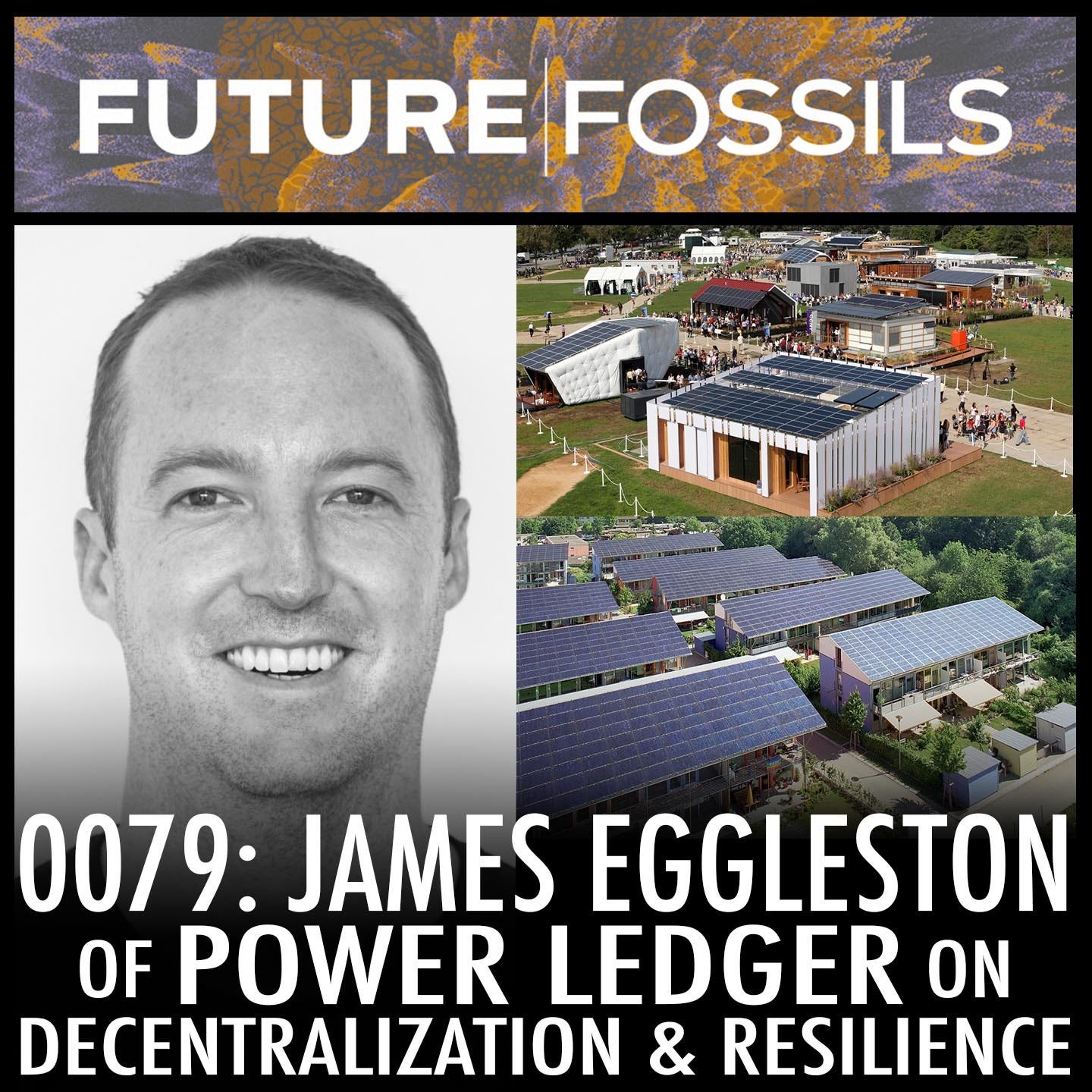
bylaws, the bulk of your energy bill is actually not the electricity you're using, it's actually the cost of being construction to get to your house. And if you build a big, global network, it's just going to still be super expensive. Greetings Future Fossils, this is Michael Garfield welcoming you to another episode of the podcast that explores our place in time. And if you've been following my posts in the Future Fossils Facebook group, you're aware that I consider one of the more potent features of our time to be the transition from centralized power structures to new distributed modes of governance and the other systems upon which civilization relies.
Yes, this episode is definitely a continuation of episode 52, where Jennifer Soudini and Michael Philip and I waxed Rhapsodic about the potentials of blockchain technology to transform our world. But because this is not technically a crypto podcast, I want to make it clear to everybody listening that this conversation with James Eggleston of Power Ledger is not some in-group buddy, buddy, backscratch for Bitcoin fanatics. But as with all other episodes of this show, we look at the work that James and his colleagues are doing as a thin section of the whole story of what it means to be human alive today and how we are collectively attempting to address and solve some of the most persistent problems our species has ever faced. In this case, namely the problem of electrifying a planetary culture, building resilient infrastructure upon which we can rely in an era of turbulence and constant black swan events.
And in James' case, this means looking at how to create a distributed energy market, a better way of doing power than centralized utilities with brittle infrastructure that ironically disempower us as individuals from participating meaningfully by sharing the load, electrically speaking, the responsibility and rewards of a decentralized utility. What does it look like when we are radically responsible for our own neighborhoods? And how do we get from point A, fracking, coal firing plants, energy monopolies, to point B, a world where clean and renewable energy is available cheaply to everybody? We're about to get into that.
I met up with James over a trans-pacific zoom call. So if you excuse the slightly substandard audio of this recording, I think you'll appreciate as I did how deeply and thoroughly the question of resilience has been integrated into every part of James' life. I found it totally inspiring. But first, a super quick shout out to this week's new Patreon supporters, Catherine Carr and Arthur Brock of Holochain, who will be on the show in just about a week.
Thanks to both of you and the other 120-something people who are supporting with small monthly donations, your $2 or $5 or whatever every month is what allows me to devote extensive time to the editing and publication of not just this podcast, but also lots of other media that I'm able to make free and public because of your support. Such as the collection of timelamps, videos, 360 videos and musical recordings, I made from all of the graphical recording sessions I did for Santa Fe Institute's interplanetary festival last week. I was up there on stage with bad-ass legendary folks like Jonathan Nolan and Martine Rothblatt and SFI President David Krakauer, who is Episode 75's guest. Go back and check that out.
It's a very lively and engaging conversation. And I'm very grateful to have been invited to participate in these discussions by projecting my own digital notes and drawings during the panels while I was on stage, as well as my own musical performance. And all of that is up on patreon.com slash Michael Garfield for free. I hope that you enjoy it and I hope that your friends enjoy it if you catch my drift.
Also a big thanks to everyone who has been reading and reviewing this show on whatever platform it is where you find it. Obviously sharing with your circles is a great way to get the show out there. But if you want to participate in the decentralized reputation engine revolution and turn on a bunch of strangers to this nonsense, then hop on Apple podcasts or whatever and give the show a five star review. It's free because time isn't money.
Let's get that right. And it's been super helpful. So again, thanks everyone who ever has or ever will help get this show out there. And with that, I end this tirade and present to you James Eggleston of Power Ledger on the future of electricity and how to cultivate resilience in your life.
So I'll just start by I'm Dan Eggleston. I give consent to this video to be recorded by video. Excellent. Well, James, welcome to Future Fossils.
Thanks Michael. Thanks for having me. Yeah, I'm excited because as I said to you in our emails, I think that your project Power Ledger was one of the earliest crypto projects discussed on this show, which doesn't really talk too much about blockchain projects and that kind of thing. But I am very fond of situating people in, you know, where like you are here in cosmic history in the evolution of the newosphere, you know.
And so there's a certain thing about the evolution of our infrastructure and the evolution of our systems, the systems in which we're embedded and our sort of awakening to our relationship to these great and mysterious things that is sort of characteristic of our time. And in that sense, your work in sort of making like the Promethean bolt here, like literally like our electrical grid, more sort of robust seems to me to be part of that, seems to me be part of like an ecologizing of our technology or a technologization of our ecosystemic identity. I don't know. Anyway, it's a great job of the show.
And I would love to just like invite you to just pull the cord and bite into the switch in whichever way you please. Great. I think that's an excellent place to start. Our, I guess, our power ledger, what we do is we don't create the wave.
We're writing it and our, we have an international board advisor by the name of people's time. And he's one of the, one of the comments or one of the phrases he's, he uses quite a lot is technology waves. And I think that fits in quite well with what we're doing and kind of where we're situated. So I mean, power ledger, I mean for those who don't know where the distributed ledger is, where the distributed energy markets, what we are is a blockchain company that provides a software solution to the energy market to enable network operators to use the market in a way that was never designed to basically reimagine the market and enable people to become not only consumers of electricity but producers as well and be rewarded regardless of how happy that generator is.
So for instance, at the moment we have big generators in regional areas powering cities with lots of infrastructure in between. That model of delivering energy that way is quite costly way. When you can see the new ways where we can generate energy much closer to the point of consumption and so we're seeing this kind of transition in the decentralization of generation assets and our software is kind of coming just at the right time on the way to be able to help facilitate that transition and ultimately facilitate the decarbonization and decentralization of the electricity network. But just people at your point, I guess since the 50s, 60s and 70s we saw lots of kind of physical signals converted into ones and zeros.
So we started to realize this human kind in terms of where this comes from. We realized that if we put a electrical, once we understood the photon and we understood that if you put an electrical current through a wire you could create a signal like a 1 or a 0. And then from the ones and the zeros we were able to then do things with them. So we saw the birth of early microprocessors and computing chips and things like that.
These types of changes or parallel shifts or steps in technological innovation underpin what we do today. And as you can appreciate once we get the ones and zeros into our processor and put those processes together, humankind started to create these computers. I probably as big as a room. Everyone's probably heard that before.
They're not snuffing you there. But those computers were isolated and people were performing very particular tasks on it. So from that we then started to see the needs to connect those computers together. So for instance within an office you might have two of these big machines.
You might be designing something in those computers. Maybe the 70s, maybe even the 80s. But you want those two computers to talk to another. So what happens then is we started to experiment with networking and our internets and things like that.
And ultimately as an evolution naturally occurs we started to see computers being networked all over the place and big networks joining other networks. So we saw ultimately why they're in networks and why they're in networks and why they're in networks. It's so large that they became interconnected and formed the global internet work operation up to the network with the internet. And so from understanding photon movement and electricity flow right up to network and computers over global internet work operation.
We then started to see this amazing innovation, narrow virtual graphic user interface. For instance when I was a teenager or maybe my primary years, I mean a dialogue modem, who could imagine that what we would use that internet for in subsequent 20 years was just unperceivable. And one of the innovations that really transformed the user of the internet was how we interact with it. So for instance if you told me when I was a very young teenager that in the future there'd be a website that we'd all be bending backwards over to upload our personal data for free.
I would have said absolutely not. There's no way that I would ever do that. So graphic user interface is an amazing innovation because that's exactly what did happen. And people around the world, everyone connected to the network.
For instance it just cannot help but upload their own onto the network to share. And the method is to do that as you're sharing with your family and friends. But obviously you share with everybody. So graphic user interface then led to data as an asset.
Because before that we had large amounts of data. But once we saw the real time uploading photos and things like that, that really exponentially drove the increase in the storage of data. And that data was valuable. In fact now, if you're in a factory or something or a couple of factories, if your factory burns down, one of the factories, in days don't mind that the destruction of that hard asset, I mean it still so often will get factory burns down.
The reduction of that asset was that, but now if you have the data, no problem, rebuild, or your manufacturing processes, you still have your customer type database. You know how you've been improving your product over time. It's the data now that is that, very precious resource. And so through that, it's finding that a digitized, almost non-material object is now more valuable potentially than a material object.
Which is really interesting because I guess we socially construct that value around that. But from data as an asset class, then came in predictive analytics. So now we have these big haystacks for data. How do we find the needle?
How do we do something with it? You know it's all one of the good having a big pile of data. But how do you analyze that data? And how do you get some more value out of it?
And so through that innovation, not only is it predictive analytics today a huge focus, particularly actuaries. So people are using actuaries science to try and make future predictions. But the move to data as well, the dematerialization that I talked about before as well, when you combine big data and dematerialization, that lends itself very well to the economy and in terms of spending. So in terms of spending money, when you were like a catcher at Uber or something like that, no money ever physically changes hands.
I call up the service, I get in the car, I walk away, that's it. But the value is digitally transacted over. I'm now transacted using an old banking system. It's a digital one, but it's an old one.
And it's a system that in some cases can take up three days to settle, which is quite interesting when you consider it's just a digital signal. No one's waiting for the credit or a genet to arrive at the bank on 9 o'clock on Monday morning to prove the transaction and copy and paste the transaction over. It doesn't work like that, it's all machines. So why does it take three days?
In this day and age? I'm particularly in Australia, I'm calling you from, we have 98% contactless payments. So what that means is that every shop I go to, I don't even have to put my car in a machine, I just wave my bank card over it and pay it. 90% in paid strange for me to go somewhere that doesn't have that feature.
But I know I travel quite a lot for work and I realise that I believe we have the highest amount of contact payment. The payment, although that's quick, it's still slow. And so that's what's brought in the application of blockchain. So those are the waves, there's photons, electrical signals to one from zero, to computer networks, to global networks, to data as an asset, to data analytics, to image utilisation and that blockchain.
And we're kind of at the beginning of that. So all of this, all of this is a, it seems like the way the narrative cast is that of a trend line toward increasingly robust and resilient systems, right? Where you're not relying on this, you know, the single point that's intermediary, and intermediating a particular transaction, you're not relying on a singular piece of infrastructure in order to provide electricity to a whole area. So how is this, I mean, is this in your mind, I guess, in this project specifically, is this more of a resilient network that's able to absorb damage or is it, like Nastim Taleib talks about, the anti-fragile?
It's actually learning and growing from its wounds, it's like a tax on the system, but be curious to hear about, like in practice, how this is playing out in the way that power ledger is decentralising an electricity market? Yeah, yeah. I mean, I guess I'll start by pointing out that we're a software company and there's many kind of technological transitions occurring that are leading to this decentralisation, particularly in the energy space. I guess a prime example, just to lead into that, would be the US Navy's invention of the internet as a technology.
So when they went to that, they wanted a communications network that didn't have a head that could be cut off. So if a node was struck in an attack, the whole communication network wouldn't go down. So one of the primary, regardless of the application, one of the primary reasons for decentralisation is for redundancy. And so in an electrical sense or electricity sense or delivery utility services, for instance, when our grandfathers were growing up, the only feasible way to provide non-stop energy to a town or a city was to build a coal-fired power station on top of a coal mine.
Like that was it. And the reality is that no one wanted to live next door to that. So you had a big generator, you then had lots of infrastructure to transmit that energy and then to distribute it. And that was a big centralised system.
And that was invented for the de-boxers' events, so to give you a sense of time-scales. That was that. And that's how, you know, it's good to provide it today, strangely. But de-boxed, no other thing, lots of coal-fired power stations out there.
So now there's a move towards decentralised energy. And the reason for that is renewable technologies. Now whether or not there are climate skeptics out there and there are others that may believe that the green agenda is a money-making machine, regardless of whether you believe that or not, about the damage that carbon can do on a climate, economically, renewable energy is just a cheap source of energy. So if you're comparing, if you've got $100 million and you want to get into the utility sector, the other part of your views on climate change, that $100 million we've better spent buying renewable generators that will be buying either a gas turbine or a coal-fired gas station.
When did that shift? Because that's been a recent thing. I know that Ramiz Nam's been going around talking about the exponential decline in solar cost. Yeah.
Yeah, so economy is a scale of driven that. But I guess, it's within the last five years or so. But the interesting thing is that obviously not buying fuel-fired with renewables. That's the cost that's the hook.
But yeah, in terms of the cost curve, so there are a number of renewable technologies. renewable technologies at the moment solar and wind are generally, in addition to pump hydro which has been around for a long time, are generally the most selected options for various reasons by large the fact that we're making so much of them drives down the price simple as that. If you look at any report about global spending on electricity, each year now more money is spent on renewables than any other source. So money is obviously still going into putting in coal pipes and power stations and nuclear and gas and things like that.
And some of those technologies for instance like gas, gas is a fantastic transition fuel. So if you are operating a city and you want to transition to 100% renewables, gas turbines are certainly a great way to do that. There's a series of reports that clearly articulate why there is the case and the beauty of gas turbine is that you can turn it on or off in an instant and ramp it up to provide constant electricity. So whereas with the other technologies, there's much more difficult to do that.
But basically with the renewable transition, we've seen the price for renewables come down, but the other important factor that's really driving uptake is actually the decreasing cost of storage, battery storage. That's the holy grail because as you can appreciate most places on the world, the wind doesn't blow all the time and obviously the sun doesn't shine all the time. So with those technologies, you're going to have to deal with the fact that you won't be generating 100% of the time and battery technology through economies of scale such as with your mobile phone manufacturing globally. I mean now every device that we carry obviously has a battery, just those massive supply chains producing batteries have also led to the decreasing cost of batteries.
And so yeah, that will happen in the last five or six years. The cost for batteries is probably still a little high. We're probably still seeing largely on the early adopters, especially batteries. But I mean, at a household scale, for instance, where I live in Australia, I do work over the world, but my market, as you can't be connected to is very easy to model.
We have one price for electricity. It's a non-contestable market. Around the end of 2019, it'll be cheaper for us here and per to have a battery and solar system, then it will be buying with source electricity. And to tie this into your resiliency question, yeah, so basically what that means is actually a great thing for the network, because what we'll start to see is what we'll start to see less reliance on centralized generation.
And we'll probably have to take an asset right down on that transmission infrastructure. But what will start to happen is the poles and wires and the street, I mean, hopefully they're below the ground, but they might be above the ground. Those poles and wires and obviously with the help of a software like Powerlage's software can become an energy internet. So at the moment, we have one directional flow.
So energy comes from a big power station to your house, over a long distance, and it goes one way. But obviously in the future, we'll see those big generators dissipate and we'll start to see houses all generating, all that roof space, for instance, with solar PV. And then we'll start to see via directional energy flows through that network. And that's what our software facilitates.
It's this idea that we call the democratization of the electricity market, or referred to as energy internet. We hear the term IOT a lot, which is internet of things. This is internet of energy. And really, a number of things have come together for that to occur.
And in a decentralized market, so the decentralization, the decentralization that's already occurring, the decreasing cost of battery storage and the uptake of implementation of household scale, in addition to a software layer that can settle transactions immediately, much different to existing software that uses banking sector, for instance. Those things culminating together will lead to a more resilient and also decentralized network. And the reason for that is if you take out one of the time it generated, no problem. Energy's coming from everywhere.
If you're a solar system, breaks, fine. What you need is exporting. So those are the types of things that drive resilience. So I want to anchor this in what I feel like is a real thing, because I know there's people that talk about accelerationism, and there's decelerationism, and somewhere in the valley of the shadow of death between those two things is a tech positive serious concern about the existential risk posed to us by things such as the Yellowstone volcano eruption, and like the potentiality of that eruption to create earthquakes that rupture a bunch of the nuclear reactors on the North American continent.
Another one that I'm like, I guess. Well, you know, in that case, in that case, actually, this was the subject of an unpleasant dinner conversation I was having with my aunt and my partner trying to convince them to move to Australia, actually, because the jet stream should keep most of that radiation in the northern hemisphere. But at any rate, there's also, and I think kind of, you know, globally, there's the issue of a massive solar flare, and the fact that the electrical grids as they are now are, you know, so tightly interwoven, and so reliant on these, you know, these transformers that do not themselves sort of possess sufficient grounding for this kind of thing. There were some, I forget the guy's name, but one guy in particular was going around in like 2008 and nine around the US and Europe, trying to, like, emphatically encouraging everyone to prepare to install massive surge protection in the transformers at every point.
And it sounds to me like a system like the system you're describing would be much more capable of soaking up a system like that, like a tragedy like that, or hurricanes. I'm just curious how you see this sort of disaster scenario stuff unfold. Okay, the hurricane was probably better. Just in terms of solar flare, I mean, every male on the planet would be sterilized, so we might have bigger problems.
Okay. And the energy market would probably be the least of my concerns. But in terms of those arguments, it's all about risk, really, and Terrence and we can put forward a great thought experiment about this where, you know, for instance, saving me our decarbonization target, you know, global leaders sat down in Paris, you know, agreed to not let global warming go about 1.5 degrees centigrade, but, you know, say we do that, but then an asteroid strikes the planet and it's going to go by. And we've been better placed to spend all that money and resources on an asteroid defense system.
So I think one example is, you know, really there's risks everywhere you look, and ultimately, you know, you have resources and you have to put those resources somewhere and do something with them that you want to do. One of my friends is in the army and he goes to war zones. And I often ask him about, you know, don't get stressed out when you go to the war zone. You know, for instance, if I could have put wrong, it's not going to be my last step, but for you, that could be the case.
And he pointed out to me that he goes, you know, do you ever drive? And I said, actually I don't have a transport transport, but for the sake of it, I did drive. You know, it's actually more dangerous to get that car every day than it could be. And the thing is, we all get the car every day, but none of us see that risk.
You know, some people go to the beach and they won't get in the water, I can go to the shark attack, but they'll drive to the beach. And that's fine. And so where we put our resources, really, there's risk everywhere you look and you just have to deal with the risk that's at hand. I mean, could it, if it's like I'm through and like, masterisation aside, you know, would it be the damage in their work?
Absolutely. I mean, it would damage everything. It might even damage the electromagnetic field of the earth. So you know, that we can't really control.
So my view would be to assess the risk, look at what is most likely and of the most likely, what aspects do we have control over and work across that. But I can't make any claim. Essentially, it would be immune from a pulse from the sun that I can't say. Well, that's fair and to the point, I'd say.
You mentioned in here, this like the warrior mentality. And before the call, you mentioned that you've just gotten back from some intense training. And I'm curious to hear you talk about that, if we can just pivot and take this into a complete, like into a different direction, but really into a kind of a continuation of the source of these questions about existential risk and the strategies that we have for managing them are a source of understanding of ourselves and what it's like to be alive at this time. And I think that there's something about the, like I have a friend in Europe who's very devoted to restoring like old Norse Viking wrestling as a sport at festivals and bringing back this culture of like safe and healthy masculinity.
And that may seem like a weird pivot for listeners, but I know that we can weave it because you've already demonstrated the capacity to like see this in terms of successive waves and systems and such. So you're just going to take that? Yeah, yeah, yeah. I mean, okay.
So for me personally, I'm definitely more of a lover than a fighter. And I think the way I see this, the way I mean, I, for instance, I'm outside of work. I'm very busy. So we work, obviously, that's a huge commitment.
I also write general articles on a researcher as well. But on top of that, yeah, I do a bit of physical training and some of it, I guess, it's done in a functional perspective. And the few, it's not cross-bed or anything like that, but the few places that offer that kind of services, they generally gear the people that are training in the military because that the function there is not about mirror muscles, it's just about how fast can you run, how I can you climb, how far can you swim, how I can you jump, you know, well, how much can you carry, that kind of stuff. And for me, I just, I guess I'm utilitarian in that perspective.
So that's kind of what I focused on, but what I've actually come to learn from doing that, and I do that every morning at 4.30 in the morning, the training sessions go anywhere between two hours a while. Basically, the way I see it is it's not so much worry mentality, it's more about mental resilience. And I'm a firm believer that if you want to increase your mental resilience, you do that through physical training. So, for instance, when you push yourself to the point that you want to stop, that's when it starts.
And the way that you grow your resilience is by putting yourself in that comfortable situation. So, from my perspective, I try and put myself in that situation every day. And for me, I find that it transfers well into my professional role. And I also find that as well, I'm planning discipline and to punch out as many general articles I can.
Because I think I'm on some, you know, if I just work all the time, I probably wouldn't be as effective as I am through that development process. And for me, that's where it comes from. I mean, I do enjoy your evenings, boxing or jiu jitsu. But once again, for me, that's just more of a, I guess you could say a sport.
There's not really something, I wouldn't necessarily encourage this kind of like tap out mentality where you go out and get something to get in the fight or something. I mean, the way I see that come up, if you're really good at fighting and you go out and someone challenges you to fight, I think you're an idiot to actually reciprocate the offer. I think it's that when a little kid might challenge you or fight, I mean, you're a fully great adult. I mean, of course, you're not going to hit a little kid.
And the other situation also stands. I think if that happens in a vast situation and you know you're going to win, I mean, the best thing you can do is walk away anyway. And it's not the reason why you do it. I think it's just a great physical test.
And there's nothing that forces you to train harder, which increases your mental resilience. And then to pick up where you started, I mean, over the last three days, I attempted that 36-hour event called Cardra Camp. For those that are on Instagram, you can see it all on Instagram at the Mil gym. And basically, the purpose of this facility is the mental resilience.
And the 36-hour Cardra Camp, ostensibly, is no sleep, no eating. It simulates some special forces training. The court, this particular course, for those six hours, in Australia, the real deal goes to 21 days. I actually lost the app before the end of the course.
So I voluntarily withdrew. And basically, it starts in the evening, starting the evening on Friday, it went all the way through Saturday. And that would have finished somewhere yesterday on Sunday. I got through to Saturday.
And it was enough. But basically, that point where, say you're running and you want to stop, well, that's the point they hold you at that entire time. And probably quite similar to what you guys have over in the States. I think you're referred to it with bugs, like the Navy SEAL training, or Hell Week.
Yeah. But interestingly, I'm going to attract all types of people. And I guess, you've got to work on all aspects of your life. I mean, I started to be talking about how I meditate.
I mean, that's one aspect. And I think your physical body is really all that you have. You might build up material wealth. And in my case, they get more publications and whatnot.
And you may be very lucky enough to have a significant impact on the lives of others, a positive impact. But at the end of the day, you've also got to be healthy. There's no point maintaining that. Without maintaining a healthy lifestyle.
And in order to get out of bed every morning and get on the row off at two kilometers or live something that you could live to. You need that discipline and you need that resilience. And so that's where all that comes from. It's interesting.
I mean, it's obvious your consistency of character across disciplines, that there's an integration here, you know, a drive towards resilience and all aspects of your life. If I may. It's a good point. That's I think in the way that people bring character to work, the way that you say Steve Jobs had that thing with design that influenced everything he touched.
And then actually I was connected to you through Robert Gordon in Perth also, who has this coaching practice. And I met him in Iceland at the seminar led by Sean Espjorn-Hargins, who I don't know if you know Sean Hargins and the Metahinterval folks, but their whole thing, like Sean's whole practice, I had him on the show to talk about how he structured his life to cultivate his head, his heart, and his horror, like his gut, you know, to live simultaneously through at the minimum, like all three nervous centers to like live completely through a whole body to approach and to make sure that he was like constantly developing himself in all of these ways. And it seems in some sense that Sean and you are both sort of animated by a similar holotropic drive. I don't know.
What do you, what is it? I guess to put that in a question, what motivates you? Yeah, I guess motivation is an interesting thing. I should just be with you, Mark.
So in terms of motivation, I guess you're on the planet for a finite period of time, and ultimately you want to do what you can. So in terms of my motivation, I actually don't know what drives me, to be honest. The why, for me, has generally always been to make a living and make a difference. And so I guess I've tried to stay true to that.
And in order to achieve what I need to achieve, what I seek to achieve, I guess it's about maintaining balance. And so through maintaining balance, that's how I achieve the goal of the mission. So that I believe is what drives me to maintain that balance, to try those different things, to work on different areas, and to do that in parallel. You can just focus on one area.
You can just eat bananas all the time, but then I think you can just eat bananas all the time, things will be really bad. So I think lifestyle as well. And I mean, all you do for living is important, but also that doesn't define you. There's many other things in your life that define you.
So it's about getting that balance right and striking that in an equitable manner. But I guess it's impossible to hold perfect balance. I think it's more like a spiderweb. And one thing kind of always starts to drift off, and you have to kind of focus on what you're building, and then something else starts to drift off, and you have to have that momentum in the balance.
It reminds me of Buckminster Fuller talking about tense segredy, like the balance of forces in a geodesic dome, everything sort of pulling and pushing against. You brought up a couple of times, you brought up your research, you brought up publications. I guess what I'm asking is, how does this aesthetic, this organizing principle, express itself in the way that you conduct your science? I'd love to hear a little bit about what actually you've been researching lately, specifically, and what kind of work you've been publishing.
Yeah, but so my research is actually writing the bottom. So my background, I used to work in research and develop a different number of years. And then I moved into government, and ended up working for an Australian Senator as an advisor in electricity space. I didn't start there as an advisor, I started there as an intern.
From that, that's led to what I currently do. So I guess my roots are very firmly grounded in technology and technological innovation. Then a lot of innovation that I was pushing for in my early days that we have proven to function was then inhibited by government policy. So that's what driving into the government side of things.
And then in the government side of things, it's actually very difficult to get change. There's a massive inertia to change to get progressive policy through. So that's what's led me back to what I am now. Now I kind of straddle halfway between government.
And obviously I'm very much in the private sector. But in terms of my research and how that all connects together is that that's driven me to focus on very applied research. Now this isn't to say that if your research isn't applied, it's not valuable. Not all research needs to be applied.
It doesn't need to be valuable in the sense that we would multiply it right now at this point in time. Bull in algebra is a great example of that. Bull in coming out with Bull in algebra probably had the acclaim of 10 mathematicians around the world. That logic process underpins every digital device in our old.
At the time it was invented, there were no digital devices. So sometimes time could be a factor in that. But in terms of how it's driven me, particularly in my research, is that I wanted to push the boundary, push the envelope in the decentralization of renewable generation and storage. And initially I was focused very much on decentralized renewable generation.
My research project for my doctoral research is a housing development referred to as WGB, where we've built 110 dwellings over four apartment buildings. And what we've done is created an open source governance framework for any of those buildings in that site to put in a big central battery and solar system on the roof. Those findings, how we achieve that, the amendments to what we refer to in the states is condominium law. We call it strata law, commercial modeling, system sizing, system architecture.
All of those frameworks that we have to overcome, all the barriers we overcame, so those frameworks we then have open source. So that means that any apartment building across Australia, so that's 30% of our housing stock, could now implement battery and solar at no cost for accessing the instructions on how to do it. And as I pointed out before, by the end of next year, it'll likely be cheaper to do that than my resource electricity. So that was my case study for my research project.
And it turns out we've influenced my approach. I mean, obviously we take very systematic, standard approaches to publishing information about that data. We certainly adhere to the peer review process. So everything is falsifiable, repeatable, holding true to the philosophies of science.
And ultimately what we do is produce articles whereby we're communicating what we've done in a way to incentivize other groups around the world to either take our research further, for instance, into other utility services. We've started plugging in electric vehicles into that site, but beyond. And so for me, I started in this research based solely focusing on the engineering and the renewable generators and our storage works. But ultimately what I've ended up working on in is software, protocols to facilitate the sharing or peer-to-peer trading or electricity between those assets.
And that's where things are at right now. So right now, obviously part of the calendar and part of our solution came out of that research project. But success is many fathers and families have opened. I'm sure there's other stories out there.
But yeah, that's the story, that's the line. And that's where it's ended up. And for me, the mission has always been the same to innovate with technology. And I tried many ways to do that.
But it seems that working in a policy institute and in the private sector seems to be the way to get so much change done at this point in time. I'd be curious to hear you speak specifically to the kind of problems that you run into working at the municipal level with a project like this. And also working internationally and across a multitude of different regulatory environments. Because obviously one of the more interesting things about the blockchain revolution or the decentralization of cryptographic technologies are you choose to look at this stuff, the trend towards this kind of thing in a very exciting and important position among these many, many exciting possible deployments.
It's like, oh, it's transforming everything. But when it comes down to it, basic access to electricity, to water, stuff like that is obviously massive and historical shift. So what is that like on the boring paperwork front? What is that like on the having to convince people in the old guard that you're not a psychopath or a threat?
Yeah. No, so it's a good point. So I guess I'll start with this with, not everyone in the world has access to electricity. So somewhere around 15% of the world's population have no access to anywhere.
So roughly 1.2 billion people. The network access is actually a huge problem in thinking. A lot of people are still in that's something that's slowly being eroded away. But that's still very real.
That's a very real reality. A lot of people are not still. So there are governments, big bodies looking at that in terms of connecting those people to electricity. So I'll just start by promising with that, not to forget about those people.
But in terms of where to, from here in a regulatory space, innovation always outfaces regulation. Regulators don't sit there and think about a possible technology and writing a rule that may apply to one day. I mean, it's not how regulation works and it's not how we would expect it to work. What it means is that innovation is actually driven on the other side.
In my case, it's the technology side. Other innovations occur in the social space. For instance, things like equal rights and whatnot. Obviously technology companies have a little influence in that space.
That's more of a government role. But generally, in my particular space I might find now, which is electricity, electricity, utilities, technology is king. And so in terms of our platform and how it interfaces and interacts with different regulatory environments. So what we've done is we, each of us come from the electricity market.
A few of us are watching as well. I mean, a true, true, to our name. I'm power ledger. I'm where a mix of power people and ledger people.
Without any mind, without any mind, what we've done is created a product that not only is a finely tuned blockchain application that's for a bus scalable and efficient and fast. But we've also designed it in a way that it can interface with any electrical market around the boat. And the way we achieved that is that we see this as an evolution, not an extinction event. So the path we went down, and we've made, there's no secret about this, is we are a software company, we're not an energy retailer.
So for instance, the rules you talk about, for instance, apply to players in the energy market, fine large energy regulation space. That would be better to be consumers and producers and all the intermediaries in point. So what we do is we position ourselves similar to the Microsoft Excel. So we're provided the software that in different markets, different application hosts would have to host the software.
So for instance, in America, one example would be behind the meter. So if you're inside an apartment building, you know, who looks after it then? So it would be the building manager. It wouldn't be the utility service.
So everyone needs an apartment building and there's a solar system and battery. And like I say, if anyone wants to know how to overcome the legal barriers to do that, we have an open source government framework to help you get through that. Then all you need to do is have the software, have the thing connected up and then training occurs through the power that you're training into. Now, training over the regulated market though, that's very different.
So in order to train to the building next door, although you might only be going through five meters of network infrastructure, there'll be a series of rules that determine who can trade energy over that network. Now, I don't know what particular state you're in, but depending on the state, I mean, let's just say it's a state where our retailer has the right to trade energy. Well, then for instance, the retailer could use our software and offer you that trading service. Now, if it was a contestable market, so if in your state you have a choice of multiple retailers, so for instance, say you think your energy's too high, in some states you have the choice and you'll be able to say, I don't like this energy company anymore.
I want to change companies. In that kind of space and the contestable space, same rules apply. Nothing would use our software and then that would actually give them a point of difference in competition with the other company. And so what you'll find is that we're not actually changing the rules of physics.
So you'll find that, you'll find that if you get your current plants and your voltmeters and you have a lot of time of building or you regulate us, spilling energy into the grid and even if they're getting paid for a lot, I know you guys have net metering, that energy is physically going to the closest point of consumption. Like, how does your platform, how software doesn't change those rules of physics? What it does do is it can see that when this person is putting energy in, this person's next door, this person pulling energy out, we can see that there was a transaction that occurred there and we can reconcile that transaction immediately, we can settle it. Here's the additional tokens.
So person A or building A has a wallet, building B has a wallet, both wallets are digital. As units of electricity are going between the buildings, digital tokens or cryptographic tokens are going to the point of generation and that's how it works. And so in that way, I mean, I can't see if you're in a risk of every country and every different body of application around the world. But basically what happens is that software can be in the market at some point, it just depends on who posted and ultimately that's how it works.
So we designed the platform with any mind and that's why we've seen such a wide international take up. So forgive me for not knowing this, I really, really, really meant to read the technical white paper before this call and life has just been very full. But I'm curious, does I know that the tokens are issued as ERC 20 tokens on Ethereum blockchain, correct? Is all network activity in the electrical market on the Ethereum blockchain?
Yes, just to clarify, I won't go too much into this. We have a dual token system. So we have a power token and some of your listeners may hold power. But we also have a spark.
And so when people are trading electricity, they're trading a spark, which is the second token. So that token is not a cryptocurrency. It's actually just a digital index. And the spark never changes in value.
So in America, one spark is one cent. It'll always be one cent per spark. You might be selling energy, let's just say 20 cents per kilowatt hour. And that would mean that every kilowatt hour you consume of your neighbours excess solar, 20 of your sparks are flying, then he's all heard a digital wallet.
And that happens instantly. So that's how the platform works. I just wanted to bring that up because I think that's an important distinction in that when people worry about the tokenization of everything, it's like not everything is actually going to be traded on an open market. And they're like, there are absolutely these things that you want to keep stable.
So there's like an ethical part of that. Yeah. So I mean, they're not to get confused with on cryptocurrency. So when we do have cryptocurrency, that's the power token, the data that that that's a separate function, the realistic application in utility services at this point in time is the cryptographic token.
And just to imagine how that works already in society, you might be an nephew's birthday, you go to the toy store, you give them $50, they give you a bit of paper that says $50 on it. That bit of paper has no value. It's just worth the paper with five and zero of another. But that then allows your nephew to return to the store and then redeem $50 a value to buy toys.
So what we do is the same thing. Instead of a voucher or instead of a gift card or whatever, what we're doing is giving you a cookie-gaffy token for your fiat money, for your money that you receive from your employer or from your investments. And from that, then that converts into a decisional token, which is then representing electricity. And so if you're exporting more energy than you're consuming, you'll be seeing your digital wallet fill up with sparks or your native sparks will be flowing into your wallet.
And then in that instance, if the energy retailers is the application host, you can return your sparks to the retailer and that would ever deem them to catch. So what is the world like that you imagine this being fully deployed in? Like, I mean, obviously this is when we talk about speculative fictions, often the mistake is to look at one technology in isolation. And I know that someone like yourself must be seeing this from tracking a dozen other technologies converging on specific possible test points on the horizon.
So what is, if you could, as we're coming close to the end of an hour, I'd love to hear you describe the future that you're actively building or the future that you hope you're helping steer into and what that looks like on a daily basis, how it works. Great. And a great place to finish as well. So there's two arguments about this.
Where is the energy network going? And so one argument is that we end up with what's referred to as the GEX or the global energy exchange. So, you know, some countries like China are very ambitious in seeking to do that by building a large transmission infrastructure all the way down through Russia, through Europe, and into Africa. And the way they foresee the future is yet one big global energy network.
But the other competing viewpoint and the one that I think is more realistic is what's referred to the modular network. As cool as the global energy exchange might sound, building a big network like that, it brings the same problems that we currently have. And the current problem we have is that we have long pieces of infrastructure that costs a lot of money. So, by and large, the bulk of your energy bill is actually not the electricity you're using, it's actually the cost of the infrastructure to get it to your house.
Son of a bitch. Yeah. So, and if you build a big global network, it's just going to still be super-attentive. And what's going to happen is you'll build a huge transmission line out to an island, because 30 houses and those 30 houses will never repay the cost of that infrastructure.
So that would let me share it by the whole network. I mean, as I'm sure you shouldn't penalise those people from being on the island. But the point is that old idea of having to build a big, long transmission infrastructure from a big centralized generator, it's been over. So, the way I personally see the future is decentralized, and that's what the trends currently already suggest.
I see the future being modular. So, you know, I mean, obviously in the States you'll continue to interconnect over the state borders, and you may have been interconnected to Canada and, you know, into Mexico and South America. I mean, on one big landmass, it makes sense. But, I mean, for instance, Australia is a great case of a test point.
We have a huge country. So, the land area of USA is pretty similar to the land area in Australia. But we only have a tiny fraction of your population. We only have about 22 million people in a year's hope.
My city, 2 million per cent. But what we do is we have a lot of land, we have to stretch our network over. And so, what we're starting to see is that you don't need to stretch a network over your entire state. You know, sometimes it's cheap, but I just put a big battery in the solar system or whatever renewable generator is, you know, is a pickle to the area in that town, in that city, because that's the cheaper way to do things.
And so, I personally feel that given the cost of infrastructure, the price of infrastructure, and group resiliency, we'll move to what's referred to as modular network, where it's increased distribution, generation, storage, innovative software, like ours, but also further software. So, you know, software that can encourage energy efficiency, turn down air conditioners or heaters when they're affecting the people that it's too much. Having a house and a place that will actually interact with you, beyond smart and intelligent. And those are the things I think are the different networkers.
And I feel we believe that that's what we're going. So, you brought it up. I did not bring it up for the record. Okay, you brought up the intelligent house, the intelligent city.
This, you know, this idea, I just saw, I forget who it was, somebody wrote a piece on Smart Cities for transhumanity.net. I think it was, and I've been getting the emails, and I've been thinking about this question because, you know, Greg Baer and Greg Egan and all these amazing science fiction writers have been toying with this idea of, oh, and, you know, China, Mayavild, the sentient city, also Paloszleri, the archeology, you know, this sort of city as organism. And so, I mean, do you feel like we are actually sort of creating a new form of life? Like, do you feel like our ledger is sort of in the process of facilitating a new, like, metropolitan, super biology?
I don't know. Well, I think in biology, it takes multiple interacting forces. And we're just one of the many, many, many organisms in there. But I guess it's like a flucker bird's eye.
So there are many technologies in the Smart Cities space. And, you know, we've been living in cities for thousands of years, really. It's not a new concept. They're always looking to innovate and make things better and more livable.
I mean, for instance, in Australia, there's a big push for that federal government. So we have lots of people moving here. So we respect, we really like immigration in Australia. We are all immigrants, we completely.
We've all come here at some point, and we also have traditional landowners as well. And from our perspective, from our government's perspective, having people wanting to live where you live is a great problem to have. And so what we do is we focus on livability in our cities. And technology is the way to achieve that.
So ultimately, you know, the goal of Smart Cities is the same, the goal is always in the city. It's human-furishing. But obviously now we're getting bigger and sharnier toys to apply in that setting to make life easier. So, you know, for instance, we play in the electricity space and we can automate transactions on the energy market.
And obviously that's one utility service amongst many within a metropolitan setting. So yeah, we are certainly part of that. We're not the main driver. But yeah, we will start to see cities go from beyond smart to intelligent.
And I mean, really, I mean, technology is just the extension of us. We're really just inside of a larger being, a larger organism. And ultimately, that would be the earth. You could probably scale that out of it.
Galaxy is all about the scale which you're relative to. But bringing it back down, we certainly see what we're offering is a great people today. But obviously, in 20 or 30 years time, we're contributing and whatnot, things will also be very different. I think it's an exciting space to be in.
And yeah, I guess watch this size. I like ending the calls in a place of heart because I feel like if this show is as I pretend it is, a message to people that will dig it up one day trying to understand what it was like to be us going through all this craziness, then you brought it up earlier in the call that 15% of the people still network access to the electrical grid. And that's a theme you hear lots of variations of in the blockchain space. The two billion unbanked people.
The way that we're trying to cross the gap of that last kilometer of missing infrastructure and provide services and provide opportunities for wealth generation to the world's poor. And I'd like to hear you speak to that. Maybe that's the way that we can sign this off is that there's something about the meek inheriting the earth here. If I can get a little heavy handed with it, that just as mobile payments shows up first in Africa because they don't have the banking infrastructure, that there's a sense in which the city is both helping us with this innovation and also maybe it will find its natural footing first in these places where there's less legacy infrastructure in place.
So I'll be here to speak to that. Yeah, great point. And that's exactly what we're finding. So obviously I've spoken quite extensively about cities.
I did mention that our last portion of the global population don't have access to electricity. You're absolutely right. A lot of our projects are actually in those areas. So basically with the power of the platform, for instance, if you have a village and they can get a solar panel and maybe multiple people want to use energy from that panel to charge their phones, which is super common.
Then you know, it would be challenging this time how long the person spends charging their phone or basically the cost of our software is so low. It's almost no existing application. That what would happen is that's all the panel would generate revenue. So if they didn't use the solar panel, it would either be coming, that people would be entering the town that formed a diesel and the money would be leaving and be going to where the diesel came from.
So once you can stop that cycle, you can have renewable generation on site. That actually traps the value in that village or community. If you're providing a service where there's just one panel, that can be paid for another panel and another panel and another panel and soon the village will probably want a battery so they can keep energy going all night. But then what will happen is that phenomenon will be taking place in the village next door as well.
So capturing that value in the town, that can actually empower those individuals to own their own network. What the town's going to do is find a line between the two, between towns on hold on mass. So those are the types of projects we started to see unfold. I mean, my research has certainly evolved in smart cities.
I do tend towards that in my discussions. But yeah, the tabular raza of a green build city that needs an energy network means they can get the futuristic energy network that you would build today. Whereas over here in the developed world, we inherit our networks from previous design methodologies. So in terms of blockchain and its liberation and emancipation of individuals that are currently marginalised and delegitimised and are emerging economies, this is certainly a crucial tool for cutting the middle person out and letting the property value say in the villages, in the hands of the people that need the services most.
And so from our perspective, I look with my policy writing hat on, you can have electricity without an economy without electricity. And so we see this as a cornerstone for really making the world a much more equal and fair just place. Right on. James Eggleston, thank you for being on the show, dude.
It's been a pleasure. Thanks, I'm Michael. Where can people learn more? Great.
So you can come to our website, which is powerledger.io. You can follow me on Twitter at James by chance. And I look forward to hearing any questions if anyone would like to send me something else with us. You have it folks.
Thanks a lot. Thank you, Michael. Thanks again for listening. I hope you enjoyed that episode as much as I did.
Future Fossils is part of the Mind of Pod Network, along with Third Eye Drops, Astro Hustle, Synchronicity Podcast, and an oodle of other fascinating programs. I encourage you to go to mindpodnetwork.com and subscribe to them all. And stay tuned because we have some awesome episodes coming up on Future Fossils. But for now, may your now be exquisite, long and wonderful.