
EPISODE · Jul 9, 2026 · 24 MIN
A Basic Guide to Reading the Bible for Yourself
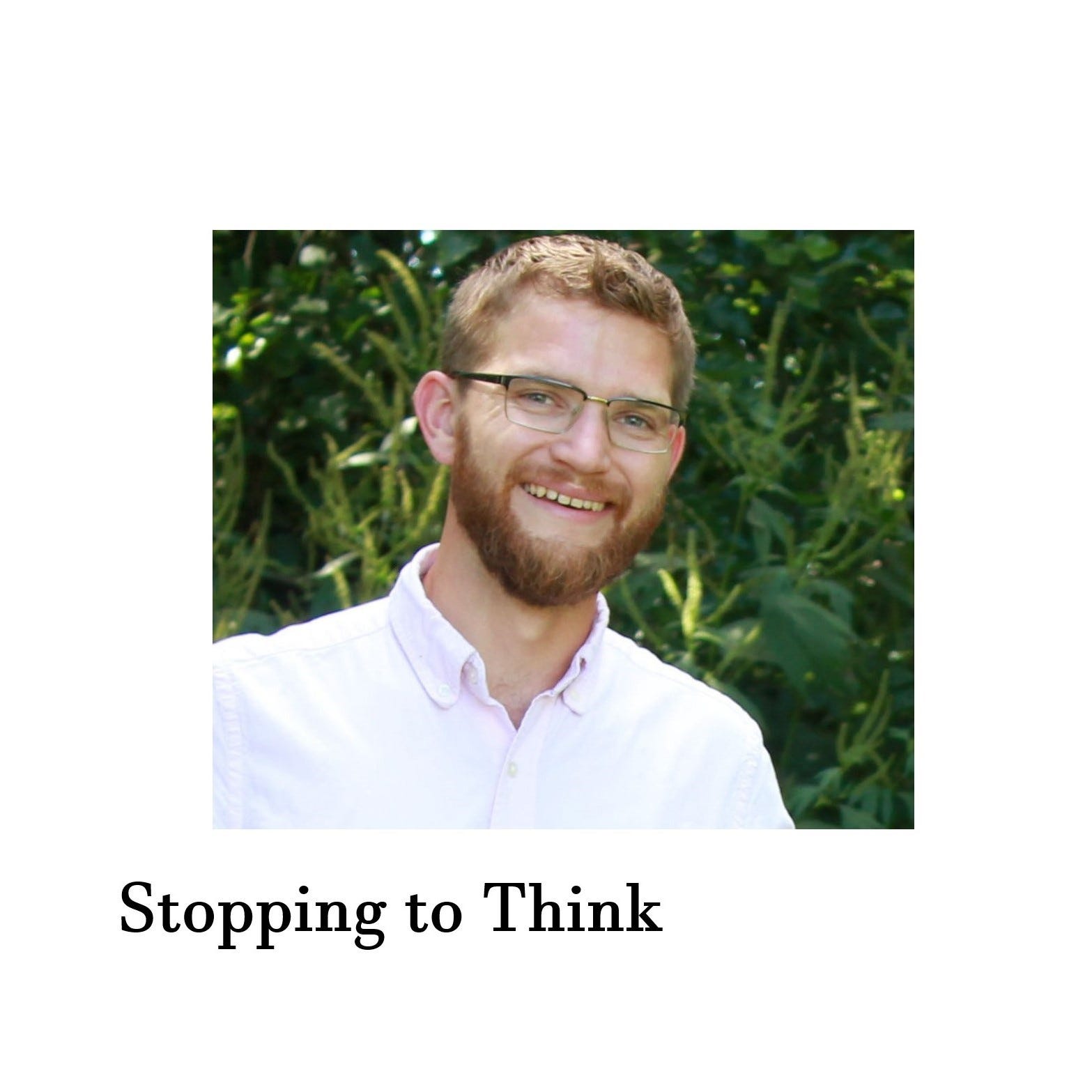
from Stopping to Think · host Will Dole
One of the most frequent comments I hear when I talk to people about reading the Bible is “it just doesn’t make any sense to me.” This little guide is my attempt to give some guidance on getting started. (video version at the bottom of the post)I. WhatWhat is the Bible? The Bible, in short, is the very Word of the Living God.When I refer to the Bible, I am referring to the 66 books which include the Old and New Testaments. Included in this “canon” are the 39 books of the Old Testament that make up the Hebrew Bible, and the 27 books of the New Testament.You’ll read a lot on the internet these days about the church “making” the Bible and suppressing these ideas that contradicted what the “powerful” people wanted everyone to believe. This is simple hogwash. The truth is far more simple, and less sensational. The church did not “pick and choose” which books to include in the Bible, but rather came to recognize those books which had the marks of true Divine Authorship, and in the course of time the church came to a clear consensus.The Scriptures themselves testify to their own Divine Origin and Authority: “All Scripture is breathed out by God and profitable” (2 Timothy 3:16), “no prophecy ever came by human will, but men spoke from God as they were carried along by the Holy Spirit” (2 Peter 1:21).In the Scriptures we hear the very voice of God, graciously disclosed in the written speech to his creatures.II. WhyWhy would you want to read the Bible? What are you hoping to get out of it? Well, based on our definition above—that the scriptures are the self-disclosure of God to his creatures—the core reason we come to the Bible is to hear God’s voice.We need to hear God’s voice, first of all, to know him. The Bible reveals to us the character of God and the work of God, especially his saving work revealed in the Gospel of Jesus Christ.We need to hear God’s voice in order to see ourselves, both as we were made to be (Genesis 1:26-28), and as we are this side of the fall (Romans 3:23).We need to hear God’s voice in order to live in accord with his intention. The Scriptures are fundamentally relational documents. They are not mere history, or a record of God’s words and work in the past. They are his word for us today (Romans 15:4, cf. 1 Corinthians 10:6).III. HowOkay, if the Bible is God’s word, how should we then read?Many years ago I was taught an acronym for Bible reading: CPRS. We should read:* Carefully* Prayerfully* Repeatedly* SlowlyThanks for reading Stopping to Think! This post is public so feel free to share it.CarefullyWhat does it mean to read carefully? It means that we must pay attention to what we are reading. This is harder than it sounds, and frankly it’s a lot harder than it was when I first learned this acronym. We live in a world where multi-billion-dollar-companies are entirely invested in harvesting and selling your attention and the associated data. This is linked to that handy glowing screen, on which you are likely reading this very article. You might feel focused at the moment, but we are only seconds away from you being distracted by a text or a phone call or an email notification. And even if those things don’t come, you are distracted, at least subconsciously, by the anticipation. Practically speaking, this means that careful Bible reading is going to require some separation. So, practically speaking, this means that careful Bible reading is going to require some separation. It’s going to mean you need to create a time and place—even if it’s just 10 minutes—where your phone isn’t with you, and you pick up your paper Bible and carefully read. Give yourself some space to think. As Sinclair Ferguson put it plainly, “Christians need to think about what the Bible says.”Try to notice things. What do you notice? It helps to keep a note pad or even a sticky note in or near your Bible to jot things down. Ask questions. What kind of questions? I’ll include a starter list below. Prayerfully The Psalmist wrote: “Help me understand your instruction” (Psalm 119:34, CSB). If we are going to rightly understand God’s word, then we must ask God to help us understand his words. Pray for understanding and pray…to obeyWe also pray as we read the Bible because the Bible itself is the best school of prayer. As you read the Bible, you will learn God’s language. You will encounter God’s actions in history, you will learn about his power, his promises, and his priorities. And while normal reading skills are genuinely useful, and advanced study and thought will help you along the way, ultimately, this is a spiritual endeavor. To quote Martin Luther, the 16th century church reformer:“That the Holy Scriptures cannot be penetrated by study and talent is most certain. Therefore your first duty is to pray…for no master of the divine words exists except the Author of these words.”Pray for understanding, and pray for the ability and desire to obey his words (Philippians 2:13-14).Repeatedly I was once listening to a lecture by New Testament scholar D.A. Carson, and he said something that, at one level, was obvious…but that I had never really integrated intentionally into my Bible reading. What he pointed out was that the Bible is meditative literature.You shouldn’t expect to sit down and give it a single read-through and understand everything. What he meant by that is that the Bible is meant to be read little by little, with you going back over and chewing on, mulling over, meditating, upon what you’ve just read. You shouldn’t expect to sit down and give it a single read-through and understand everything. That should encourage you. Over the years I’ve heard many people bemoan the fact that they read something and don’t understand it, or even forget it. Friends: it’s okay. Just read it.And read it again.And again.And again. “Blessed is the man…[whose] delight is in the law of the Lord, and on his law he meditates day and night” (Psalm 1:1–2). Meditation, biblically speaking, is not the emptying of your mind. It is fixing your mind on something, focusing on it, and turning it over and over and over. Reading something repeatedly is a basic form of meditation.Slowly Don’t be in a hurry. Even if your time available is short, just be okay with reading a very short passage and slowly reading over it. I would encourage you to read out loud. This is a great way to slow yourself down, engage more of your senses, and increase your comprehension and retention. I will even do this with longer passages if I have a lot of time but am trying to fightmy mind drifting away.“You don’t read the Bible to finish. You read the Bible to change.”Don’t be embarrassed to read slow. I love what my old pastor, Dave Donnerberg, used to say: “You don’t read the Bible to finish. You read the Bible to change.” Reading the Bible in such a way that God changes you, from the inside out, does not come from speed reading. It comes from slow reading.IV. SpecificsAs you start reading the Bible, I would suggest you set a specific time of day when you will read the Bible every day. That’s not because God will zap you dead or be disappointed in you if you miss a day, but because if you want this to be a habit, it really is going to be hard to establish if you don’t make it an every day thing. Most people are going to have better success in the morning. And I would set aside 10-15 minutes to start with. Even if you have more time available, start there until the habit is established, so that it doesn’t feel overwhelming. And then, don’t feel bad or give up if you miss a day (or a week!), just hop back on the horse and keep going.It will also be beneficial to establishing the habit if you set a regular place. For me that has some flex—my kitchen table is “the place”, but I will move outside to my patio if the weather is nice. It really helps me to smell fresh air and hear the birds as I read and pray.I would suggest starting with some well-known passages. Read those passages repeatedly until you feel ready to move on. At the end of this post I will attach a 60-day plan you can use, if that is helpful to you.Also, below you will find the questions I promised above. I wrote these down originally for my older son, as he and I have started to read the Bible together. The first five are intended to help you think carefully, and the next three to help you read prayerfully, and hopefully you will be able to answer them all as you read repeatedly and slowly. Careful Questions and Prayerful Questions:Careful Questions: a) What did I notice? b) What is confusing, or do I not understand? c) What does this teach me about God? d) What does this teach me about myself? e) How can I obey this part of God’s word?Prayerful Questions: a) How can I thank God based on what I read? b) What else do I need to ask for his help with? c) What do I need to ask him to help me understand?V. FinallyYou may have noticed that the last two questions were more broad. That is intentional. Reading God’s word meditatively will help us to understand his word better, but it is also a doorway to communing with him. It’s going to bring to mind things far beyond what you read. Like a conversation with a dear friend or trusted mentor, the conversation may drift as you pray. That’s okay. Embrace conversation with your Heavenly Father.Reading God’s word is one of the most rewarding things you can do. I cannot promise that it will instantly change your life. But I can assure you that, if you dedicate yourself to it, it will shape your life.May God add his blessing to your reading of his word. “For as the rain and the snow come down from heaven and do not return there but water the earth, making it bring forth and sprout, giving seed to the sower and bread to the eater, so shall my word be that goes out from my mouth; it shall not return to me empty, but it shall accomplish that which I purpose, and shall succeed in the thing for which I sent it.” (Isaiah 55:10-11)Stopping to Think is a reader-supported publication. Do you enjoy resources like this? To receive new posts and support my work, consider becoming a free or paid subscriber. This is a public episode. If you'd like to discuss this with other subscribers or get access to bonus episodes, visit willdole.substack.com/subscribe
NOW PLAYING
A Basic Guide to Reading the Bible for Yourself
No transcript for this episode yet
Similar Episodes
No similar episodes found.
Similar Podcasts
No similar podcasts found.