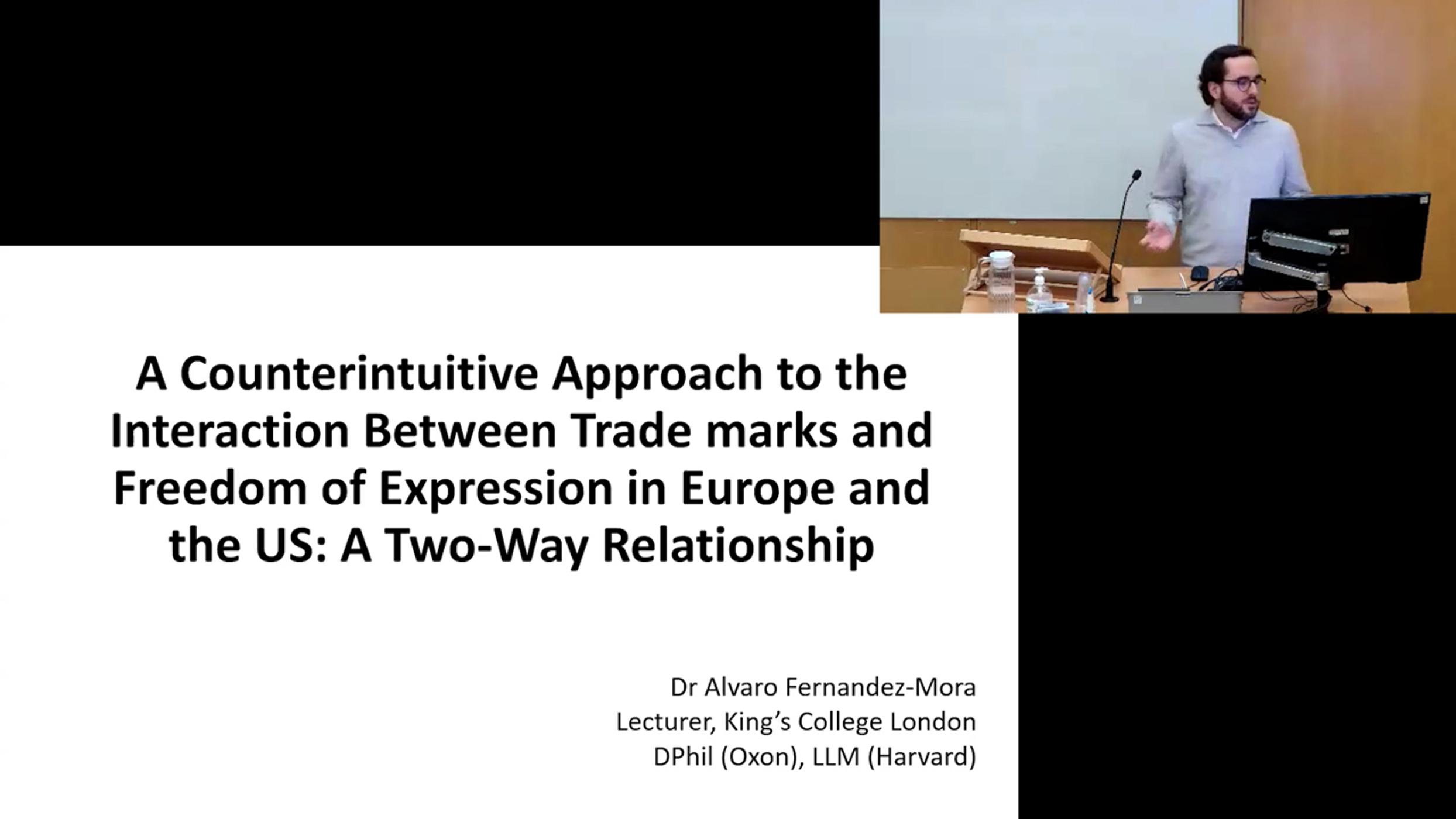
'A Counterintuitive Approach to the Interaction Between Trade marks and Freedom of Expression in Europe and the US: A Two-Way Relationship': CIPIL Evening seminar (audio) episode artwork

EPISODE · Mar 6, 2024 · 41 MIN

'A Counterintuitive Approach to the Interaction Between Trade marks and Freedom of Expression in Europe and the US: A Two-Way Relationship': CIPIL Evening seminar (audio)

from Centre for Intellectual Property and Information Law (CIPIL) Podcast

Speaker: Dr Alvaro Fernandez-Mora, KCLAbstract: As trade marks have evolved to perform an expressive function, courts and scholars on both sides of the Atlantic have devoted increased attention to elucidating when, and how, marks and speech interact. Three forms of interaction can be identified in European and US case law. First, in infringement litigation, a defendant can invoke speech with a view toward insulating from liability his unauthorized use of plaintiff’s mark for expressive purposes, usually for parody or commentary. Second, in trade mark registration, unsuccessful applicants can invoke speech to challenge the validity of a refusal of registration. And third, in constitutional challenges, a trade mark owner can invoke speech in seeking to strike down public measures encroaching on trade mark use. Regrettably, to date, commentators have had a tendency to focus on one form of interaction at a time, placing special emphasis on infringement cases. Their analyses and proposals for reform have privileged this form of interaction in an effort to avoid the severe repercussions that unbridled enforcement of trade mark rights could have on defendants’ speech. This has led to an impoverished understanding of the interaction between marks and speech, broadly considered. In the absence of comprehensive studies covering the diversity of instances where both sets of rights interact, conventional wisdom posits that their interaction is unidirectional, in the sense that trade mark rights chill expression. My ongoing research seeks to redress this misconception by engaging in a taxonomic analysis of the diverse scenarios in which marks and speech interact. Their joint study reveals that this interaction is best understood as a two-way street, where freedom of expression can simultaneously limit and validate trade mark rights. The proposed reconceptualization of the interaction between marks and speech can contribute significantly to the advancement of the field.Biography: Dr Alvaro Fernandez-Mora is a Lecturer in Intellectual Property Law at The Dickson Poon School of Law. Alvaro joined King's College London in 2024, having previously worked as a Lecturer in Law at the University of York (2021-2024). Alvaro has earned degrees from the University of Oxford (DPhil), Harvard Law School (LLM) and Universidad Pontificia Comillas de Madrid ICADE (LLB). Before pursuing his doctoral studies, Alvaro worked as an associate lawyer at Hogan Lovells LLP’s intellectual property litigation department in Madrid. Alvaro's research interests lie at the intersection between intellectual property law and other fields –notably human rights, competition law and economics–, often from a comparative perspective. Alvaro's work has been published in the Berkeley Journal of International Law (BJIL), the International Review of Intellectual Property and Competition Law (IIC) or the Intellectual Property Quarterly (IPQ).For more information see:https://www.cipil.law.cam.ac.uk/seminars-and-events/cipil-seminarsThis entry provides an audio source for iTunes.

Speaker: Dr Alvaro Fernandez-Mora, KCL Abstract: As trade marks have evolved to perform an expressive function, courts and scholars on both sides of the Atlantic have devoted increased attention to elucidating when, and how, marks and speech interact. Three forms of interaction can be identified in European and US case law. First, in infringement litigation, a defendant can invoke speech with a view toward insulating from liability his unauthorized use of plaintiff’s mark for expressive purposes, usually for parody or commentary. Second, in trade mark registration, unsuccessful applicants can invoke speech to challenge the validity of a refusal of registration. And third, in constitutional challenges, a trade mark owner can invoke speech in seeking to strike down public measures encroaching on trade mark use. Regrettably, to date, commentators have had a tendency to focus on one form of interaction at a time, placing special emphasis on infringement cases. Their analyses and proposals for reform have privileged this form of interaction in an effort to avoid the severe repercussions that unbridled enforcement of trade mark rights could have on defendants’ speech. This has led to an impoverished understanding of the interaction between marks and speech, broadly considered. In the absence of comprehensive studies covering the diversity of instances where both sets of rights interact, conventional wisdom posits that their interaction is unidirectional, in the sense that trade mark rights chill expression. My ongoing research seeks to redress this misconception by engaging in a taxonomic analysis of the diverse scenarios in which marks and speech interact. Their joint study reveals that this interaction is best understood as a two-way street, where freedom of expression can simultaneously limit and validate trade mark rights. The proposed reconceptualization of the interaction between marks and speech can contribute significantly to the advancement of the field. Biography: Dr Alvaro Fernandez-Mora is a Lecturer in Intellectual Property Law at The Dickson Poon School of Law. Alvaro joined King's College London in 2024, having previously worked as a Lecturer in Law at the University of York (2021-2024). Alvaro has earned degrees from the University of Oxford (DPhil), Harvard Law School (LLM) and Universidad Pontificia Comillas de Madrid ICADE (LLB). Before pursuing his doctoral studies, Alvaro worked as an associate lawyer at Hogan Lovells LLP’s intellectual property litigation department in Madrid. Alvaro's research interests lie at the intersection between intellectual property law and other fields –notably human rights, competition law and economics–, often from a comparative perspective. Alvaro's work has been published in the Berkeley Journal of International Law (BJIL), the International Review of Intellectual Property and Competition Law (IIC) or the Intellectual Property Quarterly (IPQ). For more information see: https://www.cipil.law.cam.ac.uk/seminars-and-events/cipil-seminars This entry provides an audio source for iTunes.

NOW PLAYING

'A Counterintuitive Approach to the Interaction Between Trade marks and Freedom of Expression in Europe and the US: A Two-Way Relationship': CIPIL Evening seminar (audio)

0:00 41:19

No transcript for this episode yet

We transcribe on demand. Request one and we'll notify you when it's ready — usually under 10 minutes.

MG Show MG Show The MG Show, hosted by Jeffrey Pedersen and Shannon Townsend, is a leading alternative media platform dedicated to uncovering the truth behind today’s most pressing political issues. Launched in 2019, the show has grown exponentially, offering unfiltered insights, comprehensive research, and real-time analysis. With a commitment to independent journalism and factual integrity, the MG Show empowers its audience with knowledge and encourages active participation in the political discourse. Breaking News Show | eTurboNews Juergen Thomas Steinmetz News is relevant to the global travel and tourism industry, human rights and global issues.Breaking news when it happens and only from the source. Eat to Live Jenna Fuhrman, Dr. Fuhrman Our health is our most precious gift and smart nutrition can change your life. Each month, join Dr. Fuhrman and his daughter, Jenna Fuhrman as they discuss important topics in the world of nutrition. Eat to Live will change the way you eat and think about food. French Your Way Jessica: Native French teacher founder of French Your Way Boost your French listening skills and test your comprehension with this one of a kind series of podcasts. Get the chance to listen to a real conversation between native speakers talking at normal speed AND customise your learning experience through carefully designed sets of questions (2 levels of difficulty) available for download at www.frenchvoicespodcast.com. All interviews also come with the transcript. French teacher Jessica interviews native speakers of French from around the world who share a bit of their life and passion. Where else would you meet in one same place a French yoga teacher based in Melbourne, a soap manufacturer from Provence, or a couple cycling around the world?

Frequently Asked Questions

How long is this episode of Centre for Intellectual Property and Information Law (CIPIL) Podcast?

This episode is 41 minutes long.

When was this Centre for Intellectual Property and Information Law (CIPIL) Podcast episode published?

This episode was published on March 6, 2024.

What is this episode about?

Speaker: Dr Alvaro Fernandez-Mora, KCLAbstract: As trade marks have evolved to perform an expressive function, courts and scholars on both sides of the Atlantic have devoted increased attention to elucidating when, and how, marks and speech...

Can I download this Centre for Intellectual Property and Information Law (CIPIL) Podcast episode?

Yes, you can download this episode by clicking the download button on the episode player, or subscribe to the podcast in your preferred podcast app for automatic downloads.
URL copied to clipboard!