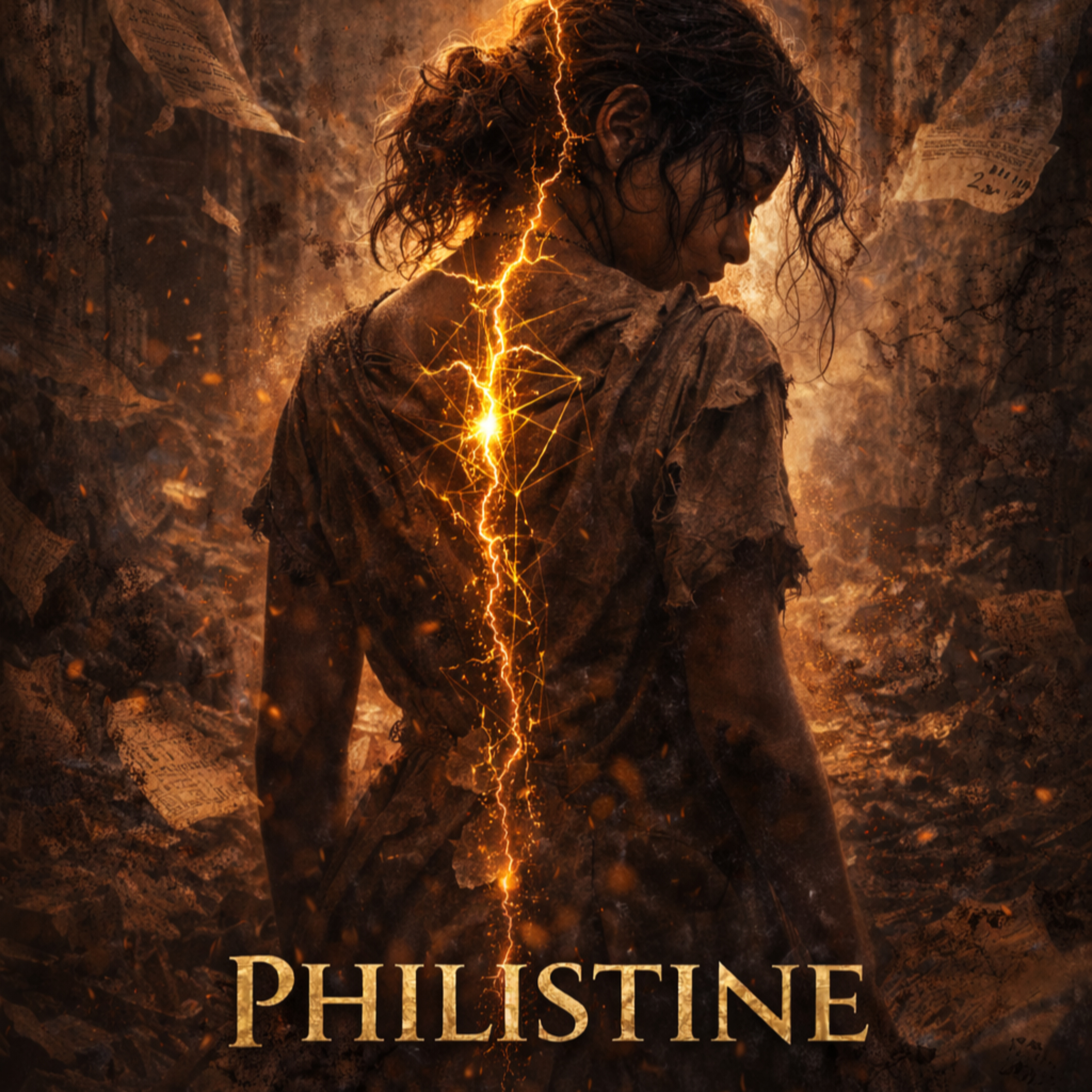
A Note to the Listener episode artwork

EPISODE · May 28, 2026 · 2 MIN

A Note to the Listener

from Philistine · host Demha Le-Rezan

A Note to the ListenerBefore you begin, it may help to know what kind of story Philistine is—and what it is not.This is not a story about a single hero who changes the world through force, victory, or recognition.It is a story about accumulation.In Philistine, change does not arrive all at once. It builds quietly, through ordinary lives that history often fails to name: a mother, a child, a family displaced, a loss that goes unrecorded. These moments may appear briefly, sometimes only for a scene or a page, but they are not incidental. They are the substance of the story.The central character, Alia, does not always stand at the center of events. At times she recedes, blends into the background, or becomes almost imperceptible. This is intentional. Her role is not to dominate the narrative, but to allow many lives—often unseen, often unnamed—to register without being erased.Throughout the series, breath functions as a guiding image. A single breath can disturb something small. Many breaths, sustained over time, become pressure. Enough pressure changes what can remain standing. Justice, in this story, works the same way. It does not announce itself as an event. It becomes unavoidable as a condition.You may notice that the story does not always explain itself, and that resolution is sometimes withheld. This is not an absence of meaning. It is part of the design. Philistine asks you to carry what you encounter, rather than wait for it to be summarized or resolved.If you continue, you are not being asked to follow every detail or remember every name. You are being asked to feel the weight of accumulation—and to notice what becomes impossible to deny once enough has been carried.This is a story that does not shout. It gathers.Philistine — 17 (Seventeen) ChaptersPurchase: https://mybook.to/philistinePaperbackEbookAudible: https://www.amazon.com/Philistine/dp/B0GQJPK1G4Audiobookcontact: [email protected]: @Fr33PhilistineThe complete 80,000+ words / 10+ hrs of audio bundle are available directly:website: https://FreePhilistine.com

A Note to the ListenerBefore you begin, it may help to know what kind of story Philistine is—and what it is not.This is not a story about a single hero who changes the world through force, victory, or recognition.It is a story about accumulation.In Philistine, change does not arrive all at once. It builds quietly, through ordinary lives that history often fails to name: a mother, a child, a family displaced, a loss that goes unrecorded. These moments may appear briefly, sometimes only for a scene or a page, but they are not incidental. They are the substance of the story.The central character, Alia, does not always stand at the center of events. At times she recedes, blends into the background, or becomes almost imperceptible. This is intentional. Her role is not to dominate the narrative, but to allow many lives—often unseen, often unnamed—to register without being erased.Throughout the series, breath functions as a guiding image. A single breath can disturb something small. Many breaths, sustained over time, become pressure. Enough pressure changes what can remain standing. Justice, in this story, works the same way. It does not announce itself as an event. It becomes unavoidable as a condition.You may notice that the story does not always explain itself, and that resolution is sometimes withheld. This is not an absence of meaning. It is part of the design. Philistine asks you to carry what you encounter, rather than wait for it to be summarized or resolved.If you continue, you are not being asked to follow every detail or remember every name. You are being asked to feel the weight of accumulation—and to notice what becomes impossible to deny once enough has been carried.This is a story that does not shout. It gathers.Philistine — 17 (Seventeen) ChaptersPurchase: https://mybook.to/philistinePaperbackEbookAudible: https://www.amazon.com/Philistine/dp/B0GQJPK1G4Audiobookcontact: [email protected]: @Fr33PhilistineThe complete 80,000+ words / 10+ hrs of audio bundle are available directly:website: https://FreePhilistine.com

NOW PLAYING

A Note to the Listener

0:00 2:19

No transcript for this episode yet

We transcribe on demand. Request one and we'll notify you when it's ready — usually under 10 minutes.

Chapter 36

Jun 18, 2026 ·14m

Chapter 37

Jun 18, 2026 ·6m

Chapter 38

Jun 18, 2026 ·6m

Chapter 39

Jun 18, 2026 ·4m

Chapter 40

Jun 18, 2026 ·11m

Chapter 41

Jun 18, 2026 ·9m

1st and 2nd Samuel (2015) Dr. Robert L. Dean Jr. From the words of a young David in 1 Samuel 17:37, “The Lord who delivered me from the paw of the lion and from the paw of the bear, He will deliver me from the hand of this Philistine.”, we derive the central theme for this study of 1st and 2nd Samuel, THE BATTLE IS THE LORD’s. We all face overwhelming circumstances in our life and the only thing that can give us strength to overcome those horrific circumstances is a realization that it is not by our might or power, but by the power of the Ho An Ordinary Giant Slayer American Family Association David’s battle with Goliath is an epic drama where the little boy stands in God’s power to conquer the Philistine giant. An Ordinary Giant Slayer American Family Association David, the son of Jesse, was just an ordinary giant slayer. David’s battle with Goliath is an epic drama where the little boy stands in God’s power to conquer the Philistine giant. CIPN - 15 February 2016 - Performance and Subversion in Public Spaces Dave Beech (Valand Academy, Gothenburg, member of the art collective Freee, writer and Professor of Art)Revolting Places: Art’s Apparatus and Radical Social TransformationChloë Alaghband-Zadeh i(Temporary University Lecturer at the Faculty of Music, University of Cambridge)Beech’s recent book Art and Value, published by Brill 2015, was shortlisted for the Deutscher Memorial Prize. His work has been exhibited at the Istanbul Biennial and the Liverpool Biennial as well as BAK, Utrecht, Wysing Arts, Cambridge, SMART Project Space, Amsterdam, the ICA, London, Centro Cultural, Montehermoso among others. He is a regularly contributor to Art Monthly, co-authored the book The Philistine Controversy, Verso (2002) with John Roberts, edited the MIT/Whitechapel book Beauty, and is a founding co-editor of Art and the Public Sphere journal. Chloë Alaghband-Zadeh is a Temporary University Lecturer at the Faculty of Music, University of Cambridge. Her research is on North Indian classical mu

Frequently Asked Questions

How long is this episode of Philistine?

This episode is 2 minutes long.

When was this Philistine episode published?

This episode was published on May 28, 2026.

What is this episode about?

A Note to the ListenerBefore you begin, it may help to know what kind of story Philistine is—and what it is not.This is not a story about a single hero who changes the world through force, victory, or recognition.It is a story about accumulation.In...

Can I download this Philistine episode?

Yes, you can download this episode by clicking the download button on the episode player, or subscribe to the podcast in your preferred podcast app for automatic downloads.
URL copied to clipboard!