
EPISODE · Mar 15, 2026 · 12 MIN
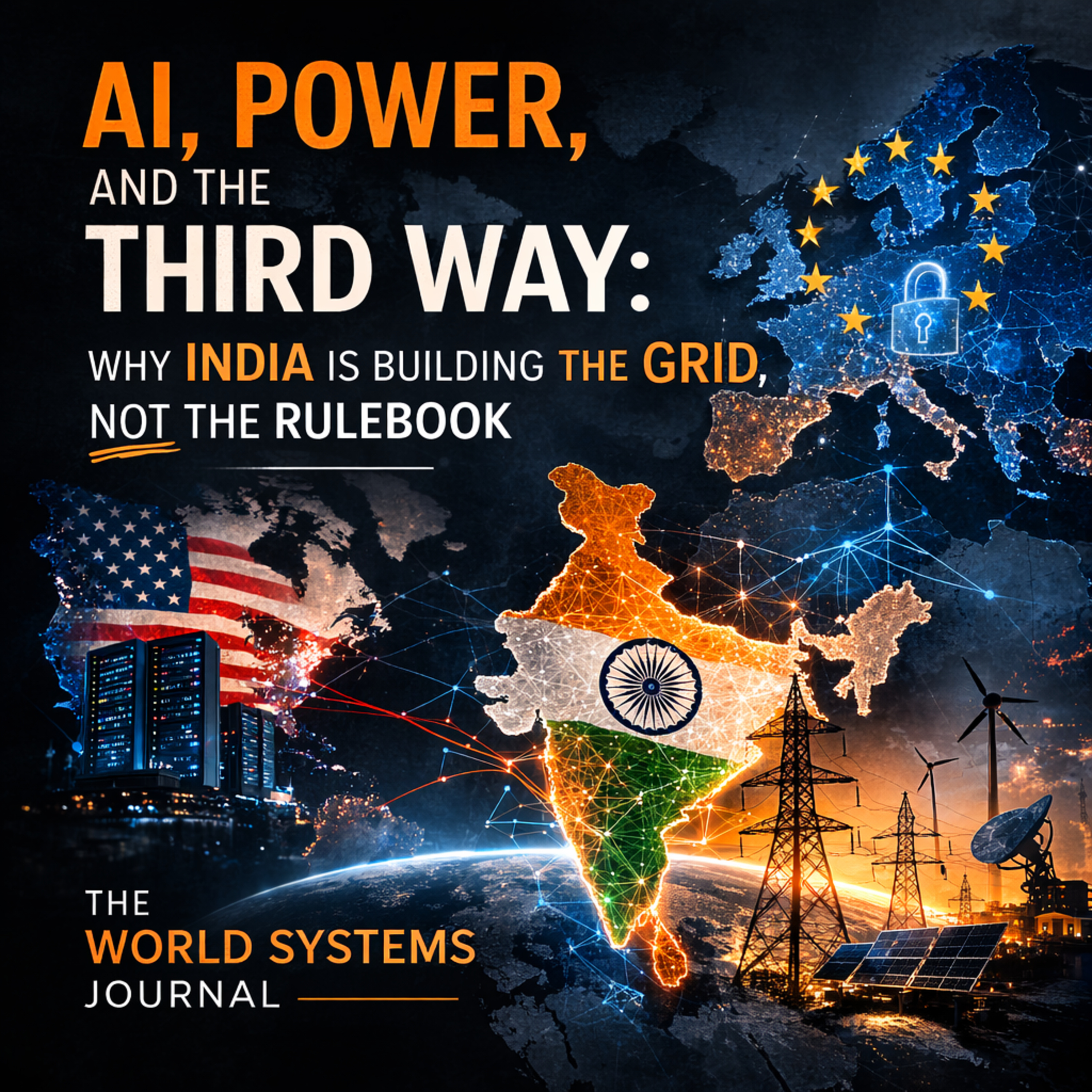
AI, Power, and the Third Way: Why India Is Building the Grid, Not the Rulebook
from The World Systems Journal · host Poornachandra Upadhya
Artificial Intelligence is no longer a conversation about apps, chatbots, or clever algorithms. It has become a question of power.In this episode of The World Systems Journal, Poornachandra Upadhya examines how AI governance is quietly evolving into one of the defining geopolitical contests of the 21st century.Across the world, governments are being forced to make difficult choices. Some are slowing AI down in the name of safety. Others are accelerating it in the race for dominance. But a third path is emerging—one that focuses not on rules or speed, but on infrastructure.This episode explores what can be described as the AI governance trilemma:safety, growth, and sovereignty.Every country wants all three. But structural trade-offs mean no system can maximize them simultaneously.Europe has chosen the path of regulation, building one of the world’s most comprehensive frameworks for AI oversight through the EU AI Act. The result is strong protections for citizens—but also growing concerns about whether heavy compliance requirements may slow innovation.The United States has moved in the opposite direction. Increasingly, AI is treated as a strategic asset tied to national power and economic dominance. Policies emphasize speed, scale, and infrastructure expansion—massive data centers, abundant compute, and rapid deployment.India, however, appears to be attempting something different.Rather than beginning with sweeping regulation or pure acceleration, India is focusing on Digital Public Infrastructure—the same philosophy that powered systems like UPI and Aadhaar.The strategy: build foundational rails first.From sovereign compute initiatives to language infrastructure like Bhashini, India is trying to ensure that AI systems work at population scale—across hundreds of languages and more than a billion users.But this path raises its own tensions.How should AI be regulated in a system built around guidelines rather than sweeping legislation?Who owns training data in a multilingual, open ecosystem?And in a world where talent flows toward the fastest-moving systems, can infrastructure alone retain innovation?Through examples ranging from agriculture and elections to court systems and global AI policy experiments, this episode explores the emerging landscape of AI statecraft.Because the real question facing countries today is not simply how to regulate artificial intelligence.It is something deeper.Who will control the systems that intelligence runs on?In a world increasingly shaped by AI, Europe may write the rulebook, America may build the largest engines—but India may be attempting something else entirely.To own the grid.And the future may belong to whoever controls it.
Embed this episode
Ready to play
AI, Power, and the Third Way: Why India Is Building the Grid, Not the Rulebook
No transcript for this episode yet
Similar Episodes
No similar episodes found.
Similar Podcasts
No similar podcasts found.