PodParley PodParley
ANAHN 02: Anatomic Concepts

EPISODE · Apr 23, 2026 · 40 MIN

ANAHN 02: Anatomic Concepts

from Clinical Deep Dives · host Dr Manaan Kar Ray

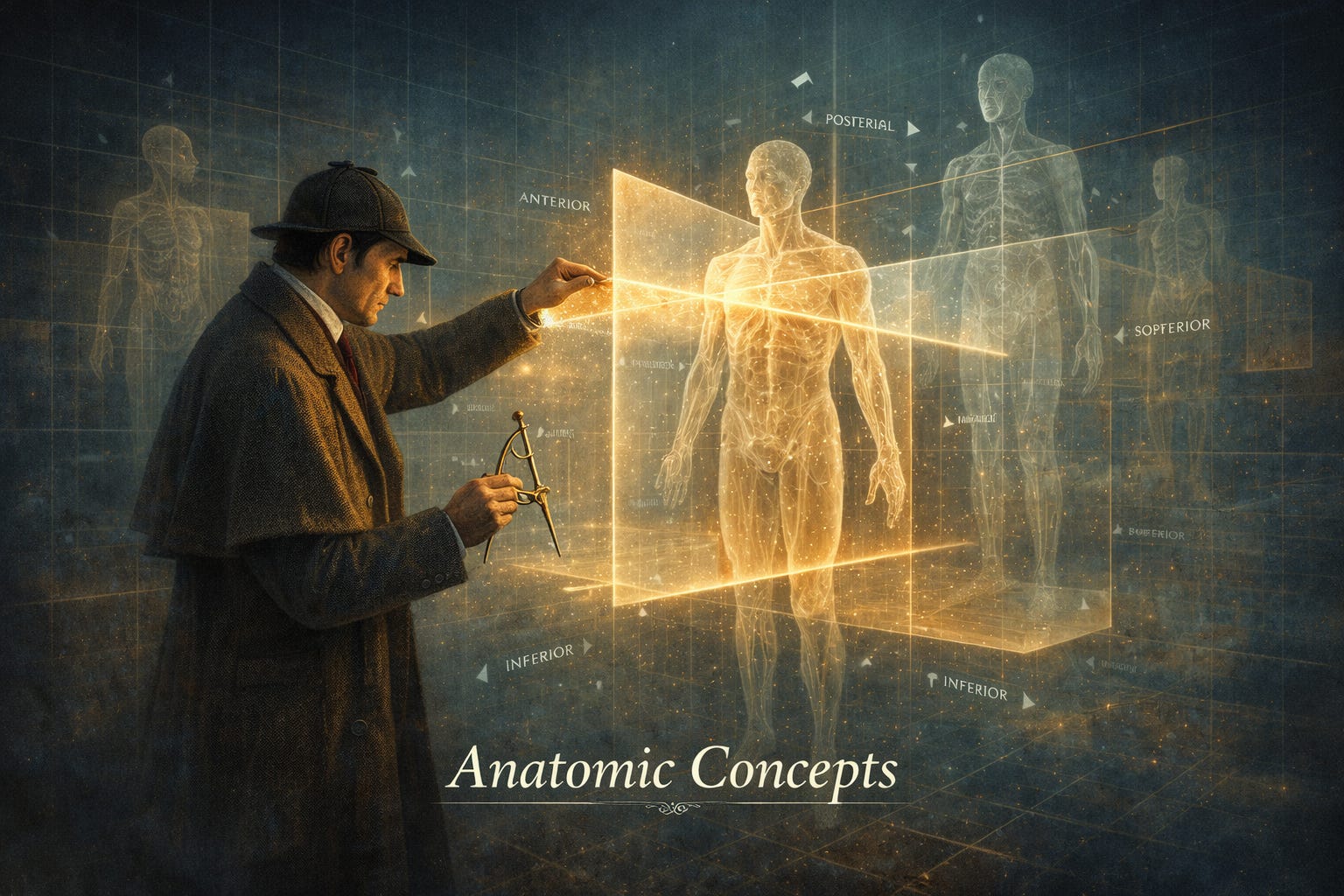
This chapter is the grammar of anatomy - the quiet framework that allows everything else to make sense. Before we explore structures, we must first understand how anatomists think, describe, and orient themselves within the human body.At its core, anatomy is a spatial science. It does not simply name structures; it describes their relationships. To do this effectively, a universal reference point is required - the anatomic position. From this standardised stance, every direction, movement, and relationship becomes meaningful and consistent.The chapter then introduces the divisions of anatomy, reminding us that the body can be studied at different scales and through different lenses: from the microscopic world of tissues to the visible architecture of gross anatomy, and from developmental origins to the intricate wiring of the nervous system. These are not separate disciplines, but different windows into the same structure.A crucial distinction emerges between systemic and regional anatomy. While systemic anatomy isolates systems for clarity, regional anatomy restores the body to its natural complexity. Nowhere is this more important than in the head and neck, where structures are densely packed and deeply interconnected.The language of anatomy is then built through descriptive terms - anterior and posterior, medial and lateral, proximal and distal. These are not just labels; they are coordinates in a three-dimensional map. Alongside these terms come the planes of the body - sagittal, coronal, and transverse - which allow us to slice the body conceptually and understand it layer by layer.Finally, the chapter introduces a humbling but essential truth: variation is normal. The human body does not always follow the textbook. Subtle differences in vessels, nerves, and structures are common, and true anatomical understanding lies not in memorising a single pattern, but in recognising and interpreting variation.This chapter teaches you how to see, how to orient, and how to describe. Without it, anatomy is a list. With it, anatomy becomes a map.Key Takeaways* Anatomy is a spatial language that describes relationships between structures* The anatomic position is the universal reference point for all descriptions* Anatomy is divided into:* Developmental (formation of the body)* Neuroanatomy (nervous system)* Microscopic (histology)* Macroscopic (gross anatomy)* Gross anatomy can be studied in two ways:* Systemic (by systems)* Regional (by body areas)* The head and neck are best understood using a regional approach due to structural complexity* Descriptive terms (anterior, posterior, medial, lateral, proximal, distal, superficial, deep) form the coordinate system of anatomy* The body is understood through three key planes:* Sagittal (left/right division)* Coronal (front/back division)* Transverse (upper/lower division)* Anatomic variation is common and must be recognised and interpreted clinically This is a public episode. If you'd like to discuss this with other subscribers or get access to bonus episodes, visit drmanaankarray.substack.com/subscribe

NOW PLAYING

ANAHN 02: Anatomic Concepts

0:00 40:18

No transcript for this episode yet

We transcribe on demand. Request one and we'll notify you when it's ready — usually under 10 minutes.

No similar episodes found.

Oncology Today with Dr Neil Love Research To Practice Medical oncologist Dr Neil Love interviews clinical investigators on new research and practical application to general medical oncology practice. My Take On It with Your Angelic Karma® Your Angelic Karma Here we take a look at how the United States measures alongside other First World Nations. + taking a deep dive into the science -The Report Metagenics Institute Podcast Metagenics Welcome to the Metagenics Institute Podcast where Healthcare Practitioners can hear innovative, cutting-edge information from leading experts from around the world. Join your host, Nathan Rose, to explore the latest evidence in Natural Health, challenge and debunk industry myths and offer practical, tangible, clinical tools which will transform your practice. The Syndicate Blogcast: Startups | Startup Investing | Tech News | Angel Investors | VC | Venture Capital | Private Equity | Crowdfunding | Fundraising Matt Ward - Serial Entrepreneur | Angel Investor | Startup Advisor | Amazon Ecommerce The Syndicate Blogcast show is an extension of The Syndicate podcast, featuring long form articles on the future technology, ecommerce, business and life. The mini-sodes deconstruct high level startup, business and tech issues to help investors and operators better understand and win the market. Recurring topics include: Facebook, Google, Amazon, Apple, Ecommerce, Blockchains, ICOs, Cryptocurrencies, Marketing, Fundraising, Venture Capital, Startup Challenges, Business Development and more. The Blogcast comes in addition to The Syndicate - the place where investors and startups combine to create crazy businesses and even crazier returns. The Syndicate podcast is a deep dive on the angel investors and VCs behind the big name startups. We interview the best and brightest investors, syndicate leads, GPs, limited partners and startup founders to create an original, off the cuff discussion on startup investing.
URL copied to clipboard!