
Marshall McLuhan was an English professor. He loved his content, you know. But when you focus on the content, you lose sight of the function of the form. And as I've come to realize the content paradoxically is actually the delivery mechanism for the effect of the medium.
You know, as Marshall said in understating media, is paraphrasing TSL yet that content is the juicy piece of meat carried by the burglar to distract the watchdog of the mind. Because while you're busy consuming content, the medium is rewiring your brain, and your senses and your personality, and your culture, and your identity, and your values and your preferences, and the whole works. And these have less to do with the content than the form, and structure. And the easiest way to sidestep that is to look at things which don't have obvious content to get hung up on.
Things like air conditioners or roads. Hello and welcome to the 11th episode of Humans on the Loop. I'm gonna start with the obvious. This is a podcast.
Maybe you're only listening, or maybe you're watching two, which changes things substantially. The podcast unquestionably retrieves conversation from the waistband it seems to have been placed in by books and TV. Although this is still parasocial and very much not a video call between us, which is why I host monthly hangouts. Gotta keep it real.
It enhances the personally curated sense of proximity of real time exploration and a landscape of ideas. It reverses the trend of the web as a fractal extension of the TV everywhere by surprising us with something approximating talk radio everywhere. It actually obsolesces talk radio though, because why would anyone in their right mind tune into just here talk constrained by the weather or current events when they can choose to listen to people talk about any topic imaginable, probably available as both narrative drama or documentary, and long-form conversational inquiry. But of course, podcasts can overheat and reverse into its opposing form, becoming intensely crafted video essays or meticulously produced studio conversations or documentary films.
And YouTube doesn't seem to care one way or the other, whether this is television or radio at the end of the day. Just keep liking and subscribing. Please and thank you. That's one quick glance around the media tetrad, one octave up from the framework for radio itself, proposed on Wikipedia.
But if you wanna go check out Marshall McLuhan's entire list of titratic observations about everything from clothing, housing, and numbered, and money and the wheel in his 1975 article for technology and culture journal, prepare to have your mind blown. My friend and inspiration economist W. Brian Arthur is known for his evolutionary theory of technology. That its nature is combinatory, that every new invention increases the state space if possible, hacked together new permutations along an exponential curve.
But McLuhan gives us the texture of those changes, the ways that each particular technology changes us. And they all do. We are trained to see technology as merely an extension, instead of something that transforms its users and the relationships between them. Whoops, let's get that sorted out right now.
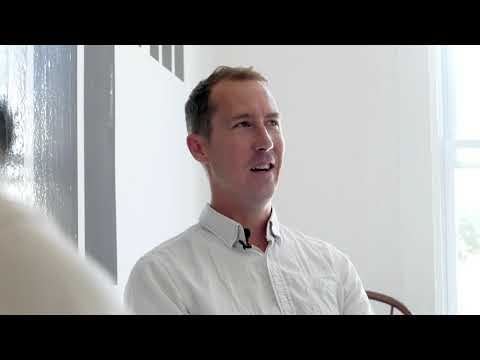
This week on Humans on the Loop, I welcome Andrew McLuhan, artist, teacher, and director of the McLuhan Institute, an arc for three generations and counting of media theory for world that desperately needs more help understanding the relationships between our tools, our minds, and our society. Andrew is a soft-spoken provocateur, a poet and a troublemaker. Soak it up. And afterwards, dig into the show notes, watch the videos I watched, read the essays I read in preparation for this conversation.
Transform your understanding of media. Refactor your relationship with the technologies of your daily life. It's what we're here for, right? Before we begin, I want to thank Sufia Calerty, Jason White, Ponda Lehman, and John Kirk for joining my base of monthly subscribers.
This work exists because people like you care enough to help me make it happen. Thanks also to my comrade, Van Bettauer, whose latest build of AskFutureFossils.com allows you to toggle between humans on the loop and future fossils podcast idea clouds, prompt either network with your deepest questions, and then explore the connections between fragments of different conversations as they may pertain to whatever slice of latent space you manage to discover. This is the kind of thing I get really excited about, a medium for which the message is enhanced reflection and curiosity, and a better handle on the years of conversations I've had with hundreds of amazing people and how they all fit together. Imagine this kind of thing for your own organization.
If you believe in the value of this, pitchinatevery.org slash humans on the loop with tax deductible monthly contributions or email me at humansontheloopatproton.me if you'd like to engage in high temperature collaborative search for strategic partnership. Our next community call is March 15th at 3 p.m. Mountain Time in case you care to join the real time cozy web discussion. And I'm going to be on the faculty for the School of Wise Innovations Spring Cultivator, program starting April 3rd, featuring many wonderful teachers you can learn about in the show notes.
Thank you for listening. I hope you enjoyed this conversation. You. Andrew, you're on the loop.
Thank you for being here. Sure. Last night I was watching your interview that you did, what was it called? The Media Ecology Gospel According to Andrew McLuhan.
Yeah. I also dug into the talk that you gave at the California College of the Arts. OK. The CBC, Marshall McLuhan, the world is a global village.
The argument that Marshall had with Norman Mailer on the summer way in 1968, which was, wow, to think about how different broadcast debates or whatever you can even call that were then and now. And then also the 99 documentary, The Out of Orbit, which was a psychedelic experience, really goes to show you how different documentary film was, even what, 25 years ago. And then I've been reading your blog. And yeah, I appreciate the way that you write, like I write, lots of citation and riff.
Yeah. And so anyway, this is a conversation about the metaphysics of technology and about navigating networked information environments and the new self that emerges from them and about finding the sweet spot between recognizing that we're not on the top of the food chain, as per the conceit of the rational enlightenment and the construct of the self as an author of its reality. But then also acknowledging that we don't have to just be the unwitting prey animal of the surveillance capitalism hyper-object and just feeding things with our attention. That is one of the top things that my grandfather talked about.
And it drives me crazy when people try to write him off as a technological determinist, right? In other words, which is code for people for saying, oh, this guy says that technology determines everything about us and we're helpless and have no agency. And nowhere does he say anything like that? In fact, he says quite the opposite.
Well, actually, they're half right. They're half right in what they're half right about in that technology does have a very strong hand in determining a lot of things about our lives individually and socially. But the main reason it does is because we accept zero responsibility and take no agency really when it comes to that. So his tall thing in studying media was about giving humans autonomy and agency.
And there is absolutely no inevitability as long as there's a willingness to contemplate the situation. I don't know how you can get much more clear about things than that. Actually, you can get more clear about things than that. I actually had to look this up for somebody else in this version the other day.
So I know that it's on page 51. Yeah, this book, Understanding Media, right? The title of it, Understanding Media. That's something that we can do.
And this is a part of how we can do it. He says, attempt at the way into the book, the present book, in seeking to understand many media, the conflicts from which they spring and the even greater conflicts to which they give rise, holds out the promise of reducing these conflicts by an increase of human autonomy. Precisely, precisely. I also want to note, I've been listening to a recent episode of my friends show, Weird Studies, Phil Ford and Jeff Martell.
And they just had a conversation with two practitioners of Chaos Magic, Don't Get Barfered, and Alan Chapman. And they were talking about, in the practice of Chaos Magic, where it's about mastery. It's about becoming more accomplished and attaining more control. And at some point, you affect what they call the great inversion, where it becomes instead about a bakti yoga, like a devotion, an idaal relationship.
And so yeah, this is something I definitely want to play around with you, is in the paradox of recognizing the convergence and the contingency in getting past a simple kind of self-other or inside-outside construct with this stuff. But we're getting ahead here. I want to start anchoring this in your own upbringing and your biography and how you are a product of your environment and how it is that you have come to devoting yourself to the care and feeding of this institution and lineage and the unique place that you have in the temple keeping of media theory. Sure.
I love talking about myself, so far away. Oh, what do you want to know? OK, so just as a point of comparison, when I speak with Nora Bateson, you can't understand Nora without understanding her growing up in the environment of the meetings that Greg Bateson is having with all of these people. You have one of these stories of, you know, like I think a lot about how all of the people that are at the helm of these prodigious franchise fandoms now.
These are people that grew up the fans of these things. So there's been a shift that I think points back into your grandfather's work and your father's work in which all of us are now engaged in some way or related in some way or exist within the light cone of these brands, franchises, institutions. And so I'm curious how you see that from within the McLuhan Institute world space. I'm curious, actually, does Nora have any kids?
Do you know? Yeah, OK. Yeah, it's interesting. This has come up a few times in conversations I've had lately.
People seem to be interested in it. It is interesting. This idea of legacy and continuity. And it's not unusual for a second generation to take over something, to step into something.
It's also very common inside trades and crafts, you know, to have martial McLuhan and sons kind of thing, if we were mechanics or shipbuilders or whatever. It's a little more uncommon in intellectual traditions, a lot more uncommon, I would say. And as far as I know, unheard of, past a second generation. I don't know anybody else who's a grandchild carrying on something.
But I hedge things a little bit because, you know, I'm not doing exactly what my grandfather and my father did, although I am in the neighborhood. But I'm also doing it a little bit differently. I guess that's not unusual. Anyway, maybe I need to just accept where I am and what I'm doing at this point.
But it's interesting. I have this picture over here. I'm always looking at it. And this to me says a thousand words about the relationship between my father and his father.
And this picture shows Marshall and Eric McLuhan, the professor and the professor said, all dressed up in suit and short pants. You know, like that to me is like them, the professor and the professor's son. And my father indeed grew up to get his bachelors and masters and PhD in English literature and worked with Marshall, his father worked together very closely. You know, Marshall worked with a lot of people, co-authored books and stuff, but there was no closer relationship than father and son.
They're literally blood, you know. And they were such of a mind. It's incredible. People don't realize just the nature of that relationship.
It was natural. My grandfather was very outgoing, very charismatic, very outspoken, very forceful personality. And my father was more of a gentle, he had his own gravitas, but it was demerre a little bit. And he also wasn't, he wasn't very social, maybe even a little socially awkward and didn't really enjoy the spotlight or anything.
My grandfather did and I do. I'm quite happy with the sound of my own voice and talking with people and doing things as you'll have noticed. So I don't think people realize just what a partnership they had, but it was something and really several things that get credited to Marshall McLuhan is really a co-author by the two of them. I'm thinking specifically of things like the laws of media and the Tetrad, which they discovered together, worked on together and really, you can't give credit to both of them for that.
But that's the way it shakes out. Anyway, I love that you got all these snacks, including a big old carrot. Way to go. Yeah, no might as well catch a snack.
So, and then I have another photo over here, which I keep in view. And that's my uncle Michael and my grandfather and my dad holding me as a little baby there. And at that point, isn't that cute? Yeah.
At that point, Marshall had a stroke and he wasn't able to speak anymore. He lived the last year and a half of his life with that condition before dying in his sleep on New Year's Eve, 1980. And yeah, no, there's so much to say about that. But, you know, I think it's quite natural for kids to not want to have anything to do with what their parents are doing, right?
And my dad was into things like DIY electronics and airplanes. He actually moved away from home and joined the US Air Force being a US, he was born in St. Louis. And I think as a teenager, that was his attempt at getting out from under and finding his own path away.
But while he was away, understanding media came out and his dad sent him a copy and he ended up doing his tour with the Air Force, getting his bachelor's degree and coming back and starting to work with Marshall in the mid 1960s and basically staying there. So worked with Marshall for about 15 years. Marshall died and he kept going on his own, got his master's PhD. But for one thing, they closed the center of for culture and technology before Marshall died after he had his stroke, the university shed it on him.
It was a bit of a scandal actually because Marshall was expected to recover. He was 68 years old, so, you know, not ancient, but universities, academics being universities and academics did what they did. And although the center is open today, I consider it closed when they closed it and it never really reopened. But the point to that being my dad did his own thing.
In my own upbringing, my dad's work, I grew up around it as you suggest, and ideas and people and, you know, maybe a different upbringing than a lot of people have. And I've always been artistic and interested in words and poetry and a poet, not so much academically inclined. I failed my way through high school, but I did finish it, but that was it, no university for me. And trying to read and understand my family's work as a teenager, it just didn't do anything for me.
I tried to get in my 20s and it really didn't do much more. And for whatever reason, in my 30s, I started helping my dad out and traveling with him because he needed an assistant, like a secretary type assistant, not a co-worker. And what he was saying made sense to me for the first time in my life, like I got what he was saying. And it was damn compelling.
I was like, whoa, it was like a theory of the universe, you know? It's like, holy shit, here's the human condition. This is why we are who we are, the way we are and how we got there. It's incredible.
And I was pretty much done after that. So I started doing more around and writing and a little bit of teaching. And eventually I decided that there needed to be something in place to keep this going because it wasn't enough that my dad was just sitting here in his library in the country. There was no McLuhan Institute.
Like I said, the center at the University of Toronto was a joke, really, no offense to anybody. It's just, it is what it is. That's a whole other conversation and probably not what I could politely and politically speak about, but long and short of it is, Marshall had started something. My dad had kept it going and there was nothing in place to keep it going past that.
And here I was and I figured if I didn't do it, nobody would. So I started the McLuhan Institute in 2017. And my dad died less than a year later, which was quite a shock. But I was really glad that I'd made a start on this.
And I guess in some cosmic sense, you know, I jokingly phrased it on Twitter the other day that when the student is ready, the teacher will disappear, you know? But it scared me for a while. It really bummed me out because, you know, and I'm still very much a journeyman and I'm still learning. And now my dad's gone and I've got all these questions and he's not around to ask them like, shit.
But then I realized he is around. He left so much behind that any question I have, the answer is here for me to find. So yeah, I miss the guy every day, but he's never far away. And we go on.
Yeah, thanks. In hearing you talk about this, I've been reading From Nowhere by Eric Wargo. I wanna point to something that he talks about in that book, which is the sense of, meanwhile, that the modern notion of simultaneity emerged into consciousness as a consequence of the telegraph and of telecommunications generally, and then deepened and enhanced with the development of cinema and the ability to create the montage and jump cuts and this kind of thing. And so when you're talking about this experience that I also have had and I think is very pertinent to the conversation I'm trying to explore about feeling ready to take up a learning process.
And then being in this way where it's like the teacher or the master or the mentor is not there, but is also present in what Caleb Sharp calls the data home, this hyperobject of recordings around us. The cinematic touch point is like Obi-Wan Kenobi, right? Right at the beginning of the learning, what you're left with is the force goes to this person. And that has a lot to do with why I wanted to start with your upbringing because one of the themes that developed out of future fossils is the brokenness of lineage and the way that the very technologies that afforded us the ability to communicate at scale, they're popularly discussed as having destroyed space and time, although that's not really accurate.
They refiggered our relationship to space and time and have decontextualized us at the same time that they have embedded us in a new relationship to everything everywhere all at once, trying to figure out how to deal with what Doug Rushkoff calls narrative collapse, the superfluity of other places and other times in this place and this time. And the consequence of that to the efforts that we would make to create linearity and autobiography and narrative cohesion, the consequence of all of that to understanding how to reconstruct a sense of passage through life stages or a movement through space from the home to the workplace to the third space of the pub or wherever. It's really important to all of this. And I want to land it somewhere specifically.
You just wrote recently on your blog. If readers approach understanding media like a book of poetry as it more closely resembles poetry than prose, it quickly becomes obvious that this is a better method. You read poetry and prose differently. You expect different things from them.
This has a lot to do with McLuhan's forward to the interior landscape where he says, the effects of new media on our sensory lives are similar to the effects of new poetry. They changed on our thoughts with the structure of our world. And then lastly, again, because this series is so hugely inspired by Bill Thompson's work, he saw the kind of communication required for navigating networks of information to be less like the linear presentation of an academic lecture and more like dancing through those networks in what he called Vissen's Constrator Knowledge Art. And so when you talk about how to rediscover agency in this, there is something about the way that poetry through the presentation of metaphorical entailments is more like neuronal connections and associative networks.
And it shows how narrative becomes a matter of choice of how you decide to project these kinds of high-dimensional associations into a sequence. And that is like moving from the arts into the sciences or from poetry into prose or from, meanwhile, into narrative, basically, I'm primarily interested in the relationship between these two kinds of things and then learning how to move between them and understanding their distinct effects on us and the way that we order reality helps us think better about why it is that we may choose one approach or the other or why it is that we may choose tools or tell stories about our relationships to tools or why poetry matters in the storytelling about how we live in the internet. Yeah, understanding media very much resembles more a collection of poems than a volume of prose. On the other hand, if you look at any given page, it's block after block of text.
So it doesn't visually present so much the way we're used to seeing poetry. But I suppose it acoustically certainly presents more like poetry and semantically presents more like poetry. Because poetry is essentially compressed thought, artistically compressed thought, generally. And that's what understanding media is it's a very condensed.
One thing about the book is that it actually began life as a report in 1960, something called a report on the project in understanding new media, which Marshall McLuhan had been hired to research and produce by the National Association of Educational Broadcasters. And he basically spent four years reconstructing, reconstructing, taking apart, putting back together, compressing into poetry the material, the results of his studies into the form that was published. And if you, like sometimes you'll get one paragraph on a page or two or three, right? But very different from modern writing.
And my own writing style, which I've been developing, is quite the opposite of that. Sentences are shorter and paragraphs are really, can be a single sentence. But the idea with the book is that it's so dense with information you have to treat it more like poetry, which is to say you take it a piece at a time and you do a lot more work of unpacking, literally, inviguratively, of the material in order to get meaning, sense, satisfaction, enjoyment, pleasure, enlightenment from it. And the other thing about it is that it forces you into an interaction more than just a passive kind of ingesting or reading or experiencing of something.
Because it's so dense, again, it requires you to add water. And the point was, Marshall wasn't trying to persuade, convince you of anything. He was trying to help you learn. And I suppose teach or show you the way or how to get there yourself.
And that was really a large part of what he was up to was he was trying to get people to wake up to what was happening in their lives with technology. And he realized that you have to go to great lengths. If somebody's asleep, you can't just whisper gently in their ear, you gotta shake them. I have kids and they could be challenging to wake up.
You can start off saying something gently, time to get up guys, time to wake up. Good morning, I love you. Plop, plop, plop, right? But that's not working and the bus is coming and they gotta eat breakfast.
It's like, okay guys, time to get up. Get up, get up, get up, get up, get up. And that's interesting because I've been paying a lot of attention to what my grandfather was doing. And so sometimes I'll just step back a bit from what he's saying from the content and observe his behavior and what he's doing.
You had brought up when we first started talking that you're watching the quote unquote debate with Norman Mailer. And it's really interesting to watch Marshall McLuhan in different situations, watch him in that thing with Norman Mailer. And he had an incredibly quick wit and presence of mind and grasp of a situation and an uncanny ability to adjust himself to it very consciously on the fly. So you'll see him counter Norman Mailer's combativeness with getting more and more relaxed.
He literally just sits back and speaks very casually and more, oh, that's interesting what she said there. And Norman Mailer is getting more and more frustrating upset. And actually know what's beautiful about that is he wouldn't see that. I don't wanna be one of those people, but it's almost, I almost feel he wouldn't see that today because there was a certain amount of respect and civility that's hard to come by now.
But Norman Mailer, they got along quite well. They weren't enemies or anything. It was a very friendly debate, I suppose you could say. Yeah, so I find it fascinating to watch but try and figure out what Marshall McLuhan was doing and how he was doing it and to contemplate why.
Again, on the long list of things people don't think about Marshall McLuhan was that he wasn't really interested in the fame or notoriety for its own sake, right? For Evo or something. He gained and lost the spotlight and was, I don't think, sad to see it go. He saw it as a means to an end.
And it's very worth considering what that end was. It's my opinion that there hasn't been a biography that's really treated Marshall McLuhan according to what he was trying to do. Various people had tried to tell his life story or various things about his work, but none of them have really understood that he was a man on a mission. He said it fairly plainly and when his letters were published in 1988, they published a letter he wrote to Ezra Pound in 1951 where he said, I have an intellectual thug who has been slowly accumulating an arsenal with every intention of using it.
And he said that his purpose was to needle the somnambulists, which is very interesting, I think. He was a humanitarian and he realized what we were doing to ourselves via our technologies. And the thing is like, he also ran into this time after time again, he says, if you speak about something, people assume you're in favor of it, right? So people figured that he was a big fan of television and that he hated books and that he said books were dead and stuff like this.
He never said that. The guy was a literature professor who loved poetry and literature. And he said, in my case, the opposite is almost entirely always true. Anything I speak about is usually something I'm very much against.
But he understood that in order to understand something, you have to look at it. He said, I'm not content to simply sit back and let the juggernaut roll over me. He realized that so much of who we are as people, as societies, have to deal with our senses, our sensory makeup, shaping who we are and that our technologies are not neutral things, our senses are not inert things that data just flows through and leaves unchanged. We're greatly changed, but we're almost completely unaware of the fact.
And if we want to have any control over who we are, if we have things that we value and we want to maintain them, then we have to be more aware because it's not a matter of desire. There's a couple of things here. One is this relationship between the means and the end. This has been coming up a lot in these discussions about people confusing, for instance, productivity with affluence or comfort or security.
You're writing about how you want to be an influencer. And you're talking about your grandfather's an intellectual thug and about the sort of devil's bargain of accumulating influence and the way that that ratchets you deeper into the co-adaptation with these kinds of attention economic market forces that require you to cultivate your riz, right? And how celebrity or influence, these are not ends unto themselves, but they are the means by which a person is able to define themselves. I guess this is related to what I'm seeing in the no AI art situation where people who work in creative trades are amping up the argument that their market value is defined by a distinct personal style and that when their work is used to train a generative AI model, that their livelihoods are jeopardized because what they're selling is their brand, right?
All that is based on what I see as the criminal part of the art market and world and system. It teaches you to develop your style, right, to find your lane and then to stay in it, which is, I think, the worst thing, because look, if you've developed a style static enough for somebody to be able to imitate it, fake it, reproduce it, whatever, you need to move on because the world's sure meant the most. No, honestly, because here's... Yeah, this is the whole point about humans is that our creativity is unlimited.
That is the strong point. Not you're developing some kind of style or aesthetic, as they call it now. No, not at all. In fact, developing a style and an aesthetic sticking with it is a sure sign that you've shut yourself off from the world because you're still over here pretending like it's 1970.
And meanwhile, the world has moved on. Art is a response to a set of conditions, right? And if the conditions change, the art necessarily has to change or I don't really consider it art. It's not serious to me, but the whole utility of art, as far as Marshall was concerned, this idea of the art as a do-line, as a radar, the artist as a radar, which is something as Rapalne talked about in the 30s, the Canary and the Coal Mine, the use of it, the use of the artist, is that they are hyper-sensitive people.
They're constantly sharpening their senses so that they can experience new things and so that they can find new ways to show it to us. This is why new art often looks strange and unusual, even offensive, abrasive, because it is new, is contact with changing situations. And the artist experiences the new just because they keep sharp. They keep their senses open.
The rest of us are senses get duller and atrophy, but the artist is capital A, artist here, is always sharpening, always on the lookout, always trying to experience things in novel ways. Because of that, they experience change first. And that is their utility as canaries in the coal mine, or techno-cultural coal mine. And that is the really primary purpose, aside from creating beautiful things, that's a different side of things.
We have so much to be grateful to art and artists for. And the worst thing we can possibly do is encourage them to develop something and stick with it, because that cuts them off. You should always be encouraging artists to develop. And the art world does not do that.
The art industry does not do that because it wants stability. Well, what about our world is stable? Very little. So artists are the sharks, if they're not moving, they're dying.
But this notion about art is such a powerful thing for media studies, because so much that affects us is hard to perceive directly. Like astronomy, a lot of what we know about space, we know not from direct perception, but from the effect of things on other objects that we can observe. That's how we know about black holes and everything. Nobody's ever seen a black hole, I don't think.
We just have theorized them because of how gravity works and affects other bodies, stuff like that. There's always a reason for a change. And Marshall tells us an understanding media to pay attention to language, for example, to slang, because our language is how we communicate, obviously. But as situations change, our language changes in reaction.
We don't just change our language usually for the hell of it. There's a reason. So if you notice changes in the language, you can understand that something has happened in order to force that change to cause that change. Same thing in art.
And the bigger the change, the bigger the cause, I think you can safely say. So that when you see a whole new genre, like in hip hop music or in anything else appear, you can guess that something pretty big has happened in order to cause that reaction. Now, going deeper from that is a whole other thing, but you can at least tell that, you know, it's like if you're taking a walk in the woods, right? And all of a sudden deer start running by you in foxes and smaller animals heading in the opposite direction.
There's probably a good chance there's a fire or something happening, right? And it's probably a good idea to turn around and go the other way. But the notion is the same that we react to things and the artist can show us the way. So one of the threads I want to strum there and that is against style, you know, in one of your blog entries on Slide of Mind, you quote a letter your grandfather wrote in 1970.
He said, I'm not a culture critic because I am not in any way interested in classifying cultural forms. And then elsewhere, you quote him in Life Magazine saying, I don't explain, I explore, you know, this notion of how the emphasis shifts from answer to question. Like what this particular series I would be a damned fool if I felt like what I were giving people was a definitive solution to the way that we think about technology. And what I'm hoping to do with this is to offer an adaptable protocol for how to develop a framework for inquiry that works in one's own environment to host a series of conversations, to contain them within a provisional bouquet of constraints, to take that and record it and compress it into a model that makes that body of work more legible in a certain way.
What actually comes out of that may or may not actually be pertinent, but it hopefully helps people think about how they could be engaging in a similar thing. And this idea of the digital twin or in your grandfather's, we're talking about how the version of you that is televised is different from the version of you that is actually you, the idea of the individual becoming an institution in electronic media. I guess I'm just pointing to prismatic diffractions of one core idea, which is that the print world tends to seek out a canon to identify a stable and authoritative form. And that form is challenged by media that function more like the retrieval of memory in that the retrieval itself changes the memory in oral storytelling, you know, the story changes every time.
And when you're talking about the role of the artist, there's something about the openness and the provisionality and that relationship to the idea of breakdown as breakthrough, that getting outside of canonical interpretation or getting outside of seeking static answers is a more honest relationship to the condition in which we find ourselves. Although we are like haunted now by. Legos of media past for sure. Yeah, like there was that moment where I saw that you or someone had pitched to South by Southwest that you would have a conversation with a language model of Marshall McLuhan.
And like that, that's like there it is again. It's like the ghost of Obi-Wan. Yeah, you've brought up a few things. One thing I'm very interested in, you mentioned in oral storytelling that the story is different every time.
As a poet, you know, in my old age, I become more interested in the history of poetry. The simple fact that poetry is much, much older than the written word. And this is something that people don't have to think about. But the poetry after the written word, without the written word, let's say, is very different from the poetry you have with the written word.
You need certain things. One book I'm rereading right now is Eric Cavilock's Preface to Plato, which is an incredible book criminally under read, I think, and very important in this work. It talks about what Plato was doing. It talks about Greek society as writing came in.
And the role of poets pre-literacy, pre-writing. And it was keepers of knowledge and wisdom and cultural information and continuity. And this is what works like Iliad and Odyssey and things were for. And in fact, they didn't vary with the telling.
The story was the same. Part of the reason for that, you know, when you look at the book of the Odyssey, you got a thick book on your hands, right? Hundreds of pages. Now consider that was completely composed and passed on orally for a long time before it's ever written down.
That's incredible. One thing I challenge my students with sometimes is to compose a poem completely orally. You can't write it down. And in order for it to be honest, you have to be able to repeat it the next day.
It is very difficult to compose more than a couple of lines of poetry. And you have to rely on rhyme. Meter also helps. But these are not frills.
They're technological advancements because it helps you remember things. They're mnemonic devices, right? It's very sophisticated technology for information storage and retrieval. Sentries millennia before computers ever came around.
Very sophisticated technology. And just about completely lost. Irretrievably, I doubt it. Because really, the history of the written word is a drop in the bucket beside the spoken word.
So I think we have a lot of things hovering just beneath the surface that are starting to come back. And I think a lot of it can be seen in culture today in places like hip hop. You have somebody like Jay-Z who doesn't write. He's not a written composer.
He sits there and listens to a beat and constructs it in his mind and then drops it. If you want to think about technology, it helps to think about more than just the most recent technology. And this was one thing which Marshall did. And really one of his great contributions to the field was essentially inventing media studies from communications studies.
And what he did was he broadened the category from simply things which we communicate more carry language and ideas to human innovation. So from clothing to computers, from speech to sleds, the subtitle of understanding media is extensions of man. And a year after that in 1965 in an article called New Media in the Arts or something, he used the phrase extensions of human powers, which I think is easier. A better way of putting it.
This extensions of man think it's certain people's backs up, which says more about them, I think, than the idea. But extensions of human powers is also a better way of saying it because one of the main things he discovered was that all our technologies are extensions of some part of ourselves. But there are also extensions of our powers. Like the whole reason we innovate or come up with a technology is to extend our power to make something faster, more efficient, more accessible for advantage, right?
Or disadvantage as the case, maybe. And that applies to everything that humans do, not just simply things like pencil and paper, telephones or computers and modems. And when you expand the category that way, it actually gets a lot easier to understand the trap of content. People get precious about content.
And again, Marshall McLuhan was an English professor. He loved his content. But when you focus on the content, you lose sight of the function of the form. And as I've come to realize, the content paradoxically is actually the delivery mechanism for the effect of the medium.
As Marshall said in understanding media is paraphrasing TSL yet that content is the juicy piece of meat carried by the burglar to distract the watchdog of the mind. Because while you're busy consuming content, the medium is rewiring your brain and your senses and your personality and your culture and your identity and your values and your preferences and the whole works. And these have less to do with the content than the form and structure. And the easiest way to sidestep that is to look at things which don't have obvious content to get hung up on.
Things like air conditioners or roads. You know, the society in North America here, the difference here in three centuries is roads. And when Westerners first appeared here, the only way to get an interior candidate and whatnot is mainly by canoe, waterways were the roads. You know, the Mississippi, things like this.
The society with roads, the society with highways, the society with rail, you know, horse speed or train speed. These are completely different societies make for completely different people. And that is as true of roads and rail as it is of, you know, telegraph or smartphones. So I want to talk a little bit about if we use the tetrad as an object here.
You've been thinking out loud on social media about language models in particular and what it is that they enhance, they reverse, they obceless and they retrieve. And talking about roads, one of the things that I found helpful in my thinking about AI broadly speaking is the way that it affords us to reflect on what we present to the mechanisms of statistical correlation at different scales, different levels of granularity. That's kind of a riff for an extension of earlier developments with, you know, the microscope, telescope, telecommunication generally. And there's something like, if we think of AI as a mirror, mirrors historically showed us what was in the frame of a sort of static space.
And now we have an elastic mirror that allows us to reflect on many different orders of magnitude of selfhood. Like now it's becoming easier to see humankind with all of our biases and so on. But you can also train models on a personal corpus. There's a lot more elasticity with that.
So just as a starting point for what is actually a much broader question for you about the way is that AI speeds up something about the way that we see ourselves and has forced teachers to place more emphasis on showing your work and on process. And I see it as like retrieving the original point of a liberal arts education and teaching people about the process instead of just the product. So that's one way in which we can say the tetra- okay, there's something that's being retrieved here. I don't know.
I just would love to hear your analysis of all of this. Well, I think you've hit on something which is an extreme case of our education system which for quite a long time has been throwing people into a classroom and shoving information into them and having them spit it out into essays and whatever else. So essentially us as large language models, right? What an incredible thing the alphabet is because in those 26 characters are entire languages and cultures.
In just those little building blocks, it's a small model that is infinitely complex. I'm not enough of a math person to come up with the statistics on it. But what you can get from those 26 characters is pretty insane. And you're right.
I think pushed to its extreme form. You get a large language model such as what we have. And in reaction, you're getting things like focus on process and even retrieving things like oral exams and less written work, more oral work, feces, defense, things like this, which is interesting. Good or bad, you didn't ask.
But whether these things are good or bad or really a matter of perspective because new technologies become habits which then become values, right? A tradition is just a habit, a cherished habit, right? Essentially. And a lot of the things we claim to value like in the United States and Canada are really born of yesterday's technologies.
However, it's a curious thing where we have the value, but the structure which supported it, which gave birth to it and supported it, is no longer there. And so we have this dissonance really, a disconnect. We have the memory of a fruit, but we've chopped down the orchard and people get upset about this. Yet we're the ones who chopped down the tree.
Like this thing is, as I said before, my family's been saying for decades, can you have the fruit of these things with the tree of them? Not so much. And so the difficulty with new technology is these structures are often not compatible, but we don't think about that. We just go ahead and throw them in and then get upset when we lose our way of life or cultures, our values.
But at this point, we ought to know better. We don't seem to know better. Case in point, AI. It's here.
And even at this point, I don't think there's going back, dialing it back as much as people are maybe starting to think about doing that. It's a little bit late. However, the interesting thing about the story of Pandora is that she opens the box and all these things fly out of it. The box isn't empty.
What's left in the box is hope. And I'm actually very hopeful. It's funny I saw a noted, very high-profile person on Twitter today talking about being cautiously optimistic that Australia or somebody is banning social media for kids under 16. And it's like, well, being cautiously optimistic is showing not a very good understanding about the effects of technology and how technologies work.
But I do have hope because I think we've actually come a very long way in our understanding of things from my position as a third generation here and seeing how we've advanced. Have we come as far as we might have? No. We have a long way to go?
Yes. But we're still here. One thing that I think humans have demonstrated over and over again is an incredible ability to overcome obstacles in our path. We just have to confront the problems in order to come up with ways around them.
I think we'll get there actually. So we're talking about parenting and we're talking about addiction and we're talking about opting out. You know, you write about the difference in choosing to go slow. I think the craziest work of science fiction that I ever wrote, I wrote by hand.
This series started with me rage quitting Facebook after 20 years, deciding to stop working at an AI company paradoxically in order to spend less time making money and more time helping people prepare for a world in which you have the compute power of a server farm inside your house. And yeah, I would love to bring this back to something grounded and actionable by just asking you one about choosing to reclaim agency and choosing to reconsolidate attention and choosing to draw a boundary or to select boundaries and then just in passing at the very end of this, who else do you think I ought to be speaking with? That might be related to this question of the people that are actually doing good work in modeling how to be more selective and deliberate. And when we're talking about media diets, making a sort of a slow food decision.
Well, marching mindfully into the void off the edge of the cliff. I don't know. It is frustrating because there's only so much you can do as an individual. There's this fun clip.
Marshall McLuhan Buck, Mr. Fuller and W.E. Auden talking about television and Auden the playwright says, I don't have a television at home. I wouldn't dream of having one.
And Marshall says, well, you merely suffer the consequences without enjoying any of the benefits. Okay? Yeah. So great.
You've thrown away your smartphone. Congratulations. And you still live in a smartphone world. Yeah.
But that's not to say that there are benefits. Like Marshall started studying the effects of technologies and he broke them down into two major sort of categories, the personal and the social. So the effect of technology is on us individually and collectively. And you have a certain amount of control over mitigating some of the effects.
The only people we have really who've done any kind of job on this and it's a hatchet job, but it's somewhat effective is like Amish people, right, who take their little corner and control it to an extent, to an extent. It's crude but effective. It's the public idea of the leadite response smashing the machines, right? But it's gopher and a whack-a-mole because you hit one and one pops up over here, right?
So that's effective locally. What can we do? It's a hard thing. One thing we can do and it does have an effect is walk to the post office instead of driving to it.
You know, you can gain some measure of control and autonomy in your own life, but understand that it will only go so far. Really if we want to have meaningful change and you said reclaim autonomy, but reclaim from where we've never had it. You know, we've never been in control of our technologies. Our technologies have always driven us.
Marshall says that understanding legs and generation behind technology. We talk about side effects and unintended consequences, but there's a big difference between unintended and unavoidable. I don't think they're the same thing. People like my grandfather, and look, I'm not trying to say that he is the only person with some answers here, but he has been studying technology as a category in order to understand things about technology as a category because the difficulty in regulating individual technologies is we always do it too late.
We do it past the time when there's anything really to be gained by trying to control it. And even then we don't control the things about it. We do what Australia is trying to do, which is no TikTok for kids under eight or whatever, as if that's really going to make a difference and as if they won't find ways around it, but whatever. You know, banning one app doesn't stop the device from doing its work either.
It's a content form thing again too. But what needs to happen is actually people need to get really pissed off and demand change and to understand anger is not enough because you've got to direct it to the right place. We need to understand the medium is the message. That trying to regulate content or use is useless really.
We need to dial it back and look at the form and deal with that. You know, Marshall says we can think things before we put them out. And that's really what we have to do if we want to have any meaningful change. And we have a lot of tools that are disposal to do it, but we have to have like a critical massive understanding of what to actually direct our attention to.
And that's why I talk about the medium is the message so much because if enough people in the world understood what that meant, then we would demand something different. It's like, you know, said I'm in the position of Louis Pasteur trying to tell people that their greatest enemy is all around them unseen, you know, bacteria. Maybe we should wash our hands before we perform surgery. Well, this is what he's talking about.
So I'm trying to do the intellectual thug thing and to tell the world that the medium is the message and help them understand that what that means is that the content is the juicy piece of meat and it's the form that's forming us. So I guess let's disintermediate and going out with our kids. All right. I got hockey.
I got to go pick up skates. It's hot here, but I have to go play hockey while I'm not playing hockey. I just get to sit and watch. There's a metaphor in there somewhere, Michael.
It's not that deep. Well, thanks. Thanks for taking the time to fumble with me through a dark forest of difficult stuff. Happy to.
Yeah, I appreciate the conversation and let's keep fumbling together. I think we'll end up somewhere good. Sounds good. Take care.
You too. Thanks again for listening. If you enjoyed this conversation, please consider subscribing on your favorite podcast provider. Humans on the Loop is made possible thanks to gifts from O'Shaughnessy Ventures, Cosmos Institute, the imaginal seeds, Fit Tensor, and listeners like you.
Explore the archives and become a supporter at humansontheloop.com and email humansontheloop at proton.me if you'd like to work together to make public goods that cultivate our capacity to dream better together, ask better questions, and make wise choices in the future where intelligence is too cheap to meet her. Join us next week when I decant my conversation with Matthew David Zagal, Professor of Philosophy and California Institute of Integral Studies. It's been months since we had it, which is a very long time for process philosophers and AIs. How's it going to hold up?
We'll just have to tell us in our March monthly Hangout on the 15th. Until then, take care and remember, attention is our greatest natural resource.