
EPISODE · Oct 12, 2016 · 28 MIN
Astrophiz Podcast 14 - Dr Alina Donea sees right through our sun - Dr Ian Musgrave - Photometry
from Astronomy Astrophiz Podcast · host Brendan O'Brien: Astronomers, Astrophysicists & Space Scientists
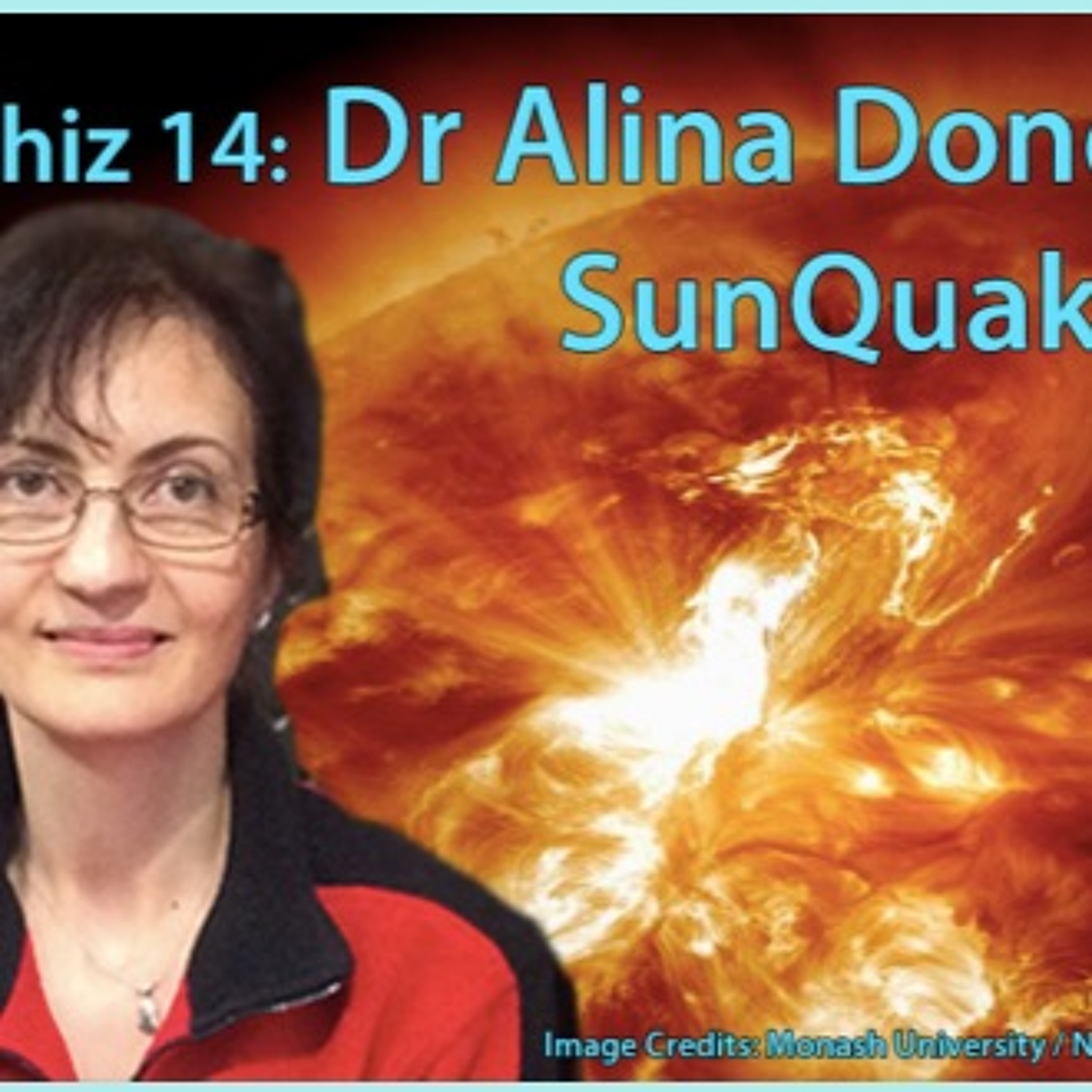
Our feature interview is from the Australian Space Research Conference where we spoke with Dr Alina Donea from Monash University who is using maths and solar satellite data to detect sun quakes and using phase shifting can accurately predict the appearance of active regions appearing around the eastern limb of our sun as it rotates, In ‘What’s Up Doc?’ this week, Dr Ian ‘Astroblog’ Musgrave tells us about viewing Venus, Mars and Saturn, a brief report on the Orionid Meteor Shower and in ‘Ian’s Tangent’ he tells us about using photometry to do meaningful research on variable stars. In the news this week: 1. The Max Planck Institute releases a paper and stunning images of a protoplanetary disk captured by the Atacama Large Millimeter/ submillimeter Array (ALMA), which has profound implications for our understanding of planet formation around young stars 2. The National Radio Astronomy Observatory (NRAO) uses ALMA to explore the Hubble Ultra Deep Field and also releases amazing images and uncovers insights into the 'Golden Age' of Galaxy Formation 10 billion years ago 3. ESO and The International Centre for Radio Astronomy in Perth have shared their revolutionary NGAS data management system with the giant 500m FAST radio telescope facility in China to manage the petabytes of data it generates each year. 4. We describe how the construction of the Canadian Hydrogen Intensity Mapping Experiment (CHIME) is completed with a unique 8000 square metre radio telescope design which is investigating the key mysteries of dark energy. 5. We report on the NASA Mars 2020 Rover’s MOXIE instrument which will produce Oxygen on the Red Planet and will be launched atop an Atlas V booster, from Cape Canaveral Air Force Station in Florida in July 2020. Apologies from Dr Cherbakov, who is taking a little break at her dacha near Tver.
What this episode covers
Our feature interview is from the Australian Space Research Conference where we spoke with Dr Alina Donea from Monash University who is using maths and solar satellite data to detect sun quakes and using phase shifting can accurately predict the appearance of active regions appearing around the eastern limb of our sun as it rotates, In ‘What’s Up Doc?’ this week, Dr Ian ‘Astroblog’ Musgrave tells us about viewing Venus, Mars and Saturn, a brief report on the Orionid Meteor Shower and in ‘Ian’s Tangent’ he tells us about using photometry to do meaningful research on variable stars. In the news this week: 1. The Max Planck Institute releases a paper and stunning images of a protoplanetary disk captured by the Atacama Large Millimeter/ submillimeter Array (ALMA), which has profound implications for our understanding of planet formation around young stars 2. The National Radio Astronomy Observatory (NRAO) uses ALMA to explore the Hubble Ultra Deep Field and also releases amazing images and uncovers insights into the 'Golden Age' of Galaxy Formation 10 billion years ago 3. ESO and The International Centre for Radio Astronomy in Perth have shared their revolutionary NGAS data management system with the giant 500m FAST radio telescope facility in China to manage the petabytes of data it generates each year. 4. We describe how the construction of the Canadian Hydrogen Intensity Mapping Experiment (CHIME) is completed with a unique 8000 square metre radio telescope design which is investigating the key mysteries of dark energy. 5. We report on the NASA Mars 2020 Rover’s MOXIE instrument which will produce Oxygen on the Red Planet and will be launched atop an Atlas V booster, from Cape Canaveral Air Force Station in Florida in July 2020. Apologies from Dr Cherbakov, who is taking a little break at her dacha near Tver.
NOW PLAYING
Astrophiz Podcast 14 - Dr Alina Donea sees right through our sun - Dr Ian Musgrave - Photometry
No transcript for this episode yet
Similar Episodes
No similar episodes found.
Similar Podcasts
No similar podcasts found.