
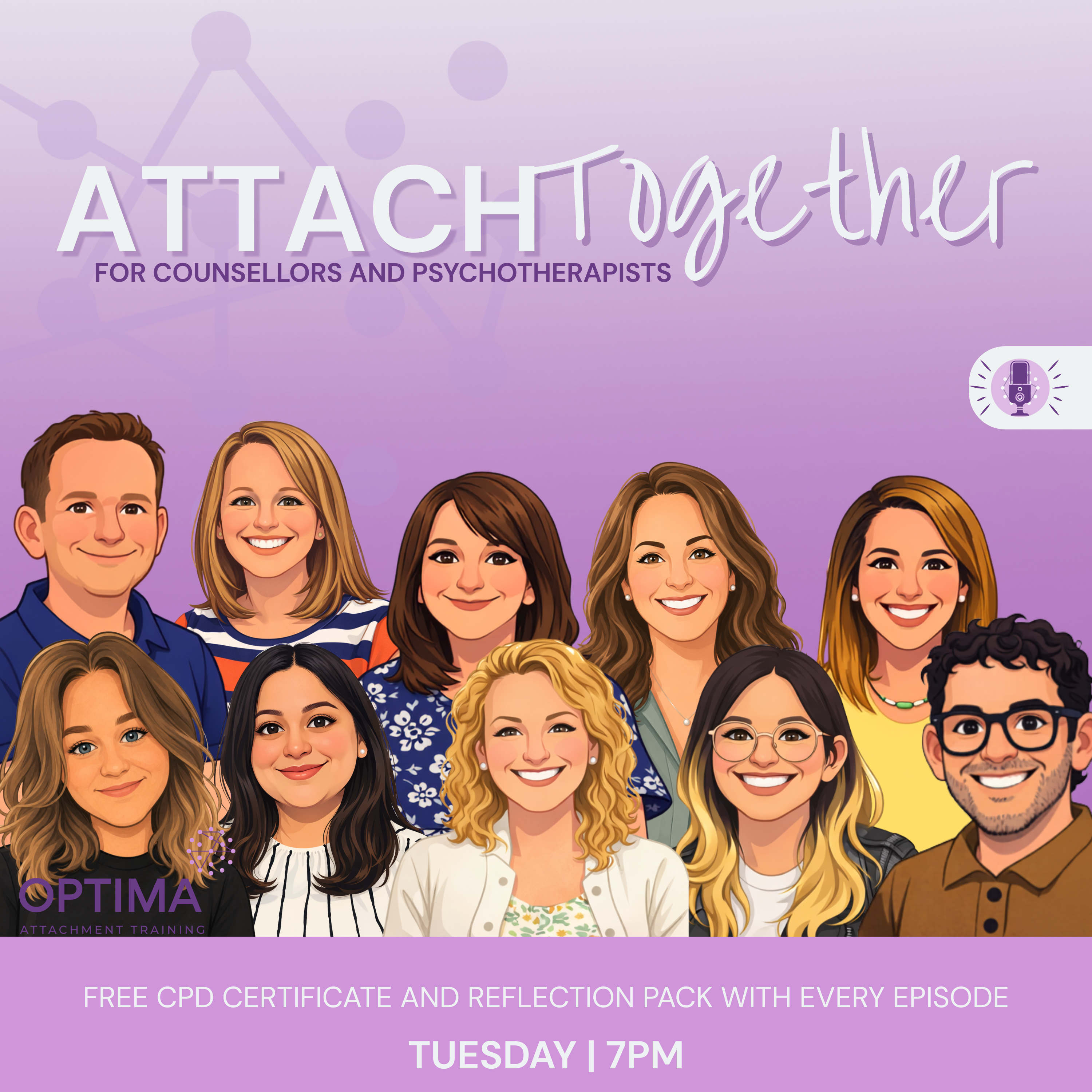
EPISODE · Jul 13, 2026 · 25 MIN
Attachment and Creative Approaches in Therapy: Working Beyond Words
from Attach Together · host Optima Health Services
CPD Certificate In this episode, Georgina Sturmer and Darren look at creativity through the lens of attachment theory, asking how play, metaphor and objects can open up the work without overwhelming the client.Creative work is much broader than drawing or painting. A game of Uno, a collection of stones, visual cards, nesting dolls or a shared metaphor may give a client another way to show us something about their internal world.Creative approaches in therapy use play, imagery, metaphor, sensory experience or physical objects to support emotional exploration and communication.For some clients, talking can feel pressured. They may worry about saying the wrong thing, getting their story right or naming an emotion accurately. Creative work can sometimes soften that pressure and bring us closer to felt experience.In this episode, we explore:Creativity beyond pens, paper and paintPlay, the inner child and pre-verbal experienceUsing games to support connectionStones, visual cards and sand tray workShame and the fear of getting creativity “wrong”Avoidant attachment and creative workDrawing with the non-dominant handNoticing rather than interpretingNesting dolls and attachment metaphorsCreative approaches in online therapyThe swimming pool metaphorCreativity in supervisionTherapist enthusiasm, pacing and relational safetyCreativity and Attachment-Informed TherapyA client’s response to creativity can tell us something about the process between us.Some clients may engage quickly. Others may become hesitant, embarrassed or self-critical. For clients with more avoidant attachment tendencies, creative work may initially feel unfamiliar or exposing.The task is not to push through that hesitation.It is to notice it.Creative work can be useful when a client feels stuck, struggles to find language or seems unsure how to use the therapy space. But the intervention should remain in service of the client, rather than the therapist’s enthusiasm for a particular approach.Common QuestionsWhat are creative approaches in therapy?Creative approaches in therapy use play, metaphor, images, sensory materials or objects to help clients explore emotional and relational experiences.How can creativity support attachment-informed therapy?It can offer another route into attachment trauma, attachment styles and relationships, particularly when direct emotional language feels difficult.Are creative approaches only for children?No. Adults may also find play, metaphor and sensory work helpful, especially when experiences feel difficult to explain verbally.Can creative approaches be used online?Yes. Therapists can use drawings, objects, visual metaphors and shared imagery in online therapy as well as face-to-face work.YouTube Chapters00:00 Welcome to Season Two00:55 Creativity in the therapy room01:31 What is a creative approach?04:09 Stones and visualising the client’s world06:47 Choosing a creative intervention09:05 Sand tray and sensory experience09:48 Attachment styles and creativity10:58 The wardrobe drawing exercise13:51 Nesting dolls in therapy16:59 Creative work online18:56 Castles, bridges and defensive strategies20:06 Creativity in supervision21:34 Keeping the client at the centreFor more conversations about attachment theory, attachment styles, attachment trauma, attachment-informed therapy and relationships, subscribe to Attached Together
What this episode covers
CPD Certificate In this episode, Georgina Sturmer and Darren look at creativity through the lens of attachment theory, asking how play, metaphor and objects can open up the work without overwhelming the client.Creative work is much broader than drawing or painting. A game of Uno, a collection of stones, visual cards, nesting dolls or a shared metaphor may give a client another way to show us something about their internal world.Creative approaches in therapy use play, imagery, metaphor, sensory experience or physical objects to support emotional exploration and communication.For some clients, talking can feel pressured. They may worry about saying the wrong thing, getting their story right or naming an emotion accurately. Creative work can sometimes soften that pressure and bring us closer to felt experience.In this episode, we explore:Creativity beyond pens, paper and paintPlay, the inner child and pre-verbal experienceUsing games to support connectionStones, visual cards and sand tray workShame and the fear of getting creativity “wrong”Avoidant attachment and creative workDrawing with the non-dominant handNoticing rather than interpretingNesting dolls and attachment metaphorsCreative approaches in online therapyThe swimming pool metaphorCreativity in supervisionTherapist enthusiasm, pacing and relational safetyCreativity and Attachment-Informed TherapyA client’s response to creativity can tell us something about the process between us.Some clients may engage quickly. Others may become hesitant, embarrassed or self-critical. For clients with more avoidant attachment tendencies, creative work may initially feel unfamiliar or exposing.The task is not to push through that hesitation.It is to notice it.Creative work can be useful when a client feels stuck, struggles to find language or seems unsure how to use the therapy space. But the intervention should remain in service of the client, rather than the therapist’s enthusiasm for a particular approach.Common QuestionsWhat are creative approaches in therapy?Creative approaches in therapy use play, metaphor, images, sensory materials or objects to help clients explore emotional and relational experiences.How can creativity support attachment-informed therapy?It can offer another route into attachment trauma, attachment styles and relationships, particularly when direct emotional language feels difficult.Are creative approaches only for children?No. Adults may also find play, metaphor and sensory work helpful, especially when experiences feel difficult to explain verbally.Can creative approaches be used online?Yes. Therapists can use drawings, objects, visual metaphors and shared imagery in online therapy as well as face-to-face work.YouTube Chapters00:00 Welcome to Season Two00:55 Creativity in the therapy room01:31 What is a creative approach?04:09 Stones and visualising the client’s world06:47 Choosing a creative intervention09:05 Sand tray and sensory experience09:48 Attachment styles and creativity10:58 The wardrobe drawing exercise13:51 Nesting dolls in therapy16:59 Creative work online18:56 Castles, bridges and defensive strategies20:06 Creativity in supervision21:34 Keeping the client at the centreFor more conversations about attachment theory, attachment styles, attachment trauma, attachment-informed therapy and relationships, subscribe to Attached Together
NOW PLAYING
Attachment and Creative Approaches in Therapy: Working Beyond Words
No transcript for this episode yet
Similar Episodes
No similar episodes found.
Similar Podcasts
No similar podcasts found.