
EPISODE · Nov 21, 2024 · 17 MIN
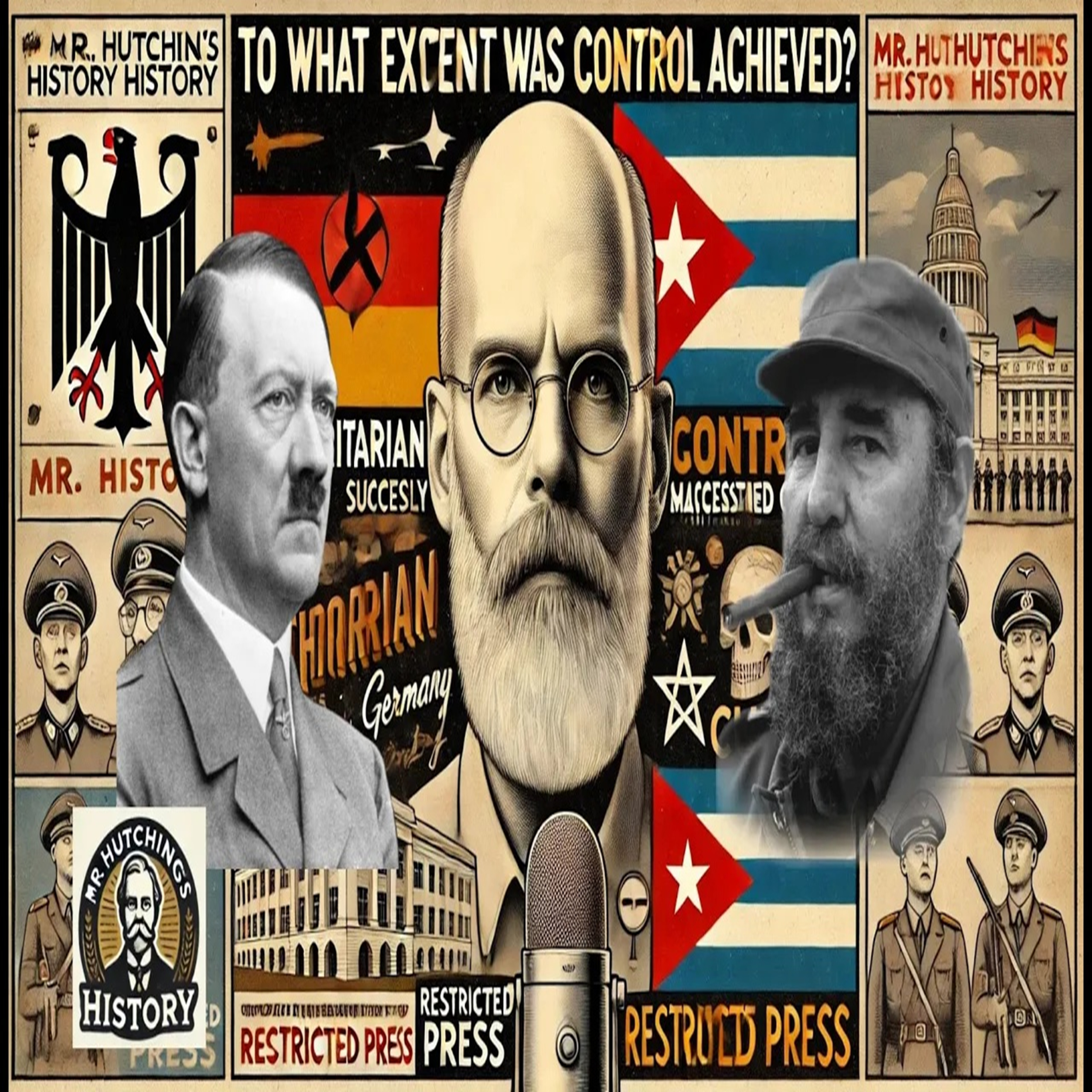
Authoritarian Power: To What Extent Did Hitler and Castro Achieve Authoritarian Control?
from Mr. Hutchings History · host Produced, created, and written by Harold M. Hutchings
Welcome to Mr. Hutchings History, where today we dive into the political control of Adolf Hitler and Fidel Castro, two of the 20th century’s most iconic authoritarian leaders. Using political scientist Juan Linz’s framework of authoritarianism, we examine the rise of these two regimes, their consolidation of power, and how they adhered to Linz’s four key characteristics: limitation of political institutions, emotional legitimacy, suppression of political opponents, and shifting powers of authority.Through a comparative analysis, we explore how both Hitler and Castro created one-party states, used emotional appeals to legitimize their regimes, suppressed opposition, and exercised shifting powers. We also examine the historiographical schools of thought, including Totalitarianism, Functionalism, Intentionalism, and Post-Colonialism, to better understand the nature of their authoritarian control.From Hitler’s manipulation of Nazi Germany’s political system to Castro’s revolutionary consolidation in Cuba, this episode sheds light on the inner workings of authoritarianism and the extent to which these leaders shaped their states.#Authoritarianism #Hitler #Castro #NaziGermany #CubanRevolution #PoliticalPower #IBHistory #Totalitarianism #PoliticalControl #Fascism #Communism #OnePartyState #Historiography #JuanLinz #HistoricalDebates #NaziRegime #Cuba #FidelCastro #PoliticalOppressionWorks CitedArendt, Hannah. The Origins of Totalitarianism. Harcourt, 1951.Broszat, Martin. The Hitler State: The Foundation and Development of the Internal Structure of the Third Reich. Longman, 1981.Eckstein, Susan. Back from the Future: Cuba Under Castro. Princeton UP, 2003.Kershaw, Ian. Hitler: A Biography. Penguin, 2008.Linz, Juan. An Authoritarian Regime: Spain. Routledge, 1964.Chapters(0:00) Introduction & Overview• Welcome and preview of today’s deep dive on authoritarian power.• Focus: How Hitler and Castro seized and maintained control.(1:00) Lin’s Framework for Authoritarianism• Introduction to Juan Lin’s checklist.• Key traits: One-party state, manipulation via fear, ruthless suppression, and vague power structures.(4:42) Case Study: Hitler’s Germany• Rapid power consolidation through the 1933 Enabling Act.• Elimination of political competition and strategic propaganda.• Brutal suppression of dissent (e.g., the Night of the Long Knives).(7:57) Case Study: Castro’s Cuba• Power consolidation through anti-imperialism and crisis exploitation.• Leveraged events like the Bay of Pigs and Missile Crisis as propaganda tools.• Established control via surveillance, self-censorship, and elimination of opposition.(13:00) Implications & Reflection• Analysis of how authoritarian patterns persist today.• Emphasis on recognizing early warning signs and engaging critically as citizens.• Final thoughts on safeguarding democratic norms.(17:27) Conclusion• Wrap-up and call to stay informed and vigilant against authoritarian tendencies
Embed this episode
NOW PLAYING
Authoritarian Power: To What Extent Did Hitler and Castro Achieve Authoritarian Control?
No transcript for this episode yet
Similar Episodes
No similar episodes found.
Similar Podcasts
No similar podcasts found.