
EPISODE · Jan 17, 2026 · 56 MIN
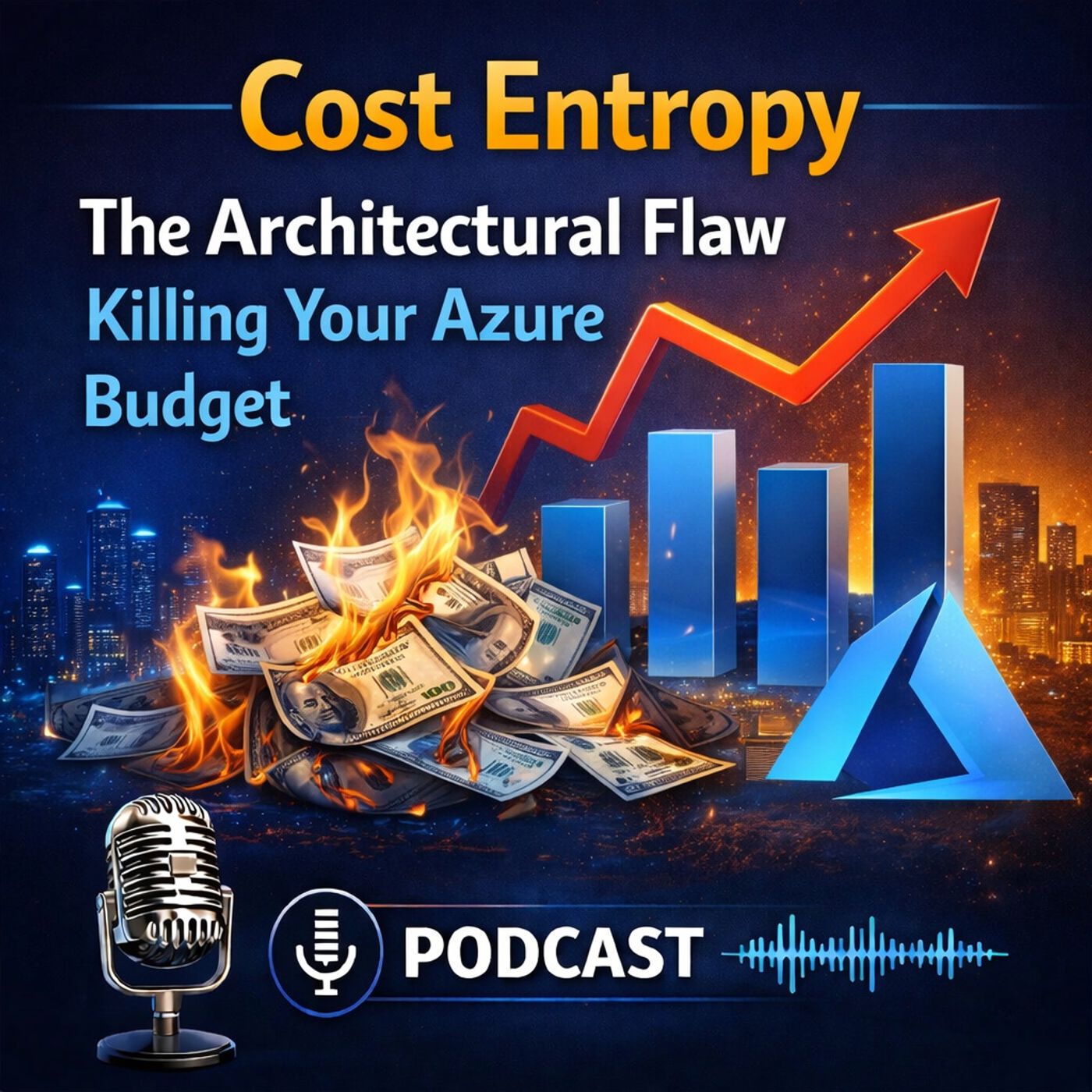
Azure Cost Governance: How to Stop Unowned Spend in Microsoft Cloud with Subscription Design, Tagging Enforcement, and FinOps Guardrails
from M365.FM - Modern work, security, and productivity with Microsoft 365 · host Mirko Peters - Founder of m365.fm, m365.show and m365con.net
(00:00:00) The Azure Cost Conundrum (00:00:32) The Illusion of Waste (00:01:20) The Physics of Cloud Cost Accumulation (00:02:20) The Visibility Trap (00:07:10) The Authorization Shift (00:12:10) The Subscription Boundary (00:20:06) The Tagging Dilemma (00:28:15) Premium Tiers and Over-Provisioning (00:32:37) Non-Production Spend Gone Wild (00:32:39) The Non-Production Spend Landfill Most organizations think Azure gets expensive because engineers “waste” money. They are wrong. Azure gets expensive because the platform is allowed to spend without ownership, without limits, and without consequences. That is not a savings problem. It is cost entropy: unmanaged deployment pathways that keep generating recurring spend long after the original decision is forgotten, long after the original project team has moved on, and long after anyone can still explain why that SKU, region, or architecture was chosen in the first place. This episode is not about dashboards, right-sizing folklore, or Spot VM myths. It is about the uncomfortable shift from asking “why is Azure expensive?” to the only question that actually matters: What did you allow, and why can nobody stop it?In this episode of M365.FM, Mirko Peters takes apart the architectural failure mode behind out-of-control Azure bills and shows why traditional FinOps tooling, cost reviews, and monthly slide decks are structurally incapable of fixing it. This is not a conversation about shaving a few percent off your invoice. It is a conversation about how your platform architecture, subscription strategy, RBAC model, and policy design either encode financial intent into Azure — or turn your cloud estate into a distributed spending engine with no brakes.The organizations that will win with cloud over the next decade are not the ones with the nicest Cost Management dashboards or the most aggressive savings targets. They are the ones that treat every dollar in Azure as the side-effect of an authorization decision, that design subscriptions as cost governance boundaries rather than convenience buckets, and that refuse to let untagged, unowned, or unjustified resources exist in their tenant. Cost control in Azure is not a finance problem. It is a platform engineering problem — and cost entropy is the symptom of a platform that has never been designed to constrain itself.WHAT YOU WILL LEARN- Why Azure cost overruns are not “engineer waste” but the predictable outcome of a platform that allows spend without ownership, limits, or consequences.- How cost entropy forms in Azure environments through temporary environments that never die, premium SKUs “just in case,” and shared services nobody feels accountable for.- Why FinOps implemented as dashboards, reports, and monthly reviews fails — and why observability without enforcement always degenerates into “cost theater.”- How to reframe cloud cost from a finance event into the runtime side-effect of authorization and policy decisions in Azure.- What it means to design subscriptions as real cost governance boundaries with owners, budgets, allowed SKUs, and escalation paths.- Why tagging keeps failing in enterprises — and how treating tags as required financial identity instead of “best practice” changes allocation and accountability.- How environment-aware controls (dev vs. test vs. prod) and SKU restrictions turn cost control into architecture rather than after-the-fact pleading.THE CORE INSIGHTAn Azure bill is not a spreadsheet problem. It is a control plane problem. Before a single Euro appears on your invoice, a series of very specific things has already happened: a resource was created or scaled, an identity was allowed to do so, a policy did not block the configuration, and a subscription silently absorbed the blast radius. Azure did not get expensive. Azure did exactly what it was allowed to do — every single time.Once you see cost as the side-effect of authorization, the failure mode becomes obvious. Cost does not start in Cost Management. It starts at deploy time. If a resource exists without clear ownership, budget boundaries, or correct tags, that is not a “missing report.” It is an authorization failure disguised as a billing problem. Every exception, every “temporary” bypass, every untagged deployment turns your system from deterministic to probabilistic: sometimes denied, sometimes allowed, depending on who asked, where, and which forgotten exemption is still hanging around from last year’s project. Financial intent is not a PowerPoint slide. It is encoded in identity, policy, hierarchy, and exception governance. Control is not a dashboard. Control is a deny.THE ENTERPRISE COST FAILURE MODE: WHEN UNOWNED SPEND BECOMES NORMALCost overruns in Azure rarely show up as one big dramatic mistake. They show up as a new normal. A “temporary” migration environment that never gets deleted because no one can prove it is safe. A premium database SKU chosen “just in case” because outages hurt careers, not invoices. Silent data egress during a network change because paths shifted and nobody noticed. None of these are exotic failures. They are the default outcome of a large Azure estate where financial intent is not enforced by the platform.Every one of these decisions is locally rational. Engineers optimize for availability, not cost. Teams optimize for speed, not cleanup. Platform teams unblock work by granting broad access “temporarily.” The enterprise does not pay for the local decision. It pays for the aggregate — and the aggregate compounds because cloud spend is recurring. Idle capacity persists. Over-redundancy stacks. Shared services grow without allocation. Over a few quarters, the abnormal becomes the baseline, and the baseline becomes “just what Azure costs here.”FINOPS IMPLEMENTED BACKWARDS: TOOLING FIRST, GOVERNANCE NEVERMost enterprises “do FinOps” the same way they do security awareness: buy tools, build dashboards, and hope behavior changes. The pattern is painfully consistent: enable Cost Management, build reports, export to Power BI, argue about allocation, add budget alerts at 90 percent. Everybody is busy. Nothing is constrained.Observability is not governance. Dashboards describe what already happened. They do not decide what can happen next. This is why FinOps so often devolves into cost theater: meetings, metrics, and emails with no structural change in who is allowed to create spend and under which conditions. Alerts become noise because they are not attached to a specific owner with authority, accountability, and a clear set of consequences. Engineers learn the real policy quickly: nothing happens when you exceed intent, so intent does not matter. Cost tooling tells you where the money went. It cannot prevent the next dollar.THE REFRAME: EVERY CLOUD DOLLAR IS AN AUTHORIZATION DECISIONOnce you accept that every Euro in Azure is a byproduct of a successful authorization, the design space changes. You stop asking “How do we save 15 percent?” and start asking “Where are we allowing spend to occur without explicit, enforced intent?” That shifts the work from finance into platform architecture and governance: RBAC design, policy-as-code, subscription strategy, tagging enforcement, and exception management.Financial intent, architecturally, is encoded as constraints: declared ownership, budget boundaries, SKU and region restrictions, and escalation paths that actually have teeth. Cost control lives at the intersection of Azure Resource Manager, RBAC, Policy, and subscription boundaries. Savings are the side-effect. Control is the objective.SUBSCRIPTIONS: THE PRIMARY COST GOVERNANCE BOUNDARYSubscriptions are not just billing containers. They are the point where RBAC, Policy, and budgets intersect. Resource groups organize. Management groups standardize. Subscriptions contain damage — financial and operational.A real subscription strategy treats each subscription as a cost boundary with a purpose. A subscription should not exist unless four things are true: a named accountable owner exists, a budget with early thresholds is defined, allowed SKUs and regions match the subscription’s purpose, and an escalation workflow is in place for breaches and exceptions. Every ad-hoc subscription is a new, unreviewed spending pathway. Subscription creation is not a convenience event. It is a governance event.Become a supporter of this podcast: https://www.spreaker.com/podcast/m365-fm-modern-work-security-and-productivity-with-microsoft-365--6704921/support.
Embed this episode
What this episode covers
(00:00:00) The Azure Cost Conundrum (00:00:32) The Illusion of Waste (00:01:20) The Physics of Cloud Cost Accumulation (00:02:20) The Visibility Trap (00:07:10) The Authorization Shift (00:12:10) The Subscription Boundary (00:20:06) The Tagging Dilemma (00:28:15) Premium Tiers and Over-Provisioning (00:32:37) Non-Production Spend Gone Wild (00:32:39) The Non-Production Spend Landfill Most organizations think Azure gets expensive because engineers “waste” money. They are wrong. Azure gets expensive because the platform is allowed to spend without ownership, without limits, and without consequences. That is not a savings problem. It is cost entropy: unmanaged deployment pathways that keep generating recurring spend long after the original decision is forgotten, long after the original project team has moved on, and long after anyone can still explain why that SKU, region, or architecture was chosen in the first place. This episode is not about dashboards, right-sizing folklore, or Spot VM myths. It is about the uncomfortable shift from asking “why is Azure expensive?” to the only question that actually matters: What did you allow, and why can nobody stop it? In this episode of M365.FM, Mirko Peters takes apart the architectural failure mode behind out-of-control Azure bills and shows why traditional FinOps tooling, cost reviews, and monthly slide decks are structurally incapable of fixing it. This is not a conversation about shaving a few percent off your invoice. It is a conversation about how your platform architecture, subscription strategy, RBAC model, and policy design either encode financial intent into Azure — or turn your cloud estate into a distributed spending engine with no brakes. The organizations that will win with cloud over the next decade are not the ones with the nicest Cost Management dashboards or the most aggressive savings targets. They are the ones that treat every dollar in Azure as the side-effect of an authorization decision, that design subscriptions as cost governance boundaries rather than convenience buckets, and that refuse to let untagged, unowned, or unjustified resources exist in their tenant. Cost control in Azure is not a finance problem. It is a platform engineering problem — and cost entropy is the symptom of a platform that has never been designed to constrain itself. WHAT YOU WILL LEARN - Why Azure cost overruns are not “engineer waste” but the predictable outcome of a platform that allows spend without ownership, limits, or consequences. - How cost entropy forms in Azure environments through temporary environments that never die, premium SKUs “just in case,” and shared services nobody feels accountable for. - Why FinOps implemented as dashboards, reports, and monthly reviews fails — and why observability without enforcement always degenerates into “cost theater.” - How to reframe cloud cost from a finance event into the runtime side-effect of authorization and policy decisions in Azure. - What it means to design subscriptions as real cost governance boundaries with owners, budgets, allowed SKUs, and escalation paths. - Why tagging keeps failing in enterprises — and how treating tags as required financial identity instead of “best practice” changes allocation and accountability. - How environment-aware controls (dev vs. test vs. prod) and SKU restrictions turn cost control into architecture rather than after-the-fact pleading. THE CORE INSIGHT An Azure bill is not a spreadsheet problem. It is a control plane problem. Before a single Euro appears on your invoice, a series of very specific things has already happened: a resource was created or scaled, an identity was allowed to do so, a policy did not block the configuration, and a subscription silently absorbed the blast radius. Azure did not get expensive. Azure did exactly what it...
NOW PLAYING
Azure Cost Governance: How to Stop Unowned Spend in Microsoft Cloud with Subscription Design, Tagging Enforcement, and FinOps Guardrails
No transcript for this episode yet
Similar Episodes
No similar episodes found.
Similar Podcasts
No similar podcasts found.