
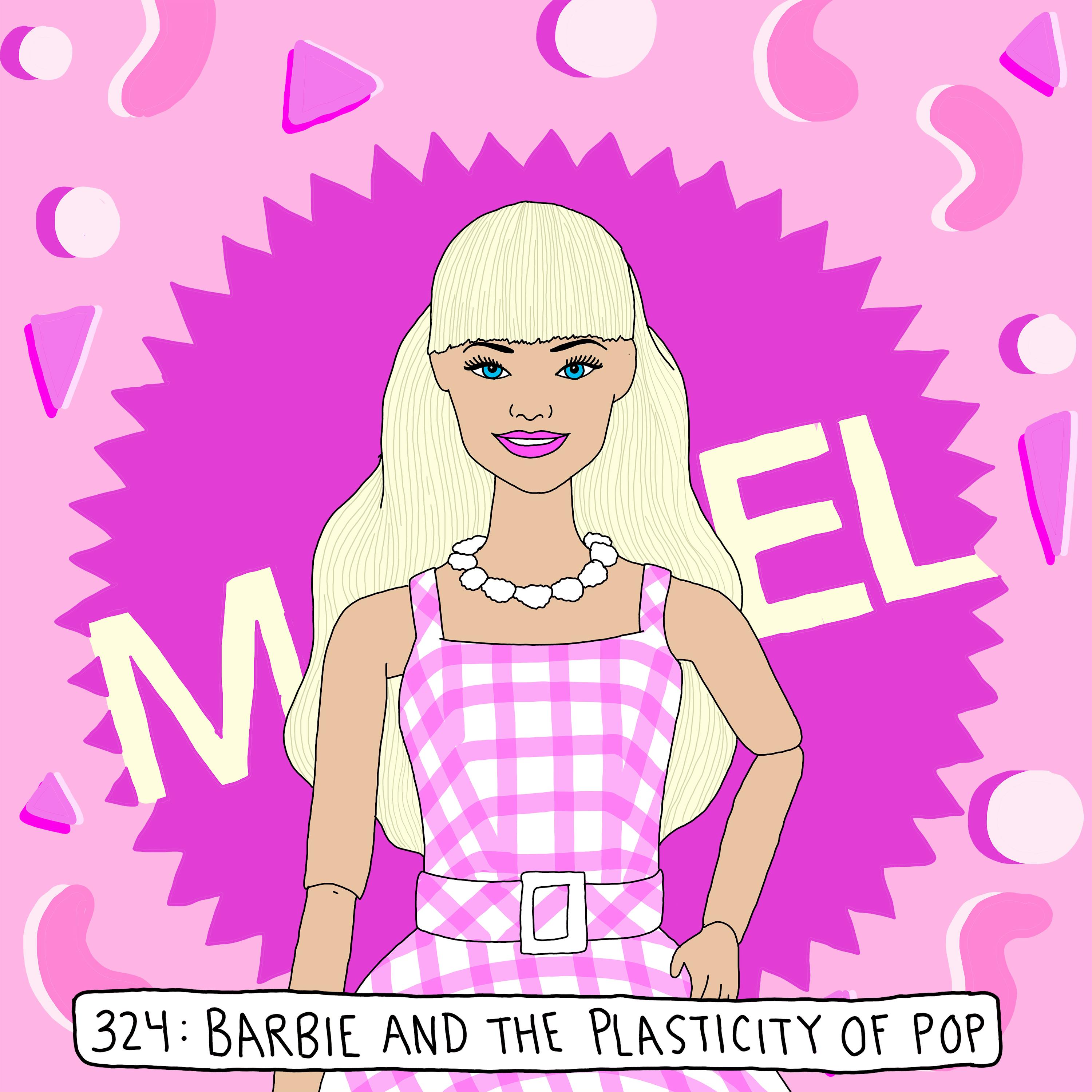
Barbie has been around for almost 65 years, but Barbie's aesthetic, you could argue it's been around even longer. When you kind of put up a timeline of the history of fashion, Barbie Quarry's always kind of been there, we just didn't call it that. And I think by the time you hit Clueless, supersiders like Paris Hilton and Nicole Ritchie, it became more of a present. The enduring appeal of Barbie fashion, this week on Intuit, Vulture's Pop Culture Podcast.
Switched on pop. Welcome to Switched on pop, I'm producer Rihanna Cruz. And I'm sorry to Charlie. So, Charlie, I feel like this summer we've approached the closest thing to a monocultural moment.
And I feel like that comes in the form of Greta Gerwig and her film Barbie. Yes, it feels like we have been inundated with Barbie messaging, marketing. Barbie is inescapable. Barbie is all around us.
Barbie is omnipotent. But the part where we come in is that any big movie these days comes with a soundtrack. Right, like Black Panther or Spider-Man. You can't just make a movie.
You have to have a whole album that goes along with it. Exactly. And the Black Panther soundtrack was executive produced by Kendrick Lamar. Metro Boomin produced the Spider-Man Across the Spider-Verse soundtrack.
This soundtrack for Barbie was executive produced by none other than Mark Ronson. Yes, Mark Ronson, friend of the show he's been on, known for his retro throwback productions with Amy Winehouse and Bruno Mars, et cetera, et cetera. Interesting to figure out what this Barbie soundtrack is going to sound like in the hands of Mark Ronson. Well, the soundtrack is kind of a who's who of popular music right now.
We have Dua Lipa. To Nicki Minaj. To Carol G. This soundtrack variety, to me, is assumedly working to capture all aspects of the Barbie experience.
I feel like the Barbie experience is whatever you want it to be. To look at the Barbie experience, we've got to look at what is Barbie. And I think Barbie contains a duality. Barbie is a commodity, but also a close personal friend.
She's everything you want her to be, but also inherently plastic and immutable. And Barbie is on track to be the biggest movie of the summer, but also represents Hollywood's strategy of milking a piece of IP for all it's worth. You know, there's dualities within Barbie and, of course, by extension, the Barbie experience. Barbie can be anything.
You just have to use your imagination. And the imagination of this soundtrack under the executive production of Mark Ronson seems to be expansive. Exactly. And that expansive plasticity of Barbie lends itself appropriately to pop music, which, similarly to Barbie, is founded on artifice and commodity and a product's relationship with the public.
But also joy and fun and all the things that we love about music. Lots of good things. I don't want to be like a doomer on the podcast. Lots of good things, too.
I'm just saying that, you know, both Barbie and pop music are products designed to be consumed by a mass audience, right? So how do we judge whether or not a Barbie soundtrack is effective or, frankly, good? I think it comes down to its ability to be plastic in all its meetings. And as we'll see, there's lots of different types of plastic, and some fit the Barbie aesthetic more than others.
Let's look at some of the songs on the Barbie soundtrack and see how well they look to embody this Barbie ethos. First, we have Barbie Dreams by 5050 featuring Kali. This, to me, is like buffed, shiny plastic. This is plastic so reflective you can see yourself in it.
It's maximalist. It's over the top. It's not trying to be anything but exactly what it is. Right.
And for the same reasons, this song, to me, is Barbie. It sums up the ethos most effectively. It's fun. It's, like you said, plastic.
It is perfect pop music, founding itself on a sample of the classic Together Again by Janet Jackson. I feel like our reporting from last summer about everything being vine-snatching, just reinterpolating prior work, that seems to be the pop strategy. And always the question is, how well do they reinterpret the original? I think Janet Jackson's Together Again is really hard to ground.
But I think they've worked the melody in a really interesting way. I call 5050s version maximalist. And for me, it's maximalist both because it sounds like it's like the 2010s pop remix of Janet Jackson, but I think particularly because they take the chorus melody and they make it the main riff that just repeats over and over and over again. So it becomes this sort of like confectious, over-the-top, overly sweet kind of feeling, which is just exactly what a Barbie song ought to be doing.
Yeah, I think Together Again is one of the world's perfect melodies. It's sweet. And the feelings that I get from it are like a sense of yearning, right? Without being particularly cloying or over-the-top with it.
By using the melody here, but shifting it, the song becomes more exciting and more youthful and fits well for Barbie, while also keeping the beauty that made the melody great in the first place. And also fitting for 5050, who are a K-pop girl group, it feels like they're really sort of leaning into the cultural expectations of the genre, while also actually making great commentary on the Barbie-ness of the music. We've talked about 5050 on the show before because of their song Cupid, which blew up on TikTok and peaked in Billboard's Top 20. And Charlie, I think you called it the updated version of Love Fool by the Cardigans.
Can we hear that? Yeah, 5050 seems to be leaning a lot into nostalgia. For me, Cupid is very much in the style of Love Fool by the Cardigans from the 90s. So this group seems to be quite good at borrowing from pre-existing IP, which makes 5050 probably the right group to be working on the Barbie soundtrack, which itself is rehashed IP.
And so I think it's fitting. I feel like 5050 works in a number of ways, because they're good at using these interpolations in their music, but also judging from Cupid and Barbie dreams. I feel like the group is really good at harnessing a sense of childlike wonder and excitement in their lyrics. And Barbie, no matter what the film's PR is saying and the PG-13 rating it has, Barbie is a product designed for children.
So this is really smart in connecting the movie of Barbie to the soundtrack, to the object of Barbie, to the people that engage with it. It speaks to everybody. And it feels like perfect synergy on all accounts. I also think K-pop fits really well with the Barbie brands because of the sort of artifice and plasticity of Barbie, as we previously talked about.
I feel like K-pop is an industry that is so carefully poured over and curated, resulting in a product, the music and the bands and the groups that come out of it. Right, they're often called idol groups. And I think that we can think of Barbie the doll as also kind of idol that so many people have shrines to in their closet. And it works.
And I feel like the song contains multitudes, much like Barbie herself. But I think there's another song on the soundtrack that invokes the multitudes of Barbie more effectively, and that is Angel by Pink Panther. Wow. Okay, first of all, what kind of plastic is this?
This is for me the like plasticky, perfectly groomed hair on Barbie's head. It's just, there's a sheen to it. I love Pink Panther's voice in the same way. She really douses her voice in auto-tune, but it somehow actually evokes more emotion.
She sings at this very quiet volume. Something about this near whisper with the auto-tune. I feel very pulled into the music. The thing that really stunned me on the song, though, are those fiddles.
I mean, we've got like some kind of Irish real music. It's giving Titanic. Like what is going on with this song? It's got a two-step beat.
It's got Pink Panther's. It's got these fiddles. So bizarre. I've never heard anything quite like it.
Yeah, this is a weird one. There's a lot of different elements at play here. I mean, right from the gecko, there's like an odd evoking of nostalgia right from the drum beat, you know, the minute the track starts. It kind of comes in like a memory, you know, something ephemeral that you're feeling in real time.
It filters in and out. Yeah, it's like it's hazy coming into vision, but then you're losing it, slipping away. And of course, like you mentioned, there's the fiddle. Pink Panther's an English singer, so it makes sense that maybe she's been exposed to this sort of Irish fiddle music.
And I've never heard this kind of crossover, especially in a more US-centric pop soundtrack world. What a bizarre mashup to bring. There's also these weird Mortal Kombat, like, oofs, used as percussion throughout the track. Mortal Kombat, that's.
So putting all these elements together, the track works super well and weirdly enough fits the Barbie ethos in a more abstract way. It plays kind of like to the open world imagination qualities that a toy like Barbie can emulate. Oh, now I know what kind of plastic this is. This is like every kind of plastic in your toy chest, because you don't keep your Barbies separate from all the rest of your toys.
They intermingle, and it feels like a song is intermingling between genres in the same way that you might play with your Barbie dolls and Teenage Mutant Ninja Turtles at the exact same time. Right, it's like if Barbie is in the countryside, but is also play fighting other Barbies, you know, like it's like multiple, there's multiple elements at play. Okay, so Pink Panther is giving us some major Barbie vibes in a way that I have never previously thought about Barbie. Well, maybe we can pivot to some of the more classical Barbie interpretations.
Some of the songs on the Barbie soundtrack really apply, right, like 50-50, but also some are stretches, you know. I'm thinking of a song like Dance the Night by Doolie, but. I don't like to get mean, but this feels like mass-manufactured plastic that you would find in a milk crate. Yeah.
It's just that we've been in this pop disco revival era since at least 2013's Random Actless Memories by Dafton. We did a whole miniseries on it, and I feel like disco has never died. It always finds new ways of reviving itself, but I feel like there's been so much of playing to the cliches of disco, right? The horn sections, the string sections, the four-to-the-four-kick drums.
I just want to hear something new, and this one could have been off of Dua Lipa's 2020 album Future Nostalgia, but the song is neither feeling futuristic nor particularly nostalgic. It just feels like it could be on a playlist of disco music to shop at Kmart, too. Yeah, it really was giving Future Nostalgia a B-side to me. But funny enough, Mark Ronson said in an interview with Vulture that he didn't write the song for Dua.
He wrote the music, and then Dua wrote the song with Caroline Aylin. But even then, despite the song not being for Dua Lipa, it feels firmly Dua Lipa, and it doesn't give me anything new, anything exciting, and even inherently Barbie. I will say, this song maybe succeeds the most of what we've heard so far as an independent radio hit. I feel like this doesn't have to be connected to the world of Barbie.
It feels like just a Dua Lipa B-side song could very happily sit next to Levitating, Don't Start Now, all those big hits. Well, what really disappoints me is that the beauty of the soundtrack is the left turns that these artists are doing and taking. Like, look at Pink Panther, right? And that's an exciting take on her sound that I haven't heard before.
And even when the artists on the soundtrack are still firmly within their own bag and their own genre, it's still working in the Barbie theme, you know? Like, take the track Speed Drive by Charlie XCX, which is also on the Barbie soundtrack. Like, yes, that is a Charlie XCX song, you know, like, unmistakably. She's written songs about cars titled Vroom Vroom, Crash, White Mercedes, Backseat, and Porsche, just to name a few.
So, the track Speed Drive definitely fits within her work, yes. And I mean, the track is about driving. And of course, Barbie has her own car. She has a lot of cars, including a Corvette.
I think she has a Jeep, things like that. Right, right. It's also fitting that the Charlie XCX song is a interpolation of the song Mickey, which could have been the song playing in Barbie's car, or moreover, I feel like you could have walked through the aisles of Toys R Us in the 1980s and 90s and hear Mickey playing in the background as you shop in the all-pink aisle for Barbie. Yeah, so, clearly, Charlie XCX is taking the source material and adapting it for her song.
Dua Lipa, for me, is not doing that. There's not even any Barbie references on the track. There's no references to dolls, toys, her car, anything of that nature. And the only thing I could even associate with Barbie is this one line in the back half of the song.
I didn't catch it. It's, I'll still keep the party running, not one hair out of place. Thinking of, like, plastic, untouchable Barbie doll hair. But even then, exactly, Charlie, it's a stretch.
You miss it. It's a simple pop song that is not related to Barbie in any sense of the word. You know, with these movie pop albums, the songs are sometimes working as soundtracking. They're sometimes working as a commentary on the film itself.
And sometimes there's more standalone songs that maybe shouldn't have fit in anyway, but, you know, they need to get a leap in there. And I just feel like this falls into that category. Yeah, I feel like Dance of the Night was used as, you know, a big lead single to put in the trailer and pull people in and kind of get that cross-radio promotion. But at the end of the day, like, it let me down.
And there's another big song on the soundtrack that also let me down. And I'm sorry to say it, but it's Billie Eilish's What Was I Made For? I used to know, but I'm not sure now what I was made for. What was I made for?
I feel like we're hearing Matt Black Plastic, which has been melted in the sun. This is a really sad ballad, which is appropriate for Billie Eilish. She gives us a lot of those style songs. And I understand that the film is trying to alter our expectations of the kinds of feelings and experiences that Barbie can have.
But you said you were let down by the song. Yeah, and I think generally, you kind of touched on this before, but I feel like there's three characteristics of a good movie soundtrack song. You know, it has to serve as soundtracking, of course, or even like the end credits, if we're really stretching it, it has to represent the themes of the film and also has to function as a standalone song. What lets me down here, you know, if you listen to the lyrics and really think about it, it feels so connected to the movie that I think it fails at that third qualification to function as a standalone song.
It can't stand on its own. Yeah, like the lyrics, taking a drive, I was an ideal, looked so alive, turned out I'm not real. just something you paid for what was i made for you've got taking a drive we previously established we know all barbies like to have an accessory car the commentary on beauty and expectations is important and yet the sort of overly saccharine just something you paid for what was i made for it really does evoke having bought a toy in the toy aisle and brought it home and be being disappointed with your purchase or something but it feels hard to decouple the barbiness from those words when i listen to this track i can hear exactly the moment in which the song is placed in the barbie movie and i haven't even seen the movie and you know it's like truth be told whether or not this is true but i hear the song soundtracking the sort of all is lost of the of the hero's journey at the end of the second act where barbie walks around dejected and wonders what her purpose is you know like it fits so accurately in that moment that i can't really hear it outside of the context of barbie it's over succeeding at soundtracking and perhaps not fulfilling your requirement of needing to stand alone a bit by highlighting the vocal so presently and using lyrics that are so barbie related it just can't speed the film it's not plastic enough in some ways i mean it's disappointing because billy eilish has done soundtracks before to great success she even won an oscar for no time to die her james bond theme there's just no time to die one of my favorite episodes of the podcast was analyzing the song and it does contain within it exactly the james bond themes but somehow subverts them just enough that i'm happy to hear it when it's on the radio right and that's another example of like billy eilish writing a song for use as ip you know and of course bond isn't barbie and i think everybody has a much closer connection with barbie than james bond but nonetheless she has experience writing these songs to function both as things that can be played on the radio but also in and outside of the movies that they're from with what was i made for it's a song that's like packaged as like personal and handcrafted but it ends up sounding so commercial because of how connected it is to barbie as an entity oh my gosh it's almost like artificial flowers you know it's like plastic flowers oh wait never mind they're not real right and that's that's the vibe that i'm getting here from the billy eilish track okay so there's songs here you feel like after the plasticity of barbie and others that perhaps are a bit too rigid and don't bend enough as plastic to succeed in both the film outside of it yes but i feel like we're glossing over a really important part of the barbie musical canon charlie what's that i think the most important song in the barbie canon how could we forget is aqua's barbie girl i feel like barbie girl is arguably as important to the barbie universe as the doll itself this song in many ways defined what barbie means exactly and we'll get to talking about it after the break can you describe what he-man looks like okay um he-man muscle biking ish white guy wiley easton's son loved playing with his he-man toys as a little kid in the 80s i think i said something like oh you could you could be a superhero too and he said no i can't be a superhero because i'm not white and that's when wiley easton decided to make a black superhero toy for her son and other kids like him i just remember my mom running rushing to me showing me a little article about a figure that looked like he-man but he was black hear the story of sun man and his fans on the latest episode of this is love listen wherever you get your podcasts you are the man who gave them the power to destroy themselves and the world is not prepared oppenheimer opens in theaters today christopher nolan's feverishly anticipated film about the brilliant but troubled father of the atomic bomb yeah no i don't want to talk about oppenheimer today you can go back to your regular life or you can know the truth about the universe the choice is now yours okay ladies let's do this let's do this flip on those heels fall off your roof we're having a giant blowout party with planned choreography and a bespoke song and we're gonna sleep over tonight because we're girlfriend boyfriend it's today explained and it's the best day ever and so it's yesterday and so it's tomorrow and every weekday at 2 p.m when we drop in a new episode of today's swing the definitive barbie song is barbie girl by the danish norwegian europop band aqua you know it whether you love it or you hate it it's iconic i personally love it i think it's perfect and fits so appropriately in this plastic barbie canon that we've established yeah it's pure europop which is fun itself maybe a bit plastic and artificial definitely but emphasis on you're not having to think too hard about it but the song is also maybe thinking hard about barbie right it's commentary like the music could be as if madonna's material girl were done over ace of base's beautiful life with the cartoonishness of the witch doctor song it is kind of a meta mashup in its own way like many of the barbie soundtrack songs and it gives voice to barbie i think like this film is trying to do while commenting on the artificial nature and pre-established imagery that we have about what barbie can actually be yes so the song came out in 1997 and understandably so is inexplicably tied to the legend of barbie that same year in 1997 mattel even tried to sue mca records which was aqua's label in north america claiming that the song which at that point had hit number one in 14 countries turned barbie into a quote-unquote blonde bimbo wait so they're saying the song is that not mattel the song specifically the song so like whatever tens hundreds of millions of dollars on marketing spent on barbie over the decade they didn't contribute whatsoever they like the kind of plasticky sexualization of barbie in the song is the thing that's put on top that's the argument yeah i kind of see where they're coming from the singer in the song representing a character of barbie even says it explicitly so it's not entirely out of left field so she says i'm a blonde bimbo girl in fantasy world so i mean they're pulling directly from the song i guess yeah but it's sung with such jest it definitely feels like a parody of barbie it's the most over-the-top valley girl nasal approach to the vocal and it feels like a broadway performance commenting on barbie-ness more than a pop song using producing ip to make a hit right and you're right on the money because the lawsuit was eventually dismissed in 2002 by being designated through the court of appeals as a parody so it is protected by the first amendment because of exactly that it's over the top and is sort of intentionally obnoxious framing the song as a sort of just conversation between barbie and ken both functioning as characters i want to give it some credit for i think capturing the barbie ethos better than any song we've heard so far with the lyric imagination life is your creation mattel could take that as a slogan and that could be the new barbie line imagination life is your creation we could even apply that statement to other songs that we've heard today like angel by pink panthers or the 50 50 track barbie dreams those really function in the sort of ethos of imagination life is your creation so yeah barbie girl manages to get barbie in the best way it's plastic it's fun for any age and it's also disposable hot music that leaves a lasting impact and for the record mattel even came around to barbie girl by aqua licensing it in 2009 for a commercial where they changed the words nope that's good not as good i understand it's the g-rated version i need to make that i get it but yeah and the mattel commercial isn't the only song to kind of reinterpret barbie girl aqua's track and the melody on the song is so good it's lasted as maybe the most defining piece of culture about barbie that isn't the doll itself and we can see barbie girl present both on and off the barbie movie soundtrack to varying degrees of success first looking on the barbie soundtrack the most obvious use of barbie girl is on the song barbie world by ice spice and the ultimate barb nikki minaj right nikki minaj fans are called barbs got it i'm sorry but hard note like i feel like if the mattel commercial of barbie girl is the kids bop version this is like the hard bop version this is let's make it more real but putting some rappers on it making more contemporary making hyper sexualized which is extending the ip and imagery of the original barbie girl but like the thing that makes barbie girl work is that it sounds classic and fake and obnoxious barbie world feels like a drill style update to barbie girl it was yeah i mean i think a good part at the very very least giving credit where credit is due there's explicit references to barbie and barbie culture writ large take this part in nikki's verse it's funny i mean maybe it's not that serious right but it does feel like it's barbie with some attitude yeah i don't think it's that serious at the end of the day i kind of like the song i think it grows on me because it's pop music at its most distilled form there's nothing to really like dissect or even think critically about you know it's just like goes in one ear makes me you know kind of around a bit and then goes out the other you know like there really is nothing to like parts here yeah lines like we got bars but we ain't balling out in that pink ferrari we peeling out yeah it's just kind of like barbie imagery boisterous you know over the top fun rap all right i guess i have no problem with the song but i still think barbie girl is far superior well yes absolutely it's it's the standard but there's also another track on the barbie soundtrack that's more of an implicit nod to aqua and barbie girl from a song that you really wouldn't expect and that's is this like sampling without sampling what do you mean well it doesn't have the actual song in it there's right no clear chords or melody taken from barbie girl but it exists in the musical universe of barbie girl if made like in puerto rico yeah so you know on paper it's a pretty standard reggaeton dance track and i don't think mark ronson touched this track at all he's not on the production credits or nothing i think the song is my personal favorite on the soundtrack because to me like you kind of said it's sampling without sampling it feels the most like aqua's barbie girl in a kind of off-the-wall winking way what the song does well and what keeps it interesting is the framing of the song as a duet between carol g and aldo ranks with the girl voice playing off of like the gruff man voice that is also present on the aqua song so listen to the beginning of what that day it's a direct nod and even an anachronistic one because there's a telephone ring and you can hear someone picking up an actual telephone like you hear it coming off the hook this is not a mobile phone it's not an iphone and i feel like aqua starts in the exact same way with a similar machismo baritone chesty voice in the barbie universe it's like somebody pulling up in a car and then like cat calling barbie you know i could have sworn it was a telephone call my gosh let's hear the whole thing i can hear there's still sound effects used in a similar way you know barbie girl has like the sound of the car pulling up and the sound of the car driving away the way that what that uses the you know phone and the picking up the phone and putting down the phone oh my god you're making me realize now i'm sorry we have to go back for a second speed drive by charlie xdx does the exact same thing with the car but uses it as a transition moment from the pre-chorus to the chorus check that out yeah it's that revving of the engine yeah yeah so carol g there instead doing it feels like you're picking up a phone from the 90s referencing the sort of fully sound universe of the barbie girl song totally and the carol g aldo ranks track brings something that the nicky minaj ice spice track barbie world can't really what that day is like fun and exciting you know it captures the sort of carefree ethos of the barbie spirit it's totally fun and just like barbie girls got this really grating plasticky sounding lead sound sort of a fake horn it's grating but it works so even though what that doesn't use the barbie girl melody explicitly aqua has their fingerprints all over the carol g track but the barbie girl melody is so simple that it lends itself to being interpolated over and over again throughout music it's sampled in 49 songs according to who sampled and of course with that popularity there's as many flops as there are bops you know not everything can be what that day and barbie dreams and the gold standard of barbie inflected tracks have you listened to all of these yeah i've done my time in barbie purgatory listening to these songs over and over and over again tough but not impossible i found a few examples that take the barbie girl melody let's first look at the song my world by jewel jewel j-u-l not j-e-w-e-l the right need to emphasize that before researching i had never heard of this song of this artist but apparently the artist jewel j-u-l is a french rapper who apparently is the biggest record seller in the history of french rap he's like french rap's drake you know why we should pay attention my gosh wow okay how do you feel the song i don't like it sorry to the french rap fans out there but i this is just not for me i think like the other examples that we talked about that incorporate barbie girl kind of pare down the annoyingness to keep it palatable here on my world the track with the auto-tune with the interpolation skewing too much into annoying for me to fully kind of jump on board the melody coupled with the instrumentation feels like a bastardized version of like a tinny music box you know like that you like play and it comes out of a toy so in a way kind of can be brought back to barbie maybe it's playing on the radio in the barbie corvette movie you have that wind-up creepy toy sound it feels more like existential soundtrack music to a thriller uh and i don't know my french is very bad now but it doesn't feel like it's capturing barbie-ness like it's using the melody for its hookiness but not for its meaning yeah the word plastique is in there but i'm gonna have to do some deeper translation later well similarly on the wrong side of barbie girl history we have party girls by ludicrous wizz khalifa jeremiah and cashing your cat are you serious i've never i've never heard of the song i don't know i mean i like the beat the beat is actually really interesting but where barbie girl comments on the sexualization of barbie-ness this song is just pure male gaze no one needs it yeah it makes me feel kind of gross and like like listening to it and using that yeah gross i'm not a fan this is also pretty terrible and what i'm realizing is that the song i think that barbie girl is used in is most likely to succeed when the track is in the same goofy conversation as the source text you know like that's why like barbie world didn't give an ice spice song maybe it's not the best song but it also kind of works because it's keeping things like light and fun and exciting if you put that aqua sample or the aqua interpolation in a track that like doesn't have the juice like takes itself too seriously it falls flat yeah it makes sense because you know if there's over a billion barbie all sold i feel like barbie girl was one of the most overplayed radio singles in the 90s and it's so embedded in its own cultural meaning that you really can't escape it if you reference it all right charlie i have one more song for you and it contains probably the most explicit reference to aqua's barbie girl predating the barbie soundtrack itself and that is not your barbie girl by ava max i mean listen it's a song about consent culture so i'm like that's great but i also think the way that it's working with the material fails to recognize what that material was like i don't listen to barbie girl and think that it's promoting sort of male promiscuity and exploitation it feels instead like a commentary on the idea of the barbie doll and not your barbie girl seems to be almost taking that text too seriously and creating the anti-barbie girl song yeah i agree that's kind of part of my issue with this version it takes itself too seriously and the metaphor of being a barbie girl it extends through the whole track you know like she is using the quote unquote barbie girl connotation to mean that dumb bimbo aesthetic that mattel was opposed to on aqua's track in the 90s she's looking to subvert that and say i am not that i am not your doll this is organic barbie yeah my issue with this version is that it doesn't really go all the way in that goofiness or even trying to like give a winking subversion to that and that's kind of a shame because this is like firmly ava max's bag like she loves interpolating goofy hits in her music and has from her whole career check out her song my head and my heart which is simply just a touch of classes around the world so she's done this before two euro dance songs with success you know like i think my head and my heart is a great song i think pulling around the world by such a class is really smart so the fact that this flops for me comes down to the fact that it's it's not silly enough it's not barbie girl enough she's kind of taking too big of a swing and making the song a little bit too serious yeah nobody asked for an all-organic fair trade barbie barbie is plastic barbie is plastic and isn't that the thing we want the music to be plastic too if we're going to reference that mattel ip i want the music to be equally as plastic imagination life is your creation and bring it back to the barbie soundtrack it seems like what the best tracks on that album do is that they keep things of the same ethos as barbie itself fun exciting plastic of course but in a good way you know the best pop music can contain a duality it can be plastic but also in that plasticity comes potential you know you can make barbie anything you want you can find us wherever you get your podcasts at switch on pop on social media and switchonpop.com you can find us wherever you get your podcasts at switch on pop on social media and switchonpop.com we'll be back again next tuesday and until then thanks for listening