
I think a lot of people are realizing that we need mechanisms. It's like we need to use technology to undo the damage caused by technology. Whether that's technologies that tell you how much you're using technology, the typical sort of breakdown or you've been on the internet for 12 hours today, maybe you want to have your dinner or just the ability to use like your screen saver to grow a tree. And then if you don't touch your phone in the meantime, and an actual tree, the tree grows to its fullest size in digital pixels, then a real tree is planted.
So it's almost like we are still very much children and need these mechanisms to undo this damage. And of course, I'm not a luddite. I think that we can use technology in a hyperhuman way, which means that we can continue to thrive, but also to continue to really become human. When I was first at Imperial College London, being paid to take LSD in hospital and to work on my creative projects, I was like, finally, let's come full circle, whereas I'm actually legally being paid to trip in a British hospital.
And actually it wasn't the acid that was a revelation. It was the one hour long polytropic breathwork session that I had, which was the control group. And that was like game changer, because that was like a five-year-old DMT experience that I was able to have just with music and my own breath. So again, very much shifting my entire worldview and building context, building this ability to be an overman to realize that I have these technologies within me, which don't require anything else, but just require the knowledge to activate them.
Welcome to the 29th episode of Humans on the Loop. It's 2026, a new year and already a crazy one. We're back from the Halcyon days of midwinter mania with an ironically sober perspective on wisdom and technology from one of my favorite inveterate second knots, because as Doug Rushkoff recently wrote on Substack, it's time to see things from another angle. Hunter S.
Thompson may have put it best. When the going gets weird, the weird turn pro. So I'm ringing in the new year with you as a professional scholar and cartographer of the weird, one of many, in a growing mass divergent open search of possibility space. And when it comes to taking another angle on technology and humanity, I can think of no one more appropriate than Carl Hayden Smith, associate professor of media at the University of East London, founder of the Museum of Consciousness at Oxford University, co-founder of the Cyberdellic Nexus, raising over 10 million pounds in research funding.
Carl has given over 300 invited public lectures, conference presentations and keynotes in 40 countries, and published more than 50 academic papers. His research interests include embodied and distributed cognition, context engineering, spatial literacy, oomveld hacking, and sensory augmentation. He's also a director of noanotics where I sit on the advisory board and the head of context engineering at Elusis. His research concentrates on the relationship between technology and the human condition, exploring consciousness through multimodal lenses, including cyberdellics, psychedelics, and sound.
In parallel, Carl is developing hyperhumanism, reframing technology as a catalyst for developing our own innate human abilities, rather than outsourcing them as in transhumanism. For the last eight years, Carl has been very fortunate to be a participant in the NNDMT and 5MEO DMT research at Imperial College London, which included NNDMT EEGs, EEG and FMRI, NNDMTX, and more recently, the 5MEO DMT nasal spray produced by Beckley-Sydec. He was the first person in the world to sustain all five doses of NNDMTX during the pilot phase of the study. In other words, he's precisely the right person to get you thinking straight about our twisted reality.
Big thanks to everybody who supports this show and my work in general, the writing and the music, the art, the community weaving. And a special shout out to new subscribers, Henry, David, and Eric, Patreon and Substack are paying out about as much as they were before I had two kids in a mortgage, and this work is kept afloat primarily thanks to the largesse of a few heavy lifters. But I am immensely grateful for each and every one of you who chips in in the ways you can, the paid support, the reviews, the tax deductible donations, telling your friends, it's a weird thing to be such a social and relationship focused person holding down this fort as a solopreneur. And especially so, when it feels like the work that really needs to be done is between us.
But that's why our monthly member hangouts are so wonderful. And the next one will be this Sunday, January 18th, at 10 a.m. Mountain Time, patrons will find a link to the call on the show notes. If you haven't tuned in for one of these, let me just say they are consistently magical, inspiring and nourishing, and I always look forward to what emerges on these calls.
And I have some more book clubs planned for this year to announce soon. So if you're someone for whom deep discussion on brilliant and edgy works is an essential nutrient, drop in at michaelgarfield.substack.com or patreon.com slash Michael Garfield as suits you. And with that, I give you the eminent, the inlimitable, the legendary Carl Hinton Smith. Thank you.
Yes. Finally, finally, it happens. Yeah, I imagine you are still scintillating from listening to Max Cooper's unreleased new album. Yeah, yeah, there's some really, I mean, I love Max because he's a scientist primarily and he comes at this with a very unusual perspective, some new album is, yeah, listening to James in there, forward to getting to listen to it on my own sound system.
I've just listened to it on the Alacoustics surround sound system. Well, that's all right. Anyway, anyways, let's talk about you. Let's start off with all of the silly stuff.
Young Carl. Yes. The embarrassing, awkward backstory. Like you got to trace the whole arc, right?
You'd be like, oh my God, who is this guy? Yeah. So cool. Who does he think he is?
Well, once upon a time. Yeah. So how far do you want to go? How far do you want to go back?
I would say I became conscious of 28. So maybe we start at 28 was the beginning, being ahead on a stick from majority of the time since then. I don't know if you've seen that experiment where you can get a tuning fork. I've got a tuning fork which is the Om sound and you whack it on your knee and you put it on your head and then it depends on how sort of embodied you are.
The further it will go down, the body might go to about here still. So I'm still on that journey from the head to the heart. It might take the next 50 years if I'm not going to have that long. But yeah, it's in some people that goes all the way through, right through into the ground.
So I guess I'm starting to really value my body in a way that I haven't done previously. And I think it's high time to be embodied. And I think that as we'll discuss, I think AI is a big opportunity now to get into the body and to really realize that's the only thing that's safe. Although organoids could be another conversation starter that's may well happen.
But yeah, I think that the typical sort of young boy, very awkward, but also very much interested in all the things. I got my first computer, I think, at eight years old, it was a ZX spectrum. I got the upgrades from 24K to 48K being the big up to the big news was that upgrade, which was huge. The abilities that you can have with that extra 24K was considerable.
Then I got my next computer at 12 and I was very, I was doing nuclear physics at 12 as well. I was at degree level nuclear physics, obsessed with fusion and fission and all the rest of it. And I was very mathematical. I was into physics, electronics, computer science, maths at A levels.
And then discovered cannabis at 17 was like, oh my god, like there's philosophy and history of art. And so I suddenly became very much more using both sort of hemispheres. I then ended up in Iran, my first job reconstructing the palace of Darius in Persepolis, which was thanks to the dot com bursting in 1999, which we may now see mirrored in the potential AI nuclear winter that may be upon us. But yeah, it was pretty severe.
I remember doing my masters in Java programming. And everyone starting that program was on 140,000 pounds. Starting salary, if you finished your masters, then the dot com went west and everyone was stacking shelves. But because I had the art background, I got into a research project, which was 3D modeling back in the day using CAD and VRML to reconstruct an extraordinary site in the middle of nowhere, which is Persepolis.
And I was working on palace of Darius. So that was my first real foray into academia, but also into 3D modeling, which changed my world view. I did a whole TIDX Oxford talk on that. But yeah, it was a real game changer because it took me back to the Greek Mystery Schools.
The orators never writing anything down, having these seven hour speeches that they mapped that seven hour speech into virtual architecture and amphitheatre being typical. And so from that experience, I was then placing my PhD into the structure. So I carried on for about seven years building building out sacred architecture. I was in Yorkshire, reconstructing six Cessertian abbeys, these massive cathedral structures.
And it made me a better driver. I could see further down the road because I was building all these structures virtually in my CAD, but also in my head. And I then mapped my PhD into those structures in order to have it communicate with itself in a way that you can't do with 2D. And yeah, that's the early car.
At what point did the recursion and introspection start for you? Why was it 28 when you grew up? I think I was very skinny and I discovered cheese. And in three months, my whole face filled out, very large, and I was at 27 and a half.
And then suddenly I discovered cheese and I put on a couple of stone and then I was there. It was fully there. So I think it's down to cheese. That kick started my existence.
The microbiome. Yeah. It all just clicked into place. I can't thank cheese enough.
What about the psychedelic and technology link? Yeah, well, as I said, cannabis was a big start for me in terms of writing. I was always aware of the channeling that it opened up. And I guess I've been interested in anything that opens up that channel to writing, to the introspection, the ability to everyone.
Everyone says if you write stone, then it's all nonsense. I never found that. I always found that even now I can look back on some of those scrambled journals and find nuggets of gold. So I feel like, yeah, the living archive, I was at my most poetic when I was 15.
I was fine. That very interesting. Why are we so poetic at such an early age where we haven't lived yet? But yeah, we're just spilling out all this poetry and it strikes me that it's just more evidence that life is not linear.
There is no linear progress. It's more like a spiral where you're having these abilities and then losing these abilities and then maybe getting them back. And then it's all about this going backwards and forwards, but constantly trying to resolve things that you may have left unresolved. So I find that very interesting.
And that's part of the whole journaling adventure that you realize that you're not in this linear timeline. Well, there you go, adding a dimension. I think that's one thing you and I have in common is, maybe I told you the first real serious encounter I had with an unidentified flying object was in 2006. I'd already seen them a couple times, but that was the time that I felt like I was being instructed.
And what it taught me among other things was if you imagine a plane composed by three points as not just dimensions and space, but perspectives in subjectivity, then the synthesis of those points is figured by a fourth perspective that creates a tetrahedron. And that this is the way that the cosmos is constructed, that you just keep building out by adding a dimension perspective indefinitely. And they're like, so that's basically what a couple's counseling is. And that's what trigonometry is.
And that's what radar and all this. Everything that is about orienting oneself in space and studying that the Janus Anakantavada, the plurality of things is about that. So it makes sense that now I have a through line that puts you in architecture and 3D modeling and so on. There's a clear looking into the computer, seeing how you can structure things inside of the representations in a computer and then turning it around or inside out and starting to think about some of the stuff that you sent me about structured journaling and Hegelian synthesis in reflective process on one's life.
But where I wanna start you is in this piece that you sent me over becoming hyperhumanism as a bridge towards interbeing. Because this being a show with humans in the title, you lay out a frankly absurd number of kinds of humanisms, trans, meta, post, over, hyper, et cetera, in this. And I think saying all of this out will give people a grasp of where you stand with respect to the metaphysics of technology and what we can do well with it and what we can do poorly or what we can do very well but in a wrong headed way. So how about it?
Yeah, thanks. I think this is why I've involved in technology and utilizing hyperhumanism. I mean, if we just talk about hyperhumanism versus transhumanism, we're really seeing a push in an agenda, which is pretty violent in terms of neurolink. And we can argue that transhumanism is very much here.
As you've got a phone, you're already fully kind of cyberorganised, it's very hard for people to relinquish that addiction, that utility. And of course, I think that as I mentioned, AI is an opportunity now to really return to the human project in a way that we haven't done before. And I think that as I mentioned on in previous contexts, I don't think we know what we are as humans. I think that there's a misunderstanding, that we are these discrete entities that are humans.
I think that we are, as we know, half bacteria and we are covered in fungi. So we are three kingdoms enmeshed in this nested ecology. And the sooner we realise that, the sooner we can really progress because we may not be human yet. And I'm very interested in the opportunities that this new sort of fork in the road gives us, where I think there will be, you've got kids, the alphas, as opposed to the gen Z is, what will the shift be in terms of their relationship to technology?
Will they sort of downgrade from, it's interesting going to different cities and seeing how in London we're very technocentric and Amsterdam, they're more cautious, more in the world? And I think that there is this opportunity now to really question what have we atrophied with these digital technologies that are very poorly designed, they're designed from a technocentric perspective, rather than any kind of concern as to what is happening to humans as a result of using these things. And I always quote the idea that we are, the love of your life walks past, but you had no idea because you're just stuck on your tiny little bit of real estate. It doesn't matter where you are anymore because you're in your tiny bit of real estate.
So I think a lot of people are waking up to that and realising that we need mechanisms. We need to use technology to undo the damage caused by technology. Whether that's technologies that tell you how much you're using technology, the typical sort of breakdown or you've been on the internet for 12 hours today, maybe you want to have your dinner or just that kind of the ability to use like your screensaver to grow a tree. And then if you don't touch your phone in the meantime and an actual tree, the tree grows to its fullest size in digital pixels, then a real tree is planted.
So it's almost like we are still very much children and need these mechanisms to undo this damage. And of course, I'm not a luddite. I think that we can use technology in a hyperhuman way, which means that we can continue to thrive, but also to continue to really become human because I don't think we are. And I like humans in the loop in your context because I think a lot of people are grasping that quite quickly.
And hyperhumanism may not be the ultimate term. I like hyperhumanism, that we should be more humane. It's not just ourselves, but all the other kingdoms queen of which we are one of six, as we know. I don't think the wisdom is with humans.
I think that if you look at the mycelium underneath that everywhere we walk, their default mode network is to share as soon as they're in abundance. They share with not just their own kind, but with the trees and the plants. So that's the ultimate trip to see that wood wide web in action. And to understand that the mycelium have survived five mass extinctions whilst we caused the sixth, where is the intelligence?
If we are looking at AI as everything's all about intelligence, but that's not what it's all about. What about wisdom? What about all the other things? You know, I don't see a lot of wisdom in our human space.
You know, I have a lot of people's criticized this focus on nature. And a lot of people want to go post biological. I think that's again the big narrative. It's not, we're just here as a stepping stone to produce the general artificial intelligence.
And then we just either maintain the machines or we get out of the way entirely because we'll be just taking energy from them. And people seem to be like welcoming that. And I'm like, really? I mean, in the same sense that we are now giving the machines the opportunity to be poets and musicians.
Shouldn't that's what we want to do, isn't it? So I appreciate the way that you anchor all over this in Friedrich Nietzsche. And I'd like, if you will, just in brief to explain how you lay your thinking onto the thinking of Nietzsche and how his work pertains to this conversation. Yeah, the reason why it was linked to Nietzsche in that context anyway, because it was an anthology on Zarathastra.
And in Zarathastra we have the archetypes, which are the after-worlds man, the last man, and the over-man. And a lot of people associate Nietzsche with transhumanism. And I felt like that needed to be corrected because the transhuman in Nietzsche's thinking is the last man, which is your everyday man that's just trying to get through it. It doesn't really want to be stuck here in meat space.
They're just waiting for God-o, anything to blunt the instrument and to nullify or to just to numb themselves into oblivion and not really realize that the jackpot win, that it is to be human. The after-worlds man is living for the afterlife, or the virgins that you're going to have access to when you pass as the after-worlds man, the religious man. And the over-man is what I consider the hyper-human, that is really considering this existence as an opportunity for ontological design, for context engineering, for realizing that we may not just have five senses, about 30, 40 senses, how many people are utilizing those senses, how many people are aware of those senses. So now we move into a new economy, which is a context-based economy where we can change the way we see.
We can change the way we hear, and that transforms all the content that already exists. So much like with my students in London where we're talking about trans media, it's not so much about the story or the song anymore, it's about the story plus the story world. So it's not enough to just create songs or art, but you're creating a world with that piece. And I think that's the opportunity that we have, that we now have the ability to change the context.
And of course you can do that in multiple ways, and I'm documenting as many ways as possible with this project, Holotenica, which is your part of, which is the idea you're either using your endo technologies, which your typical fasting, your breathwork, your meditation, your anything you can do without any external technology needed, everything you can do on your own, then you have your traditional plant medicines and entheogens and all the research chemicals, et cetera, et cetera. And then you have your cyber-dellics. So these are the tools, some of them create context more effectively than others. When I was first at Imperial College London, being paid to take LSD in hospital and to work on my creative projects, I was like finally, it's come full circle, whereas I'm actually legally being paid to trip in a British hospital.
And actually it wasn't the acid that was a revelation, it was the one hour long, holotropic breathwork session that I had, which was the control group to the acid. And that was like, game changer, because that was like a five-empo DMT experience that I was able to have just with music and my own breath. So again, very much shifting my entire worldview and building context, building this ability to be in overman to realize that I have these technologies within me, which don't require anything else, but just require the knowledge to activate them. And so yeah, Nietzsche talks a lot about Amor Fatih, the eternal recurrence, and I think that let's maximize our days, let's not just try and get through it, but realize that we have the potential to become overmen, to become gods, but let's not go down the Atlantis route where we just, I think that this is the real challenge at the moment that we may have seen entire civilizations wiped off the face of the earth because they, I don't know, there is no day, who knows?
But I just think that we, when you go to ancient Egypt and you see the kind of technologies that were present, that must have been present to build these structures, we may be still cavemen in relation to our ancestors. So that's what I find fascinating. So among the principles of hyperhumanism that you list here and bound by this idea that rather than trying to escape our humanity into technology, hyperhumanism is about a deeper embrace of it. And therefore implies we may not even be fully yet, we may not even know what that means, these technologies of reflection.
So you have one of the principles, as you said earlier, the human being results from hybridization, that we are already composite entities. And so yeah, one of the things that I'm exploring in this, and that you've already paid care to highlight, is that this is not the rejection of technology. How could you, the technology, as you and I use the term, is so broadly defined that it includes things like your own ability to operate on, this is in your body. But specifically this idea of hyperhumanism, technology acts as a temporary and supportive container, scaffolding that nurtures the development of new skills, skills that are in a, and currently on exercise that we can reignite to regenerate a form of human enhancement prosthetics.
It's funny because, you know, when you say we're like cavemen to what we could be or possible even were, that seems to be due to the fact that, if you think of physical therapy, there's a huge conversation in the States right now about the healthcare system and keeping people sick for life. And this idea like, oh, well, I've introduced something so that now you are both more and less. Freud talked about this, like the way that the prosthetic, as this frame introduces it, diminishes us as it magnifies us. And so I'm curious, because I think you and I both know that this is not something that is necessarily a property of the tool, but arises in a way between us.
If a hyperhuman includes technology, that there's a hyperhuman way to use a phone or to use AI or whatever, and then there's the transhuman way, the big question I wanna linger on with you, is one of what the difference is, because yeah, we can design tools that are easier to use in a way that gives us new abilities without coercing us into dependency. The human on the loop piece, you know, which is kind of related to the Amar Fatih thing of Nietzsche, is like, well, this is what we have. Like we are already here. Decisions have been made, and you're never entirely out of the loop, but you're never entirely in the loop either.
How do we get on the loop in a situation where we were off the loop without deluding ourselves that we were in the loop, or that we can achieve this sort of transcendent power, the pursuit of which just draws us ever deeper into chaos and instability? Yeah, I think it's the one thing, it's not all about transcendence. I think that's a fundamental error. I think it's as much about transcendence and going into our darkness and into the Earth, and we're constantly trying to peek beyond the veil.
DMT Extended is a great example, right, where we now have a technology that could easily be used in a transhuman way, where we go hicki-komori, and we reject our humanness in favor of living in hyperspace, because we know that there is very little tolerance to a continuous infusion of DMT. We know that you could be, as in Andrew Galamor's vision, you could be kept in a pod suspended animation, where you are controlling your own dose, you're coming across entities, you're having these incredible meetings, you're bringing back languages. You could either do that for the benefit of yourself, or the benefit of the human race, none of that term human race, but I think that my vision for DMTX, and I know we're both involved in this project, is a much more of a hyper-human approach, because I have done three months of DMTX, and I was the first person in the world to do all those dosing sessions, and have zero anxiety ratings. So I think that there are ways of treating this opportunity, as an opportunity that doesn't atrophy our human project, that does potentially give us two-way access to this sentient other, I'm still completely on the fence as to whether we are interacting with an independent parallel reality, or whether it's higher self, our own archetypes, our future self even, but yeah, there's a hyper-human approach to that, and there's a transhuman approach to that, and I think that the danger is the transhuman approach, where we use it as another escape, there's plenty of escapes that we are generating as technology advances, and whether it's living in virtual reality, living in DMT land, living just like a typical Hickelmory in Japan, which is half a million plus, young, mostly men that have decided that reality is too tough, I can't have a family and support them, and so I'm just not gonna bother, I'm just gonna check out of society altogether, and I think that's the real danger that we see a mass exodus from society, and we are social creatures, by default, that's the whole point, and I find it hilarious when you see all these billionaires, building bunkers, thinking that they're gonna have an advantage by isolating themselves off, I've got a friend who's got 11 tons, I think of imperishable food in a lockup in London, and I'm like, well, you're gonna be the only fat one, do you think that's gonna work?
So I think that, yeah, there's lots of people just trying to escape the human condition, and I see these conversations, these frameworks as ways of working through what is adjustable in that human condition, what's more or less permanent, you could argue that we haven't really, as we talked about with the ancient world, in some senses we haven't progressed at all, in fact, you could argue that we've gone backwards, so if we also think about language, and a lot of the time when I'm in these DMT worlds, I'm communicating with these entities very easily, telepathically, and I think telepathy was probably the primary form of communication, then we built language on top of telepathy, language was less optimal, now we're building the metaverse on top of language, this mixed reality world, which again is a further abstraction away from telepathy, so we live in very interesting times, and I think that these large language models means that people like my girlfriend maybe will be in an advantage position because she's an amazing writer, she's an orator, she is somebody that would have been valuable in the past, now she feels like her value, her currency has dropped into the ground, she's not a technologist, but at the core we have a ration, how good are you with language, because it's all about a large language model, at present, who knows how long that will be in the ascendancy? But I do believe if you know the words the world is made of, you can make of the world what you will, as Terrence McAnan points out, but the key thing I think is that we need to understand that we are receiving this, we are channels, so how do we maintain, and I think this relates to this humans on the loop, how do we maintain our channeling, how do we understand that the more we press these buttons, these instant, give me a girlfriend, get me a job, get me a one button solution to everything, everyone's just pressing make me an essay, and I tell my students don't just get the computer to do the work for you, because you'll end up useless, you'll end up with no skills, and you will have wasted all of your precious time at university at great expense, by outsourcing your intelligence to the machine, and I think we're already seeing evidence that the convenience, the instant results, of course we are creatures of comfort, we are creatures of convenience, so it's almost like we need to build friction back in, and I know people that won't even go to the internet, unless they found out other ways of getting the answer, they won't even go to the bigger brain, as they call it, without trying their best to get there without that ease of access. So I think the key thing is, how do we understand that we are these channels, we need to respect the signal, and if you suddenly start pressing buttons to get all of your creative work done, you're likely to actually feed that channeling ability, and I think it's mirrored in the way we understand consciousness, I think that we are receiving consciousness, I don't think we are transmitting it from our brains, I don't think the brain is the core of our ability to be conscious, come from that sort of perspective, but yeah, how do we build friction back in, but understand that life is hard, and how do we maintain our willpower, I think is central here, how do we maintain our will to thrive, not just to survive, but where's the human flourishing? And not only that, but what am I doing now, that will benefit the next five generations to come?
I think that's a great frame. Think about what are you doing now, that will benefit not just your family, yourself, your community now, but the next five generations to come, and then the next 50, so that's really where I'm coming from. So to make this a little bit more tangible, if I think about what it means to rediscover our humanity, you bring up John Vervake in the notion of transjectivity, which is something I adore, and it gets back to this notion that part of what it means to be human is to be inseparable from, it's an act of reconciliation. So the friction only occurs in points of contact.
So concretely, what changes for you about the way that you relate to the smartphone or the language model as a way to create useful friction? I just finished my conversation with K.I.L.A. and McDowell, and they're hugely inspired by Dale Pendell, Farmico, Gnosis, and the notion of the poison path, and the idea that technology can be engaged in the way that we engage psychedelic drugs, because you talk about psychedelic drugs, and you're not tripping all the time, and it has enormous metabolic demands to open the brain up like that. So there are situations in which that is good.
Instead of thinking of technology as the enhancement of our leverage, thinking about technology as the ability to help us structure ourselves. And this is where we might as well just put the other foot in your piece on Hegelian journaling, because I was reading all of this, and I was thinking this has a lot of resonance with what I hope more people start seeing as the real utility language models. You use Joelle de Russne, I hope I'm saying that right, the macroscope, the idea of being able to see beyond one's concept of self, and the patterns and the relationships and the systems, and this is what journaling and the essay have done for us historically. That I think about the language model as a scalable mirror, and yes, obviously we have run right into the narcissistic component of that mirror, in what Josh de Colleo calls the scalar synecdoche, which is as soon as you see the Earth from space, you start thinking about technocratic conquest, global systems management.
But I wanna hear how you and your life have played the other side of this, in ways that people might shift in the relationship to the things that they actually have in their built environment, and that are a part of them, but are not part currently of this transjective self. Can you just explain what you understand by the meaning of transjective? Yeah, if subject and object are co-arising, then what you're calling friction is the relational property, like, well, the friction is not in my hand or in the table, and none of this stuff is, you make a point that I, in your work that I make a lot, which is we're already in VR, that this is the way that the brain presents phenomena. So it seems like both the objective and the process of hyperhumanism are tied up in the shift of frame from, I'm gonna use the smartphone to get what I want, to, the smartphone is already a part of me that is making certain things harder when it's being used at times, that the function more appropriately belongs to that of some other organ, if that makes sense.
Yeah, I mean, I really love that comment, but you know, the paradox of choice and the idea that you may be watching your kid play baseball at school, and you're thinking, this is fantastic, but I could be checking my email, my work email right now, and even if you don't check your work email right now, the fact that you are thinking about checking your work email right now means that you're not there, you're not there with your kid. And I think that's really fundamental. And one of the ways I have been hacking or using my technology from a hyperhuman perspective, I know we've shown you this, is I've smashed my screen, half the screen at the top there is unusable. I'm gonna do that the last time, I was talking, because it felt like locked in syndrome, I was like, okay, I'm locked into my device, I can't access all these contacts, I can't access my data.
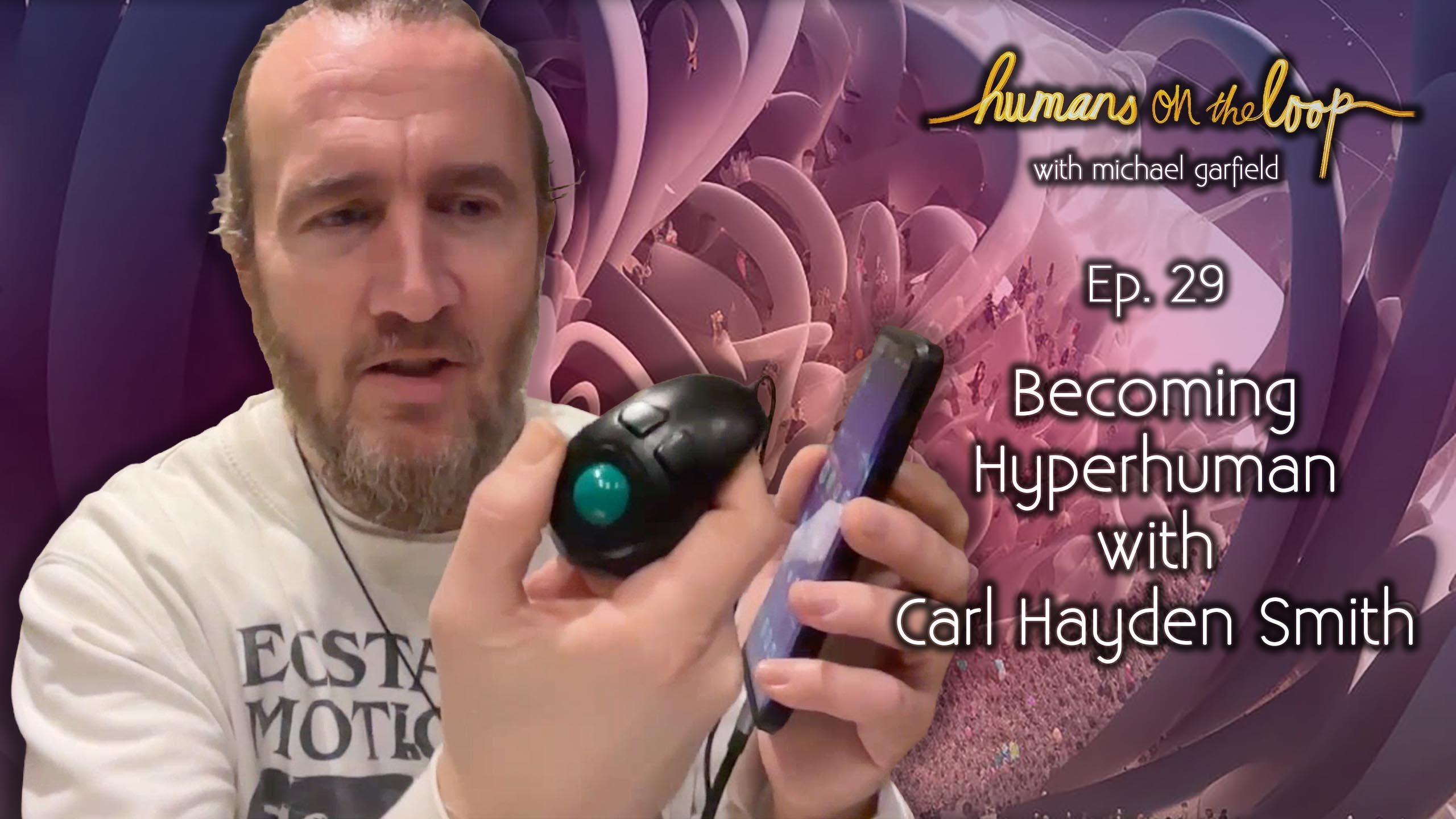
And of course, it's not the phone that's important, it's the data that you really want, right? And all the functionality that it provides. So then I was told that you can plug a dongle, so this is just a USB-C dongle, and then a mouse, so this is a track ball. And so I literally, I now, I've been using this for over a year, and so now I can use this to control my device, and I'm able to separate my hand from my phone.
And suddenly I've got good posture, because I'm able to keep it at a certain perspective, I'm able to utilize everything about it, but I've downgraded the keyboard so that I'm actually typing each letter, in Wales they just introduced a 20 mile an hour speed limit, and I've said to my friends that I like pulling their hair out, I can't go any further than 20 miles an hour, and I just treat it as a meditation. So now I treat my interaction with my device, because it's clunky, because it's a barrier to entry, as a meditation, so I'm intentionally utilizing certain things. I'm using, much less, I'm using it, instead of 150 times a day, I'm touching my phone, I'm going through it about five times a day, because I can also plug a keyboard into this, it's not just the mouse. So now I'm only interacting with the globe, right?
That's my whole new range of muscles are being brought in, I got rid of my repetitive strain injury. My arm was freezing up to the point where I couldn't use it anymore. Now I've completely got rid of that in one year of using it. This was initially a massive track ball, bigger than this one, and I was walking, and it was lit up, and I was walking around, going on the underground, with a big red button, for at least eight months, and nobody said it was.
There was not a single tap on the shoulder to say, what are you doing, sir? What is that huge red button? Like, as if there's nobody watching. Of course, if I was Muslim, it'd be a whole other story, I'm sure, but this is just one way where you can get your life back, and you can still have the access to the technology, but you remain in control, it's a simple device, just when you quid, and I refuse to go back.
And in fact, I could upgrade my phone, but I don't want to, because the temptation, I have to have this, I can't use this device without this, because it's smashed. So I'm either encouraging everyone to smash their screens, to force them to become hyper-human, but this is a really tangible example of how we can get our lives back. I know so many people that are just scroll-doming, to either keep their phone in their hand permanently, it's like an appendage, it's like an extension, and it's terrifying how we've been suckered into these terrible devices. Now it's just another object, it's not my other half, it's just this barrier to entry that I've created that really has worked.
So it has had a tangible effect on me that I feel as if I've become more analog. I've got more agency as a result of this smash screen, of this dongle. And but you're right, we are already living in VR. Again, I don't know if you look at my TEDx talk, Oxford, the fact that we look in the mirror, and we don't see ourselves as we are, we are image of splits, and other people see us as we are, other people hear us as we are, but we don't.
You know, we are fundamentally removed from our reality, from our own selves, and then we're stuck in these tiny bits of real estate, we are stuck in social media in the pandemic, and we're stuck in, or without any optic flow, which is this movement through space. And when you move through space, back to getting optic flow, and without that, you become a goldfish. You lose your ability to think. It's a bit like when you sit in front of a screen all day, creativity is dead, but it seems to just vanish.
So there's a direct link between movement and creativity. Again, another hyper-human principle. I would love to have the ability to be on a treadmill, constantly a movement, but I know that if I had an accident and a bike crash a year ago now, I couldn't sit down for three years. No sitting.
It was amazing because my health improved no end, and my creativity improved no end, because I had movement constantly, like those essays. If I look back on that time, I was probably at my, not a peak, I wouldn't say, but I was certainly going places. And I would look around everyone on the tube, scrambling for a seat to sit down for five minutes between stations, and it was mad, but it was an amazing insight into this connection between movement and creativity. Yeah, you're one of the first conversations I've had for this where I'm at my standing desk.
Yeah, nice. And obviously I very much appreciate that. And I want to think about all the other kinds of movement with you. There's something in the smashed phone that is, well, it can be your destiny if you choose it, or it can be your fate if you didn't just let it happen to you.
And you've embraced it after the fact, there's an opportunity for people to catch it in the moment that I'm really interested in. And so the other axis we could rotate on is, and I feel like I'm getting ahead of myself in this, but I really do want to hear you talk about Hegelian journaling and then link it to the idea of the language model as a tool for thought, and how it can help us structure our knowledge and discover new things about ourselves in better ways. That rotation, just to be super clear, maybe from having the machine spit out the writing that you want to having the machine to your writing, and reveal patterns in it you might not have otherwise noticed, were to, who was it recently? I was just reading, oh yeah, Charles Eisenstein said he tried to get Chad GPT to write an essay in his style, and he was like, oh, it was hack needed and awful, and he's like, but I realized sometimes I'm like that.
Like sometimes I do this, and again, that's the on the loop piece, is if you actually, wherever you want to put it as you balance the equation, if you actually do reflect on the output of these systems, if the reflection is there somewhere, then you see the automaticity where it's not. And yeah, I'm curious to hear you reflect on that. Thank you, yeah. I think the key thing being a professor in London at the moment in teaching some of this technology and thinking about how can I, it's a moral question.
You know, a lot of the students I'm teaching are wanting to work in the creative industries and the creative industries, the lowest hanging fruit for these technologies. And if you want to be a lighting engineer or a cameraman, and then it's, well, do I point out that a lot of this stuff will be automated or people will be making films with large language models, they're already doing it, I know DJs are no longer downloading tracks, they're prompt DJing. So they literally don't know what's going to come out. It's a bit like the Algo Raves back in the day, right?
So literally, this is a whole new thing that's being birthed. And I think that it's fascinating that we can't really stop students from utilizing these tools. Some people try, but the problem is that some people write like an AI, they just do, that's how they write. So it's very difficult to police and whether we should police or not, that's why I say it's just your, like you say, having the machine attend to your writing, enabling you to reflect.
I think that's again, we'll start talking about the journaling, but the ability to reflect on your own creative output, as long as you are still creating, as long as you're still tuning in and receiving the signal, I think that whatever tools help with that, the better, I think that's the thing, as long as you feel good in yourself, that you are still mastering the technology, the technology's not your in the ascendancy, not the technology I think is critical, but I see a scenario where a lot of lecturers at the university are like getting so pissed off because all the kids are now writing their essays by a chat GPT or whatever. And then they're like, why should I bother marking them? I'm gonna use chat GPT to mark the essays. And then it's just a conversation between two, nobody's there, the humans are not in the loop, there's no humans present.
So when it comes to the journaling, I think it's what Cuchy-Gard says, that life must be lived forwards but can only be understood backwards. That we're not taking an active role in our construction. I think that's what the journaling practice gives me. I write from three sort of semantic levels, content what I did, context what I felt, and concepts what I thought.
So I have the perfect dataset for an AI, really, because I have thinking, feeling and doing. And it's multimodal, so all of the ideation is handwritten, because there's something about writing by hand. And again, this is what I tell my students in day one of class to get yourself a notebook, get yourself a pen, start writing by hand, because there's something about imprinting that occurs. And that's why I choose to write down the ideas.
They stay there, there's an imprinting going. The doing, the to-do's is the content. That's all written into a Word document, really roughly around three million words long. It's 38 years now that I've been writing my diary.
And it's an extraordinary resource, because it's keyword searchable. And then the context, which is all of the mood, all of the emotion, that's captured in photographs and videos and some audio recordings. And I've been writing Facebook for 20 years, and Facebook is its own beast, because I don't write anything personal on my Facebook, it's all about, again, ideation. I'll come up with a term like context engineering, and then I'll create an image and say this is context engineering, and then the next day I'll have another image, and then another image, and then another image.
And then people start sending me examples of context engineering, they'll be going, is this context engineering? I'm like, yeah, you got it. And then I'll be invited to Japan to do a whole symposium on context engineering. And that's why I think we should be using these social medias for is creating our reality, context engineering.
This is exactly the point, right? Whether it's double consciousness, creating these literacies that you actually then create movements, I think that this is part of it. And you're all obviously all my chat or the social media chat and everything else. This is all something that I can take as cross sections.
So I can look at this day last year and the year before and the year before and the year before, and the year before, and I got to 38 different me's, communicating again. And as we mentioned earlier, different skills occur at different times. You know, I was most poetic when I was 15, and then I'm probably not very poetic now, but it demonstrates the spiral, that we are going in a spiral through life. I'm much like that's reflected in the cosmos, right?
So that we're on this planet Earth, space of Earth is also moving in a spiral through space. So it's almost like revealing the cosmic structure that I'm getting as a result of journaling. And you know, I'm very much in this reflective shine and I'm very excited to talk about it, that it's worked, it's a lot of work too, but it doesn't take a lot of time because it's something that I've automated. And I've become a detective, I can become a detective because I've got the data, I can become a detective in my own life, I can create the overview effect, I can jump out of point of view and go into field of view at any point where I lose perspective, which is twice a day.
I can see I'm on the path because I've got the data. But a lot of mental health is a direct result of not having any perspective or any ability to regain your perspective. So even if I'm having a shitty day, I can still see shit, I've done all this much. So I think wisdom is gained.
And as I mentioned, it's not all about intelligence. I think wisdom is gained by taking this high road of perspective, this overview effect and also making sense of your life as a whole, going back to that transjective thing. It's I can get this journal, gives me a real sense of, not so much, but yeah, it's kind of purpose. It's this, I'm writing my diary in order to live my life and I'm living my life in order to write my diary.
I can't have the same material every day. I need new material, I need to maximize my day. As a Nietzsche's Amor Fatih, Nietzsche talks about the eternal recurrence. And the eternal recurrence is maybe you don't reincarnate.
Maybe, just maybe, you have the same life over and over again. And even if it's not true, imagine it is. Imagine that as the operating system, because that means each day is infinity. So make sure you want to do what you're doing forever.
And that's a really amazing way of understanding that you don't want to fuck up, even on a daily basis. So it also really, I think it comes down to balancing the tantra and the sutra. We talk about the psychedelics. I'm very strong when it comes to having time off from any journeying, because otherwise, it's just a pissing pawn.
Unless you action the insights that you gain in these higher realms or lower realms, whatever in the incendence, then you're just pissing in the wind. I think you need to really go out there for a specific purpose, maybe go into the MTX for six hours, come back with a new language, come back with some sort of like. Yeah, but I think the dynamic range of our human existence is to have the highest highs and the lowest lows, because that's what gives you your human character, your canvas, and you want that to be as wide as possible. Really, and this is the problem with SSRIs, that people are narrowed in.
They're locked into these very narrow perspective. They can't feel the highest highs. They don't get the lowest lows either, but I think there's a great cost at that. So what I did is the content, what I felt is the context and what I thought is the concept.
So I think that structure is really helpful and again, I only write for five minutes a day. I only write what I did at least for five minutes a day. Everything else is automated, but it does give me the superpower where I can say, I've been in a relationship for a year. I can read that entire relationship in an afternoon and I can get a bird's eye view over it.
I can start to see pattern recognition and stuff that I would never see in real time. And I think this is also reflected in social media where you can see on Facebook, it used to be called Memories, it's now called On This Day, where indeed you're going through a cross section of your timeline. So you see this day last year on the Epifornia for however many years you've been on Facebook. So it creates a feedback loop, it forces me to live.
And I think that there's nothing more useful than that. And in much the same way where you take photos and you think, I might have ever gonna look at this again, which of course, all those people at gigs, where they're just like not even there, they're just holding their phone up, they're looking through their shitty phone and they're recording constantly, even though they're never gonna look at any of that again. And that's how I treat the diary. I'm like, is this worth doing?
Because does it fit into the body of work that already exists? And when I take the cross section through it, am I gonna gain anything from doing this? So it really does in some way limit what I do, but also makes me push forwards in that hyperhuman way where I wanna get new experience, new ontologies, new types of experience. And I'm thirsty for it, I've had a life review, this whole other thing, but I had a life review and in that life review, I was able to access anything in the scene.
So this is where double consciousness sprung from because I was in, I'd stopped moving forwards in time, I was only able to go backwards in episodic chunks. So I was in my normal consciousness as I am talking to you, but I was also in the consciousness of my avatar going backwards in time. So I was in a double consciousness. Then the first thing I tried to do was go into a table and become wood consciousness.
And I successfully experienced what it was like to be a wood consciousness. I was in a triple consciousness. And then I was able to access anything else in the scene. So whether it was books, I could become the author, films, I could become the all the actors, don't get me started on that.
But that made me realize that in the death state, we are most likely experiencing a field of view, not a point of view. So I now realize that it's my responsibility to drive my point of view, to access the field of view in the death state, because I do believe your life becomes a product. It is a learning chamber, whatever we're in it. So it's some sort of learning experience.
And so therefore be very careful about who you spend your time with, be very careful about where you go. So I need to go to the Amazon, at least for a day, so that I can then access the Amazon at will, and go into every life form that's in there, which is again, like, don't spend all your time with humans. Don't even make music just for humans. Make music for the other species, because you'll be rewarded.
In that double consciousness. Again, I feel like normally I'm on the other side of the table here, but in conversation with you, it's my job to keep things mundane. Oh please, please. I feel like I had in a previous episode of this life, a long entanglement as a social media professional.
Like two points I wanna make on that, that I think tie in to everything that you just said, and I'd love to hear you embroider further, which is that I get the sense that most institutions still treat what Fred Turner would say is network media, as though it were broadcast media, that they're using social media to amplify themselves, rather than, and again, this gets back to the transjectivity piece, it's rather than to understand that, to carry it forward into language models, when you prompt something, you get something back, and then you review it, you reflect on it. It's not just, it's not a one way thing, and that what works best on social media to solicit engagement is often to ask questions. It's like this is a chance for you not just to say what's on your mind, but to ask what other people notice, and that this is a means to a double consciousness, in that you've got the on this day, the linear axis of time, if you're gonna collapse it down to that, then you have the spatial and the socio-cultural axis, and then likewise, for reasons I completely sympathize with, a lot of my friends lately have been not just deactivating Facebook and Twitter, but deleting their accounts, and I get it because I was somebody who journaled obsessively through high school, and then got to a point in my life where I decided I was going to burn them all, and I did, and now I look back on that without the embarrassment of whatever it was that I felt like I was trying to distance myself from, and given enough distance, that stuff becomes useful again, and I've been telling my friends, I'm like, look, I get it, if you never wanna be on Facebook again for the rest of your life, I'll support you, but there's an opportunity there that you're throwing in the fires of Mount Doom, which is all of that data by destroying it, you're not saying, you're not harming Facebook in any meaningful way, and it gets back to that thing of me versus them, it's like, well, I'm sorry to tell you this, but actually book is part of you now, you're not gonna get away from that, like you're gonna cauterize it maybe, but then you have a phantom limb, and there's no chance that you'll ever learn anything new from that, and so I would just, yeah, again, these like all these mundane ways that I think the really exciting opportunities available to us through the very bleeding edge of technology are already present at every layer going back down the tech stack, and I just love to hear you riff on that. Yeah, so just starting with Facebook, I have such an amazingly, I spent so much time debating that, and of course, none of it's yours, right?
It's all for you, but none of it's yours, and so I've printed it all out, I've printed it all into books, and you can easily do that with it, so I've got my social books, I've got my Facebook that enables it, but it enables me to have a whole bookshelf, each year is 400 pages, it was less during the pandemics of no events, but I have now 20 books, thousands of pages, and what's interesting about it is that each post in that book has a QR code, so I can go back to the digital from the analog, and I find that super empowering, because now even if they, even if for whatever reason I get thrown out of Facebook, I've still got it, and I really value that journey, it is a journey that I've been on, and Zuckerberg, God bless him, like you say, he's created a huge opportunity for me, even at my girlfriend on Facebook, so there's no denying that if you use these services in a hyper-human way, you can really benefit, and you can break the algorithm, right? Because the algorithm doesn't know what's going on, it can't operate or it can't really, it can't really understand how you're using it, and that's again this whole thing about technology, you don't know how it's gonna be used, and that's maybe very cautious about my work, a lot of my work has been using mixed reality to train astronauts, or using cyber-delics to change consciousness, and of course all of that have been approached by the military many times to say it can be used to work, and of course I always say no, but they'll use anyway, there's no way of avoiding it. So no matter what we do is a triple-edged sword, I think that's the thing, the transjective thing, we are, we're all in it, even if your intentions are good, those can be bastardized, we also media, the fact that I've got a bunch of talks online so I can be cloned at any moment, my voice could be talking in other contexts I'm not aware of anymore, in the same sense that a lot of authors will be horrified to see their books put through chat GPT, but unfortunately your book is out there, and it can easily be uploaded, bastardized, re-mixed, so yeah, I think it's a fascinating time to be a professor of media, it's almost ironic when we're all becoming media, and the media is the virus, I saw it being on T-Shap with media as the virus, I think that what's fascinating is that we don't know, we do live in a virtual reality, and we don't really want to get what we think we want, I think that's a shushik perspective, so again, if you can reveal your own will to yourself, because we are living in these kind of obscure, in these obscure times and obscure worlds, there are certain people that can't forget anything, that they have these sorts of memories that I think is only about 30 years in the world, but they cannot forget, they literally have this problem where they can't forget, and I remember that terrible Black Mirror episode where there was this couple arguing, and they were going, oh, you said this, and they were going, no, I didn't, I never let this happen, look, everything was recorded, because they were recording everything through their contact lenses, and of course, if we aren't able to forget, it's a disaster, I think the only reason that we can have any kind of friendships is because we heavily curate how much time we spend with people. When you're stuck with somebody on a holiday or you're living with somebody, that's when you really know someone, most of the people that you're friends with, you probably don't even know who they are.
So yeah, I think that it's very important that we have these paths that we can really notice that when one door closes, another one opens, because often it's the case, but unless you've got that data set, you can't necessarily keep track, and I guess I'm aware that I only keep what I share, which is another big insight from journaling is that, I'm able to remember or find something, if I've shared it with somebody. So it's a really powerful thing to be like a mycelium and to share as much as possible, because we're here for such a short time, and it's a thousand months, that's your 83 years, a thousand months, and we think we're immortal. How many parties have we got left? How many good parties have we got left?
And I think that's a real impetus, and it's like having, I've got like 10,000 vinyl records. When you've got 10,000 of anything, it really blows your mind, because I can only really play record once, that's it. It's absurd to have such a record collection, unless you can share it, unless everyone else can access it, and I know John Peel, God bless him, and he passed his record collection, but it was digitized, so everyone could have access to his records. So I'm a hoarder, I'm a living archive, and it's all a bit of a paradox, because I try not to stop living.
In fact, I hope to live to maximize my life in that thousand months, but it is a constant trip. Because you and I agree it's a constant trip, and because, I want to give you two images here. One is tech bros, microdosing, and Silicon Valley do enhance their innovation, to juice the ideation process, or turn up the temperature on search. And the other is people who have no choice, but to adopt technology, because otherwise they cannot compete in the economy.
They're homeless, but they need a phone. And this seems like a Mobius strip to me. The more I talk about those two things, the more they seem like the same thing. But then opposite that, across the diameter of the Mobius strip, is on both sides, something like someone who got dosed at a party without their consent and ended up having a really good time, or someone who started going to yoga, because they wanted to pick up chicks, but they discovered the power of the practice for their personal transformation.
And what I would be remiss to neglect, if I didn't land it here with you, is something like, what do you offer for people who find themselves on either extreme? What is the way, if you are diluted enough into believing that you are off the loop, or in the loop? What is the way that you get back on it? In my case, for instance, I can't stop my kids from watching TV.
I can exert enormous effort to curate that more responsibly as a parent. I can introduce friction, I can make it a reward for chores, I can do all this stuff. What are the other ways you see people who are in the situation, they are on the, whether you wanna call it a hill climbing algorithm or gradient descent, or what have you, what is the turn that you recommend to people and can give some examples of instances where you find yourself, like you did with your smashed phone, leaning into it and bring a new, in your case, literal axis of movement, being able to actually restore lost motion to the arm. Well, I think it's, I never rest on my laurels, I think, I always, I'm always actually in a poverty mindset.
No matter how much success or whatever you wanna call it, I think that we're in a time when, you know, the polycrisis or the hyper objects that we're all embedded within, I feel as if, so you need to have this multi-perspectival ethics, you need to have this pluralism, you need to be as adaptable as possible, I always, even though I'm constantly hoarding, I'm always thinking, I'm in my living living from Glasgow to Sheffield, and I was living out on the bat, like just a bag, and it was so liberating to have no stuff. So yeah, I guess it's this imagining, this is why whenever I do a psychedelic trip, I always introduce cannabis, because cannabis opens up the shadow. I don't want to live in a yin without the yang. I wanna be challenged, I want to be my listening, but with me, you see, my consciousness, it's funny going to Berlin, because they can't stand the yin, or they can't stand the healing sounds, they want the challenging, because they're so jaded, because they live in one of the most comically heavy psycho-geographies of any place on earth, so you can play them the most sort of yang sounds, and they lap it up, and I think that it's the same for me, I want constructive criticism, I want, I don't get much from praise, and I think that's the case for humans, as a result of our human condition, that we learn way more from our troubles, from our crises, and I don't see that changing, because this is why I think the big problem with this convenience, this leaning towards one button solutions for everything, is it leads to disaster, because you need the grit in order to flourish, you don't really flourish from success, unfortunately, in some ways it's a cosmic joke, that we learn only from things that go wrong, so I think sharing your, not your best practice, but the worst thing, it's like, and it's more common now where you'll start a conversation, and it will be, how are you really?
And then people are starting to authentically relate, I think that's a huge part of hyper-humanism, and it's not about sugarcoating it, it's, yeah, I'm in a really shit place, I'm just, I fucked up my foot, and I'm hobbling around like a homeless guy, and I think it's really important to be able to drop into being homeless, even if you're wealthy, I think that, you know, we'll step away from the game, Michael, Michael, the Douglas film, where everything can be taken away from you, and in fact it should be, because you've become jaded, and you've lost your perspective, and now it's time for you to be kidnapped and taken to Mexico and have all your bank accounts emptied, and then you have to work your way back to your life with no help, with no access to your friends, and even though that's a simulation, I think that it's even a service now, it's even something that you can pay for, for your jaded friends. So I think it's important, again, it comes back to the journaling practice to have that reflectivity, to understand that you're living a gifted life if you're not struggling to raise a dollar a day to survive, which is the majority of the world. If you are in a privileged position where you do have times be creative, so fucking succumb to the convenience of, oh, I've just made an amazing album, and it was all done by my LLM. So yeah, hopefully that gives you some perspective on my position.
Tomorrow I'm releasing a thing I might have, something you already have forgotten, where I went into a text to music, and got all this really cool stuff back, and then I was like, I'm gonna make this hard. I'm gonna try and layer and agonize over this for a year. I'm gonna spend a year on one seven minute track, and that ended up being the theme music for the show. Beautiful.
There are certain things I'm just not good at. But I'll let the machine do that, and any part that I feel I can do better, or might be able to do better. And obviously at some point, you didn't have to grow your own hemp to make your own rope to all that, but. Yeah, so let's land this in your best future vision.
We're there, we're here. It's now, where are we? What do you observe about? This amazing world that includes all the things, not just the stuff we were trying to avoid, but they're there.
But the things that we thought were too good for us, and we have those two. Yeah. I guess it's a world where we've abandoned screens altogether because we can no longer trust anything on them, whether it's audio or visual, which is not really thought about as a potential outcome for where we're at with media. That we may just abandon screens altogether.
This is again a very thought experiment. But I think I love this term, Hobotism, one of my friends came up with it, and he says that the ultimate art project of a human is to become a hobbit, and to be in nature make a really good cup of tea. And I think that there's something in there. I think that maybe we've gone around the houses and created all these things.
We already have it all within us. And with my pontificating and coming up with all these different technical and all these different things that we can do to change the consciousness. For me, it's about how do we move away from this obsession with altered states? We move into a place where we can start creating altered traits.
So lasting change that is meaningful, that is multi-generational, that will help the next five generations, that isn't just creating a piffley porn, which is never integrated. So yeah, I think let's really understand that we are in a nested ecology. We need to feel that. I think if we can use technology to understand that we're in this nested ecology, we need to start to actually understand that everything's alive.
Everything's also hallucination. And it's all you and you need to just be part of it. Try to stop being a part. You just gave me this idea.
I think I heard about somebody doing something like this somewhere where it's, if you hear a party around the corner, you're gonna go. Even if there isn't actually a party that, if you play Bird Song in Wounded Meadow and then birds start coming, and then eventually there are enough birds there, and then you take another field recording and you're like, it's an even bigger party. And then more birds show up and that it's like a sourdough starter or something. I was just talking with, I don't know if you know Richard Bartlett, but he and I have something in common.
And if you don't know him, I'd love to introduce you, which is this, he's talking about how he loves to code his own psychedelic experiences, write the music, play the music in advance. And then there's just something, it's like a fecal transplant. It's just something about getting that closing that loop. Gordon White says this about chaos magic also.
It's like art of the magical working with sigils is that you kind of have to forget that what it was that you did, the intent has to cross the manifold for it to come back. And yeah, I don't know. It's just a lovely place to leave it. I love the idea of us not being the last on the biospheric dance floor, but the first.
Yeah. Being like, hey, it's the right kind of deep fake. Exactly. I think the key is that we need to make culture, continue to make culture, but make it not just for your own limited bandwidth human project, but let's not making culture for everything that is us that is around us.
And let's see what happens as a result of that. Well, I'm glad to be in whatever impoverished layer of cultural topsoil still includes both of us. But yeah, I'm just living out while we can. Thanks again for listening.
Humans on the Loop is a listener supported project committed to making public goods that help us dream better together. If you like these conversations, find a link to the Discord server in the show notes, subscribe and review the show wherever you listen, and consider becoming a patron at humansontheloop.com, where you will also find my enormous list of recommended books and interactive knowledge graph and years of provocative writing. Our next dialogue is with another hyperhuman marvel, the trickster octopus shaman bodysatva known to some as layman pescal. Until then, stay tuned.
And remember, imagination and attention are our greatest natural resources.