
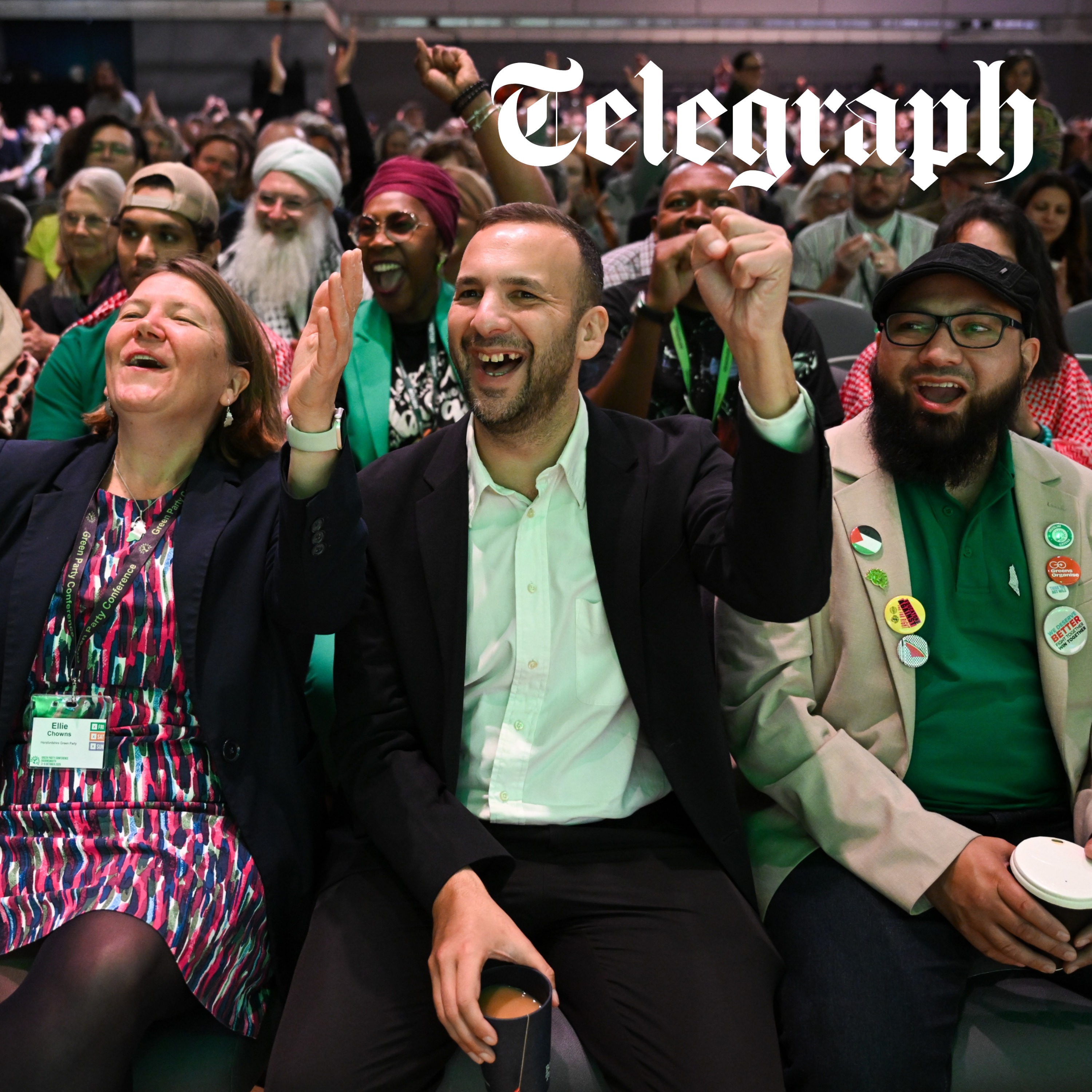
The Telegraph. As the Greens surge in the polls ahead of the local elections, are some of the party's policies not just bonkers, but downright racist? Any chance the MP for North Herefordshire defends her party's policies, but the former deputy leader, Dr. Shira Ali, tells us that Greens are becoming a danger to society.
Welcome to the Daily Team with me, Kim Otomony and me, Tim Stanley, Camilla. The Green Party almost overnight is pulling incredibly well. It's probably going to do very well in their collections, especially in London. And, and we are talking now seriously about a Green Party coalition in the future.
Who would have funk it? Right, so we've obviously got to start to ask what does this party really want to do? Who runs it? What's it all about?
Yes, and we need to probe some allegations made against the Greens that they are inherently anti Semitic because of their policies on Gaza, that some of the people have had in the membership and indeed standing as councillors have expressed some pretty dodgy views that some of their economic plans are downright crazy. And of course, probe that infamous Zapp Polanski. I can make your breast probe bigger incident as serious journalism on this podcast as ever. So we're basically going to get the case for the Greens and against.
We're going to start with against. Yes, we're going to speak to Dr. Shira Ali, a former deputy leader and a spokesman of the party who has recently been expelled. And do stay tuned because it's basically like a return to the 80s where I, as a avowed Thatcherite and capitalist, take on Ms.
Chowns, who I'd say is at the opposite end of my political section. Stay tuned. This almost turns into a dynasty style cat fight. It's quite something.
Dr. Shara Ali, thank you for joining us. You were deputy leader of the green party from 2014 to 2016. I want to go back a little bit before that and ask, when you first joined the Greens, what did you think they were about?
I joined the Greens even a decade earlier when I became deputy and it was an honour to be serving in. And it was soon after stint at the European Parliament. I was working on environmental risk assessment and I came into contact with Green parliamentarians including Karen Licas, and I was very impressed with the environmental credentials of the party and that's when I joined, roughly around 2002. So it was.
You joined what you thought was a Green Party, but even at that time, were you conscious that it had a wider politics? Yeah, absolutely. I mean it was traditionally and still now regarded as a left wing socialist egalitarian platform. And that for sure did appeal to me.
But it was also the style of doing politics that really appealed to me at the time. I saw it as having interpreted political intrepidity and when I used to make a joke around, you know, going into politics to get elected quick, especially in the Green Party. But it's partly because the end doesn't justify the means. And I see a complete reversal of that at the moment, if I may, in Hunter Zakalancy's leadership, which is that the end does justify the means and we're going to do anything in our power to get elected at all costs.
That's what. But you fill out the party before Polanski and we'll get into how. Why was there something that changed in the party that led to you having a disagreement with them? I think the main change was cultural and also to do with some of the ideological baggage associated with the so called transgender rights platform.
I would rather describe it in the positive, which is to say standing up for the rights and single sex status and protection of women and girls and the conflict that came to bear when particularly some policies around 2016 were pushed around trans women and women. So you believed in protecting gender based rights. Other people in the party did not disagree with you over that. Is that what then led to your conflict with the party?
Well, even taking a step back to some extent, even just to have that debate and the unpreparedness of the governing clique, if I can call them that, of having that debate. And I would say partly because we did have a good political culture, almost like University of Ideas, when you put motions for debate in, it was an open question and you could win that debate on the power of persuasion. I like to think I was quite good on Conference four and things were being moved, even though it might have been a balance against me. And I think the fear in the party was we don't want that to be up for debate because we fear that we will lose it.
Right, okay. So not just they were against your views on this, but this supposedly terribly Democratic party which you joined in partly because of its collegiate style organisation and actually didn't want to have the debate at all. Yeah, So I mean, this is totally debilitating not just to the operation, the transparent operation of political party, but its effectiveness in government. Because essentially if you can't make good policy because you haven't scrutinised it, you haven't allowed differing libertarian at heart in terms of free speech and the power of that, if you don't allow the opportunity for testing your ideas, you're going to come up with bad policies.
I think at the moment, under heightened scrutiny as well, there might be, I think journalists are discovering, you know, what a hornet's nest of policies are within the party at the moment that have been approved. So, Dr. Ally, you are stripped of your deputy leadership of the party in September 2024. But that comes after you've won a legal case against the Greens for discriminating against you for your gender critical view.
So you win £9,000 in compensation and you have your legal fees which stretch to £90,000 paid after that court victory. Yes. It can't be easy taking that kind of Goliath on and yet steal your script of your membership. But you won the case.
Yeah. I mean, by any measure that is totally unhinged behaviour. Okay. So this was a landmark case following the Forster ruling.
Maya Forstner, who basically said, I cannot be discriminated against because I don't believe that a trans woman can be a woman. Yeah. All the possible formulation is that I believe that there are two sexes in human beings, Homo sapiens, and that's it, it's immutable. And so she won that.
And it resulted in quite a slew of employment related cases. But this was employment related. This was to do with a political association. And so white was a harder threshold, so to speak, is that although my case was around my removal as a National Party spokesperson at the start of 2022, that's not employment consideration, but it is to do with.
Under what threshold can you move a spokesperson who admittedly you expect to be representing the party policies? And I was doing that. And so the judge found the judgment, found that they had discriminated against my gender equal belief. Now, I maintain, and I think this was effectively argued in court on my behalf as well, that we have a whole slew of sexualist policies in Ponzi.
So, yeah, it was very hard for the party to show and they were unable to show after 18 months of litigation and six days of trial, how I had breached the Speaker's scale of conduct space based on scale of conduct. And on that basis I won. Unlawful Gender Criminal Explanation. The first protective belief discrimination claim against People Party.
And within that context, as I've been receiving, on the receiving end of a brunt of a whole series of confected weaponised disciplinary complaints, they just revived a couple of them and put me through the mill on a different process and removed my membership. Because your case actually speaks to a question that people have been asking themselves about the modern day Greens. Yes. And it's how do you unite people with gender critical beliefs who may by the way, or not be Muslim?
And I do bring your religion into this because we look at the Muslim support for the Greens and we say, does that align with their own social conservatism around transgender issues of drugs? They want to get rid of faith schools. Yes. And then we also perhaps look at left wing feminists who may also be gender critical and ask ourselves, well, can they now have a place in what is ostensibly a party for them?
It should be for them because it's socialist, it's on the left, it's constantly banging on about equalities and rights. So you're almost an interesting test case of who now the Greens want to exclude even though they are directly appealing to members of your religious community at least. Dr. Ally and I don't want to make this about identity politics, but there's a contradiction to play here that the public is observing.
We're all wondering how these different caucuses of support actually align under Polanski. Sure. I mean, I think there's a mistake that people make, which is the idea that depending on the policies and policy platforms of the electoral party, they may we be within their rights to exclude people from membership. That's not even the case.
And one very principle reason for that is that until unless you have diverse few ideas and viewpoints with political party, you can't change policy. And that would be contrary to the function of any political party. And in addition to that, under the Equality act, any and all protected characteristics are protected within political association. That was found in my favour because whilst you might say, well, gender people belief isn't on a par with other types of discrimination, when it is, it's as on a par as the BNP or you know, a racist so called party not being allowed to discriminate against somebody because of their race.
That's not allowed. So what's happening now though is, and it's a hypocrisy that the Green Party has found itself in because on one hand they think themselves entitled to put their not to exclude people on the basis of sex reass belief. On the other hand, they're embracing with open arms a Muslim community and contingent in a very sort of sectarian manner whose views do not align with Queen Party policy. Yet as it happens, they are welcome to join the party.
But the biggest problem we face at the moment is the inherent. I make no bones about this. I think that Islam has in the contemporary west had a Significant problem with misogyny and patriarchy. Just the way in which women are increasingly in London, which I find extremely worrying are being, you know, presenting with a veil.
There's no way of interacting with them, let alone having them stand for election with a veil. I think that is fundamentally odds to be theory. Can we just pass one follow up on that because. Okay, we cannot speak for Muthinali who is the deputy now of the Green.
So your successor whose wife has appeared at events with him dressed fully in a niqab, so she's head to toe in black with only her eyes exposed. Now I don't know what he thinks about for instance transgenderism. I would imagine that he's gender critical. Why is he allowed to be deputy leader and not you?
Yeah, I mean I wouldn't want to say anything about members of his family because I just. Yeah, I think, I think we don't need to do that. But I think what is apparent is Motun Ali has not been vocal on like the issue of I've been saying about the niqab and there are a whole hostel of things like to do with. Why are women and girls of particular age prohibited from participating in a fun run in town Hamlet?
Why is the religion of the Pakistani child rape grooming gangs predominantly Muslim? There is an issue there. I mean, I might say and I think that this proper investigation has to be done. I might say that one of the reasons is that when those men come home, their women aren't empowered to say where were you tonight, hubby?
Yeah, that's just not within their zone of influence, that sphere of influence. But Mothin Ali's problem, and I wouldn't describe as gender critical word of the name because he certainly hasn't stood up for those of us in the party of which there are many, many great women. And I'm one of the last men standing, so to speak to be going to court all these individuals who built the foundation on which Mota Nali laid to the party and argued exactly as well later, the party are now standing on Mota has to stood up for them ever. So he's not gender worthy of a name.
He might be sex realist in the sense that in order to be practicing an inherently dogmatic ideology which is in itself patriarchy, obviously you have to believe that there are two sexes, but that doesn't make him gender worthy of a name. We don't want to try and send guess what he thinks about anything. Sure. But you have described the party as being quote infiltrated by Islamists who are a quote, dangerous society.
Yes. Forming a quote, unholy alliance between Islamists and gender ideologues. Now I infer from that that there are people who are exploiting the Green Party and are entering it purposely in order to manipulate it in order to exercise power. Is that what you're suggesting?
Yes. When I first stood Muslim as a general election candidate in 2004, I was faced with abuse from Muslims, whether you want to call them Muslims or otherwise, but they were basically targeting. I didn't describe myself as a Muslim in politics and I very rarely do anyway, even though I might be Muslim, you know, as a spiritual and private affair, I don't think I should be attacked by politics, but it doesn't matter. But what's changed is that looking 22 odd years ago, Muslims then were attacking people for actually engaging in democracy.
Now they're actually participating in democracy and pursuing often very skewed agendas. It could be on guards and Palestine, which I'm not saying it's not an important matter, but it's exclusion of everything else. Our, the Green Party's by election win in Gordon Denton was, was phenomenal by any measure, but it was also arguably an abuse of prophecy because what we were doing, we were saying different things to different people and we were exclusively targeting the Muslim bloc vote with Gaza Palestine and that's disingenuous. And some self professed Muslim voters spoke of buyers remorse.
Right. And arguably there's a trade description violation there, which is to say you haven't actually put forward your positive program. Yeah. You mentioned OGDP rights.
Some of these Muslim votes would be aware of that or relaxed liberal, I would say wrong policies in terms of, we call it in the party, sex, work, prostitution. They might have felt as a social conservative, so to speak, that that was the thing they could abide by. So I think it's, I can say at this point for sake of balance that the Green Party I suspect would reply, look, we're certainly not Trojan hordes for Islamists and we don't court Muslims directly. It's just that we happen to take a position on Palestine which appeals to Muslims.
So Muslims are our voters who are consumers like everyone else and they've just left Labour and come to us because we happen to connect with them on that issue and doesn't actually say something about the sophistication of Muslim voters. That they're willing to back a party that in all other regards they completely disagree with, but because they recognise that politics is about coalition building, I think that could be true of voters. It might even be true of the majority of members who have been joining in their droves, the Green Party, some of whom will be Muslim. I'm afraid I don't think it applies to many of our candidates, including Mohs Nahi.
Because you say and raise them should be charitable. Why isn't he putting his view about his relationship between Islam, his religion and politics, why isn't he making that clear? He gets many anti regards, understand why he refuses them or the party's insulating from them. I think what you'll find is that when a story crops up, whether it's Tal Hamid's fun run, whether it's a niqab, you know, whether it's child rape, Pakistani grooming gangs, he's silent.
Not only is he silent, but he might be. I think he's being reported as having prevented or stopped or complained against a Reform councillor for bringing that up in his own council election chamber. So I think his position is becoming clear by default. He may not be vocal on these issues, but my estimate of his statements on this and lack of statements on this is that he puts Islam first.
And I think that's an affront to liberal democratic politics. And we do have many leading politicians who have religion. I think they rightly understand the place of their religion within their wider politics. And that's crucial and critical because as Green candidates, as Green parliamentarians and politicians, we need to serve all citizens equally.
And we can't actually do that effectively if we're constantly parading our religion and prioritising Muslims above all others, non Muslims. We should stress, by the way, that we have reached out on many occasions to Mr. Ali for interview and we do look forward to speaking to him in the future. He has written for the paper, he has written for the speech.
The other policy that the Greens have been pushing very heavily since Polanski took power is the idea of equating Zionism with genocide and being extremely anti Israel. And you may say that the party now has a so called Jewish problem. Do you think it does? Yes, 100%.
I mean, I'm ashamed of the party that I seek to get back into. But one reason I want to get back into the Green Party because I think it's possibly a danger to society. And I say that with my pride. I know of Jewish members, many of whom I might Disagree with in 2018 around anti semitan divisions, but they are feeling besieged at the moment.
And the Zionism is racism motion, which didn't reach a vote in the spring conference, it will be back in autumn. And what you see is a deep and fundamental hypocrisy within the party because Zach, class included, makes all the right noises when it comes to. Well, he's certainly promoting his pro Palestinian causes. He will also speak against anti Semitism as such.
And I think that he and others realized that Zionism and racism was a political calamity waiting to happen. So what they've done internally is they sabotage it from coming to a vote, but it will get through. The hypocrisy is that they're trying to face both ways at the same time. They're trying to make out that they are pro Palestinian.
But when it comes to that motion, they realise that it's politically suicidal even to actually push all that, because it is a racist motion. And in the same way that we've seen outside the last festival conference in Bournemouth, they're on the beach and they were chanting from the river to the sea. Except a couple of them stopped chanting at that point. Now that's a hypocrisy.
Somebody needs to ask them, why did you stop chanting? It's because you really understand that that is a controversial thing to say, Controversial for the right reason. You shouldn't be saying it. But then why do you assess, associate yourself so closely with others around you who are charging them and not actually stopping them from saying it.
Because you probably at some level you understand that it's anti Semitic thing to say because it calls for effectively the abolition or annihilation of the state of Israel, which is contrary to Green Party 2 section policy in anyone. This is very interesting because the Green Party gives the impression of being a party of idealists. One reason why they're gaining so many votes is because people are sick of politicians to say one thing and then do another. And you might at worst get someone like Zach Lansky and thing if he makes an error.
It's out of naivety. But what you're suggesting is, no, they actually know they're walking a tightrope here. There is a knowing hypocrisy here and I think the same thing follows with the increased scrutiny. Right, so Andrew Gilligan and others is being placed on local election candidates, several of whom across London.
And I understand that, you know, Green Party central office and local officers were advised, I won't mention the names, but these were candidates who had had very troublesome social media, even very recent history. Right. So either talk about false flag operations. Incredibly, a bright, offensive thing to say about October 7, let alone also within the UK mainland, around the haps of our ambulance arson attacks.
These are live issues. And what's happened is that even when Zak Platy does speak on these things and let alone if Mozinali dares to say anything on this, they're empty. Because what's happened unfortunately is the Green Party successfully presented itself for that Muslim vote that it doesn't want to say anything that would risk offending even the extremist elements within. Thus seeing a conclusion I can draw because what they haven't done, which is they have an obligation to do, is to vet and quality control and risk assess their candidates.
And there's obligation upon candidates also to do that. At the moment we have a slew of candidates it seems on bird papers who a lot of questions have been raised around allegations of anti civic and nothing is being done about it. But the Green Party that I knew even in 2018 was pretty zero tolerance about that. So what's changed?
Dr. Ally, thank you very much for joining us on the Daily Tea. Thanks. Having me.
Coming up to defend the party against Dr. Ally's claims is the relatively recently elected Green MP for North Herefordshire, Ellie Chowns. We're delighted to be joined by Ellie Chance, the MP for North Herefordshire. And you are also, I believe, the Green Party's primary spokesperson in Westminster.
Yes, because I saw you at PMQ's calling for the Prime Minister to resign this week. Is that the first time you've done that? Do you know what? I can't technically remember probably the first time at PMQs I fought for him to resign.
Right, okay. There must have been one or two moments where I previously thought he was doing quite a bad job, but it was quite the moment. It was quite a dramatic moment. So thank you.
You landed it. Well, just quickly, how long are you getting him? Oh, I mean he's a, he's a dead dark, isn't he? As a leader of the party and has been for quite a long time.
I'm sort of amazed that he's still clinging on by his fingertips to power. I mean, I've been having conversations with people on podcasts and radio and tell you about this for literally months. And you know, it's one thing after another, one crisis scandal after another. I think after the local elections.
I hope it seems like the obvious time, but of course labor haven't got, you know, they haven't got somebody waiting in the wings kind of like in position. There's all of these issues about all of the potential candidates and some people say, oh, you know, we think he'll limpon until the autumn and he's clearly not going to be there by the time we get to the next general election. But it can't be much longer. Unusually, your party leader is very popular party.
Unusually, your party leader isn't in parliament. If you held a general election, your party won, but Zack didn't. Who would be prime minister? You.
Well, that would be. I mean, that would be a lovely bridge to cross when we come to, wouldn't it, Tim? I confess I haven't got as far as thinking about that, honestly. But you know, I am.
I mean, I'm not betting woman, but I would be very enthusiastic about and pretty confident about the fact that we would, you know, hope to win sack a seat at the extreme election. Okay, all right. Okay. Serious question.
Now. I have in the past voted Green. Thank you. Probably about 10 years ago, a little election actually, because I quite like the party position on the silent secrets.
I think I'm surprised I passed the Telegraph betting sometimes. But I did principally think the Green Party was an environmental party. And I feel that the more successful you've become, and you're very successful now, you're riding high in the polls. According to one poll, you're on 18% and your membership has passed 200,000 people.
And I believe your youth membership is one of the largest in Europe, which is all very impressive, but I feel the more successful you've become, the less I like you. And it's because. It's because I feel you're less and less like a Green Party and more and more like a radical far left party. Well, I don't want to, you know, I don't want to sound ungrateful for your prior support, Tim.
I'm very pleased that you previously voted for us and who knows, you may one day again. But I think that this idea that, you know, the Green Party signs, so long as it kind of sticks to its little environmental box and people can occasionally vote for it, but only on environmental reasons. It's a complete misunderstanding of Green Party, I'm afraid. You know, we've always been a party that has said that, you know, human well being has kind of, you know, it's a stool with three legs, environmental, economic and social.
You can't kind of separate them out. Now, we've previously perhaps sometimes been able to cut through in the media, in the general discourse, particularly on environmental issues, because we were so clear and strong on those nobody else was. And of course a name Green. You know, we absolutely are at heart a soundly environmental party.
But that's not to the exclusion of social and economic justice. In fact, I think if you asked any member of the Green Party, they would say that those things have always been closely interlinked. I'm sorry, I do feel that some of your campaigning is now excluding environmental message or at least eclipsing it because you did not win Gordon Denton on some sort of balanced ticket of we are both in favour of social justice and climate justice. It was one on campaigned on and one on the issue of Palestine.
I would disagree actually. I mean, I was up in Gordon Denton campaigning on, I think five full days. It wasn't just a campaign about Palestine at all. It was a campaign about who is going to represent this constituency best.
It was a campaign about the fact that people feel so hugely let down by Labour. It was a campaign about the fact that people are facing a cost of living crisis and they need actual solutions to that and somebody that knows going to have their back and be speaking out for them, not just towing the party lines. So it was a campaign on all those sorts of issues and I think that kind of boxing, it being a campaign about swan row issue isn't actually a fair understanding of what the campaign was about. And if we're talking about social justice, I mean, you know, we have always, for example, I do a lot of work on fuel poverty and the need for better housing standards and retrofit of existing housing.
And that is an issue that has always brought together those social, environmental and economic threads kind of under the roof of one policy. We've never said we want energy efficient homes, just about tackling the climate crisis. We've always said it's about tackling fuel poverty, it's about making sure people live in decent conditions and not mouldy homes. It's about saving people money as well and using resources efficiently.
So I feel that we are still talking in terms of all of those three things. Interlinking we do seem to kind of caught the attention of some of the media as suddenly cutting through speaking about broader equality issues. But we've, you know, wealth taxes, for example, we've been banging that drum for a number of years now. What's different is that with the leadership of Zach particularly and his ability to do heaven knows how many interviews kind of on the trot, his fantastic ability on social media and, you know, he's managed to capture people's attention.
People have started listening to our messages, our holistic, you know, interlinked messages and getting over their perhaps previous preconception that we were just an environmental party and recognising that we were a party with full state of speaks to the things that they're facing at the moment, because people are facing the effects of the climate crisis, flooding and things like that, but people are also facing very, in a very real and direct immediate way, the cost of living crisis. We will get onto some of the other policy ideas as well, but just back to Gauntin. You have a campaign in which you do campaign in leaflets, in Urdu and indeed in English. You have leaked messages from WhatsApp groups suggesting that it would be good to target voters when they come out of mosque prayers and during Ramadan, where they're more easily available.
You have your candidate there, Hannah Spencer, sort of dressed in a red and white kefir scarf. You then have simultaneously this policy going that the Green Party wants to support a motion suggesting that Zionism is racism. So that does all add up to a party that once cared about removing pollution from the riverside and the sea and now advocates a policy if we believe some of the chance at some of the protests are from the river to the sea. I think that's a perfectly cogent connection for the public to make about your foreign policy.
I actually really disagree and I'll explain why. I mean, first of all, just to take the matter of the motion Zionism is racism that was put forward to our party conference online party conference just a few weeks ago. That wasn't actually the mediation of votes on. In the end, any party member can put forward any motion.
Is it a motion racist policy? I don't agree with that. Is it a racist motion? I do not agree with that.
Is it racism? Anyway, I'm going to just ask you for an answer to that question because I think most Jewish people would consider a motion which says that Zionism is racism to be racist in itself. And let's just be being very clear about the Greens and what you stand for on your policies. Let's just have a yes or no answer to that question.
Is the motion itself racist? I can understand the anxieties of many Jewish people about that. Not all Jewish people, but many Jewish people. And I personally don't feel that it's productive in politics to have people on all other side of them are an argument.
If I can just sitting throwing accusations of racism to and from a motion saying I just want just a simple answer. I'm perfectly happy to state here and now that my belief is that that motion is racist. Do you agree with me or do you disagree? I think that's an oversimplification because, and I think the motion itself is an oversimplification.
The motion itself says that anybody that identifies with Zionism and Zionism is itself contested concept. The motion says that that is simple racism. And to say that anybody who supports the motion is themselves racist, I think, again, is an existing misunderstood. I understand Zionism very clearly to be pro Israel.
That's what Zionism is. And so to suggest that being pro Israel is inherently racist is to suggest that in some way supporting Israeli people and therefore Jews is inherently racist. The opposite of supporting Israeli people and consequently Jews is to not support them, which in itself would be racist, wouldn't it? No, again, I think it's an oversimplification.
And of course, we know that issues in relation to Israel and Palestine are hugely contested, hugely subject to oversimplification, and hugely subject to being becoming more and more conflictual. And for me, you know, I want to see peace in Israel and Palestine. I've been very outspoken in my criticism of the actions of the Israeli state in recent years, particularly the prosecution of genocide against the people of Gaza, the active support of secular violence and expansion of settlements, of illegal settlements in west bank, and now, of course, the illegal attacks on Iran and the continued attacks on Lebanon. All of that action on the part of the Israeli state is, in my view, clearly, completely wrong.
I'm an outspoken critic of the Israeli state. I also support the right of every Jew to live in peace and securely in their identity. And I support the right of Palestinians to live in peace and securely in their identity. And I think this is why I don't support that motion and why I don't think it's productive to engage in debates that are primarily focused on, will you put this thing in this particular box?
Rather than saying, let us listen to the hurt of Jewish communities, let us listen to Palestinian communities, and let us always return to the question of fundamental principles here, the right of everybody, the importance of respect of international law. And that is why I've been such an outspoken critic of the actions of the Israeli state. And that is also why I do not support support this particular motion. But I suppose the counter narrative to that is that one would welcome more outspoken criticism within the Green Party, for instance, of the deputy leader, Muffin Ali, when he appeared to glorify the October 7th attacks and indeed when he described the rabbi in Leeds as an animal.
One would want more open condemnation, for instance, of Green Party candidate Mark Adderley, who has compared Netanyahu to Hitler and in one video last month described Israel as, quote, the biggest threat to our planet because they are the chosen people. Another candidate in Birmingham, a man called Mr. Hawash, shared a post shortly after the October 7 massacre titled Courage in the Face of Aggression, using Hamas name for the attack the Al Aquasa flood. Another candidate, this time in Camden, a man called Aziz Hakimi, shared videos blaming Zionists for 911 and claiming the Quran cures cancer.
One would hope that a party like the Green that absolutely wants to foster this spirit of inclusion would condemn everything I've just mentioned. I absolutely condemn. I condemn violence, I condemn antisemitism, I condemn racism of any form and discrimination of any form. And so does the Green Party.
Those are the values that we stand by. Now, I understand that there are some ongoing. I'm not familiar with the particular cases you've talked about there, but I do understand that there are some ongoing disciplinary cases or complaints that have been raised about particular individual candidates. And the party does have clear processes for dealing with those.
We do not think it is acceptable to glorify violence or to engage in any form of discriminatory speech or action. Okay, so just one follow up, because we spoke to a man called Dr. Sharad Allian. He was a former deputy leader of the Greens and he was suspended from the party because he had gender critical views.
If the party is so good at stamping people out who they disagree with, I mean, in this case, I think we can disagree over whether or not he deserved to be ejected because he was gender critical, why then has the appointment of Moffin Ali as his successor not been challenged when, as I say, and it is on social media, he did appear to glorify the October 7 attacks? Why would you fire one deputy leader for being gender critical, but support another that it appeared to glorify the mass murder of Jews? I can't reconcile that in my mind. Okay, so I'll share with you my understanding of the situation.
So, first of all, with regard to Martinelli, he was elected by the membership of the Green Party as a democratic vote. So it's not that he knows it's not an appointment, it's an election by members of. Of the party, as indeed was Chara Ali when he was our deputy leader back in 2014-2016. I think Martin has, and had, at the time of that election, apologised for the comments that you're referring to there.
With regard to Chara, my understanding is that he was suspended from his post as a spokesperson for the party because he was advocating views that were not the party's policy. That's a difference. And there was a court case and it was found that there were procedural issues with the suspension, that the actual decision to suspend was perfectly legitimate for the party to say that it was not. Okay.
It was not possible to have a spokesperson. Perfectly clear. The court found that there had been procedural unfairnesses in some aspects of Dr. Ali's suspension.
So he won that part of the case. But the court also found in favour of the party's right to suspend a person sentence that the party does have a right, any political party has a right to decide not to have a spokesperson who doesn't advocate for or advocates counter the party's policy. Okay, so is it the party's policy then that it's acceptable to both glorify October 7th and describe a rabbi as an animal? No, the party has been very clear that it is not acceptable to glorify Rapid.
So why didn't Abdul Ali get disciplined or indeed suspended? Those comments were before Mr. Ali was elected and he apologised for them. That is my understanding.
You know, it's absolutely clear as a party we do not support violence. It actually says that in a fundamental philosophical basis. We are a party that supports non violence and we are an anti discrimination of any sort party and we have disciplinary procedures in place to deal with any cases that apport the party's attention. But that's not.
I'm, as an mpn, I'm nothing to do with those myself. You see, I come back to. I've always thought of the Greens as a lovely, cuddly, soft left, pro environment party. I don't get why an environmentalist, let's call you democratic socialist secular party is attracting support from open Islamists.
What the hell has Islamism got to do with the Green movement? Tim, you know, if there are candidates who are expressing views who are, that are completely counter to the Green Party's values, as I've explained, our disciplinary process is for dealing with Ozen. My understanding is there are a handful of those cases being dealt with urgently right now. But we have thousands of candidates standing.
You know, we are standing more candidates than we have ever stood before as a proportion of available seats. And those people are people who are passionate about serving their communities. They're passionate, yes, they're passionate. Many people involved in Green Party because they recognize we face a climate crisis, a biodiversity crisis.
They want to engage with those issues. And many people got involved because they started very much in terms of grassroots community service. They want to build, you know, they want cleaner streets, they want their local park Protected. They want decent public services, libraries, potholes filled, all of these issues.
And that's really what these local elections that are coming up are about. We are really, really hopeful of winning many, many small seats in many, many more places. In fact, latest polling is looking really positive for us in London, for example, as well as all across the country. And, of course, the Welsh Senate elections, again, anticipating our breakthrough in the Senate.
That's what these elections on May 7th are about. And this is what the Green Party is about. Genuine public service rooted in this understanding that a better, a better life for us all in this country is a greener and a fairer life. Now, can Zach Polanski be trusted, particularly by women?
There is this famous boob, pardon the pun, that he once made as a hypnotherapist in 2013, where he seemed to suggest that women could be hypnotised into having bigger breasts. Now, I appreciate there was a prodigy for that and that he initially distanced himself and then footage emerged of him speaking to the BBC insisting that, no, actually there could be something in this hypnotherapy. Now, if you're a female voter, you might look at all this and think, not sure about this bloke. Sounds like somebody who might actually try and manipulate very vulnerable women into giving them their cash for nothing.
Do you know what I mean? I honestly find it quite interesting that this story is fully set up, because we're in 2026 now. I think it was 2013, something like that. So this is 13 years ago.
Obviously, it was a ridiculous claim for that be to make. As he's explained, he was set up by a Sun journalist. You know, people do make mistakes. I'm willing to forgive him for making that mistake, saying that, making that ridiculous claim.
But I think female voters are going to be looking at what Zach has done and said over a much more recent period of time. They're going to be looking at what he's done since he was elected as the leader of the Green Party. And we can see that in their swathes, women and men are flocking to the Green Party. The quadrupling of our membership, the quadrupling of our vote share in these polls.
You know, we're kind of. Some of these polls have shown us as the second most popular party in the country. And so I do find it quite interesting, to be honest, that in that context, this one clearly ridiculous thing that's acted 13 years ago is kind of repeatedly brought out as Exhibit A. And, well, it wasn't quite a problem with him.
It wasn't quite a thing because he did later go on the BBC, there was no sting there. The journalist asked him, do you believe this could be true? And he said that there was, quote, anecdotal evidence to support physical growth. So it's come out to haunting because it's the most extraordinary thing for somebody to say to somebody, isn't it, that they can be hypnotized into having bigger breasts.
You can't sort of avoid it. And similarly, I wouldn't imagine anybody in the Green Party necessarily objects to Guardian investigations into some of the allegedly anti Semitic language Nigel Farage used in school decades ago. So this is what happens. People go over people's pasts and if they find skeletons in the closet, they give them a good shake.
He's a member of the Thames. He was a member of the Thames. You know, the BBC thing that you're talking about, I think it was like a handful of days after the original sunscreen. This is still 13 years ago.
Yes, it's a ridiculous thing that, you know, of course I'm not going to defend it. It's absolutely ridiculous. But it's also, frankly ridiculous that he bring it up as, you know, the thing to worry about, Zak about, to be perfectly honest. And I don't think there's any kind of parallel with the Guardians investigation, for example, of a hugely repeated pattern and however many dozens of people there were who were giving evidence and testimony about Nigel Farage being very racist in his school days.
But I also think that we should be paying attention to things like where is Reform getting its money from? You know, £9 million from a billionaire crypto investor who's kind of based in Thailand, 4.5 million pounds from another billionaire crypto investor who's been prosecuted and found guilty in the United States for monetary dealings. I mean, these are the things that we should be talking about when we're criticizing political party leaders. Well, that's interesting, because if you've got millionaire donors, which I presume you do have, are they actually going to be clobbered by your own economic policies?
For instance, this idea of capping top wages at any firm at 10 times the level of the lowest wage wages. So let's assume that somebody's on minimum wage at a company. That therefore means that the boss of that company can't earn over, say, 260 grand. That's a lot of money.
But for the top person owning the company, if we say the minimum wage, it still sounds to me like a lot of money. Wait for a minute. While I get my tiny finances. I mean, let me first of all deal with the donors issue and then you're going to have a lot of problems just sorting out the BBC, aren't you?
Let alone anyone else. So let's all run on the donors, this issue. You know, the Green Party is very proudly kind of a brass Reese funded party. I was looking at the other day, the electoral commissions kind of information about political party donations and reform have had, you know, these millions and millions and millions of pounds of donations from just a couple of people, not even at the moment UK based.
One of them is planning to come back to the UK to try and get around the restrictions that the government is planning to put in place. But ultimately actually we need a cap on political donations because it's completely wrong in a political system in which every vote supposedly counts equally can have some people who are effectively buying influence. But I have been arguing, in fact I was on the Representation of the People Bill Committee, we were arguing about, you know, debating this in committee just last week. I've been very passionately advocating for a cap on political donations because it is crucial that we take action to even up the way that huge amounts of money can influence our politics.
On the question of pay ratio, I mean, exactly as Tim said, 260 million is a heck of a lot of money. Then the vast majority of people in the United States, if you want to earn more, raise your workers wages and precisely. We're not saying there's an absolute cap of this, we're saying that it should be within a business. If the chief exec wants to earn more money, then they're going to be doing that thanks in large part to the work of those who are under chief.
If a chief exec wants to earn for instance a million, the cleaner must earn 100,000 a year. Something like that, yes. Is that practical policy? I don't think he's to earn a million pounds a year, but if people live on 30, 35,000, boss might, I mean he might not go over capital, he might say I'm going to move abroad.
The boss might say I'm incurring and I'm importing all of the risk and therefore I get the reward. But I always say this, we have to probe, especially with you informed because you are untried and tested. Exactly. As we look at some of reform's policies and we say, is this really workable?
I do have to say to you, but that that policy would result in multi million pound CEOs having to pay cleaners and others at the other end of the scale, hundreds of thousands of dollars. Or they take the business abroad or it would result in CEOs just having to be paid, not quite such hugely obscene amounts. Why would they stay in the UK and do that? Well, I think that we should have have international regulation that equalises taxation so that we do not have this kind of phenomenon and people threatening to move abroad.
But actually the reality, people can go wherever they like in a free country. Well, but the reality of course in the world is that not everybody can move wherever they like in the world. Perhaps those with extreme wealth find it easier than others. People with wealth who employ people move abroad and they therefore close down their businesses in the uk.
All these sorts of policies lead to is unemployment. The wealth taxes has been tried everywhere in Europe and failed. So it's not actually true. We have to probe some of these policies because people might rightly look at them.
Higher taxes on top earners, earners above 50,000, that's doctors and nurses and headteachers. I think we also need to probe the assumptions that you're working with. Right, so my starting point is the assumption that if somebody is making huge amounts of money running a company, then that is in large part thanks to the efforts of those who are working for less money within that company and that the success of that company ought to be shared somewhat equally between everybody who contributes towards it. That's the theory.
That's the idea, the principle, the value that underpins the policy of a 10 to 1 pay ratio. Now, there are plenty of people who work very happily in organisations with much lower pay ratios because actually nobody needs to earn a million pounds a year. Should we not be paying our attention to ensuring that everybody within our country has a decent, decent standard of living? We've got more than a third of children growing up in poverty in this country.
That should be our primary focus, not the potential welfare of those who are already hugely wealthy. And we should also be very careful about this false argument that is sometimes put forward that, oh no, if you make any policy that might slightly hit the pockets of the over wealthy, that just beetle off abroad. Because that is not what the evidence shows. That's about literally.
But you did make this point, you did make this point about, oh, what if all of the billionaires go abroad? You know, the only document that's been produced in the last few years making that argument was produced by a wealth management consultancy, cited 11,000 times or something in the media in about a year and then comprehensively debunked People live in this country because they get all sorts of benefits from living here, including very wealthy. They get the benefits of living in a society in which we have broadly functioning public services which would function even better if we invested more in them. We get broadly functional law and order, we have a broadly functional health service and we have a highly educated workforce.
And of course people have historic and cultural ties. It's fantasy to argue that wealthy people will go abroad. Many of them actually want to contribute war. And that's why the organization Patriotic Millionaires has been so popular.
Let me put it slightly different ways. We're talking about sort of fantasy. Where in the world have policies like this, including a 10 to 1 ratio, capping bosses pay and redistributing wealth worked? What example can you give me of another country that has adopted these policies and been successful?
So I don't know of a country with a 10:1 ratio, but there are companies who do that. In terms of redistributing wealth. There are a large number of countries that have adopted policies that redistribute wealth. And of course we look at countries like the Nordic countries, which are both very successful examples of kind of a form of capitalism that actually shares those benefits around more widely and has a much better standard of living for the average person.
But I would also kind of question your assumption that somehow no political party should ever come up with policy ideas that haven't been tried and tested somewhere in the world and move into work. Actually, in part, the function of the Green Party in the last 50 years of our existence has been to be at the forefront of making arguments for things that other people have ignored or swept on the carpet for a long time. Tim, you talked about our huge track record as an environmental party. The important role that we have clearly played in political discourse over recent decades, drawing attention to the climate crisis.
Now, 50 years ago, somebody like you, Camilla, might say, where anywhere in the world has it been shown that investment in renewable energy or transition away from fossil fuels could possibly be a good thing to do? And perhaps at that time there weren't many examples, but that doesn't mean it wasn't important. Indeed, a vital, a crucial and essential policy position to take. And so I'm proud of the fact that the Green Party puts forth policy ideas that some people think might be a little bit out there, potential to bankrupt the country.
So I think it needs to be ridiculous if a 10 to 1 pay rat race, you could bankrupt them. Yeah, I think it could spark or tested. It's a policy that is designed to appeal to people because it's got the promise of giving people something for nothing. And I've asked you whether there's not been some priest anywhere and you've admitted no.
And yet, for some reason, during centuries of effectively different forms of capitalism proving successful across the world, and in the case of the Nordic countries, it's still capitalism, it's just high tax. That you would be so cavalier as to propose a policy like this which could be hugely economically damaging to Britain. And then when I ask, have you got any evidence that this would ever work? You've replied, no.
I think this is an absolutely extraordinary claim on your papa, Camilla. Not least because at the point where the UK used to have a much lower high to low pay ratio in the post war period, those 30 years post Second World War, that was the period of our greatest dynamism as an economy and our greatest success in tackling inequalities and raising the standards of everybody. Now, expectations, we also produce a lot carbon in that time too. Oh, absolutely.
And that was problematic. But my point is that in terms of expectations of astronomically high CEO to worker pay ratios, that is something that's going up since the 1980s, that is something that is demonstrably unhelpful economically. What? Why?
Because the uber wealthy will swivel their money away in fancy yachts or private jets or something like that. Whereas if that money was more fairly distributed among people at a more ordinary standard of living, it would be spent in the real economy, it would be recycled, circled around, it would be more effectively taxed. Uber wealthy, on average, then they pay about 1% tax, the average person pays, you know, 20 or more prosperous in the 70s, in your mind? I'm just intrigued by this, talking about that post war period, do you believe the country to have been more prosperous in the 70s or the 80s?
The point that I was making is that in the post war period, from 1945 until about the mid-70s, of course then we had the oil product shock, which was an externally generated shock, which of course had reverberations in the same way that the COVID shock has had impacts on us, in the same way that the Russian invasion of Ukraine has had impacts on us. But in terms of the impact of lower inequality between high and low paid, that was a period of huge economic dynamism within companies in the uk. That is my point. So your argument that extreme inequality in pay between CEO and worker is necessary to have high levels of economic dynamism is, I think, comprehensively countered by that period.
Of history. Your other point, you said that the 10 to 1 pay ratio is arguing for. You said that it would be popular because people like it when they get. It's a policy that gives people something for nothing.
Obviously not. It's about people being paid fairly. There'll be some middle class people listen to this, like me, who are attracted to your policies on the climate because we think there's indeed a climate emergency and we also just want to conserve the world around us but feel we don't want to destroy capitalism as well. This isn't destroying capitalism.
I mean this is an extraordinary thing. You know what I mean? Capitalism. There is still, you know, within the framework of this there is still the potential to say, right, you know, this company is going to Pay this person 10 times more per hour than this other person even if they're all considered to be essential to the operation of a company.
And let's face it, the people who clean the toilets are essential to the operation of a company. I know. Amy's favorite. We must quickly ask about legalizing heroin lead to a quick question on your broth's policy which does perhaps scare the Jesus out of the average Telegraph reader.
Legalising heroin and crack campaign. Do you know what? There's been a great deal of misinformation about this. In fact, I mean lately the title dental violation labor was driving vans around with complete, complete misinformation about that and of course no parity that it was labor misinformation.
You know, the Green Party wants to take a public health approach to the problem of drug addiction. It's clear that the so called war on drugs hasn't worked. It's clear it's hugely expensive and problematic and we still have many, many people whose lives are destroyed by drug addiction. And so we think it's essential to focus the resource on making sure that we ensure people have access to treatment, making sure that people don't get addicted in the first place.
And it's been quite interesting to see how this has been attempted to be weaponised against the Green Party in recent months. For example, by completing this representation of this policy by sarma and so forth and how they actually seem to have stepped back from that because so many Labour people themselves have been saying it's really not working because the general population recognize that drug addiction is a problem, they recognize that existing problems, policies have not worked and they actually support this idea that we should treat like this as the public health crisis it is and make sure that we give people the support they need to avoid addiction and to recover from addiction. Okay. Thank you very much, Ellie.
HMS thank you very much. Thank you. I'm Mara From. Coming on.
We love the yin and yang of socialism versus capitalism. You know I love you, but the revelation that you once voted green. I have voted for every major party in Britain, with the exception of the BNP and the Lib Demps. And I probably consider the Lib Demps the worst of the two.
Hey, cows. May be surprised to learn that I've never voted for the BNP and would never plan to. And on that note, we'll be back on Monday with yet bands at 5pM and guess what? It's lunchroom week.
Yay. Yay on the road. Get your car keys, Tim. We're hitting the motorway.
Peace, man.