🌼 Beyond Honey: Why Pollinators Are Secretly Feeding the World 🐝 episode artwork

EPISODE · May 23, 2026 · 21 MIN

🌼 Beyond Honey: Why Pollinators Are Secretly Feeding the World 🐝

from The Deep Dive Lab: Unraveling Materials Science · host Son Hoang

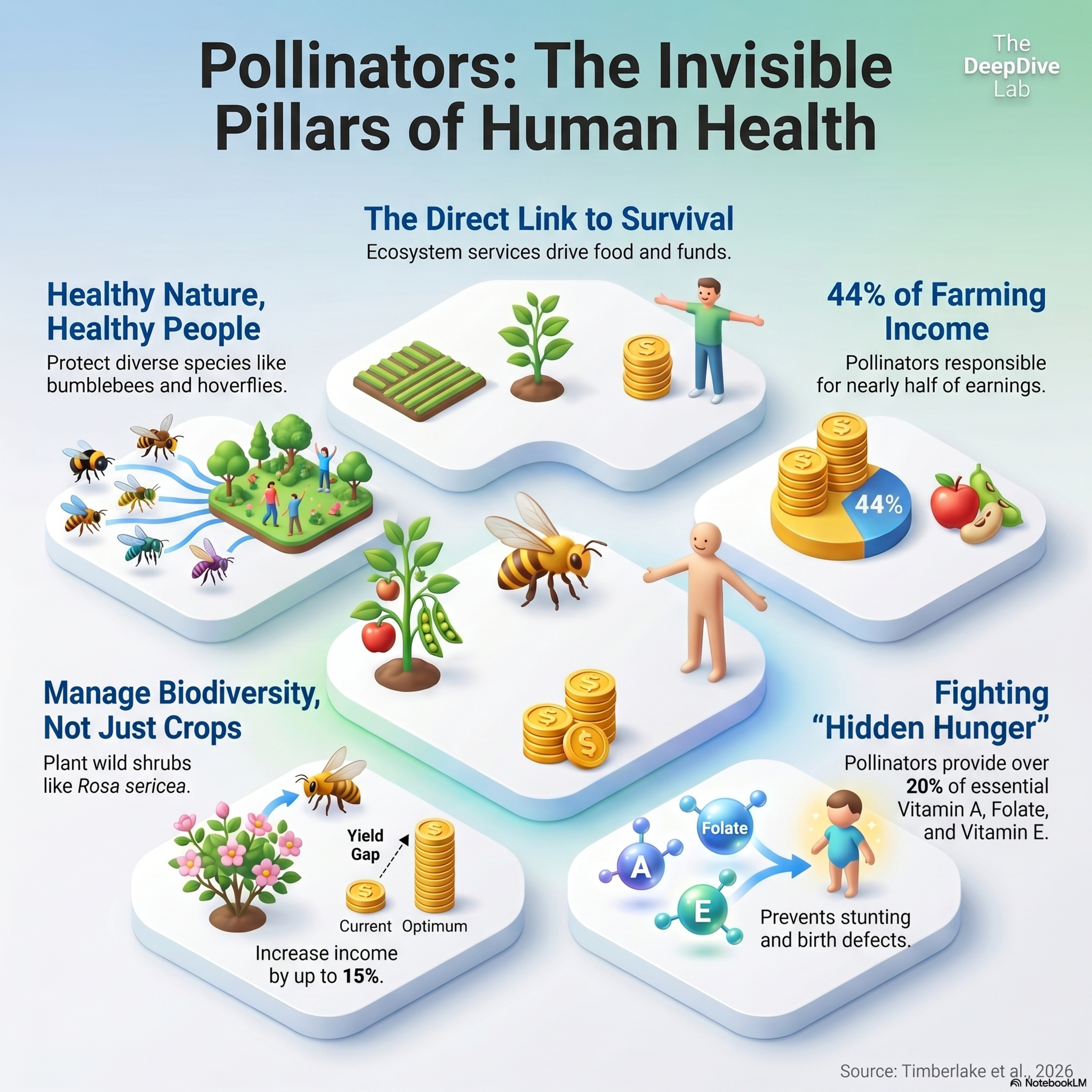
What if the future of human survival depends less on factories and more on insects? In this episode, we dive into a revolutionary Nature study revealing how pollinators sustain nutrition and income for some of the world’s most vulnerable communities. 🐝🌾Researchers in Nepal discovered that pollinator-dependent crops provide critical micronutrients including Vitamin A, folate, and Vitamin E, while insects themselves contribute nearly half of household farming income. Even more surprising? Common weeds and wildflowers act as essential fuel stations for bees and hoverflies, turning biodiversity into a living economic engine.We explore the concept of “hidden hunger,” ecological resilience, native bee species like Apis cerana, and why protecting biodiversity could be one of humanity’s smartest investments for future food security.📚 Source Paper:Timberlake, T.P., Sapkota, S., Saville, N.M. et al. Pollinators support the nutrition and income of vulnerable communities. Nature (2026). https://doi.org/10.1038/s41586-026-10421-x#Pollination #BeeScience #FoodCrisis #SustainableFarming #Ecology #NaturePodcast #ClimateSolutions #Biodiversity #Micronutrients #Health #EnvironmentalPodcast #ScienceNews #FutureFood #Conservation

What if the future of human survival depends less on factories and more on insects? In this episode, we dive into a revolutionary Nature study revealing how pollinators sustain nutrition and income for some of the world’s most vulnerable communities. 🐝🌾Researchers in Nepal discovered that pollinator-dependent crops provide critical micronutrients including Vitamin A, folate, and Vitamin E, while insects themselves contribute nearly half of household farming income. Even more surprising? Common weeds and wildflowers act as essential fuel stations for bees and hoverflies, turning biodiversity into a living economic engine.We explore the concept of “hidden hunger,” ecological resilience, native bee species like Apis cerana, and why protecting biodiversity could be one of humanity’s smartest investments for future food security.📚 Source Paper:Timberlake, T.P., Sapkota, S., Saville, N.M. et al. Pollinators support the nutrition and income of vulnerable communities. Nature (2026). https://doi.org/10.1038/s41586-026-10421-x#Pollination #BeeScience #FoodCrisis #SustainableFarming #Ecology #NaturePodcast #ClimateSolutions #Biodiversity #Micronutrients #Health #EnvironmentalPodcast #ScienceNews #FutureFood #Conservation

NOW PLAYING

🌼 Beyond Honey: Why Pollinators Are Secretly Feeding the World 🐝

0:00 21:55

No transcript for this episode yet

We transcribe on demand. Request one and we'll notify you when it's ready — usually under 10 minutes.

No similar episodes found.

No similar podcasts found.

Frequently Asked Questions

How long is this episode of The Deep Dive Lab: Unraveling Materials Science?

This episode is 21 minutes long.

When was this The Deep Dive Lab: Unraveling Materials Science episode published?

This episode was published on May 23, 2026.

What is this episode about?

What if the future of human survival depends less on factories and more on insects? In this episode, we dive into a revolutionary Nature study revealing how pollinators sustain nutrition and income for some of the world’s most vulnerable...

Can I download this The Deep Dive Lab: Unraveling Materials Science episode?

Yes, you can download this episode by clicking the download button on the episode player, or subscribe to the podcast in your preferred podcast app for automatic downloads.
URL copied to clipboard!