
EPISODE · Mar 17, 2025 · 13 MIN
Beyond Milliseconds and Minutes: ASKAP Unveiling Intermediate Neutron Stars
from Multi-messenger astrophysics · host Astro-COLIBRI
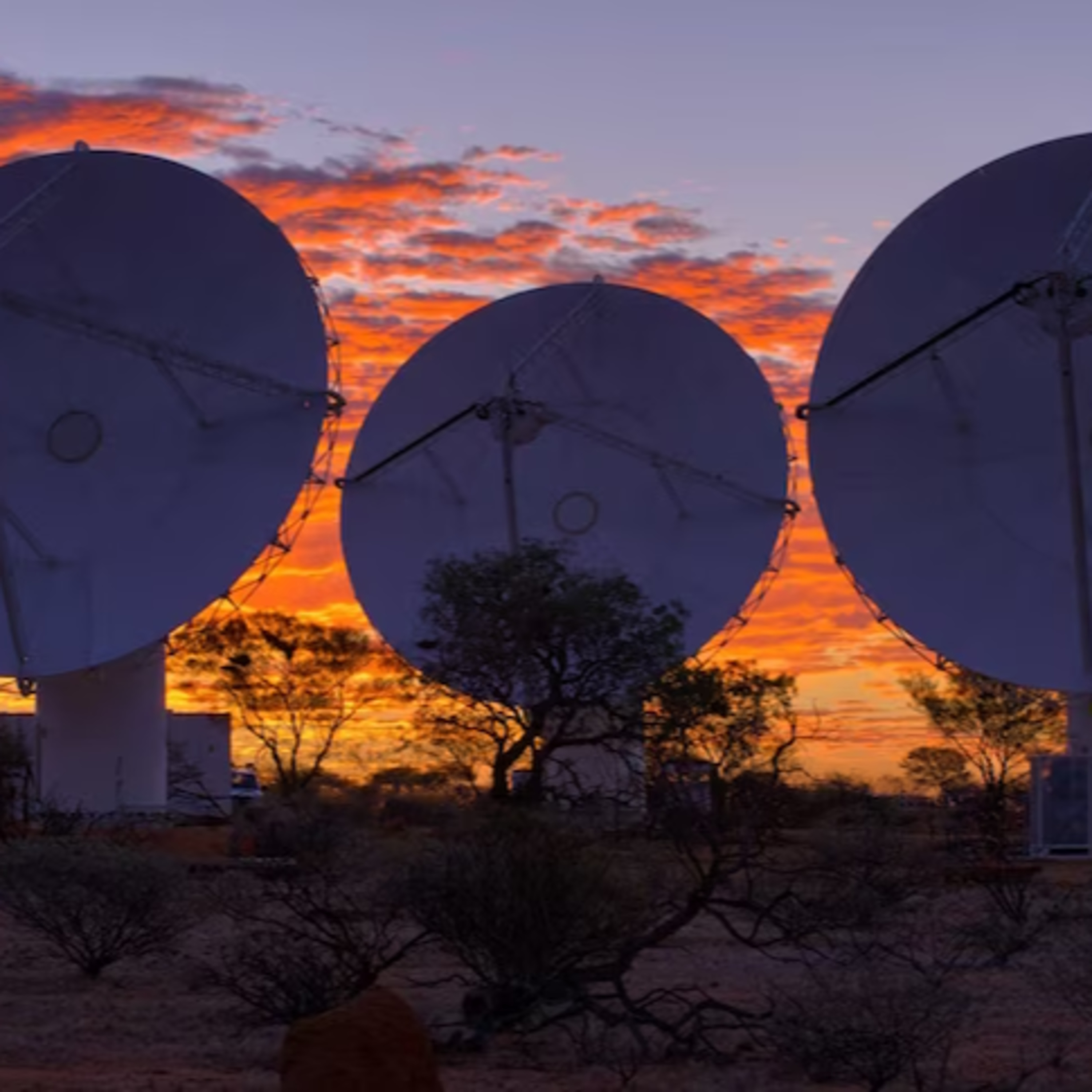
* **Introduction:** Astronomers have discovered a new celestial object, PSR J0311+1402, a radio pulsar with an unusual spin period of **41 seconds**. This discovery bridges the gap between normal pulsars (millisecond to seconds) and long-period radio transients (LPTs) (minutes to hours).* **The Discovery:** PSR J0311+1402 was first detected by the **Australian Square Kilometre Array Pathfinder (ASKAP)** during commissioning tests of the CRACO system in January 2024. It exhibited pulses with a duration of about 0.5 seconds.* **Intermediate Nature:** Unlike normal pulsars and LPTs, PSR J0311+1402's **41-second spin period** falls in a previously under-explored range. Traditional pulsar searches were less sensitive to these periods, and image-based LPT searches missed shorter pulses.* **Pulsar-like Properties:** Despite its long period, PSR J0311+1402 shows characteristics similar to normal pulsars, including **low linear (∼25%) and circular (∼5%) polarisation** and a **steep spectral index (∼ −2.3)**. It also has a double or potentially triple-peaked pulse profile.* **Below the Death Line:** Intriguingly, its spin-down properties place PSR J0311+1402 **below the pulsar death line**, a theoretical boundary where radio emission is expected to cease due to insufficient particle production. This challenges current understanding of pulsar emission mechanisms.* **Relation to Long-Period Transients (LPTs):** Known LPTs have much longer periods and often exhibit radio luminosities too high to be powered by rotation alone, along with high polarisation. PSR J0311+1402's properties, such as its luminosity being potentially powered by rotation and its low polarisation, suggest it is more likely a pulsar. Its duty cycle also aligns better with the trend observed in typical pulsars.* **Implications:** The discovery suggests the existence of a **previously undetected population of neutron stars with intermediate spin periods**. Finding more such objects will help bridge the gap between pulsars and LPTs and improve our understanding of neutron star evolution.* **Future Research:** Ongoing observations and timing studies are crucial to refine PSR J0311+1402's spin-down properties and shed light on its emission mechanism and evolutionary state. The ASKAP CRACO system is expected to discover more such intermediate period objects.**Reference:*** Wang, Y., Uttarkar, P. A., Shannon, R. M., et al. (2025). The discovery of a 41-second radio pulsar PSR J0311+1402 with ASKAP. *arXiv preprint arXiv:2503.07936*.Acknowledements: Podcast prepared with Google/NotebookLM. Illustration credits: Alex Cherney
Embed this episode
Ready to play
Beyond Milliseconds and Minutes: ASKAP Unveiling Intermediate Neutron Stars
No transcript for this episode yet
Similar Episodes
No similar episodes found.
Similar Podcasts
No similar podcasts found.